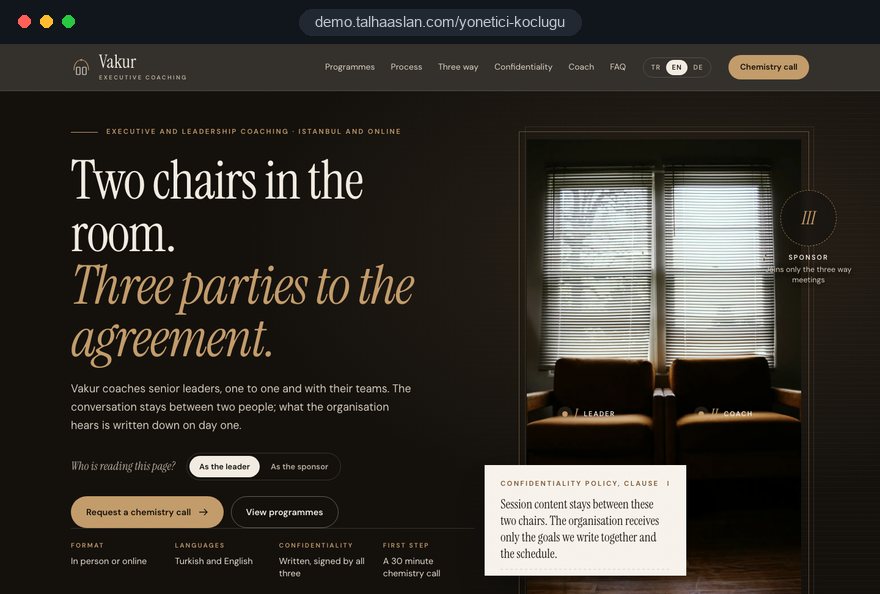
An executive coaching website opens to two very different readers in the same week. One is a newly promoted vice president who heard your name from a peer and is quietly checking whether you are the right person; the other is an HR or L&D manager comparing three coaches for next quarter's development budget.
This guide walks through the decisions you make, in order, when planning the site: measuring your buyer mix, building program pages, writing confidentiality and the line with therapy, preparing a bio that can be checked, shortening the route to a chemistry call, supporting corporate procurement, and measuring all of it. Each section ends in something you can apply straight away.
01Reading your buyer mix from recent engagements
Decide where the site's weight sits by looking at who pays you, not only at who gets coached. In some executive coaching engagements the leader pays privately; in others the company pays but the leader chooses the coach; in others HR builds the shortlist and the leader only joins the final conversation. Each of these needs a different order on the home page.
Before any layout work, we suggest putting your last ten or fifteen engagements into a simple table with these columns:
- Who paid the invoice: The leader, the company, or a central learning budget?
- Who made first contact: The leader, someone in HR, or a referral from a former client?
- How many people decided: Was it one conversation, or separate talks with the sponsor and the leader?
- Which program was bought: One to one coaching, a role transition, team coaching or a group program?
- Where they found you: LinkedIn, search, a talk you gave, or a past client?
If corporate work dominates, the organization route goes into the first screen of the home page and the process page sits visibly in the menu. If private clients dominate, the coach's approach and the chemistry call lead, and the corporate route follows in second place. If the table is balanced, both routes appear side by side as two clear choices of equal weight.
02The questions a program page answers in order
A program page should open with the reader's situation, not the name of your method. Leaders do not recognize themselves in a coaching school or model; they recognize the moment they are in: taking over an inherited team, managing former peers, starting to report to a board. The following order works for most leadership coaching programs.
- Starting point: Two or three typical situations in which the program is requested, written close to the reader's own words.
- Who it is not for: For example, someone in the middle of a crisis who needs urgent decision support rather than a structured program.
- How the work runs: Number and length of sessions, in person or online, and the gap between sessions.
- What the leader contributes: Preparation between sessions, gathering feedback, keeping their own notes.
- Midpoint and closing reviews: When they happen and whether the sponsor takes part.
- One next step: A button that leads straight from the program page to the chemistry call.
Name programs the way buyers search for them. A title like "the transformation journey" may sound appealing, but nobody types it; "new role transition coaching" is both readable and searchable. A separate page per program also lets a sponsor paste one specific link into an internal email.
03Writing down what the sponsor will and will not see
The confidentiality page should answer the leader's first question, "what will my company find out", in a single sentence. Standard 2.2 of the ICF Code of Ethics asks for a clear agreement among coach, client and sponsor on what information is exchanged. Putting that agreement only in the contract is not enough, because the leader decides about the site long before seeing any contract.
We suggest stating these points separately on the page:
- Shared with the organization: Whether sessions took place, the goals agreed in the three way meeting and a closing summary the leader has approved.
- Not shared: Session content, the leader's personal reflections and the coach's notes.
- How notes are kept: Where notes are stored, who can access them and what happens to them when the engagement ends.
- Limits: Any limits to confidentiality that your coaching agreement contains, worded exactly as in that agreement.
- Consent first: Any additional sharing with the organization is discussed with the leader beforehand.
Link this page from the organizations page too, since the HR buyer asks the same question from the other side: "how much will we see." When both parties read the same page, the topic rarely needs reopening in the three way meeting. Before launch, compare the text line by line with your coaching agreement; nothing on the site should promise more or less than the contract.
04A coach bio that a buyer can verify
Write the bio so that someone comparing coaches can check every line. A corporate buyer often places three executive coaching candidates side by side in a spreadsheet; if your row is vague or empty, the shortlist shrinks without you. A row of accreditation badges does not fill that spreadsheet.
These details belong on separate lines:
- Leadership experience: Sectors, level and years in leadership roles; sector and company size are enough if you prefer not to name employers.
- Coach training: Name of the program, the provider and the year you completed it.
- Credential: For ICF, the ACC, PCC or MCC level and date exactly as on your certificate; ICF lets the public verify credentials in its own directory.
- Supervision: Whether you receive regular supervision and in what form.
- Working languages: The languages you coach in, a line multinational buyers look for.
Replace vague phrases such as "hundreds of leaders coached" with documented facts; if your practice hours are recorded in a credential application, use that figure.
Close the bio with a short "how I work" paragraph: whether you ask more than you advise, whether you use feedback instruments, what you expect from the leader between sessions. The spreadsheet gets the facts; this paragraph tells the leader what it will feel like to be in the room with you.
05Making the line between coaching and therapy visible
Showing clearly that coaching is not treatment protects both the leader and you. Standard 3.7 of the ICF Code of Ethics asks coaches to tell clients when they act in another role, such as therapist. Many leadership coaches have a background in psychology, which makes this line even more important on the site.
We pay attention in three places. The first is vocabulary: on program pages, replace clinical phrases such as "treat anxiety" or "heal burnout" with workplace language such as "making decisions under pressure" or "reshaping your workload". The second is the FAQ: answer "Can coaching replace therapy?" briefly and directly, and state that you will refer the leader to a mental health professional where appropriate.
The third is the intake form. Do not ask about health, medication or psychological history; data you never collect cannot leak. The ICO's guidance on the right to be informed expects a privacy notice that explains purposes, retention and sharing, so place it next to every form. If you also offer therapy, consider presenting the two services in clearly separate areas; we describe how therapy sites are built around professional rules on our page for psychologist websites.
06Shortening the route to a chemistry call
The chemistry call is the real front door of executive coaching sales, so the site should get a visitor there in two clicks at most. Senior calendars are full, and trading emails to find a date is the first thing that cools interest. A short intake form followed by self scheduling removes that obstacle.
- Button: The same wording on every program page and coach profile, for example "Book a chemistry call".
- Short intake form: Name, company and role, who will pay for coaching, a line on the situation, preferred language.
- Calendar: Only the slots you reserve for chemistry calls, with time zones shown automatically.
- Confirmation email: Length of the call, how it will take place and two or three questions worth thinking about beforehand.
- Reminder: One day before, with a single click to reschedule.
- After the call: A program proposal or a corporate quote within the same week.
The "who will pay" question is small but valuable: the answer tells you early whether to invite the sponsor to the next conversation. Check in advance where your scheduling tool stores data and what it asks for. If you would rather run the whole flow inside your own site, our appointment booking website setup is built for exactly that.
07What HR and procurement need on the organizations page
The organizations page should work like the first page of a procurement file, not like a brochure. The HR or L&D manager who budgets for coaching usually has to defend the choice to a senior leader or to procurement. Give them the material that makes that defense easy.
These belong on the organizations page and in a downloadable one page summary:
- Coach matching: If you work with several coaches, how many profiles a leader is offered and who makes the final choice.
- Goal setting: When the three way meeting happens and who writes the goals.
- Reporting limits: When and in what form the organization hears about progress, linked to the confidentiality page.
- Contracting and invoicing: Package or session based billing, plus cancellation and rescheduling terms.
- Personal data: How participant details supplied by the organization are processed and kept.
Proposals usually travel by email, and corporate mail systems filter unfamiliar senders hard. If your domain's sending records are incomplete, a proposal can land in spam; you can check SPF, DKIM and DMARC in a few minutes with our email authentication checker. Fields on the corporate form such as budget period and number of participants bring the first conversation much closer to a quote.
08Using client comments with consent and restraint
In executive coaching, client comments appear only with written consent and are usually anonymous; their value comes from the concrete situation they describe, not from a name. For UK audiences, rule 3.7 of the CAP Code requires documentary evidence for objective claims before publication, and rule 3.1 rules out materially misleading marketing. Invented or polished up testimonials have no place on the site.
When preparing a comment for publication, we use these criteria:
- Identity: Role and sector instead of a name, for example "Finance director, retail"; a name only when the client explicitly asks for it.
- Content: Sentences about how the work ran, such as the value of preparation questions, rather than "it changed my life".
- Approval: The final wording is shown to the leader and the written consent is kept on file.
- Company logos: Only with the organization's permission; otherwise a general line such as "we work with organizations in the public and private sectors".
The same standard applies to claims on program pages. A line like "transform your leadership in ninety days" cannot be evidenced and makes experienced executives wary. Describe instead what the program covers, what the leader will work on and how progress will be reviewed.
09The referred leader's route on a phone
A large share of leadership coaching work arrives by referral, and that visitor often opens your site on a phone between two meetings. They hear your name from a peer, look at your LinkedIn profile and click through to the site.
- Name search: When someone searches your name, your site's title and description should say in one sentence what you do.
- LinkedIn alignment: Your headline, featured link and site copy should name the same programs in the same words.
- Link preview: When your link is shared in a message or post, the right image and title should appear; you can see this with our link preview checker.
- First screen on mobile: Who you are, who you work with and the chemistry call button, visible without scrolling.
Speed shapes trust on this route. In Google's Core Web Vitals, the good threshold for LCP, which measures how quickly the main content loads, is 2.5 seconds or less; for INP, which measures how quickly the page responds to a tap, 200 milliseconds or less; and for CLS, which measures how much the layout shifts while loading, 0.1 or less.
An oversized portrait and a heavy background video are the usual culprits; serving the portrait at the right size and dropping the video is often enough. Test on a mid range phone over a mobile connection, not only on a desktop.
10Showing up in program searches and AI answers
In search, the goal is to reach the buyer who does not know your name but knows their situation. An HR manager searches for "leadership coaching program" or "coaching for new managers"; a leader may search for "executive coach for new CEO". Each program page should answer one such search clearly, using the terms buyers use rather than internal jargon.
These question types make a good content plan:
- Distinctions: Coaching versus mentoring, coaching versus training, coaching versus therapy.
- Process: What happens in a three way meeting, and how an engagement is brought to a close.
- Buying: What a company should look for in an executive coach, and how to build a shortlist.
- Situations: Managing former peers, presenting to a board, leading through a merger.
Leaders now ask AI assistants to recommend coaches too. Clear definitions, short question and answer blocks and articles signed by the coach improve the chance of being cited in those answers, though no structure makes a particular placement certain. We set up page structure, internal links and structured data together as part of our SEO service. If you coach in more than one language, planning the other language pages from the start with a multilingual website structure gives a cleaner result than bolting them on later.
11Running workshop and cohort announcements separately
A seasonal leadership workshop or a cohort program with fixed start dates should not be mixed into the permanent pages of the main site. An expired announcement left on the home page makes the whole site look neglected.
For cohorts we suggest this pattern. Each round gets a single goal page with dates, number of sessions, participant profile, capacity and application steps. For closed cohorts run inside one company, that page also explains participant confidentiality and what the organization will be told. The main site shows only a short announcement card that disappears automatically once the date passes.
- Before the round: The single goal page goes live with an application form and capacity details.
- During applications: LinkedIn posts and email announcements point to the page with their own tracking tags.
- After the round: The page turns into a "notify me about the next cohort" form, so no links break.
- Archive: A short summary of the content, without participant names, is added to the permanent program page.
To publish these pages quickly without touching the main site, we use a landing page setup.
12Measuring individual and corporate inquiries separately
The question that matters is which page and which channel bring chemistry calls, and individual and corporate inquiries need separate answers. A single "form submitted" count is not enough to support almost any decision on an executive coaching site.
- Separate events: Individual chemistry calls, corporate quote requests and cohort applications are recorded as separate conversions.
- Source: The landing page and channel of each inquiry are stored with the form data.
- Consent: Non essential measurement runs only after the visitor accepts in the cookie banner; the ICO's PECR guidance treats cookies that are helpful but not strictly necessary as needing consent, and Google requires consent mode for measurement and ad personalization for users in the European Economic Area.
- Out of scope: Free text from the form, the leader's described situation and personal details are never sent to analytics or ad platforms.
A monthly look at three things is enough for most coaches: which program page brought the most calls, which channel brought corporate inquiries, and at which step unconverted visitors left the form. Those answers decide your next article and which program you put forward on LinkedIn. Confirm with a test booking before launch that a calendar booking also registers as a conversion on the site.
13Common mistakes on executive coaching websites
Most of these mistakes come from content decisions rather than design, and each one has a better alternative.
- A home page that opens with a method: Instead of leading with a model or school, open with the situations leaders face and offer two clear routes.
- Leaving confidentiality to the contract: State what is shared with the sponsor on its own page, before anyone signs anything.
- Badges without level or date: Replace a row of logos with the body, level and year as on your certificate, and mention the verification directory.
- Clinical language: Swap words that suggest treatment, healing or diagnosis for workplace language, and explain the therapy line in the FAQ.
- One contact form for everyone: Build a short individual form and a separate corporate request form instead of pushing leaders and HR through the same fields.
- Client logos without permission: Get written permission, or use a general line about the sectors you work in.
If your current site has two or three of these, starting with the confidentiality page and the program pages usually brings the quickest improvement.
14Choosing a web partner and your next step
Judge a web partner for your executive coaching site by the questions they ask rather than the designs they show. A team that talks colors and templates without asking about your buyer mix, your confidentiality terms and your accreditation documents will most likely deliver a generic personal site. We suggest asking:
- How do you build separate routes for leaders and organizations on the home page?
- Who drafts the confidentiality and therapy boundary text, and how do we approve it before launch?
- Which documents do you take accreditation details from?
- How are chemistry calls and corporate inquiries measured separately?
- Can we add a new program or cohort page ourselves after launch?
A live demo of the structure we build for executive coaches is linked on this page; it is not a client site but a demonstration of our approach, and you can try both routes and the chemistry call flow on your phone. Our work in other sectors is on the references page.
To prepare, list your programs, gather your accreditation documents and fill in the buyer table from your recent work. You can review package scopes in our web design pricing section, and for a written scope and quote tailored to your practice, get in touch to arrange a short first call.