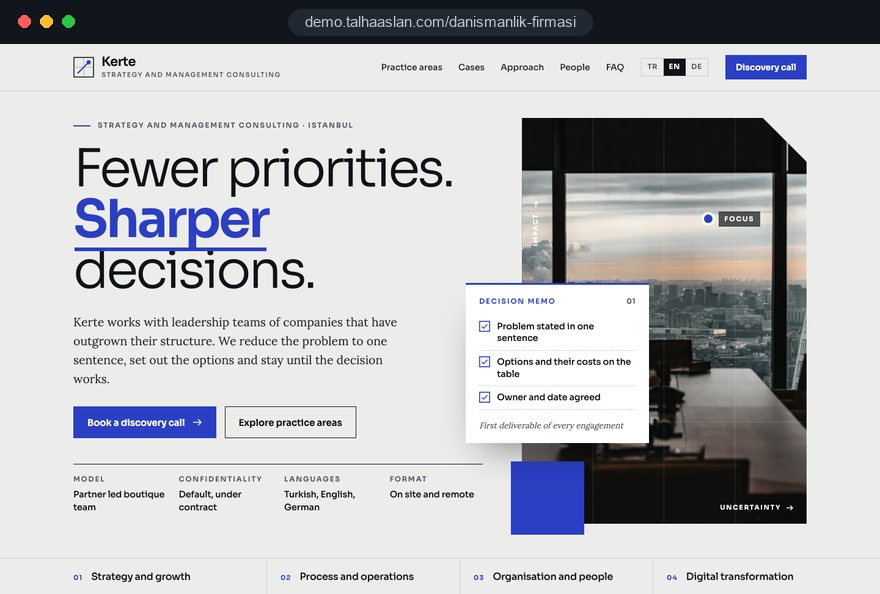
We do everything
Strategy, operations, people and digital transformation sit in one list, one line each. Visitors cannot tell where the firm is genuinely deep, and search engines find no clear page for any practice area search.

Your Windows contrast theme is on; colours come from your system.
Your device is set to reduce motion; animations are already off.
Your choices are saved in this browser only.
Industry-specific web design
Before a buyer books a call with a consultancy, they want two answers: have you solved a problem like mine, and who will actually do the work. We build consulting firm websites around those two questions, linking practice area pages, case studies that protect client confidentiality and consultant profiles to one discovery call flow. We work remotely with firms in the UK, Europe and beyond.
Open the live demoA demo design we built for a fictional brand
In short
A consulting firm website explains each practice area on its own page, proves results with case studies, introduces the consultants and leads visitors to a qualified discovery call. Work that cannot name the client is written up anonymously, with sector and company size. In the UK, a limited company's website must also show its registered number and registered office. The same structure suits boutique consultancies and independent advisers.
Talha Aslan and teamLast updated:
Why it needs its own approach
Consulting is an intangible purchase; buyers cannot inspect the product, so they judge the evidence and the people. Generic company templates leave no room for either.
Strategy, operations, people and digital transformation sit in one list, one line each. Visitors cannot tell where the firm is genuinely deep, and search engines find no clear page for any practice area search.
Every consultancy calls itself results driven and a trusted partner. Without a single case study showing the sector, the scale and how the problem was approached, buyers see no difference between firms.
A client buying consulting is really buying a team. A site with no names, experience or areas of focus leaves trust to the first meeting and loses out in the shortlist.
Name, email and message say nothing about company size, topic or timing. The team spends hours on poor fits while serious enquiries wait in the queue.
A firm that publishes no guides, reports or point of view never reaches the executive who is still researching. Nobody books a call before seeing how the consultant thinks.
A new partner joins, a new practice opens, a major project closes, and the site stays the same. A website still showing the team and services of years ago does not describe the firm today.
Our approach
We do not build a consultancy website like a brochure; we build it in the order buyers decide. First they recognise their problem on a practice area page, then they read a similar case, then they meet the consultant who would lead the work, and only then do they ask for a call. Every practice page links to the relevant cases and people.
If you serve clients in several countries, we plan a multilingual structure from day one; for a webinar, report or a single practice campaign, a landing page can go live without touching the main site. As we have no live client project in this field yet, we show the approach on a live demo site.
Design, development and content sit in one team, so none of this is patched on later. Talha Aslan sets the strategy and an experienced team handles delivery; with firms abroad we work entirely online and in English.
Home
Each practice area page answers its own search; cases and consultants all lead into the same discovery call flow.
The right setup
All three start from the same foundation; the number of practice areas, the size of the team and where clients are based make the difference.
Boutique
Clients look for a specialist, so the site aims to be the most thorough source on that one subject.
Multi-practice
The brand is the firm; each practice is presented with its own team and cases.
International clients
Buyers research from another country, so the site speaks their language and follows their buying process.
Built for consultancies
These are the points firms decide on most often when we plan a consultancy site.
For each area: the problem you solve, who you work with, the stages of an engagement and common questions. Fewer areas, covered in depth; each page links to the related cases and consultants.
Written as situation, approach and outcome. Where the client cannot be named, the case is anonymised by sector, size and problem; names and logos appear only with the client's written consent.
Experience, focus areas, sectors served, certifications and a real photo. Titles and certifications are shown only as they can be evidenced.
A short form that asks topic, company size and timing, followed by calendar scheduling. Enquiries are collected in one place with their source and measured as conversions.
Guides, reports and opinion pieces published under the same headings as your practice areas. For gated downloads, marketing consent is collected separately with a clear privacy notice.
Under the UK trading disclosure regulations, a company must show on its websites the part of the UK where it is registered, its registered number and its registered office address. We place these in the footer and on the legal pages; your accountant or solicitor should confirm the details.
Comparison
| Topic | Generic company template | Site built for a consulting firm |
|---|---|---|
| Practice content | All offerings on one page, one line each | Each practice area on its own page: problem, approach, stages |
| Proof | A logo strip and broad claims | Case studies told by sector and company size |
| Team | One group photo | A profile per consultant: experience, focus, sectors |
| Enquiries | A general form with name, email and message | A discovery flow that asks topic, scale and timing |
| Content | A news section nobody updates | Guides and reports tied to practice areas |
| Measurement | Visitor numbers | Which practice page brings discovery calls |
Quick check
Must haves: does your site have them?
0 of 6 in place Tick the boxes to see where your site stands.
Added as needed
We choose which of these you need together during the scoping call.
Share your practice lines, your team and the clients you want to win; we will come back with a page structure and a written quote.
Process
We define your business, your audience and the site’s one-sentence job: who it sells what to, through which action. Scope and timeline are written from that answer.
The home page and key templates come to you as designs first; no code is written before your approval. We do not like surprises, and we do not cause them.
The approved design becomes fast, secure, maintainable code. You follow progress in the CRM and see every page in a staging environment before launch.
The site goes live with analytics, Search Console and conversion tracking connected; panel training is given, first-year hosting and maintenance included.
Search and speed foundations
Buyers search for the problem they have and the type of help they need, not only for your firm's name. Each practice page is built to answer one search and is linked to the guides that support it.
Executives now put the same question to AI assistants. Clear definitions, question and answer blocks and content with a named author improve the chance that your page is cited in those answers.
Firm name, address, contact details and consultant profiles are marked up so search engines can read them; nothing is marked up that is not on the page.
Forms, calls and scheduled meetings are tracked as conversions from day one, so you see which practice page and which piece of content brings discovery calls.
Free tools
Before planning a new site, test how the current one performs in search, on mobile and in AI answers, and whether your proposal emails are properly authenticated. The tools are free and need no sign up.
Tech SEO
Scan any URL for title, meta description, headings, canonical, indexability and speed signals, and get an SEO score with a clear to-do list.
AI Search
Score how ready a page is to be read and cited by ChatGPT, Perplexity and Google AI Overviews: AI crawler access, llms.txt, schema, citable structure and content without JavaScript.
Tech SEO
Test whether a page works well on phones: viewport, font size, tap targets, a mobile screenshot and Core Web Vitals.
Tech SEO
Generate rich-result JSON-LD for Article, Product, FAQ, Local Business.
SEO
Test your title and meta description with pixel-based measurement, desktop + mobile view.
Why do your emails land in spam? Check a domain's SPF, DKIM and DMARC records, find the errors and get a corrected record to copy.
How we work
We do not have a live client project in this field yet, so we show our approach on a live demo site built by our team. The demo is not a client site. You can see our work in other sectors on the references page.
Live demo
For this field we built a one page demo site for a fictional brand, made only to show our approach. You can explore the design, the copy structure and the mobile view live in three languages.
Open the live demoBefore any layout, we discuss which practice lines bring revenue and enquiries, and build the page structure in that order of priority.
We turn finished engagements into situation, approach and outcome, remove anything confidential and have you approve every case before it goes live.
We never guess experience, titles or certifications; we take them from what your consultants provide and avoid inflated language.
The discovery form is designed around who responds and how quickly; enquiries reach the right person by topic and are measured.
Related pages
Industries
For recruitment and HR firms that need candidate and employer journeys.
Industries
A separate structure for accountants bound by professional rules.
Industries
Explaining expertise without overclaiming and booking a first call rests on the same principle.
Solutions
A page structure per language for firms with clients abroad.
 How to Build a B2B Website: Site Structure That Generates Qualified LeadsRead article
 How to Build Brand Authority with Content Marketing: Become the Trusted Source in Your IndustryRead article
 Lead Form Design for Booking, Quote and Demo Requests: UX Rules That Lift ConversionsRead article
 Website CRM Integration: How to Track Form Leads AutomaticallyRead article
FAQ
If your question is not here, write to us; we will send you an answer and a written quote.
Next step
In a free 15-minute call, in English, we will go through your practice areas, your team and the clients you want to reach, then send a written scope and quote.
In-depth guide
An executive looking for outside help rarely arrives at a consulting website cold. They arrive with a short list: two names from a peer, a search result, a conference card. Within minutes they decide whether you stay on it, based less on design than on how concretely the site answers their question.
This guide walks through the decisions you make, in order, when planning a consulting firm website: which practice areas earn a page, how to write case studies inside confidentiality limits, what belongs on a consultant profile, what the discovery form should ask and how to measure all of it. Each section gives your partners a criterion or checklist to use right away.
Your site should feature the practice areas you want to sell and can prove, not every service you are able to deliver. Consultancies tend to add offerings whenever a client asks, and when all of them reach the navigation, visitors can no longer tell where the firm is genuinely deep. Before anyone sketches a layout, test every service against the same five questions.
An area that scores four or five yes answers gets a dedicated page. One that scores two becomes a subsection of the closest main practice. The rest belong in conversation, not on the site.
Example: a boutique whose executive coaching serves only a handful of clients needs one paragraph on its operations page, not a coaching page. Accountancy practices bound by professional rules need a different structure again, which we cover on our page about websites for accountants.
A strong practice page answers the buyer's questions in the order the buyer asks them. Pages that open with a definition of the service rarely get read; the visitor first wants to recognize their own situation. The sequence below works for most fields, from strategy consulting to people and organization work.
The "who it is not for" block is the one firms hesitate over, yet it is among the most useful. A line such as "we do not run this program with companies under twenty employees" filters out poor fits early. If a block would be empty, remove it rather than padding it.
An engagement you cannot name can still become a convincing case study, as long as the anonymization actually works. Many firms give up on cases because of confidentiality agreements. What buyers want to see, however, is usually not the client's name but how a problem like theirs was handled.
Write each case as situation, approach and outcome: sector, size and problem; the steps taken and why; then what changed, as far as the client agrees to share.
The most common slip is that details which look harmless on their own identify the client once combined. Run this check before anything is published:
Rounding the size ("a midsize food manufacturer"), widening the city to a region and reducing the date to a year usually suffice. If publication is ruled out entirely, an article on how you approach that type of problem does similar work.
The outcome section of a case should stay within what was measured and what the client has approved. In consulting, most results come from several factors at once, and a line like "we cut costs by a third" may make your former client uncomfortable when they read it.
Even without numbers you can describe outcomes concretely. A changed decision, a new structure or a problem that disappeared is often more persuasive than a percentage.
If you do use figures, use data the client measured and agreed to share, and state the period. It also helps to keep "output" and "outcome" apart: the report you delivered is an output, the decision made after it is an outcome. Separating them shows honestly what your firm controlled.
A consultant profile answers the buyer's question of who will actually do the work, so it should be a short, verifiable introduction rather than a pasted resume. Clients buying consulting are buying a team and want to meet it before the first call.
Using the same fields on every profile makes comparison easy and keeps the site orderly:
Titles deserve care. Words like "expert", "senior" or "certified" should rest on something you can show, and a lapsed certification should come off the profile. Profiles should match professional network profiles, because careful buyers check. When someone leaves, remove their profile that week. Present project associates in a separate network section, with their role stated plainly.
A "how we work" page answers half the questions that would otherwise fill the first call, and it makes that call more productive. A business owner hiring a consultancy for the first time does not know the process: how much of their time it takes, who needs to be involved, what they will receive.
The page should answer these questions:
You do not need to publish fees, but explaining what drives them lets the buyer arrive ready for the budget conversation. Clear engagement models also mean fewer "just give us a number" requests. Link this page from the end of every practice page so undecided readers have somewhere to go.
The discovery form should be short, yet collect enough for your team to judge an enquiry at a glance. A generic name, email and message form puts every request in the same queue, so the team spends time on poor fits while a serious executive waits for a reply. Five to seven questions is usually the right number.
Telling people what happens after they submit is the most neglected step. A line such as "the consultant responsible for this area will review your request and call you within two business days" eases the wait, and you then have to keep that promise.
Calendar booking after the form speeds things up for executives who have finished their research, and routing requests by topic to the right consultant shortens response times in firms with several practice lines. Show the time zone on the booking screen for international clients.
The purpose of an insights hub is not volume; it is being present while the buyer is still researching. Executives try to understand a topic before they speak to a consultant, and the author of the guide they read at that stage has the strongest chance of making the shortlist.
A simple method: open the notes from your last few months of discovery calls and list the questions clients raised in the first ten minutes. Each one is a candidate for a guide linked to a practice page.
Every piece should name its author and link to their profile. Asking for an email address before a download collects leads but cuts readership; leaving the summary open and gating only the full report is a sensible balance. If you plan to promote a report or webinar, a single goal campaign page can go live without touching the main site and is easier to measure. Choose a schedule your team can sustain.
If buyers do not know your firm's name, they find you only by searching for their problem or the type of help they need, so each practice page should be built to answer one search. Rather than competing on a broad term like "management consulting", a boutique usually does better targeting narrower queries with clear intent, such as "family business governance consulting" or "post merger integration advisory".
Executives now ask the same questions of AI assistants. The factors that improve your chance of being cited there overlap heavily with sound search structure:
You can see where your current site stands with our free AI visibility checker. If you serve clients in several countries, each language needs its own pages with reciprocal hreflang annotations; our multilingual website structure page covers this in detail. If you want the technical foundation and the content plan handled together, take a look at our SEO service.
Executives often open your site on a phone between two meetings; if the page loads slowly or the text is hard to read, that visit may not happen again. Google's Core Web Vitals give you clear targets. A page counts as "good" when at least 75 percent of visits stay within these thresholds:
On consultancy sites the usual culprits are oversized team photos, autoplay videos on the home page and heavy scheduling widgets loaded on every page. Serving images at the right size and loading the calendar only where it is needed solves most of it.
The second blind spot is the trustworthiness of the domain you send proposals and reports from. If your SPF, DKIM and DMARC records are missing or misconfigured, a proposal can land in the client's spam folder, or someone can send convincing email in your name. Our SPF, DKIM and DMARC checker shows this in seconds; if anything is missing, fix it alongside the new site.
Because a consulting website collects personal data through forms, bookings and downloads, the legal pages are part of the structure, not something added at the end. Data protection law in the EU and the UK expects people to be told how their data will be used when it is collected, so every form needs a clear link to your privacy notice.
During planning, treat each of these separately:
For UK firms there is one more fixed requirement. Under regulation 25 of the 2015 trading disclosure regulations, a company must show on its websites the part of the UK where it is registered, its registered number and its registered office address. We place these in the footer and on the legal pages; your accountant or solicitor should confirm the details for your firm.
A consulting website succeeds by bringing qualified discovery calls, not by visitor numbers, so you need to see which page each call came from. A practice page that brings a few well matched calls a month is worth more than a blog post with heavy traffic and no enquiries. Measurement has to be in place from launch day.
We suggest this setup:
Step four is the one most firms skip, and it carries the real insight. If a page brings many forms but they are all outside your size range, the problem is the page's promise, not its traffic; sharpen the "who it is for" block. And since analytics only records visitors who consent, the CRM record should be your main source of truth.
These are the mistakes we see most often on consultancy sites, each paired with an approach that works better.
Most of these come from planning, not design, and none of them requires a large budget to fix.
When choosing a team for your consulting firm website, pay more attention to the questions they ask than to their portfolio. A team that talks colors and templates before asking about your practice areas, cases and enquiry flow will most likely deliver a generic corporate site. Ask these questions in your first conversations:
This page links to a live demo of the structure we build for consultancies; it is not a client site but a working example of our approach. You can see our work in other sectors among our client references and review the full scope on our web design service page.
To prepare, a short list of your practice areas, two or three engagements you would like to feature and your team is enough. If you already have a site, tell us which pages bring enquiries today so the new structure keeps them. You can review package scope in our web design pricing section, or get in touch to book a short call and receive a written scope and quote for your firm.
Start a Project
Thanks {name}, we've received your brief. We usually reply within the same day.
What happens next?