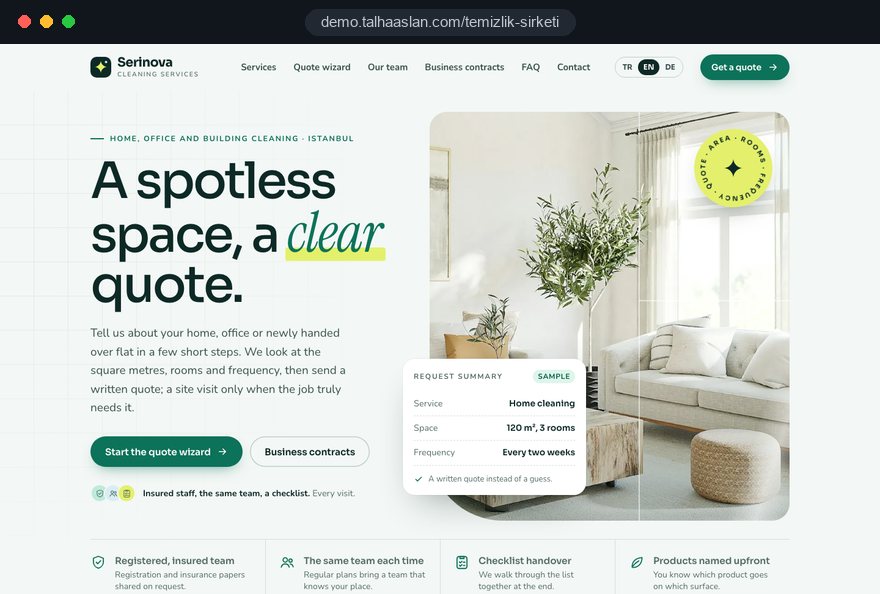
For a cleaning company, the website is not a brochure that sits next to the phone; it is the first step of the quoting process. A visitor either describes the job, the property and the frequency and leaves a complete enquiry, or calls you and answers the same questions out loud.
In this guide, we at Talha Aslan and team go through the decisions a cleaning firm makes when planning its site, in the order they come up: which services deserve their own page, what the quote form should ask, how to present regular contracts, what earns the trust of homeowners and facilities managers, local search and measurement. Our general project process is on our web design service page.
01The order in which customers check a cleaning firm
People looking for cleaners check three things in sequence: whether you do their kind of job, whether you cover their area, and who will actually come into their home or office. The page order of a cleaning website should answer those questions in the same sequence, because a visitor who cannot see their job type on the first screen leaves before describing a single room.
The questions cleaning teams hear most often before quoting also tell you what the home page must show:
- Job type: whether you do regular domestic cleaning, office cleaning, end of tenancy, after builders or carpet and upholstery work.
- Area: which towns or postcodes you cover and whether outlying addresses carry extra conditions.
- Date: whether there is a slot this week or at the weekend, and how far ahead people need to book.
- People: who will turn up, whether they are vetted and insured, and whether the same cleaner returns.
- Supplies: whether you bring products and equipment or the customer provides them.
Open your current site on a phone and test it against this list. If any answer is more than two taps from the home page, the problem is page order rather than design, and that is the first thing to fix when you plan a new cleaning company website.
02Which cleaning services deserve their own page
A service deserves its own page when people search for it by name, when its scope clearly differs from your other work, and when you quote it differently. A service that meets fewer than two of these criteria is better explained as a section on a related page; thin pages that look alike lose value with search engines and with customers.
Ask these questions for each service before you commit to a page:
- Do customers search for this job by its own name, such as "end of tenancy cleaning" or "office cleaners".
- Is what is included and excluded clearly different from your other jobs.
- Do you need different information to quote it, such as floors and access for window cleaning or the number of seats for upholstery.
- Does this job bring regular clients or well paid projects.
- Do you actually have the team and equipment to do it yourselves.
For most firms, regular domestic cleaning, office cleaning, end of tenancy cleaning and after builders cleaning end up as separate pages, while extras such as inside the oven or inside the fridge stay on the relevant page as add ons. Creating a page for work you do not do, or pass to a subcontractor, produces enquiries you will later turn down; build the list around your real capacity.
03What a strong job type page contains
A strong job type page closes the scope question in the customer's head before they ask for a quote: what is done, what is not done, how long it takes and what you need from them. Phrases like "thorough, professional cleaning" answer none of these.
A possible outline for an end of tenancy cleaning page:
- Included: kitchen appliances inside and out, limescale in bathrooms, skirting boards, inside cupboards, window sills and light switches, listed one by one.
- Not included: rubbish removal, repairs or redecorating, stated plainly so nobody is surprised on the day.
- Time and team: the factors that set the duration, such as property size, number of bathrooms and condition.
- What the customer prepares: water and power on, furniture and belongings already moved out, access arranged.
- Common questions: three to five specific to that job, for example whether you work from the letting agent's inventory checklist.
Every job page should end with a button that opens the same quote form with the job type already selected. The customer does not have to choose again, and you can see which page the enquiry came from. If you use photos, choose pictures from your own jobs, taken with the client's permission and framed so that no personal belongings show. Stock imagery works against you with domestic customers, who are looking for signs of a real team.
04Building the quote form step by step
The steps of your quote form should come from the order of questions your team already asks on the phone; the fastest way to design it is to write down your last twenty enquiries with every question you had to ask. That turns the form into a description of your work instead of a generic contact box.
For domestic and office cleaning, this flow suits most firms:
- Job type, already filled in when the visitor arrives from a job page.
- Property details: size, bedrooms and bathrooms, floor and lift, pets.
- Frequency: one off, weekly, fortnightly or monthly.
- Preferred day and time, and whether someone will be home or keys will be left.
- Contact details and preferred channel: phone, WhatsApp or e-mail.
Putting contact details last keeps the visitor focused on their job first and makes it easier to see at which step abandoned forms stop. On a phone, show one group of questions per step with large forward and back buttons. A customer who does not know the floor area can choose an approximate option or let the number of rooms stand in for it; keep required fields to what you genuinely need to quote.
For UK domestic customers who book online, the Consumer Contracts Regulations set a cancellation period that ends 14 days after the contract is made, and you may start sooner only if the customer expressly asks. If people book this week's clean through the form, add a clear request to start early at the final step and link your terms; the legal wording of those terms remains your responsibility.
05Show an estimate, ask for photos or visit first
Showing an estimate in the form speeds things up when the job is measurable and repeatable; when the scope changes every time, photo assessment or a site visit is the safer route. This is a commercial decision rather than a technical one, and you can make it separately for each job type.
- Estimate shown: standard domestic cleaning where rooms and frequency drive the figure; the formula follows your own pricing rules and is clearly labelled as an estimate.
- Photo assessment: carpet and upholstery or end of tenancy work; the customer adds two or three photos and the team quotes without travelling.
- Visit required: large after builders jobs, facades and commercial contracts; the form books a survey instead of asking for a quote.
- Mixed route: instead of any figure, a clear promise such as "with these details we send your quote the same working day".
If you add photo upload, mention in your privacy notice that images may contain personal data and add a short note asking customers to photograph only the areas to be cleaned. Sending uploads to a panel with restricted access rather than as e-mail attachments is cleaner for both security and organization. Whichever route you choose, the final screen of the form should say what happens next and when the customer will hear from you.
06Turning one off customers into regular contracts
Regular cleaning is rarely something customers ask for on their own; it is an option the site shows them. That is why regular plans need their own page and also need to appear inside the one off booking journey. The page answers the question "if you came every week, what exactly would you do" with a concrete list.
A regular contracts page should include:
- A task by task list for each visit on weekly, fortnightly and monthly plans.
- Rotating tasks done monthly or quarterly, such as inside windows, tops of cupboards or the oven.
- The rule for cancelled visits, holidays and changing the regular day.
- How the agreement renews and how either side ends it, in plain English.
- Whether the same cleaner comes each time and how the customer is told if that changes.
The most natural moment to move a one off customer to a regular plan is right after the job. A one tap suggestion on the thank you screen, in the follow up message or at the end of a satisfaction survey, for example "same cleaner every two weeks", takes far less effort than a separate sales call. If you track which job types lead to regular plans, you also learn which services deserve more promotion.
07A separate route for facilities managers and offices
The person who buys cleaning for an office, a school or a managed building asks different questions from a homeowner and usually compares several contractors, so a separate commercial page with its own form shortens the decision. This buyer wants scope, supervision and documents more than photos.
What the commercial page should cover:
- Downloadable scope: daily, weekly and monthly tasks by area, in a format the buyer can hold against their own specification.
- Staffing: how staff are employed, trained and supervised, and who covers absences so the contract runs without gaps.
- Supervision: who is responsible on site, how often checks happen and how results are reported.
- Insurance and paperwork: the cover you hold and which documents you can provide on request, stated only where you can back them up.
- Separate form: organization name, type of premises, total area, opening hours and suitable days for a site survey.
If commercial clients have given permission, a client list on this page is a strong signal; without permission, anonymous examples by sector and type of premises are enough. Also say under the form who replies to commercial enquiries and how quickly. For a manager comparing contractors, predictable communication before the contract is a preview of the service after it.
08Who has the keys: staff vetting and trust
A domestic customer's biggest hesitation about cleaners is usually not the quality of the cleaning but the person entering their home. A trust page removes that hesitation by describing a process, not by repeating "reliable team". Every step you describe needs a document or a real practice behind it.
Questions the trust page should answer:
- How cleaners are recruited: interviews, reference checks, background checks and trial periods you actually carry out.
- What training new staff receive before working alone and who accompanies them on early jobs.
- What insurance you hold for accidental damage and whether staff are covered.
- How keys are collected, stored, labelled without addresses and returned when the agreement ends.
- How staff identify themselves and whether the customer learns the cleaner's name before the visit.
If you show staff photos and names, get each person's clear permission and remove people who leave promptly. Writing down the steps you follow after damage or a missing item shows in advance how a problem would be handled, and that persuades a hesitant customer more than general reassurance.
09Making quality checks and complaints visible
Describing quality control on the site tells customers in advance what happens if something is missed, which makes a one off booking easier and a regular contract easier to keep. A concrete checklist is more convincing than any line about customer satisfaction.
An end of job process can be described like this:
- The team works through a room by room checklist and ticks each item.
- If the customer is home, they walk round together; if not, a short photo summary is sent.
- If the customer reports a missed area within a set time, the team returns to that area.
- For regular clients, a supervisor carries out unannounced spot checks at intervals.
Explain your products and equipment in the same section: which products you use on which surfaces, what you do in homes with pets or small children, and whether you bring supplies or use the customer's. If you show Google reviews on the site, show genuine reviews with their source and without picking only the favorable ones.
When you describe the complaints route, state who to contact, through which channel and with what details, such as the date, the address and a photo of the area. That frame also shows your team which faults repeat in which job type.
10Town searches and the Google Business Profile
A large share of cleaning enquiries comes from searches that combine a job type with a town and from map results, so job pages, area pages and your Google Business Profile have to support each other. We cover the wider search work on our SEO service page.
- Profile name: Google's guidelines require the name to match your real world business name, without added keywords such as "cleaners Croydon".
- Address: if customers do not visit you, you can run the profile as a service area business, hide the address and list the areas you cover.
- Area pages: only for towns where you regularly work, with travel time, typical property types and the jobs you do most there.
- Review routine: adding a review link to the message sent after each job turns collecting reviews into a habit.
Copies where only the town name changes tell customers nothing and search engines do not value them. A good area page might focus on end of tenancy work in a town full of rented flats and on office contracts in a business district. If you offer cleaning before and after moves, describing how you work alongside removal companies adds natural context to those searches.
11Mobile speed, click to call and WhatsApp
Most domestic cleaning enquiries come from phones, so a cleaning company website should be designed for small screens first, with call and WhatsApp buttons within thumb reach on every page. Speed here is not decoration; it decides whether the enquiry arrives at all.
Google's Core Web Vitals give you a useful check, measured at the 75th percentile of visits:
- LCP: measures how quickly the main content loads; good is 2.5 seconds or less.
- INP: measures how quickly the page responds to a tap; good is 200 milliseconds or less.
- CLS: measures how much the layout jumps while loading; good is 0.1 or less.
You can check your current site with our mobile friendly test. A WhatsApp button that opens with a prepared message such as "Hello, I would like a quote for regular home cleaning" removes the effort of writing the first line; you can build one link per service with the WhatsApp link generator. Stating your reply hours next to the button prevents the doubt an unanswered evening message creates.
The usual causes of slow cleaning sites are large before and after galleries on the home page, autoplay videos and several chat plugins at once. Phone sized images, galleries moved to job pages and a single contact button usually help most.
12Measuring enquiries and contracts
The purpose of measurement is not counting visitors but seeing which job page and which channel bring quotes, and which bring regular contracts. That requires form submissions, calls and WhatsApp clicks to be set up as conversions from the first day; tracking added after launch loses the early months.
- Define form submissions, call clicks and WhatsApp clicks as separate conversions.
- Attach the source job page and channel to every enquiry automatically.
- Keep enquiries in one list and mark them as quoted, accepted or moved to a regular plan.
- Once a month, compare enquiries, quotes and contracts for each job type.
This table might show that the window cleaning page brings many enquiries but few contracts, while the office page brings fewer but more valuable ones. If you run Google Ads for seasonal work such as end of tenancy cleaning in the summer moving period, a single goal landing page measures the campaign separately from the main site. UK and EU privacy rules require consent before non essential tracking cookies, so the privacy notice and cookie consent must be ready before launch.
13Common mistakes on cleaning company websites
The mistakes we see most often on cleaning company websites come less from design and more from building content around the firm instead of around the customer. Each one has a better alternative:
- Every service on one page: give jobs that are searched separately and scoped differently their own page, and keep extras on the related page.
- A form asking only for name and phone: ask for size, rooms, job type and frequency so the team does not call every enquiry back.
- Trust claims without proof: replace "fully trusted staff" with your vetting steps, insurance cover and key handling process.
- No mention of regular plans: show contract scope on its own page and in the message sent after each job.
- Copied town pages: create area pages only where you work regularly, with details specific to that area.
- Stock photos: use real job photos taken with permission; if you have none yet, clear text without photos is more honest.
Most of these can be fixed on your current site without waiting for a new one. Start with the form and the job page that brings the most enquiries, then trust details and regular plans; add area pages last, as real local detail builds up.
14Choosing a partner and your next step
When you choose a team to build your cleaning company website, look at how closely they question your quoting logic before you look at design samples; a team that does not ask about floor area, frequency and your share of commercial clients in the first call will give you a generic template. Questions worth asking:
- How do you decide the steps of the quote form, and how do you track abandoned forms.
- Where and at which moments do you build the path to regular contracts.
- Which documents do you base trust and staffing statements on.
- How do you report enquiries, quotes and contracts by job type.
- Who updates text, forms and pages after launch, and how long does a change take.
We do not yet have a live client project in cleaning, so we show our approach on a live demo site linked on this page; our work in other sectors is in our references. Package scopes are in the web design pricing section. To share your service list and the questions you ask before quoting, get in touch with us, and we will work out a page structure and a written quote for your firm together.