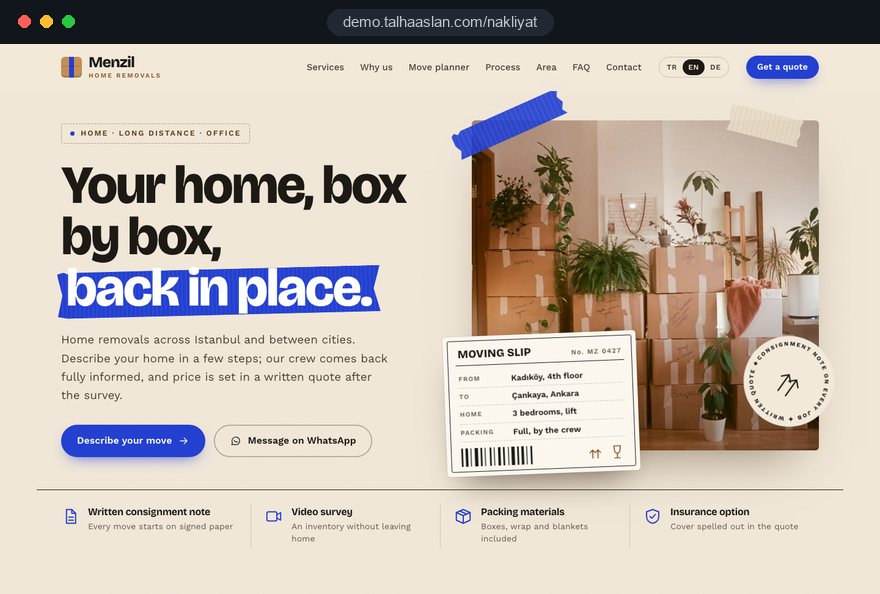
Most people choose a removal company in a single evening. They open three or four sites, fill in two forms, call one firm and carry on with whoever gives the first clear answer. A removals website has a short window to show that you cover their area, that you will understand their move, and that they can trust you with everything they own.
In this guide, we at Talha Aslan and team walk through the decisions a moving company makes when planning its site, in the order they come up: scope, the quote form, area pages, trust details, mobile use, enquiry handling and measurement. Each section gives you a criterion or checklist you can apply to your own site straight away; our general project process is on our web design service page.
01The order in which customers check a removals site
People planning a move check area first, then scope, then trust; the page order of a removals website should answer those three questions in the same sequence. A visitor who cannot see on the first screen whether you work in their town or on their route will leave before describing a single room.
The questions removal teams hear most often before quoting also tell you what the home page must show:
- Area: whether the collection and delivery addresses fall in your patch, and which long distance routes you run regularly.
- Scope: packing, dismantling and reassembling furniture, storage, and whether you handle flats with no lift.
- Date: availability on a given day or weekend, and how far ahead to book around month end and completion days.
- Trust: your operator license where it applies, your terms and what happens if something is damaged.
- Contact: a way to leave an enquiry in the evening and a clear promise of when you will reply.
Test your current site against this list on a phone. If any of these answers takes more than two taps from the home page, the problem is page order rather than design, and that is the first thing to fix when you plan a new removals website.
02Define your services and lead with your main work
The structure of the site should follow the work that earns you the most; listing every service with equal weight leaves visitors unsure what you actually do. A firm doing local house moves and a firm running weekly London to Edinburgh trips should not have the same home page.
In the planning call, we ask three questions. Over the last year, was most of your work local or long distance? Are office moves and storage a separate customer group or occasional extras? Do you offer part loads or shared vans? The answers decide the menu order, the first headline on the home page and which services deserve their own page.
Our rule for separate pages is simple: every service where customers ask different questions gets its own page. In an office move, the buyer is an office or facilities manager who asks about downtime, weekend work, archives and server equipment. For storage, customers want to know about conditions, terms and access to their items. Piano and specialist item moves come with questions about stairs, doorways and insurance. Squeezing all of this onto one "Our Services" page makes it harder for each service to appear in its own searches.
Also state what you do not do. If you do not offer international moves, or you pass piano work to a partner, saying so on the service page filters out mismatched enquiries and protects your team's time.
03Build the quote form from your phone questions
A good quote form is the questions your surveyor asks on the phone, put in order and trimmed; the steps should come from real calls, not from a template. We ask whoever quotes for your firm to write down every question from their last ten calls and build the form from that list.
For house removals, this order works for most firms:
- Type of move: local, long distance or office; the following steps adapt to this choice.
- Addresses: collection and delivery town and postcode area first, the full address later.
- Property and access: number of bedrooms, floor and lift access at both ends, parking and distance from van to door.
- Special items: tick boxes for a piano, safe, large fridge freezer, antiques or glass furniture.
- Services: packing, dismantling and reassembly, short term storage.
- Date and contact: a fixed date or a flexible window, name, phone and preferred reply channel.
Show one group of questions per step and use a progress bar. Asking for name and phone last means people invest effort before they hand over their details. Keep photo upload optional; when it is required, someone fumbling with a phone gallery may abandon the form. Consider a separate short form for business clients, where the questions are headcount, desks and cabinets, server room and the days the move can happen.
04Choose between published rates, surveys and video surveys
Whether to show prices is a business model decision, not a design decision, and the quote form should be built around it. There are several routes, and each has a different cost for your team.
- Collect details, then quote: the form shows no figures, and your team reads the enquiry and calls or sends a written quote. The most flexible route, but it demands fast replies.
- Home survey booking: the form ends with a date and time for a survey at the property. Often necessary for large houses and office moves.
- Video survey: the customer walks through the rooms with a phone while your surveyor watches remotely. It saves travel on long distance moves.
- Photo assessment: the customer uploads a few room photos, which speeds up quotes for small moves and single items.
Whichever route you choose, state the next step clearly on the site: how many hours until you reply, whether the survey is free of charge or not, and which channel the quote arrives through. Uncertainty is the most common reason a customer fills in a second firm's form the same evening. Even with fixed rates, explaining how floors, access and parking affect a quote heads off later arguments about extra charges.
05Write area and route pages with real local detail
An area page is only as valuable as what it says about moving in that area; copies where only the town name changes neither persuade customers nor last in search. That is why we recommend limiting the number of pages to places you really work in and can write about.
What we want on a town page:
- Housing: typical properties, such as Victorian terraces with narrow staircases or newer blocks with lifts and loading bays that need booking.
- Access: streets with permit parking, where a council parking suspension may be needed, steep roads or restricted loading times.
- Common routes: the towns and cities people most often move to from there with you.
- An example from your own work: a short account of a real move, without the customer's name and with photos you have permission to use.
- Quote link: the form with that town already selected.
Route pages for long distance work answer different questions: the days between collection and delivery, the difference between a dedicated van and a part load, how items are secured on the road, and how the delivery day is arranged. Writing the delivery window in the same words on the route page and in your terms answers the "when will it arrive" question before anyone picks up the phone.
06Put license, terms and insurance on one trust page
Someone handing their belongings to strangers wants to find the trust details on one page; when they are scattered, doubt creeps in no matter how well the firm works. We write the trust page from documents you give us and never publish a claim you cannot back up.
In Great Britain, GOV.UK states that a goods vehicle operator license is needed for vehicles over 3,500 kg gross plated weight or over 1,525 kg unladen. If your fleet needs one and you hold it, show the details. Rules differ in other countries, so we list only what your own documents confirm.
Checklist for the trust page:
- License: the license type and number where one applies, with a readable image if possible.
- Terms: what your terms and conditions cover and when the customer agrees to them.
- Insurance: what your goods in transit cover includes and how a claim works, worded from your insurer's or broker's information.
- Damage process: what the customer should do if they spot a problem at delivery, and whom to tell.
- Payment: deposit, when the balance is due and invoicing, without amounts.
If you do not offer cover for some items, say so and explain what options the customer can look into. Silence makes people assume the worst. Decide early who updates this page when a policy renews or a document expires.
07Show your crew, vans and packing in real photos
Stock photos of lorries are the quickest way for a moving company to look like every other listing on a comparison site; real photos prove in one glance that the firm exists. One photo day, ideally on a real moving day, is usually enough.
The shot list we prepare for that day:
- The fleet side by side, with your company name clearly readable.
- The crew in their own uniforms, a few people individually and with faces visible.
- Packing materials: blankets, stretch wrap, corner protectors, wardrobe boxes.
- Dismantling and reassembling furniture, with close ups of the tool kit.
- Specialist equipment such as piano skids or stair climbers, if you use them.
- If you offer storage, the inside of the warehouse, racking and how items are labeled.
In photos taken in customers' homes, make sure no personal items, family pictures or address details are visible, and ask the homeowner for permission. Compress images and upload them at the right size; it directly affects the speed figures in the next section. A crew page with each person's first name and role helps too; customers like to recognize a face when they open the door on moving day.
08A fast site that works with one hand on a phone
Most quote requests come from phones, so a removals website should be designed for a phone screen first and for desktop second. People planning a move often browse with one hand while standing among boxes.
To measure speed we use Google's Core Web Vitals. The "good" thresholds, met at the 75th percentile of visits, are: LCP (largest contentful paint, how long the main content takes to load) of 2.5 seconds or less; INP (interaction to next paint, how quickly the page responds to a tap) of 200 milliseconds or less; and CLS (cumulative layout shift, how much content jumps around while loading) of 0.1 or less. If moving between quote form steps is sluggish, INP suffers and customers assume the form is broken.
The rules we apply for phones:
- Sticky bottom bar: click to call, WhatsApp and get a quote buttons within thumb reach on every page.
- The right keyboard: a number pad for phone fields and a date picker for the moving date.
- Large tap targets: bedrooms and floors are buttons to tap, not text fields to type into.
- Saved progress: if someone leaves the form and comes back, their answers are still there.
You can see how your current site behaves on a phone in a few minutes with our free mobile friendly test.
09Appear on the map with your Business Profile and reviews
For searches with a town name, map results often sit above ordinary listings, so your Google Business Profile should be planned as part of the removals website. The profile, the site and the area pages should show the same name, phone number and service area.
Google's guidelines say the business name must match the real world name, with no added keywords; turning "Hill Removals" into "Hill Removals Cheap Man and Van Croydon" can get the profile suspended. Service area businesses can hide their address and define the areas they serve instead, which suits most removal firms whose yard or office does not receive customers.
A simple routine for collecting reviews:
- Send a short thank you message the day after delivery.
- Include the direct review link, so the customer does not have to search for your profile.
- Put a QR code linking to the review page on your vans and on the delivery paperwork.
- Reply to every review, including negative ones, calmly and with specifics.
You can create the code for van doors or business cards with our QR code generator. To turn search visibility into a full plan, our SEO service page explains the scope of that work.
10Collect enquiries in one list and reply fast
In the removals trade, lost enquiries usually come from what happens after the site, not from the site itself; when form, WhatsApp and phone enquiries are not gathered in one list, unanswered leads go to competitors during busy weeks. The site's job is to deliver the enquiry complete; the team's job is to see it through.
In the setup we build, every enquiry becomes a row with its channel, landing page, type of move, date and status. Statuses stay simple: new, called, survey booked, quote sent, won, lost. A short reason for every lost job shows within months whether price, dates or reply speed is the real issue.
Habits that speed up replies:
- Automatic first reply: a short message confirming the enquiry arrived and when you will call.
- Saved WhatsApp replies: prepared texts for confirming survey slots, asking for missing details and sending quotes.
- A rota: a named person responsible for evening and weekend enquiries.
- Follow up reminders: quotes with no answer after two days rise to the top of the list.
To add a prefilled greeting to your WhatsApp button, use our WhatsApp link generator; the customer then starts with a line like "Hello, I would like a quote for a three bedroom house move."
11Measure which pages bring work
On a removals website, visitor numbers alone say little; what matters is which area and service pages bring quote requests and how many of those turn into jobs. The measurement plan should be written before launch, not bolted on later.
From day one we count these as conversions: quote form submissions, click to call taps, WhatsApp button clicks and survey bookings. Tracking each form step separately shows where people give up; if many drop off at the address step, asking only for the town and postcode area often solves it. If you add a source tag to the QR codes on your vans and leaflets, you can also see how much interest comes from the street.
Measurement has to sit within the law. In the EU, consent is needed before non essential tracking cookies are set, and Google requires consent mode for users in the European Economic Area; the UK has its own cookie rules, so check them with your adviser. Because the form collects names, phone numbers and addresses, link your privacy notice directly below it.
A single monthly table is enough: enquiries per page, jobs won and reasons for lost jobs. It soon shows which area pages need more content and which should be merged.
12Balance the busy season, ads and comparison sites
Demand for removals is uneven; school holidays, month end and the end of tenancy periods concentrate it, so the site and any ad plans should be ready before the season starts. A site that goes live in the busiest weeks spends its first month fixing problems.
If you plan to advertise, a single goal landing page for one town or route keeps the promise in the ad and the message on the page aligned, without touching the main site. In Google Ads, Quality Score is made up of expected click through rate, ad relevance and landing page experience; Google calls it a diagnostic tool, not a direct input in the auction.
Still, sending someone who searched "removals Croydon" to a Croydon page is clearer than dropping them on a general home page. Our Google Ads management page explains how we plan campaigns.
With lead platforms and comparison sites, we suggest this balance:
- Give customers who arrive through a paid platform your own web address, so their next move comes to you directly.
- Check that your platform profile and your site never contradict each other.
- Count enquiries from platforms and from your own site separately.
13Common mistakes on removal company websites
Most mistakes on removals sites come from not anticipating the customer's questions rather than from design. These are the ones we see most often, each with a better alternative:
- Sixty town pages: instead of pages where only the name changes, describe the few areas you really cover with their own detail.
- One long form on a single screen: instead of fifteen fields at once, ask the same questions step by step with a progress bar.
- Trust claims with nothing behind them: instead of "fully insured and reliable," state your license, your terms and what your cover actually includes.
- No reply time: state under the form when and through which channel the enquiry will be answered.
- A home page of slogans: instead of spending the first screen on a tagline and a lorry photo, start with area selection and a quote button.
- Keywords in the profile name: keep your Business Profile name to your real trading name and earn visibility through area pages and reviews.
Apply this list to your current site. If you recognize yourself in more than two items, replanning the structure may take less effort than a series of small fixes. One more small but common slip: a phone number on the site that differs from the one on the vans, the business cards and the profile. Customers do not know which to call, and search engines see inconsistent data.
14Choosing the right team and your next step
The team building your removals website should ask about your workflow before it talks about design: who carries out surveys, how quickly you reply to enquiries and which areas you really cover. If those questions never come, the result will most likely be a generic template.
Questions to ask any agency you speak to:
- What will you base the quote form steps on?
- Who writes the area pages, and from what information?
- Where will enquiries be collected, and how will we see their source?
- Will you measure Core Web Vitals before launch and share the results?
- Who makes seasonal changes after launch?
Ask for the answers in writing, and make sure the domain, hosting and admin access are registered to your company.
This page links to a live demo we built for the removals trade, where you can try the quote form and area pages yourself; our work in other sectors is on our references page. As a next step, send us the towns you cover, your long distance routes and the questions you ask before quoting. You can arrange a short call through our contact page and review the fixed price packages in the web design pricing section; we prepare a written quote for your firm's scope after the call.