A company website in Hatay has to work for visitors who have almost nothing in common: a purchasing manager in Rotterdam comparing filter suppliers, a trader in the Gulf checking which documents a transit load through Cilvegözü needs, and a family in Antakya looking for lunch. Good web design in Hatay gets each of them to the right answer in a few taps, in a language they read.
This guide from Talha Aslan and team is written for business owners in the province and for the importers, distributors and partners abroad who depend on them. It walks through the decisions in the order you will face them, and it covers what changes when a company's address, plant or working pattern has shifted since the February 2023 earthquakes.
01What a Website Has to Do in Hatay's Economy
A site in Hatay first has to know which of the province's economies it serves, because heavy industry on the Gulf of İskenderun, port and border trade, and farming and food each bring a different visitor. In the Ministry of Trade's export data by production location, Hatay held 2.0% of Turkey's exports in 2023 and ranked 11th; in the same table Gaziantep held 3.6% and Adana 1.6%.
In 2023, the year of the earthquakes, the province's exports fell by 11.7%, and TÜİK's 2024 figures then placed Hatay third among all provinces for its contribution to national growth. During a recovery, first contact with a new buyer usually happens on the website, so the site's job is to describe the company as it is today, accurately.
Before any design work, answer these four questions in writing:
- Main buyer: Do most orders come from a plant on the Gulf, an importer across the border, a distributor in Europe or local customers?
- Current facts: Have your address, capacity or lead times changed since early 2023, and does the old site still show outdated details?
- Proof: Which certificates, test reports, project photos or menus are ready to publish today?
- Language: What share of your enquiries arrive in a language other than Turkish?
These answers set the menu order and the first sentence on the home page. A spare parts maker selling mostly to Gulf plants opens with product groups; a firm selling to local customers opens with phone, address and hours.
02Who Searches for What Around Hatay
Searches connected to Hatay usually include a district name or a product specification; the province name alone rarely carries the query. Rather than guessing, log the questions customers ask by phone and email for one week, then plan pages around them.
- Industrial buyers: They type part numbers, thicknesses and standards, such as "hot rolled coil tolerance table" or "truck air filter cross reference", and often leave out the city entirely.
- Shippers and traders: They search by route and service, for example "İskenderun port warehousing", "Reyhanlı transit haulage" or "customs broker Cilvegözü".
- Food visitors: They search on the move from a phone, for "Antakya künefe", "Defne breakfast" or "Samandağ fish restaurant".
- Specialty food buyers abroad: They look for "Hatay olive oil wholesale" or "pomegranate molasses supplier Turkey" and want packaging, shelf life and shipping terms.
Seasons shift the mix. Citrus harvest around Dörtyol and Erzin and the olive harvest across the province bring wholesale enquiries, while holiday weeks raise searches for restaurants and dessert shops. Publishing product pages and seasonal content a few weeks before these peaks means the site is ready when demand arrives, instead of being updated in the middle of it.
03Choosing a Partner Outside the Province
Our work with businesses in Hatay and their partners abroad runs entirely online, so the right partner is the one who documents decisions clearly, not the one who is closest. What matters is what you hold in writing after each video call.
Ask every agency you consider these questions and get the answers in writing:
- Relevant work: Can I open a live site you built that has technical product tables, transit service pages or a menu, and test it on my phone?
- Scope limits: Which pages and languages are included, and how is an extra language such as Arabic handled if we add it later?
- Approval: Will I see and sign off the design before any code is written?
- Visibility: Where can I see the project status without sending a message?
- Weak connections: If a manager joins from a temporary office or a site, are calls recorded and decisions written down afterward?
The last question matters more in Hatay than elsewhere. A written record of each decision keeps the project moving even when someone misses a call. Our live projects are on the references page.
When comparing quotes, look past the page count. If a proposal does not say who enters dimension tables, who checks the Arabic pages or who supports you after launch, that gap will return later as extra work.
04Ownership and Access in Your Company's Name
The domain, hosting, code and every analytics account must be registered to your company; when addresses and staff change, that is the only reliable way to keep access. Recovering a domain tied to a former employee's personal mailbox can take longer than rebuilding the site.
Before starting a new project, check your current setup in this order:
- Domain record: Is your company listed as the registrant, and do renewal notices reach a mailbox someone still reads?
- Recovery details: Do the recovery phone numbers and addresses on the domain, hosting and Google accounts belong to people you can reach today?
- Backups: Where is the latest backup of the site, and who can restore it?
- Analytics and maps: Is the primary owner of Search Console, GA4 and the Google Business Profile a company account, or an agency or an individual?
- Source files: Are certificates, product photos and logo originals kept in one shared folder the company controls?
With us, the domain is registered in your company's name, all admin access is handed over at launch and the site can move to any provider. Agencies should hold user permissions only. Reviewing recovery details once a year, for example at domain renewal, is a habit that prevents most lockouts.
05The Project Process, Step by Step and Online
Speed in an online project comes from knowing, at the end of every step, exactly what was approved and by whom. Our process with Hatay clients runs like this:
- Discovery call: Over video, in English or Turkish, we review your products, buyers and current site, and list any facts that changed after 2023.
- Written scope: Pages, languages, forms and timeline arrive in writing; work starts when you approve.
- Content collection: One checklist covers dimension tables, certificates, menus and photos, all shared through our CRM.
- Design sign off: You review the design in the browser and leave comments on the exact element; no code before approval.
- Build and testing: The site is tested on several phones, on a slow mobile connection and with every form.
- Launch and training: After launch, a video session shows your team how to update content.
Everyone involved, whether in Antakya, İskenderun, Kırıkhan or abroad, sees the same live status in our CRM. If you are in Istanbul and prefer to meet in person, we can do so at our office in Ataşehir, but this is never required.
Content collection is usually the step that stretches the timeline. When documents and photos sit in different plants or with different people, naming one person in your company to gather them speeds things up noticeably.
06Local SEO From Antakya to Arsuz
The first condition for appearing on the map in Hatay is a Google Business Profile that matches reality today. If a business that moved still shows an old address, phone number or photo, new customers are sent to the wrong street.
- Address and hours: The profile, the site's contact page and directory listings should show the same address, phone and opening hours.
- Temporary premises: If you operate from a temporary shop or building, say so in one plain sentence on the site and write directions to match.
- Duplicate listings: If a second profile with the old address remains, request that it be closed or merged.
- Business name: Google's guidelines require the profile name to match your real world name; adding words like "Cheapest Künefe Antakya" puts the profile at risk.
- Service areas: Businesses that travel to customers may hide their address and list the areas they truly serve, such as Defne, Samandağ or Belen.
Our rule on district pages is simple: we do not publish copies where only the district name changes. If you really run separate branches in İskenderun and Arsuz, each gets its own page with its own address, team and photos; otherwise the districts you serve are listed clearly on one page. To plan local and product search together, see our SEO services.
07When English and Arabic Versions Pay Off
The second language for a Hatay business follows the buyer, so a single language package for every company is the wrong default. A filter maker's European distributor reads English, a border trader's counterpart often reads Arabic, and a neighborhood restaurant in Antakya may need no second language at all.
A second language earns its keep in these cases:
- Technical exports: If product tables already bring enquiries from abroad, English product pages are part of the sales process.
- Transit and customs services: If your counterparts do not read Turkish, document lists, routes and contacts belong on an Arabic page.
- Specialty food exports: If you sell olive oil or pomegranate molasses to wholesalers abroad, product and packaging details should be in that market's language.
Arabic reads right to left, so menus, forms, tables and even arrow icons need their own layout. Each language lives at its own address and is linked with hreflang tags, signals that tell Google which page belongs to which language; every version points to itself and to the others. Having a person who knows your industry review technical terms prevents the poor impression machine translation leaves. With three or more languages, plan the structure from the start, as we describe on our multilingual website page.
08Speed, Hosting and Email Security
Many visitors open a Hatay company's site on a phone, at a plant, on the road or at a construction site, so speed is a basic requirement here rather than a design preference. We measure it against Google's Core Web Vitals.
Google considers a page good when, for 75% of visits, LCP (largest contentful paint, how long the biggest element takes to appear) is 2.5 seconds or less, INP (interaction to next paint, how fast the page responds to a tap) is 200 milliseconds or less, and CLS (cumulative layout shift, how much the layout jumps while loading) is 0.1 or less. On industrial sites, uncompressed plant photos and catalogs loaded as one heavy file are the usual culprits.
Before launch we check:
- Weak signal test: Menu and contact details must be readable within seconds on a slow mobile network.
- Off server backups: Backups are stored away from the hosting server, and a restore is tested at least once.
- SSL and updates: Certificates renew automatically, and one named person is responsible for software updates.
- Email authentication: SPF, DKIM and DMARC records are set so quotes sent abroad stay out of the buyer's spam folder.
You can check your domain's authentication records before we talk with our SPF, DKIM and DMARC checker.
09Page Structures for Hatay's Sectors
Hatay's sectors decide which pages a site should lead with. The examples below are not client case studies; they are general structures we use for business types common in the province.
- Steel and filter producers: According to the İskenderun Chamber of Commerce and Industry, plants on the Gulf hold about a third of Turkey's steelmaking capacity, and 60 to 65% of the country's engine filters come from the area. Each product group gets its own page with dimension tables, standards and cross reference codes; see our manufacturer website page.
- Port and transit firms: The İskenderun Harbour Master's ports handled 70.9 million tonnes in 2025, third in Turkey. Handling, storage and customs services each get a page with a short quote form; the logistics company website page explains the structure.
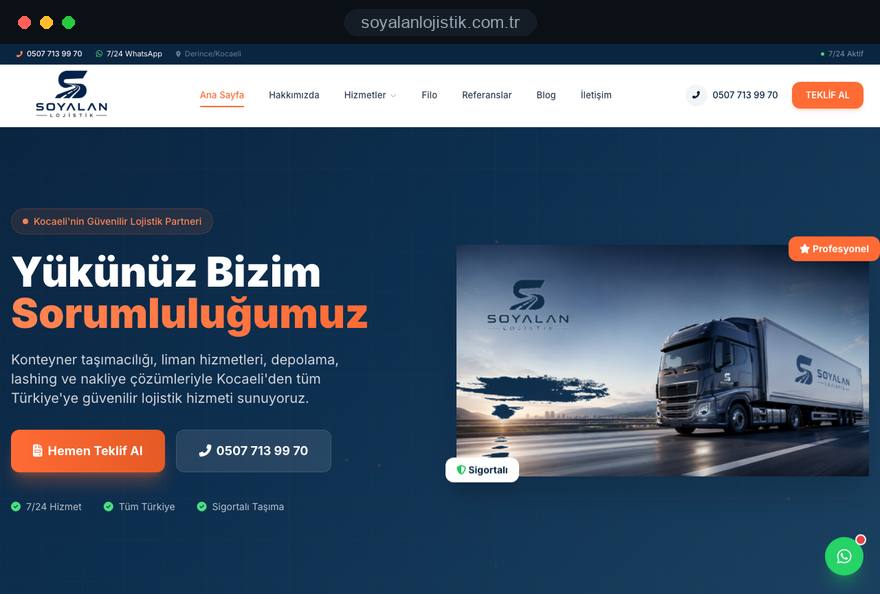
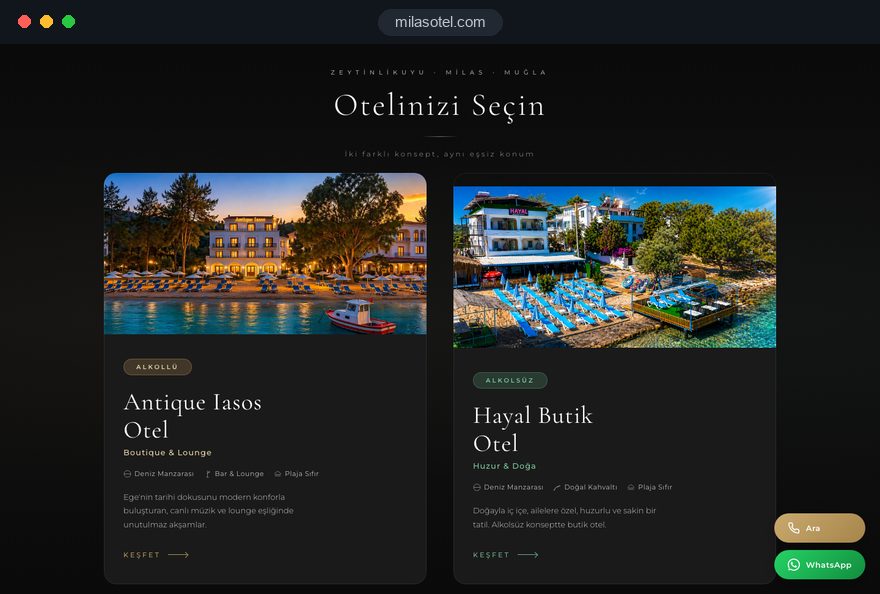
- Künefe shops and restaurants: Hatay has been a UNESCO City of Gastronomy since 2017. Menu, hours and location sit on the first screen, and shipping details get their own page; more on our restaurant website page.
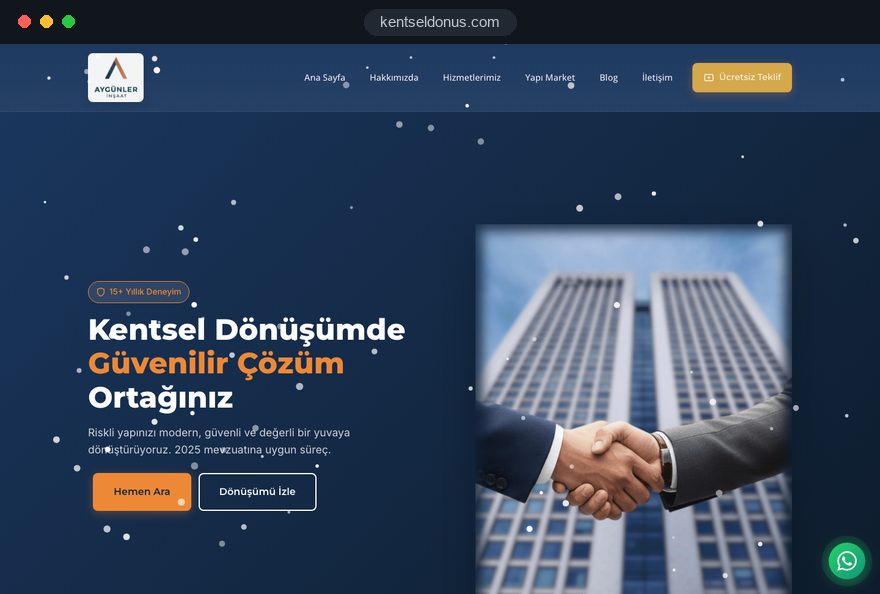
- Construction and retrofitting firms: Completed work is shown with real photos, the type of work and supporting documents, in plain technical language; see our construction company website page.
- Citrus and olive growers: Orchards, harvest timing, packaging options and a wholesale quote form sit on one producer page, with retail shipping kept separate.
In construction especially, we advise against turning grief into marketing; documented work builds trust where images of loss do not.
10Legal Basics: KVKK, GDPR and Distance Sales
A site's legal texts must describe the data you actually collect and the sales you actually make; templates copied from another company are inaccurate and erode trust. In Hatay we most often deal with quote forms, WhatsApp orders and shipping food to customers elsewhere in Turkey.
- Privacy notice: Article 10 of KVKK, Turkey's Law No. 6698, requires an information notice wherever you collect personal data, including quote forms, explaining who processes it and why.
- Cookies and EU visitors: Cookie consent should match the analytics and ad tags you run; export sites that target visitors in the EU need consent before non essential tracking, and Google requires consent mode for its measurement and personalized ad features there.
- Distance sales: Turkey's Distance Contracts Regulation requires pre contract information and gives consumers a fourteen day withdrawal right; contracts for goods that spoil quickly or may pass their expiry date are listed among the exceptions.
- Forms in other languages: Arabic or English forms should carry the privacy notice in the same language, next to the form.
If you ship künefe or fresh products, confirm with your legal adviser which items fall under that exception; olive oil with a long shelf life may be assessed differently. Buyers abroad selling to consumers in their own market should apply their local rules as well. The legal content is your and your adviser's responsibility; we make sure the texts are placed correctly, readable and linked to every form.
11Redesigning Without Losing Rankings or Customers
The biggest risk in a redesign is changing the addresses Google knows without a plan, and in Hatay this often coincides with a change of physical address. Getting the order right when both change at once protects your visibility.
- Inventory: List every page on the current site, the ones bringing visits in Search Console and the ones with links from other sites.
- One to one mapping: Each old address points to its closest new equivalent with a 301, a redirect that signals a permanent move; sending everything to the home page wastes that value.
- Physical address update: On launch day, the profile, contact page, structured data and directory listings switch to the new address together.
- Retired services: Pages for services you no longer offer either redirect to the closest current page or are removed with a clear note.
- Monitoring: In the first weeks, Search Console error reports are checked and missed addresses fixed.
Blocking a staging site in robots.txt is not enough: Google cannot read a noindex tag on a page blocked by robots.txt. To keep a page out of the index it must be crawlable and carry noindex; password protection is the safer route for staging.
If the old site was offline for a while after the earthquakes, some old addresses may already have dropped out of the index. Checking which pages still attract links helps you decide which redirects matter most.
12Common Mistakes on Hatay Business Sites
Most repeated mistakes on Hatay sites come from outdated information and misdirected content rather than from design. These are the six most common, each with a better alternative:
- Leaving the old address online: If you moved, update the footer, directions and contact page on the same day as the profile, not only the profile.
- Publishing the catalog as one PDF: Move each product group to its own page so a buyer can find the exact size; keep the PDF as a download option.
- Building Arabic pages left to right: Instead of translating text into an unchanged layout, rebuild page direction, form fields and tables for Arabic.
- Uploading the menu as a photo: Replace an image that is unreadable on a phone with a text menu page that is easy to update.
- Using earthquake images in promotion: Rather than drawing attention with damage photos, show your work, your documents and the projects you have delivered.
- Relying only on Instagram: Keep your account, but put hours, menu, address and ordering details on a site you control, so customers can still find you if account access is lost.
Many of these can be fixed without a new site. If you spot several on your current one, it is worth discussing which can be solved by editing content before deciding on a full redesign.
13What Drives Scope and Budget
Scope, not location, determines the cost of web design for a Hatay company; our prices are the same for Hatay, Istanbul or a client abroad. Knowing what enlarges a quote helps you decide what to do now and what to leave for later.
- Product depth: A filter or steel catalog with hundreds of sizes and codes needs far more structure and content work than a site with five service pages.
- Number and direction of languages: Every extra language needs adapted copy, and a right to left language such as Arabic needs separate layout work.
- Document library: A searchable, updatable archive for certificates and test reports is a setup of its own.
- Ordering flow: A WhatsApp link is simple; a store that takes payments adds shipping, returns and payment integration.
- Migration work: Redirects from the old site, recovering lost accounts and cleaning up duplicate profiles can be separate line items.
On a limited budget, start with accurate contact details, the main product or menu pages and one language, and add other languages in a second phase. If the structure is built for several languages from day one, that second phase does not require rebuilding the site.
14The First 90 Days and Your Next Step
Launch is where measurement begins, and the first 90 days show which pages deserve more work. We split this period into three parts.
- Month one: Search Console and GA4 are monitored and crawl errors fixed; quote forms, calls and WhatsApp clicks are tracked as separate conversions.
- Month two: The most visited product or menu pages are improved, and enquiries from abroad are split by the language version they came from.
- Month three: New content and any added languages are planned around harvest seasons, trade fairs or the holiday calendar.
Before deciding, answer the questions in this guide for your own business: who your main buyer is, whether the site reflects your situation today, and which language actually brings enquiries. We set scope and price in a written quote tailored to your request; reach us through the quote form. After the call, we send a written scope and quote.
To make the first call productive, bring three things: your current site address, a list of your three top selling products or services, and a few recent enquiries from abroad. With that, we can agree in the first meeting which page comes first and which language can wait.