Every service on one page
Container haulage, warehousing, port services and customs share one list with a line each. A buyer who needs to move steel coils cannot tell whether you handle them, and search engines have no page to show for that service.

Your Windows contrast theme is on; colours come from your system.
Your device is set to reduce motion; animations are already off.
Your choices are saved in this browser only.
Industry-specific web design
The person looking for a logistics partner is usually a buyer or a logistics manager with a specific load, a specific lane and a deadline. We build websites for hauliers, forwarders and warehousing firms around service line pages, a quote form that asks for cargo and route up front, and clear fleet and company details, for firms in the UK and elsewhere working with a remote team and for Turkish logistics companies that need an English site for partners abroad.
In short
A logistics company website explains each service line on its own page, from full and part loads to container haulage, warehousing and customs, shows the fleet and the company behind it, and collects quote requests with cargo type, quantity, origin and destination. The audience is other businesses, so the site is built on facts, process and verifiable company details rather than slogans.
Talha Aslan and teamLast updated:
Why it needs its own approach
A logistics customer is a business that has already made a promise to its own customer. It is not looking for a slogan; it wants to know which loads you move, on which lanes, with which vehicles and under which company. Generic business templates do not organise that information.
Container haulage, warehousing, port services and customs share one list with a line each. A buyer who needs to move steel coils cannot tell whether you handle them, and search engines have no page to show for that service.
A form with name, phone and a message box does not collect what a quote needs. Cargo type, weight, dimensions, origin and destination are chased by phone one by one, the request waits in a queue and the speed advantage is gone.
Customers want to know whether you have the right vehicle for their load: curtainsiders, low loaders, container chassis, forklifts. When the fleet section is a single stock lorry photo, that question stays open.
In the UK, a limited company must show its registered number, registered office address, place of registration and the fact that it is a limited company on its website. Buyers checking a new supplier look for exactly these details; a site that hides them slows down onboarding.
When an overseas consignee or a partner forwarder opens a Turkish logistics firm's website and finds only Turkish, the conversation moves to long email threads. Services and lanes that are not explained in English cost the firm enquiries.
Customers call operations to ask where their shipment is. Without a clear link from the website to the tracking system or customer portal you already use, the same question is answered dozens of times a day.
Sources: GOV.UK: Running a limited company, signs, stationery and promotional material
Our approach
We build a logistics website around the buyer's checklist. First they see that the service fits their load, then they check your capacity and credentials, and finally they ask for a quote. That is why every service line has its own page, the fleet is described by vehicle type and every page leads into the same quote form.
The quote form asks in advance what your operations team would otherwise ask on the phone: service, cargo type, quantity and weight, dimensions, origin, destination and an estimated date. If you work with partners abroad, we set up a multilingual structure from day one; if you plan to advertise one lane or one service, a landing page can go live without touching the main site.
Design, development and content sit in one team, so the service pages are written from how your operation actually works. Talha Aslan sets the strategy and an experienced team handles delivery. We work remotely and in English with firms abroad, and firms in Istanbul can meet us in person.
Home
Each service page answers its own search, and all of them lead into the same quote form.
The right setup
All three start from the same foundation; service lines, target customers and the number of languages make the difference.
Regional operator
Customers look for an operator close to a port or an industrial area, so the site explains the region and the capacity.
International transport
Customers and partners sit in different countries, so the site explains lanes and modes in their language.
Trade services
Customers want a process solved, so the site walks through procedures and the documents they need.
Built for logistics firms
These are the points logistics and freight firms decide on most often when we plan a site together.
For full and part loads, container haulage, warehousing, port and customs services: what is done, which loads it suits, how the process runs and common questions. If a cargo type is specialised, such as steel coils or bulk materials, it gets its own page.
Service, cargo type, quantity and weight, dimensions, origin, destination, estimated date and company details are asked step by step. The request reaches your operations team complete, and customers who prefer it can send the summary over WhatsApp.
Vehicles are described by type and by the loads they carry; warehouse space, handling equipment and maintenance routines are shown with real photos. Capacity you do not have does not appear on the site.
UK limited companies must show their registered number, registered office address, place of registration and limited status on their website. We place these details, along with any operator licences and certificates you hold, where buyers find them, using only the documents you provide.
If you use a tracking system or customer portal, we add a clear login link to the main menu; where the system allows it, a tracking number lookup is connected to the site. We agree the scope at the quote stage.
For Turkish logistics firms with overseas customers and partners, services and lanes are explained on separate English pages, or in any other language needed, with correct hreflang markup. We do not publish raw machine translation.
Sources: GOV.UK: Running a limited company, signs, stationery and promotional material
Comparison
| Topic | Generic business template | Site built for a logistics firm |
|---|---|---|
| Service content | All services on one page as a short icon list | Each service line and special cargo type on its own page |
| Quote requests | Name, phone and a message box | Step by step form for cargo, quantity, route and date |
| Capacity | A stock photo of a lorry | Fleet by vehicle type, warehouse and equipment |
| Credentials | General trust statements | Company details, licences and certificates stated clearly |
| Partners abroad | One language or machine translation | Pages per language and hreflang |
| Measurement | Visitor numbers | Which service page brings quote requests |
Quick check
Must haves: does your site have them?
0 of 6 in place Tick the boxes to see where your site stands.
Added as needed
We choose which of these you need together during the scoping call.
Share your service lines, your fleet and the customers you work with; we will come back with a page structure and a written quote.
Process
We define your business, your audience and the site’s one-sentence job: who it sells what to, through which action. Scope and timeline are written from that answer.
The home page and key templates come to you as designs first; no code is written before your approval. We do not like surprises, and we do not cause them.
The approved design becomes fast, secure, maintainable code. You follow progress in the CRM and see every page in a staging environment before launch.
The site goes live with analytics, Search Console and conversion tracking connected; panel training is given, first-year hosting and maintenance included.
Search and speed foundations
Buyers usually search with a service and a place: container haulage plus a port name, warehousing plus a town, a cargo type plus haulage. Service pages, the contact page and the Google Business Profile are built to answer these searches together.
Company name, address, phone and services are marked up so search engines can read them; nothing is marked up that is not on the page.
Operations run in the field and customers are often on their phones. Pages are designed for mobile first, images are compressed and Core Web Vitals are measured before launch.
Quote forms, calls and WhatsApp clicks are tracked as conversions from day one, so you can see which service page brings requests.
Free tools
Before planning a new site, see how the current one looks to a buyer checking a new supplier. The tools are free and need no sign up.
Tech SEO
Scan any URL for title, meta description, headings, canonical, indexability and speed signals, and get an SEO score with a clear to-do list.
Tech SEO
Test whether a page works well on phones: viewport, font size, tap targets, a mobile screenshot and Core Web Vitals.
Security
Check an SSL certificate's validity, expiry date, issuer, hostname match, certificate chain and TLS versions in seconds.
Why do your emails land in spam? Check a domain's SPF, DKIM and DMARC records, find the errors and get a corrected record to copy.
Tech SEO
Correct hreflang tags for multilingual sites; x-default automatic.
Conversion
Create a wa.me link with a preset message + embeddable button code.
Real project
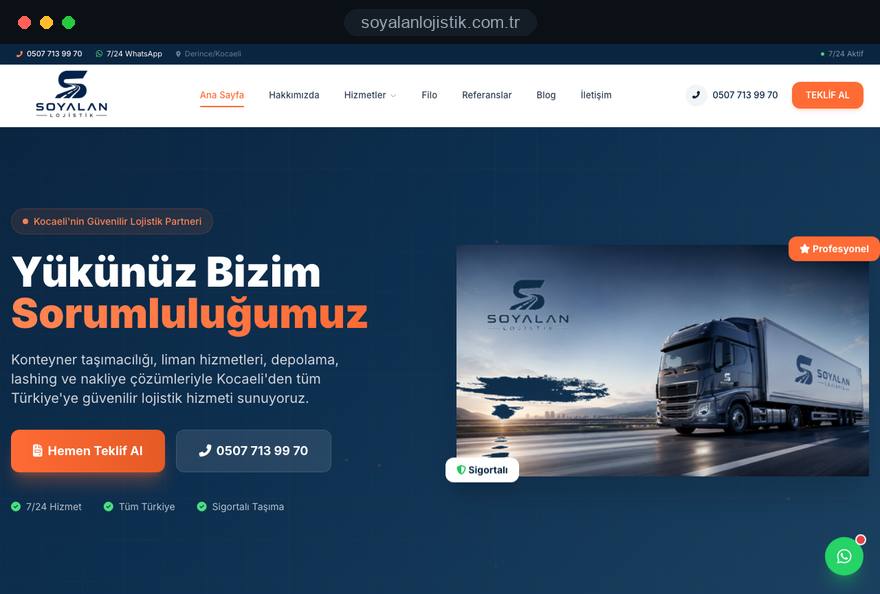
Our team designed, built and wrote the website of Soyalan Lojistik, a firm offering container haulage, warehousing and port services around the ports of Kocaeli in Turkey; the site is live. You can see our other work on the references page.
Logistics and port services · web design, SEO, content
Related pages
Industries
A separate setup for removal firms moving homes and belongings for private customers.
Industries
For manufacturers on the shipper side who present products and technical data.
Solutions
A page structure per language for partners abroad and international lanes.
Solutions
A single-goal page matched to an ad for one lane or one service.
 How to Build a B2B Website: Site Structure That Generates Qualified LeadsRead article
 Lead Form Design for Booking, Quote and Demo Requests: UX Rules That Lift ConversionsRead article
 Website CRM Integration: How to Track Form Leads AutomaticallyRead article
 Multilingual Website SEO: How to Reach Global CustomersRead article
FAQ
If your question is not here, write to us; we will send you an answer and a written quote.
Next step
In a free 15-minute call, in English, we will go through your service lines, your fleet and the customers you want to reach, then send a written scope and quote.
In-depth guide
The person who opens a logistics website is usually a professional under time pressure: a production plan is fixed, a ship date has been promised to their own customer, and there is a load that has to move on a specific lane. They scan a handful of supplier sites, shortlist two or three, and ask for a quote from whoever looks most likely to answer quickly and completely.
In this guide, we at Talha Aslan and team walk through the decisions we make, in order, when we plan a website for a freight, haulage, warehousing or customs business. Every section ends in something you can apply to your own site today: a criterion, a checklist or a question to put to an agency. Our general project process is described on our web design service page.
A logistics website has to answer several roles from the same customer company, not one generic visitor. The person who requests the quote, the person who approves it and the person who sets you up as a vendor are rarely the same, and each needs their answer in a predictable place.
In our planning workshop we write one question for each of these roles and map it to the page that answers it. Any question left without a page shows you where the gap is.
This is where a business to business freight site differs sharply from a household moving site. Moves that one person decides on in an evening need a different structure, which we cover on our removals company website page; in logistics, the decision is made by a team, on the basis of documents and process.
Every service line deserves its own page, because a shipping manager looking for full truckload capacity and an exporter looking for customs brokerage ask completely different questions. Listing everything on one "Our Services" page with a line each leaves both of them without an answer.
We use four criteria to decide whether a service gets its own page:
The menu then follows: full and part loads, container haulage, warehousing and handling, port services, customs and trade compliance. A mode you do not operate yourself, for example air freight you book through agents, should not be presented as a core service; say plainly how you deliver it.
A good service page says what you do not handle as clearly as what you do, because no buyer wants to spend a day on a quote that was never a fit.
This is the skeleton we use for a service page:
Linking these pages to the industries you serve also pays off. A carrier that moves parts for automotive suppliers can show in a few concrete sentences that it understands just in time delivery and what a stopped assembly line costs a customer. If you want to see how the shipper's own site is built, our manufacturing company website page shows the other side of the same conversation.
A lane page is valuable when it describes a route you run on a schedule or a port you serve every week; copies that only swap a city name mislead readers and search engines alike.
For an international carrier or forwarder, a lane page should carry the route and border crossings, departure frequency, typical cargo, required documents such as the CMR consignment note for international road freight, and the practical issues on that lane. For a regional operator, the page describes your relationship with a specific port, industrial zone or free zone: distance from your warehouse, the steps for port access and the loads that customers in that area typically ship.
Before we build a lane page, we answer these questions:
If any answer is no, the route stays as a short section on the service page. A few lane pages full of real detail bring more trust and better qualified requests than dozens of thin ones.
The questions on your quote form should be exactly the ones your team asks by phone today before they can price a job; if the form collects them up front, your first reply can be the quote itself. A form with name, phone and a message box leads only to a round of follow up questions.
We build the form in steps, because people abandon a single screen with fifteen fields:
We keep mandatory fields to a minimum and offer an "I don't know yet" option for dimensions. Choosing container reveals container type and count; choosing customs reveals the type of procedure. An upload field for a packing list or commercial invoice can be added for customers who prefer to send documents.
A quote form only earns its keep when the request reaches the right person, complete and fast; a well designed form that drops into a shared inbox loses its advantage. That is why we plan the inquiry flow in the same meeting as the page design.
These are the points we settle in that meeting:
When the flow needs custom work, for example connecting requests to your rate tables or showing customers their quote history, we plan it separately as part of our custom software service. The question to ask any agency is simple: after the form is submitted, exactly who receives the request, in what format and how many seconds later.
On a fleet page, a buyer is not looking for a glossy truck photo; they want to know whether you have the right equipment for their load, so describe the fleet by vehicle type and use.
For each vehicle type we show a short card: the type (curtainsider, reefer, low loader, container chassis and so on), the cargo it suits, approximate load dimensions and payload, and any tracking equipment on board. We take this information from your vehicle list and have your operations lead approve it before launch. Subcontracted capacity is never shown as your own fleet; if you work with partner carriers, the page says so.
If you offer warehousing, the page should describe covered floor space, racking, the number of loading docks, handling equipment and how inventory is tracked and reported. Photos should come from the real facility, shot in good light on the same day; stock images are among the first things an experienced buyer notices.
Corporate customers check a new supplier before they set it up as a vendor, and when the details sit clearly on one page, onboarding goes faster. A site that scatters or hides them sends the same requests back to you one email at a time.
In the UK, a limited company must show its registered number, registered office address, place of registration and the fact that it is a limited company on its website. Other markets have their own rules for licenses and operating authority, so we work from the documents you hold. This is what we suggest for the page:
We take every detail from the documents you provide and have it approved before publishing. An expired certificate left on the site is a real trust problem, so we suggest adding a review date to each document and checking the page at least once a year.
For a logistics firm that wins work across borders, a second language is not decoration but a quote channel; your exporter's overseas buyer or a partner forwarder has to understand you in their own language. The reliable way to do that is a separate page per language, each at its own address with its own content.
When we plan language versions, we pay attention to the following:
Our multilingual website page explains the per language structure in detail, from URL patterns to translation approval. We confirm the number of languages and the source of translation in writing at the quote stage.
If customers call operations to ask where their shipment is, the quickest win on the website is a clear way into your tracking system. That can mean anything from a menu link to a full integration, and the right depth depends on the system you already use.
We look at three options in order. The first is a clear login link to your tracking system or customer portal in the main menu; it works with any system and can be live on day one. The second is a tracking number lookup on the site, if the system allows external queries, so customers see the status without logging in. The third is a customer specific dashboard or reporting screen, which is a software project in its own right and is planned separately.
Before deciding, we suggest asking your tracking provider these questions:
Shipment data can include personal information such as consignee names and addresses. So rather than a lookup that shows everything to anyone who knows a number, we prefer one that shows only a status and location summary.
Buyers usually search for a logistics provider with a combination of service, cargo and place, and search visibility comes from pages built around that combination.
After service and lane pages, the second layer is guides that answer the questions buyers ask while they decide. Topics a trade compliance manager genuinely looks for are good examples: how Incoterms rules split transport responsibility, when to choose a part load over a full load, which documents to prepare before customs. Each guide links to the relevant service page and ends with a route to the quote form.
Your operations team is the most reliable source for these guides. We ask you to collect, for one month, the questions customers ask by phone and in writing; every question that repeats is a candidate for a guide or an FAQ entry.
Google Business Profile guidelines require the business name to match the real world name; adding words such as "logistics freight customs" to it breaks the rules and puts the profile at risk. Company name, address, phone and services are added as structured data, markup that search engines can read, and nothing is marked up that is not on the page. Our SEO service page explains how that work runs.
A logistics website is opened in the warehouse yard and on the road as often as at a desk; a site that loads slowly on a phone or has a form that cannot be completed on one loses the most urgent requests.
Google's Core Web Vitals define "good" at the 75th percentile as: LCP, which measures how long the main content takes to load, at 2.5 seconds or less; INP, which measures how quickly the page responds to taps and clicks, at 200 milliseconds or less; and CLS, which measures how much the layout shifts while loading, at 0.1 or less. We measure these separately for service pages and the quote form before launch. You can check how your current site behaves on a phone with our mobile friendly test.
The goal of measurement is not visit counts but knowing which page produced which quote request. Form submissions, call clicks and WhatsApp clicks are tracked as conversions from the first day and attributed to the service page they came from. For visitors in the European Economic Area, cookie consent and Google's consent mode are set up before any non essential tracking.
If you plan to advertise a single lane or service, send that traffic to a dedicated page rather than the home page, and track conversions per service in the ad account as well.
Most mistakes we see on logistics websites come not from design but from guessing wrong about what the buyer needs to know. Here are the six we correct most often, each with the better alternative.
Applying this list to your own site takes about an hour: mark each item yes, no or partly. Every "no" belongs on the task list for a new site.
The right partner for a logistics website is the team that first asks questions to understand your operation and only then moves on to design. An agency that opens with colors and templates will most likely try to squeeze your service lines and quote flow into a template later.
These are the questions we suggest you ask in any agency meeting:
In our process, design, development and content sit within one team: Talha Aslan sets the strategy and experienced specialists on the team carry out the work. You can look at our live work in logistics and our other projects on our portfolio page.
Fixed scope packages are listed in our pricing section; because the number of service lines, language versions and tracking integration change the scope, we prepare a written quote for your company. To talk through your service lines, fleet and target customers, book a short call through our contact page, and we will send you a written scope and quote afterwards.
Start a Project
Thanks {name}, we've received your brief. We usually reply within the same day.
What happens next?