The fleet is one big gallery
Every boat sits in one pile of photos. Guests cannot compare length, cabins and capacity side by side, and search engines cannot connect a search for a boat's name with the right page.

Your Windows contrast theme is on; colours come from your system.
Your device is set to reduce motion; animations are already off.
Your choices are saved in this browser only.
Industry-specific web design
Guests fall for a boat in the photos, but they ask the same questions every time: how many people fit, how many cabins, which bays, is the skipper and food included, is that week free. We build yacht charter websites around those answers, with a page for every boat and every route, and day trips and weekly charters sold in separate flows, for operators in Turkey and across the Mediterranean.
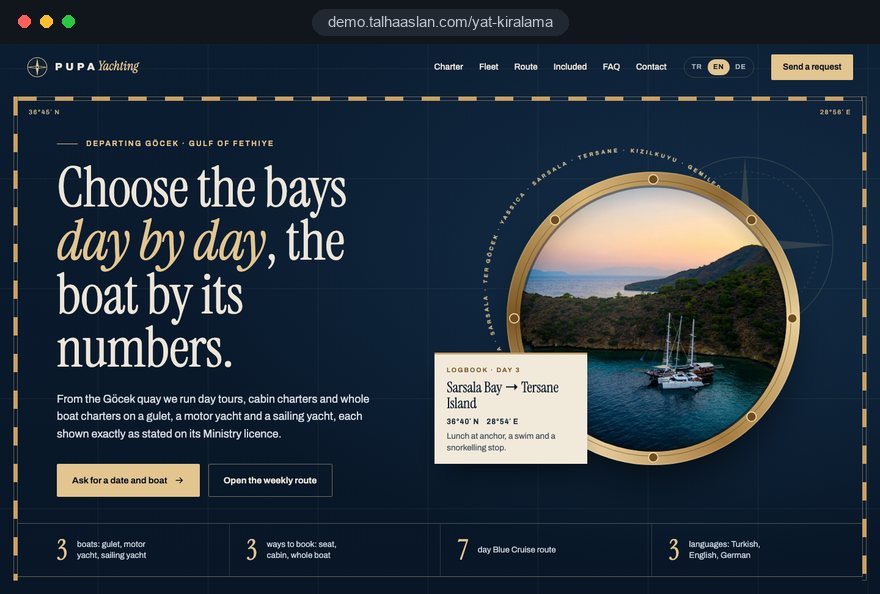
Open the live demoA demo design we built for a fictional brand
In short
A yacht charter website gives every boat its own page with length, cabins, capacity and crew, shows routes day by day, sells day boat tours per seat and gulet or yacht charters by date and cabin, and lists what is and is not included. In Turkey, the Marine Tourism Regulation requires promotion to match the operator's Ministry licence and not to mislead, so boat details are written from the vessel's documents.
Talha Aslan and teamLast updated:
Why it needs its own approach
Charter guests buy a vessel and an experience at once; length, route, crew and inclusions matter as much as the photos. Generic business templates have no place to show any of it in order.
Every boat sits in one pile of photos. Guests cannot compare length, cabins and capacity side by side, and search engines cannot connect a search for a boat's name with the right page.
The site shows one photo of a bay. Guests cannot see where the boat leaves from, which bays it stops at or how the day runs, so they have nothing to compare when they look at another operator.
Nobody says whether the skipper, meals, fuel, port fees or water toys are included. Guests cannot estimate the total, and the same question arrives by message every day.
Per-seat day boat tours and date-based gulet charters share one enquiry form. A couple looking for two seats meets a whole-boat rate and leaves.
In Turkey, the Marine Tourism Regulation requires a marine tourism business to promote itself in line with its Ministry licence and without misleading information. A page listing a capacity or vessel type that differs from the documents is an avoidable risk.
Guests from Germany, the UK or Russia cannot read the boat's specifications and cancellation terms in their own language, so they ask on WhatsApp one by one; when the reply is slow, they book another boat.
Our approach
We build a yacht charter site in the order guests decide. First they choose a route or a type of boat, then they look at the boat's size, cabins and crew, check availability for their dates and group, and finally send an enquiry or pay a deposit. Day boat tours are sold per seat; gulet and yacht charters by dates and by cabin or whole boat, each in its own flow.
If guests should pick dates and pay entirely on your site, we set up an online booking system; if most guests come from abroad, we plan a multilingual structure from day one. For the season opening or a single route, an ad-matched landing page can go live without touching the main site.
Design, development and content sit in one team, so availability, payment and language decisions are not patched on later. Talha Aslan sets the strategy and an experienced team handles delivery, working remotely and in English with charter operators wherever they are.
Home
Every boat and every route answers its own search; availability, inclusions and payment come together in one flow.
The right setup
All three start from the same foundation; what you sell makes the difference: a seat, a cabin or the whole boat.
Day boat tours
Guests look for a place on a boat for one day; departure time, route and lunch are enough to decide.
Gulets and Blue Cruises
A family or a group of friends weighs a week's route and the cabins together.
Yacht fleet
Guests filter by dates, group size, type of boat and departure port.
Built for yacht charters
These are the points we decide on with you when planning a yacht charter or boat tour site.
Length, build and refit year, cabins and bathrooms, day and overnight capacity, crew and equipment. We write them from the vessel's documents and build them as fixed fields, so guests can compare boats side by side.
Departure port, bays, approximate sailing times and the fact that weather can change the route are stated plainly. The meeting point comes with a map and coordinates, so guests do not get lost on the quay.
Turkish rules define a day trip boat as one that returns its passengers to the same port on the same day. We carry that split into the site: day trips sold per seat, yacht and gulet charters by dates and cabins, on separate pages.
In Turkey, bareboat charter of Turkish flagged yachts carrying up to twelve passengers requires at least one of the charterers to hold an adequate licence. If you offer bareboat, the enquiry step asks for the licence and the documents you need; rules elsewhere depend on flag and cruising area.
Skipper and crew, meals, fuel, port and marina fees, water toys and transfers appear in two lists, included and not included. Guests see what the package covers before they pay.
In Turkey, promotion must match the Ministry licence and must not mislead. Vessel type, capacity and business name are written exactly as in the documents; the final legal check is yours.
Sources: Turkish Marine Tourism Regulation, Official Gazette no. 27298, articles 24, 34 and 53
Comparison
| Topic | Generic business template | Site built for yacht charters |
|---|---|---|
| Boat content | All boats in one gallery | Each boat on its own page: length, cabins, capacity, crew |
| Route | A few photos of bays | Departure port, bays and a day by day plan |
| How it sells | One contact form for everything | Day trips per seat, charters by date and cabin |
| Inclusions | Not stated, asked by message | Included and excluded items in two lists |
| Licence details | Type and capacity differ from the documents | Boat details written from the documents |
| International guests | One language | Pages per language with terms in the guest's language |
Quick check
Must haves: does your site have them?
0 of 6 in place Tick the boxes to see where your site stands.
Added as needed
We choose which of these you need together during the scoping call.
Tell us how many boats you run, whether you sell day trips or charters, your departure ports and where your guests come from; we will come back with a page structure and a written quote.
Process
We define your business, your audience and the site’s one-sentence job: who it sells what to, through which action. Scope and timeline are written from that answer.
The home page and key templates come to you as designs first; no code is written before your approval. We do not like surprises, and we do not cause them.
The approved design becomes fast, secure, maintainable code. You follow progress in the CRM and see every page in a staging environment before launch.
The site goes live with analytics, Search Console and conversion tracking connected; panel training is given, first-year hosting and maintenance included.
Search and speed foundations
Guests do not only search for yacht charter; they use the departure port, phrases like gulet cruise, Blue Cruise or boat trip, and the boat's own name. Route, port and boat pages are built to answer each of these searches separately.
Decks and cabins are best understood in a short video. Videos are placed so they load only when the guest plays them, without slowing the page.
Business name, contact details and the key specifications on each boat page are marked up so search engines can read them; nothing is marked up that is not on the page.
Enquiries, WhatsApp clicks and deposit payments are tracked as conversions from day one, so you can see which boat and which route page bring guests.
Free tools
Before planning a new site, see how the current one opens on a phone at the quay, convert your boat photos to lighter formats, get coordinates for your meeting point and make a QR code for the boat. The tools are free and need no sign up.
Tech SEO
Test whether a page works well on phones: viewport, font size, tap targets, a mobile screenshot and Core Web Vitals.
Image
Convert between JPG, PNG and WebP in one click or in batches; it detects the input format, lets you set quality and a background for transparency, and uploads nothing.
Currency
Convert euros and 30 currencies with official ECB reference rates, look up any past date since 1999 and see monthly averages.
Conversion
Turn URLs, WhatsApp, Wi-Fi, vCard and text into a QR code in seconds; download high-res PNG or SVG.
Maps
Convert latitude and longitude between decimal degrees, DMS, DDM and UTM, and get the distance, bearing and midpoint between two points, with map links.
Conversion
Create a wa.me link with a preset message + embeddable button code.
How we work
We do not have a live client site for yacht charters or boat tours yet, so we show our approach on a live demo. The demo is not client work. You can see the sites we built in other sectors on the references page.
Live demo
For this field we built a one page demo site for a fictional brand, made only to show our approach. You can explore the design, the copy structure and the mobile view live in three languages.
Open the live demoA seat on a day trip, a cabin or the whole boat: each needs its own availability and payment flow. We settle this with you before design begins.
Length, capacity, cabins and vessel type are written from the documents you give us; we do not publish a detail you cannot back up.
We listen to how you run each route, from the departure port and bays to the alternative when the weather turns, and turn it into a day by day plan guests understand.
We track which boat and route pages bring enquiries and where guests drop out of the payment step, and fix it before the busy season starts.
Related pages
Industries
A separate setup for villas and holiday homes that rent out accommodation.
Industries
Tour and departure date pages for agencies selling scheduled package tours.
Solutions
Let guests pick dates and pay entirely on your own site.
Solutions
A page structure per language for boats with mostly international guests.
 How Website Video Affects Conversion Rate: When It Helps, When It HurtsRead article
 Multilingual Website SEO: How to Reach Global CustomersRead article
 How to Choose a Payment Gateway: What to Check Before You SignRead article
 How to Optimize Images for Your Website: Format, Size and SEO SettingsRead article
FAQ
If your question is not here, write to us; we will send you an answer and a written quote.
Next step
In a free 15-minute call, in English, we will go through your boats, your routes and where your guests come from, then send a written scope and quote.
In-depth guide
A charter guest buys two things at once: a few hours or a week on the water, and the boat that carries that time. They look at the photos first, but their confidence comes from the specifications, the route, what is included and how cancellations work. When a yacht charter website does not give those answers in a clear order, the same questions land in WhatsApp all season.
In this guide, we at Talha Aslan and team walk through the decisions we make, in the order we make them, when we plan sites for day trip operators, gulet owners and companies running a fleet of yachts. If you rent out accommodation rather than boats, our guide to villa rental websites is a closer starting point; this one is about boats, routes and how a day at sea is sold.
Decide what your sales unit is before anything is designed; the calendar, the way prices appear and the payment step are built differently for each answer. On a day trip you sell seats: the guest picks a date and a group size, and the system deducts them from that departure's capacity. On a weekly gulet charter you usually sell the whole boat, and some operators sell individual cabins.
The split also shapes expectations. Guests booking a cabin need to know up front that they will share the boat with people they have not met; if you sell private trips, the page must say plainly that the boat belongs to that group alone. If one boat works both day trips and weekly charters, both sales channels have to share a single calendar.
Before the first design meeting, write down answers to these questions:
A boat page should answer questions in the order guests ask them: does this boat suit us, how comfortable is it, and is it free on our dates. The gallery must not break that sequence; nobody should have to scroll past fifteen photos to find the capacity.
The order we recommend:
Fixed fields let a guest open two boats side by side and compare the same rows. In the cabin plan, the difference between a double bed, two singles and a convertible saloon berth is what families ask about most.
On a phone, a sticky "Check dates" button at the bottom of the screen lets guests return to the decision from anywhere on a long page.
Every number on a boat page should have a counterpart in the vessel's documents. In Turkey, the Marine Tourism Regulation requires marine tourism businesses to promote themselves in line with their Ministry licence and without misleading information, so a page showing a capacity or vessel type that differs from the documents carries an avoidable risk.
Capacity is where errors appear most. The number of passengers allowed on board during the day and the number of guests who can sleep aboard are different figures and belong on separate rows. Pick one length measure and use it for every boat; when one page shows length overall and another the deck length, comparison becomes meaningless.
The same discipline prevents disappointment at the quay, because guests step aboard the boat they saw online. The final legal check is yours; we build the page from fields that are tied to the documents and easy to audit.
A route page should be specific enough for guests to picture the day: departure time, arrival at the first bay, swim stop, lunch and return. Weekly routes need the bay or harbor for each night and an approximate sailing time for each leg. State on the route page, not at checkout, that weather can change the plan and that the captain makes that call.
The meeting point is the most searched detail on departure day. "Marina entrance" is not enough; give the pier name or number, a map pin and coordinates. To convert coordinates between formats, you can use our coordinate converter.
What every route page needs:
Repeating these details in the confirmation message and in a reminder sent the day before is the simplest way to cut down calls on departure morning. If you sail from several ports, each route page should show only its own port; one group at the wrong marina delays everyone.
The calendar is the most sensitive part of the site; one date that wrongly shows as free means the same boat sold to two groups. A calendar therefore needs at least three states rather than two: free, on option and confirmed.
An option holds a date for a short time until the guest pays the deposit. You set its length; when it expires, the date should return to free automatically and the guest should receive a reminder. Day trips work on capacity rather than dates: each departure has a number of seats, sales reduce what is left, and guests see when only a few seats remain.
Points to settle before the calendar is built:
If guests should choose dates and pay entirely on your site, we build the calendar as a website with an online booking system. A single boat operator may do well with an enquiry form and manual confirmation; what matters is that guests are told which route their request takes.
Guests should know how much they pay, when, and in which cases they get money back before they reach the payment screen. Weekly charters commonly take a deposit at booking and the balance a set period before departure; day trips take the full amount or a small deposit. You set the terms, and the site repeats them identically at every step.
Boats add a cancellation reason most businesses never face: weather. A guest changing their mind and a captain cancelling for safety need separate rules. If nobody has written down whether the second case means a new date or a refund, the tensest conversations start that morning.
The payment step should show:
If you will take card deposits, start the payment provider application alongside the design work, since approval can take time. The confirmation message should then list date, boat, amount paid, balance due and cancellation terms in one place; it becomes the document guests check most.
The included and excluded lists are the only place where guests can estimate the total cost, so write them like contract clauses rather than marketing copy. Instead of "meals included", state how many meals are served, whether drinks are covered and how dietary requests are handled.
Fuel causes the most disputes. On day trips it is usually included; on weekly charters a set number of engine hours may be included with the rest charged, or fuel may be entirely on the guest. Larger yachts often work with an advance provisioning allowance (APA), a sum paid in advance to cover fuel, food and port costs; if you use one, explain how it is spent and how the unused balance is returned.
Printing exclusions in small type makes an offer look attractive for a moment, but the argument on the quay tends to end up in reviews. Keep the list in the same order with the same headings on every boat page so guests can compare on this point too.
If you offer bareboat charters, the request form must establish early whether the guest is qualified to skipper the boat. In Turkey, bareboat charter of Turkish flagged yachts carrying up to twelve passengers requires at least one charterer to hold an adequate licence; elsewhere, the rules depend on the flag and the cruising area. A sentence on the page is not enough; the condition belongs in the form itself.
We recommend designing this step apart from crewed charters. A crewed request asks for dates and group size; a bareboat request opens extra fields and takes no payment until the request is approved. Offering a skippered option on the same screen keeps guests whose qualifications fall short instead of losing them.
Uploaded licences and IDs are personal data. Next to the form, link to your privacy notice and state how long documents are kept. Store them in a protected panel that only authorized staff can open, rather than forwarding them by email.
Charter sites are mostly opened on phones, sometimes on a weak connection, and heavy galleries delay the first screen. Google treats these values as good: LCP (how long the main content takes to load) of 2.5 seconds or less, INP (how quickly the page responds to a tap) of 200 milliseconds or less, and CLS (how much the layout shifts while loading) of 0.1 or less.
Converting photos to modern formats before upload is the quickest win; our image converter handles that. Deck videos should load when the guest presses play, not when the page opens, with a light cover image shown until then.
You can check how your current site behaves on a phone with our free mobile friendly test. The weakest page is usually the boat page with the most photos, so start there.
If many guests come from abroad, adding flags to the menu is not a language strategy; each language needs its own URLs and its own presence in search. Hreflang annotations tell Google which page is the equivalent in which language, and each version must reference all the others and itself.
Translation has to cover cancellation terms, inclusions and meeting instructions, not only the specification card. If you show rates in several currencies, state the exchange rate source and the currency you actually charge in; a different figure at checkout shakes trust quickly.
A midnight enquiry can wait until morning if the confirmation screen tells the guest, in their language, when to expect a reply. Planning languages from the start is far less work than adding them later; we cover URL structure and translation workflow on our multilingual website page.
Guests do not only search for "yacht charter"; they search with the name of a departure port, with phrases like gulet charter, bay tour or Blue Cruise, and with the name of a boat they have seen. Without a page ready for each of those searches, a search engine sends them to the homepage or nowhere.
Your Google Business Profile matters for local searches too. The guidelines require the business name to match the real world name without added keywords, so a company whose sign says "Blue Yacht" should not call its profile "Blue Yacht Gulet Charter Bodrum". We do not promise rankings; we build structure, speed and structured data around these searches and continue with our SEO service.
Without knowing which boat and which route bring enquiries, season planning is guesswork, so measurement belongs in place from launch. Form submissions, WhatsApp clicks, phone calls and deposits should each be tracked as separate conversions.
Measurement and guest data go together. In the EU, cookie consent is needed before non essential tracking, and Google requires consent mode for measurement and personalized advertising features for users in the European Economic Area. If you operate from Turkey, KVKK also requires an information notice wherever you collect personal data.
If you need passport details for port formalities, ask for them in a separate step tied to a confirmed booking, not in the general enquiry form. That way you collect data only from people who will actually board and keep no more than you need.
These mistakes usually come from a site built in a hurry before the season; each has a practical alternative.
Checking your current site against these six points gives you a short improvement list even before you decide on a new build.
When choosing who builds your yacht charter site, look past the design samples and notice how quickly they understand your sales unit and your calendar logic. Ask these questions in the first call:
When comparing quotes, insist on a written scope: how many boat and route pages, whether calendar and payment are included, which languages launch first and who updates content after launch. Without that, quotes cannot be compared fairly.
We do not yet have a live client site in this field, so we show our approach on a live demo linked on this page. The demo is not client work; you can see projects in other sectors on our references page.
Fixed packages and their scope are listed in our web design pricing section. Tell us how many boats you run, what you sell, where you depart from and where your guests come from, and get in touch; we will prepare a page structure and a written quote for your fleet.
Start a Project
Thanks {name}, we've received your brief. We usually reply within the same day.
What happens next?