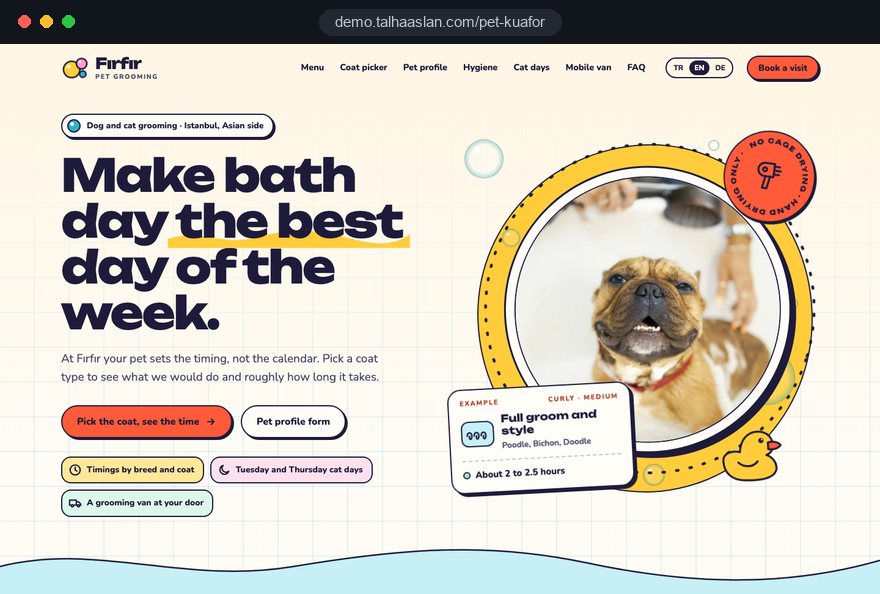
Most calls to a pet grooming salon ask the same three things: how long will my dog take, what do you do with a matted coat, and when can you fit us in. A website earns its place when it answers those questions before the phone rings; otherwise it is a nice brochure with cute photos.
In this guide, Talha Aslan and team walk through the decisions we make when planning a pet grooming website, in the order we make them: the timing table, service pages, the matting policy, the intake form, booking rules, cats, mobile routes, hygiene, the gallery, legal pages, local search and measurement.
01Build the timing table before any design work
The backbone of a grooming site is not the color palette but a table showing how long each kind of pet spends on your table for each job. Without it, both the service menu and the booking calendar run on guesswork.
We build the table from your existing appointment book:
- Collect recent bookings: List the last few months of appointments with breed, size, the work done and the real finish time.
- Group, do not list: Sort pets into small, medium and large, and short, medium and long coats, rather than breed by breed.
- Separate what slows you down: Give matting, heavy shedding, sensitive skin and fear of the dryer their own columns.
- Write ranges, not minutes: Give every cell a lower and an upper limit.
- Connect it to the calendar: Let the booking system size each slot by the upper limit of the range.
The table does not have to be published as it is. Yet the timings on service pages, the questions on the intake form and the length of calendar blocks all come from it.
When something changes, you update one source instead of three pages, and a new groomer plans their day from the same table as everyone else.
02Write service pages around the actual job
Each main service needs its own page or at least its own section, because the owner booking a bath and the owner looking for hand stripping read for different things. Hand stripping, removing dead coat by hand on wire coated breeds such as Border Terriers and Schnauzers, gets lost in a one line list.
We use the same skeleton for every service page:
- What is included: Which of bath, dry, clip, nails and ear cleaning a full groom covers, so nothing is a surprise at collection.
- Who it suits: Coat type and size it is meant for, for example what you recommend for double coated breeds.
- Who it does not suit: Pets with open wounds, skin problems or recent surgery, where you ask for the vet's view first.
- Rough timing: The range from your timing table and what can extend it.
- Aftercare: Brushing at home, care between baths and when you suggest the next visit.
The "who it does not suit" part is missing from most grooming sites, yet it builds more trust than any other line. Owners who see that a salon turns some work down believe their own pet will be assessed with care.
We suggest writing the health related part of that section with your vet rather than from experience alone.
03Publish a clear matting and shave down policy
Matted coats cause more disagreements than anything else in grooming, so the policy deserves a page of its own. When an owner drops off a long coated Cockapoo for a teddy bear trim and collects a short shave, the problem is rarely the work; it is that nobody discussed it beforehand.
A useful policy covers five points:
- How matting is assessed: The coat is checked at check in and light matting is told apart from a pelted coat.
- How the decision is made: Dematting or a shave down is chosen together with the owner, with the pet's comfort first.
- How consent is given: When a shave down is needed, the owner gets a photo by message and you wait for their reply before starting.
- Effect on time and cost: Dematting sits on the menu as its own line and can lengthen the appointment.
- What happens next: How to brush the coat as it grows back and the home routine that keeps mats from returning.
Linking this page to the intake form completes the job. When an owner ticks that the coat is matted, a short summary of the policy appears inside the form along with a box to confirm they have read it.
A surprise at collection becomes a calm conversation at booking, and your team uses the same wording at the desk.
04Collect the pet profile with a short conditional form
The longer the booking form, the more owners abandon it; the answer is not fewer questions but showing each one only when it matters. A conditional form, one that opens new questions based on earlier answers, does exactly that.
A sample flow looks like this:
- The owner picks dog or cat first; choosing cat opens only the cat questions.
- Breed and weight follow, with a "crossbreed, approximate size" option for mixes such as Doodles of unknown size.
- Coat condition comes next; answering "matted" shows the policy summary and a photo upload field.
- Behaviour questions follow: the dryer, nail trims, other dogs, or being handled around the face.
- If it is a first visit, a short introduction session is offered.
The second job of the form is to spare returning clients. Once a profile is saved, the next booking only asks whether anything has changed.
For fields such as vaccination status, ask yourself one question: do I actually use this on the table. Anything you do not use comes off the form. For puppies, a short note at the end explaining that the first groom is kept brief and is about getting used to the salon is usually enough.
05Put your booking rules in writing
If lateness, cancellation and late collection rules are not written down, each one becomes a separate negotiation on the phone. A short, calm booking rules section protects the salon's day.
- Drop off and collection: The window for dropping off and collecting, and how owners are told their pet is ready.
- Lateness: After how long a groom may be shortened or moved to another day.
- Cancellation: How much notice you need and through which channel.
- Late collection: What happens if a pet is collected after closing time.
- Rebooking: A reminder for the next visit at the interval you recommend for that coat type.
If owners choose their own time, an online booking system should read from the timing table. When a large long coated dog is selected, the calendar reserves a longer block on its own, while a small dog's nail trim fits between two big jobs.
Whether you take a deposit is your call; if you do, state the refund terms on the same page. A short reminder sent the day before, using the pet's name, is a simple and effective way to cut forgotten appointments.
Peak weeks, such as the first warm spell, deserve a rule of their own: early booking for existing clients, for example, or long grooms grouped on set days.
06Give cat owners their own path
If you groom cats, cat owners should see it on the home page under its own heading; one line under a dog focused menu is not enough. Cat owners arrive with different worries: barking, the smell of dogs, waiting time and the carrier.
A cat page should answer these questions:
- On which days or at which hours cats are seen, apart from dogs.
- Which jobs you do, such as dematting, a lion cut or nails only.
- Whether you pause when a cat shows signs of stress, and how the owner is told.
- Where the carrier waits and how the cat is taken out of it.
- That no medication is used in the salon and anything needing sedation is left to the vet.
A separate page also tells search engines plainly that you groom cats, which helps owners searching for cat grooming or a lion cut nearby.
When cat is chosen in the form, dog questions should close. Instead of asking whether the cat is calm on the table, ask whether it goes into the carrier easily and whether it has been groomed before.
07Plan the area and route for mobile grooming
For a groomer working from a van, the website is as much a route planner as a map. When it is clear which areas you visit on which days, enquiries from outside the area drop and two bookings on the same street can share a day.
- Split the area by day: Give each working day a group of towns or postcodes, and let the form show only that area's days once an address is entered.
- State what the van needs: Parking space, whether water or a power hookup is needed and how much room the van takes on the street.
- Handle outside requests politely: Offer a waiting list or a clear reply rather than letting enquiries go unanswered.
- Explain where grooming happens: Inside the van or inside the home, and where the owner should be meanwhile.
On Google Business Profile, service area businesses that travel to customers can hide their address. For a mobile groomer working from home this is an important privacy setting, and the areas on your site should match the service area on the profile.
The business name on the profile must match your real world name. Adding keywords such as "mobile dog grooming" to it goes against Google's guidelines and puts the profile at risk. Photos of the van, its layout and its equipment, on the other hand, work well both on the profile and on the site.
08Explain hygiene and safety as concrete steps
Owners leave their pet on a table they cannot see, so a hygiene page should list steps they can follow, not general phrases about a clean and safe environment. A concrete step is a promise owners can check.
- Between pets: How the table, tub, combs and clipper blades are cleaned after every animal.
- During drying: Who stays with the pet while it dries and how heat is checked.
- On the table: How the pet is held safely and whether it is ever left alone.
- Separation: How pets waiting their turn are kept apart.
- When something is unusual: How the owner is told if a small nick or skin redness is noticed.
The last point is missing from most sites, yet it is what owners wonder about most. Saying that the groomer does not diagnose, only notices, informs the owner and suggests a vet visit, draws a clear line.
We cover how exams, vaccinations and emergency care are presented on our page about veterinary clinic websites. A grooming site should stay out of that territory and speak the language of care and observation, not treatment.
09Arrange the gallery by coat type and ask for photo consent
The gallery is the most visited part of a pet grooming site, but photos in random order do not show owners what they are looking for. An owner wants to see how a dog like theirs looks after a groom.
- Filter by coat group: Curly, long and straight, wire and short coats, so owners reach their group with one tap.
- Same setup for every shot: The same corner, light and angle let the work itself stand out.
- A short caption: The work done under each photo, for example "dematted, short teddy trim".
- Consent: If the owner's face, house or car registration plate is visible, permission before publishing.
Rather than asking for permission each time, one consent box on the booking form is enough. If the owner says no, the photo goes only to them, which is a nice touch at collection anyway.
Phone photos are often several megabytes and slow the gallery down. Shrinking files with a free image compression tool before upload helps the page open quickly on a phone. Alt text naming the breed and the work done helps visitors using screen readers and also helps in image search.
10Price lists, licences and legal pages
The legal side of a grooming site is short but should not be skipped: how prices are shown, which extra services need a licence, and personal data. Set up properly at the start, these pages save corrections later.
- Prices: If you publish prices, keep them identical to the list in the salon, and show extras such as dematting or flea baths as their own lines so the figure at collection matches what the owner read.
- Day care and boarding: In England, the 2018 animal activities licensing regulations list dog boarding and day care as licensable, while grooming is not on that list. Defra's statutory guidance says commercial dog day care needs a licence from the local authority.
- Privacy notice: The owner's name, phone number and address are personal data; data protection rules in the UK and EU expect you to explain what you collect and why, next to the form.
- Cookies: If you use analytics or ad tags, set up the cookie notice and, where required, a consent step before launch. In the EU, consent is needed before non essential tracking.
If you also offer training or boarding, these belong on separate pages with their own entry requirements; we cover that setup on our page about dog training and boarding websites. This is not legal advice; outside England, check with your local authority which activities need a licence.
11Win local searches with breed and job pages
Grooming searches are mostly local, but owners often type the breed or the job as well. Local visibility therefore stands on two legs: the map profile and pages built around breeds and jobs.
- Selected breed pages: Not every breed, only the few you groom most, each explaining what you do for that coat.
- Job pages: Searched jobs such as a Labrador deshed, cat dematting or a puppy's first groom, under their own headings.
- Area pages: For mobile groomers, short pages only for towns you really visit, with visiting days and parking notes.
- Asking for reviews: A review link in the message sent after collection; never offer a discount in exchange for a review.
- Structured data: Opening hours, address or service area marked up so search engines can read them.
Copying breed or area pages from a template is tempting, but pages where only the breed name changes tell neither owners nor search engines anything new. A Shih Tzu page and a Golden Retriever page should describe different work, different timings and different home care.
We handle the choice of these pages, their internal links and tracking which of them brings bookings as part of our SEO work. A new breed page should only go live when you have something real to say about that breed.
12Set up phone speed and measurement before launch
Most owners open your site on a phone, on a walk or on the way home, so speed and measurement are checked before launch, not after. Google's Core Web Vitals give clear targets, rated good when met for at least 75 percent of visits:
- LCP: How long the largest element on the page takes to load; 2.5 seconds or less.
- INP: How quickly the page responds to a tap; 200 milliseconds or less.
- CLS: How much content shifts while loading; 0.1 or less.
On grooming sites, LCP is usually hurt by large gallery images and home page videos; CLS by a booking button or cookie banner that loads late. Running your page through a mobile friendly test before launch shows these problems early.
On the measurement side we track from day one: completed bookings, WhatsApp clicks, phone calls and direction requests. We also measure at which step of the booking form owners give up; if many stop at the same question, that question is either unnecessary or in the wrong place.
13Common mistakes on pet grooming websites
Most mistakes we see in this field come not from design but from failing to carry the salon's real workflow onto the site. These are the ones we meet most often, with what we suggest instead:
- Stopping at "depends on the dog": Show the ranges from your timing table and the factors that extend them next to each service.
- Using stock images: Replace polished photos from someone else's salon with real shots taken on your own table in the same light.
- Raising matting at collection: Publish the policy, show its summary when matting is ticked on the form and ask for confirmation.
- Taking bookings only through direct messages: Connect Instagram messages, WhatsApp and the phone to one calendar so the channel does not split your day.
- Mixing boarding into the grooming page: Give extra services their own pages, list only licensed ones and state their entry terms.
- Making health claims: Instead of lines like "stops itching" or "ends shedding", describe the work done and send health questions to the vet.
What these mistakes share is that the owner has to ask on the phone or at the desk what the site should have answered. Each fix protects table time and owner trust at once.
14Choosing the right team and your next step
When choosing a team for your pet grooming site, look first at the questions they ask you, not at their design samples. A team that never asks about your timing table, matting policy or route plan will build a generic template, however polished it looks.
Questions worth asking in the first call:
- Can the calendar reserve blocks of different lengths by breed and coat type.
- Will the form be conditional, and will returning clients have to retype their details.
- Can I update prices and service timings myself from the admin panel.
- Will speed be measured before launch, and will bookings and WhatsApp clicks be tracked.
- Who reviews the pages with me after launch, and how often.
We have not yet published a website project in this field; you can see our work in other sectors on our references page. If you would like to see our approach, a live demo site we built for pet grooming is linked on this page.
You can read what the scope includes on our web design service page and see fixed packages in the pricing section. To talk through the breeds you groom, your packages and your area, get in touch with us; we will work out the right page structure and a written quote together.