The brand lives only on Instagram
All the marketing hangs on one profile; when the account is restricted or the algorithm shifts, new enquiries stop too. Someone searching your name on Google finds other trainers or an old gym page instead of you.

Your Windows contrast theme is on; colours come from your system.
Your device is set to reduce motion; animations are already off.
Your choices are saved in this browser only.
Industry-specific web design
Most people find an independent trainer on Instagram and then send the same message: how does working with you actually work. The answer gets typed out from scratch every time, health details end up scattered across DMs and programmes go out as PDFs after a bank transfer. We build personal trainer websites around your name, clear ways to work with you, an intake form and online programme sales, for trainers in the UK and elsewhere who are happy to work with a remote team.
Open the live demoA demo design we built for a fictional brand
In short
A personal trainer website introduces the trainer and how they work, sets out one-to-one training and online coaching on clear pages, gets to know new clients through an intake form and sells ready-made programmes online. Transformation stories must be genuine: in the UK, the CAP Code requires documentary evidence that a testimonial is real and permission to use it, and health details collected in a form are special category data under UK GDPR.
Talha Aslan and teamLast updated:
Why it needs its own approach
An independent trainer's brand is their own name; there is no gym sign above the door. Every decision a client makes rests on who the trainer is, how they work and how honestly results are presented.
All the marketing hangs on one profile; when the account is restricted or the algorithm shifts, new enquiries stop too. Someone searching your name on Google finds other trainers or an old gym page instead of you.
One-to-one sessions, online coaching and ready-made programmes are explained together in one long message. With no written answer to how many sessions, where, for how long and what is included, every new enquiry starts the same conversation again.
Injuries, medication and long-term conditions arrive scattered across WhatsApp and Instagram messages. Health data is special category data under UK GDPR; collecting it without a clear lawful basis and a defined place to store it leaves the trainer exposed.
Before and after collages with no source and reviews from unnamed people create doubt rather than trust. The CAP Code says marketers must hold documentary evidence that a testimonial is genuine and must not use one without permission.
A programme is paid by bank transfer and emailed as a PDF, with no pre-contract information, terms or refund rule. As sales grow, tracking gets harder and every dispute comes down to a conversation.
Your qualifications, the clients you work with and what you specialise in are not set out anywhere. When a new client cannot find what sets you apart from other trainers, the decision comes down to price alone.
Sources: CAP Code (UK Code of Non-broadcast Advertising), section 3, rules 3.47 and 3.50, ASA · ICO: What is special category data?
Our approach
We do not build a personal trainer website like a gym site; we build it as the site of one person and their work. The home page says who you are and who you work with, each way of working has its own page with the number of sessions, location and length, and every page ends at the same intake form.
The form asks about training history and goals, and takes health questions in a separate step with explicit consent. Sessions can connect to a calendar where clients pick a time, ready-made programmes are sold with online payment, and the terms are accepted as part of checkout. For a new programme launch, a focused landing page can go live without touching the main site.
Design, development and content sit in one team, so none of this is patched on later. Talha Aslan sets the strategy and an experienced team handles delivery, working remotely and in English with trainers abroad. We write the copy in your voice with you, and nothing goes live without your approval.
Home
Every service page leads to the same intake form; health questions are asked in a separate step with explicit consent.
The right setup
All three start from the same foundation; where you train clients and how you deliver programmes make the difference.
In-person sessions
You train clients in a gym, at home or outdoors; the site is built to fill your free slots in the area you cover.
Remote
Clients may be in another city or country; the site sells the programme and explains exactly how check-ins work.
Hybrid
You train locally and take online clients too; both services are explained separately and lead to the same form.
Built for personal trainers
These are the points that need a decision most often when planning a site for an independent trainer or online coach.
One-to-one training, online coaching and ready-made programmes on separate pages: who each suits, where and how it runs, the number and length of sessions and what is included. Whether to publish package prices is a decision we make with you.
Goals, training history and weekly availability come first; injuries and health questions come in a separate step. Health data is special category data under UK GDPR, so the privacy notice and explicit consent sit inside the form and answers are stored in one place rather than in inboxes.
The programme page explains the content, length and how it is delivered; payment is taken online and terms are accepted at checkout. Under regulation 37 of the Consumer Contracts Regulations 2013, the right to cancel digital content ends once supply begins with the client's express consent and acknowledgement, so checkout asks for both.
Only real clients, with written permission and in their own words. CAP Code rules 3.47 and 3.50 require evidence that a testimonial is genuine and permission to use it; we also recommend stating the timeframe, noting that results vary and offering clients the option to hide their face.
A real photo, your qualifications, the clients you work with and your approach. Qualifications are listed only as they can be evidenced, and wording that suggests medical treatment is left out.
Anyone who completes the form is offered a short discovery call, with a time slot, WhatsApp or phone option on one screen. Which page and which service each enquiry came from is recorded.
Sources: The Consumer Contracts (Information, Cancellation and Additional Charges) Regulations 2013, regulation 37, legislation.gov.uk · CAP Code, section 3: endorsements and testimonials (rules 3.45 to 3.50), ASA · ICO: What is special category data?
Comparison
| Topic | Link in bio and messages | Site built for a trainer |
|---|---|---|
| Introduction | Profile bio and story highlights | A profile covering who you are, your approach and qualifications |
| Services | Explained to each person by message | Separate pages for one-to-one, online and ready-made programmes |
| New clients | Scattered questions in DMs | Intake form with explicit consent and a discovery call |
| Programme sales | Bank transfer and a PDF | Online payment, pre-contract information and automatic delivery |
| Transformation stories | Collages with no source | Genuine stories with written permission and a stated timeframe |
| Measurement | Follower count | Form submissions, call requests and programme sales tracked separately |
Quick check
Must haves: does your site have them?
0 of 6 in place Tick the boxes to see where your site stands.
Added as needed
We choose which of these you need together during the scoping call.
Tell us whether you train one-to-one or online, which programmes you sell and how new clients reach you today; we will come back with a page structure and a written quote.
Process
We define your business, your audience and the site’s one-sentence job: who it sells what to, through which action. Scope and timeline are written from that answer.
The home page and key templates come to you as designs first; no code is written before your approval. We do not like surprises, and we do not cause them.
The approved design becomes fast, secure, maintainable code. You follow progress in the CRM and see every page in a staging environment before launch.
The site goes live with analytics, Search Console and conversion tracking connected; panel training is given, first-year hosting and maintenance included.
Search and speed foundations
People who saw you on Instagram search your name; new clients search their area or a service such as online coach. The aim is for your site to rank for your own name and for each service page to answer its own search.
Your name, service area, contact details and social profiles are marked up so search engines can read them; nothing is marked up that is not on the page.
Most visitors arrive from Instagram on a phone. Pages are designed for phones first, training photos and videos are compressed and Core Web Vitals are measured before launch.
Form submissions, discovery call requests, WhatsApp clicks and programme sales are tracked as separate conversions from day one, so you can see which post or page brings in clients.
Free tools
See how your current site loads on a phone and how it looks in search; write your Instagram bio and WhatsApp link, check your engagement rate and work out calorie needs you can share with clients. The tools are free and need no sign up.
Tech SEO
Test whether a page works well on phones: viewport, font size, tap targets, a mobile screenshot and Core Web Vitals.
Tech SEO
Scan any URL for title, meta description, headings, canonical, indexability and speed signals, and get an SEO score with a clear to-do list.
Bio
Write an Instagram, TikTok or X bio in seconds: hundreds of short, aesthetic and funny bio ideas, a builder for your name and niche, plus fancy fonts.
Conversion
Create a wa.me link with a preset message + embeddable button code.
Social
Measure real account strength: ER calculation + tier scale + influencer check.
Health
Find your BMR and TDEE with the Mifflin-St Jeor equation in lb and ft or kg and cm, and get daily calorie targets to lose, maintain or gain weight.
How we work
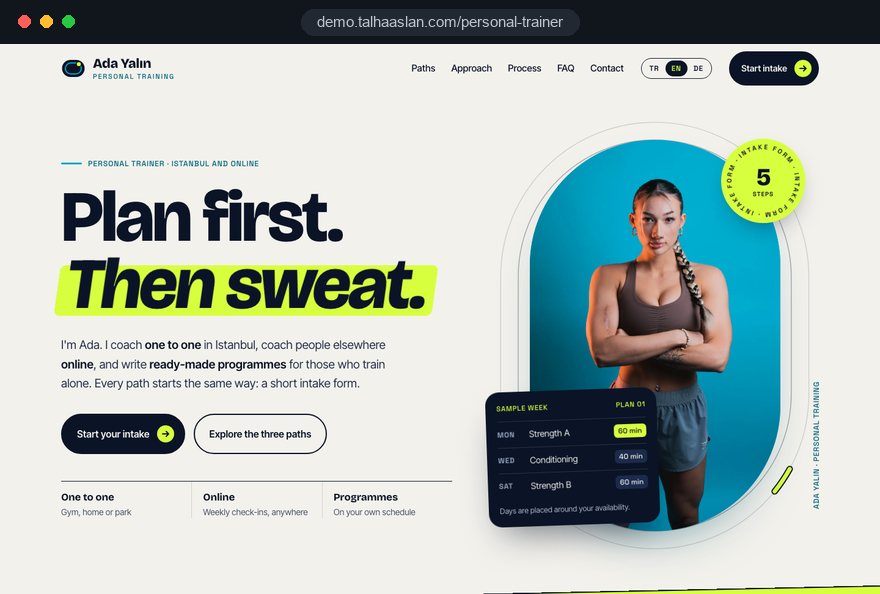
We do not yet have a live client project for a personal trainer to show, so we explain our approach on a live demo site. The demo is our own showcase, not a client. Our other client work is on the references page.
Live demo
For this field we built a one page demo site for a fictional brand, made only to show our approach. You can explore the design, the copy structure and the mobile view live in three languages.
Open the live demoBefore design starts, we write down your one-to-one, online and programme options and how sessions and delivery work; the pages are drawn from that split.
We decide with you which intake questions are truly needed and take health questions in a separate step with explicit consent; the legal review of the wording stays with your adviser.
We require written client permission for transformation stories, with the timeframe and conditions stated; images with no clear source are not used.
We write your profile and service copy with you, use real training photos, and nothing goes live without your approval.
Related pages
Industries
A separate setup for gyms built around memberships and a class timetable.
Industries
For studios running capacity based group classes and class packs.
Solutions
Let clients pick a one-to-one session time from your calendar.
Industries
For dietitians offering nutrition advice as a profession of its own.
 Why Is My Instagram Ranking Above My Website on Google? How to Win Back Your Brand SearchRead article
 How to Choose a Payment Gateway: What to Check Before You SignRead article
 Turkey Advertising Regulation Changes: What Foreign Brands Need to KnowRead article
 How to Write an About Us Page: Structure, Trust Signals, E-E-A-T and a Free TemplateRead article
FAQ
If your question is not here, write to us; we will send you an answer and a written quote.
Next step
In a free 15 minute call, in English, we will go through how you work, your programmes and how new clients find you, then send a written scope and quote.
In-depth guide
An independent trainer's website is not a small gym website. What you sell is yourself, your hours and your method. That is why the quality of a personal trainer website depends less on visual style and more on making the right decisions in the right order.
This guide walks through those decisions one by one: your working model, your profile, the intake form and health questions, online coaching, program sales, client stories, search and measurement. Each section gives you a checklist, a step or a question to act on.
The first fact that shapes a personal trainer website is how many in person sessions you can deliver each week and how many online clients you can coach at once. A single trainer's capacity is limited, and a site built without knowing that limit either wastes enquiries or promises more than you can deliver.
Before the first planning call, write down your answers to these questions:
These answers change the main goal of the site. A trainer with full hours should steer visitors to online coaching or a program; one with empty slots should aim for a discovery call. Plan from the start what happens when you are fully booked: the form should switch to a waiting list so a new enquiry does not feel turned away.
The first screen of the home page has to answer three questions: who you are, who you work with and what to do next. Because the brand is your own name, a real photo of you and a one sentence description of how you work do more than any slogan.
The profile page is where people decide, and it should cover:
Keep wording that suggests medical treatment out of the profile. A line like "the program that cures back pain" oversteps your profession and erodes trust; "strength training within the limits your doctor has cleared" is honest and more reassuring.
One on one training, online coaching and ready made programs answer different questions for different people, so each needs its own page. Explaining all three on one page simply moves the confusion of your DMs onto your website.
Using the same headings on every service page makes comparison easy:
Publishing package prices is a business decision; either way, the scope must be written out clearly. If you offer both in person and online work, end each page with a short pointer to the other, so a visitor who is out of town still finds the right service. Every service page should lead to the same intake form, and the form should record which page the person came from.
A clear focus brings more of the right clients than a general promise of "training for everyone", because visitors fill in the form when they recognize themselves on the page.
A practical way to find your focus is to list what your longest staying and most improved clients have in common: age range, work schedule, goal, training history. That profile becomes the one sentence on your home page and the "who it suits" block on each service page.
Saying who you are not right for matters just as much. A note such as "if you have had recent surgery, speak to your doctor first" or "we do not coach for bodybuilding competitions" filters out the wrong enquiries before they reach the form.
Nutrition needs the same clarity. Talking about general eating habits alongside a training plan is different from writing individual meal plans, and in many places the second is reserved for regulated professions, so check what applies where you work. If you offer nutrition support together with a registered dietitian, describe the partnership on the site so it is obvious who does what.
The intake form is your main tool for getting to know new clients and screening out the wrong fit, but because it asks about health it needs the most careful design. Under UK GDPR, health data is special category data, which means you need both a lawful basis and an additional condition, often explicit consent, to process it; similar rules apply across the EU.
We recommend splitting the form into two steps. The first asks for name, contact details, goals, training history, weekly availability and the service the person is interested in. The second covers injuries, surgery history, regular medication and any limits a doctor has set, and it comes with the privacy notice and an explicit consent checkbox.
Run these checks on the form:
We build the form within these limits; the legal review of the privacy and consent wording stays with your adviser. Decide in advance how long answers are kept, and make sure the privacy notice says the same.
A submitted form is not the finish line; the real conversion happens when the enquiry becomes a discovery call and then a first session. Because every step depends on you alone, automated steps save real time.
The flow we recommend:
The last step is what makes measurement meaningful. Without it, the page with the most form submissions can look like the winner even when it produces few clients. The same flow applies to enquiries that start on WhatsApp; a prefilled message shows which page the person came from, and sending them on to the form keeps health details out of chat threads.
People who buy online coaching are not buying a program file; they are buying ongoing attention, so the most important part of the online coaching page is the description of a typical week. "A tailored plan and constant support" leaves the real question open: how often, through which channel and how fast.
The page should answer these questions in concrete terms:
As your client list grows, a client area starts to pay off. When the program, exercise videos and the weekly review form sit behind a single login, PDFs and message traffic shrink, and clients can look back over previous weeks. A client area is not essential on day one, though. If you start with a handful of online clients, a structured form and an email routine may be enough.
A ready made program is the one product you can sell without using up your hours, but selling it through bank transfers and emailed PDFs creates tracking problems and disputes as volume grows. The program page, checkout and delivery should be designed together.
A good program page states who the program suits, how many weeks it runs, how many workouts per week it contains, what equipment it needs, how it is delivered and that it is not individually tailored. That last point matters; presenting a ready made program as personal coaching undercuts the value of your online coaching page.
Terms and the information required before purchase are accepted at checkout. In the UK, regulation 37 of the Consumer Contracts Regulations 2013 says the right to cancel digital content ends once supply begins, provided the client gave express consent and acknowledged losing that right, so checkout should ask for both. If you sell to clients elsewhere, confirm the local rules and your refund terms with an adviser and display them before payment.
When you launch a new program cycle, a focused program landing page is cleaner than reworking the main site: it carries only that program, the start date and the purchase step, and it closes when the cycle ends. Automatic delivery means a sale made at midnight reaches the client without waiting for you.
Client stories are the strongest trust signal on a trainer's site, but only when they are genuine, consented and given context. In the UK, CAP Code rules 3.47 and 3.50 require marketers to hold documentary evidence that a testimonial is genuine and not to use one without permission; check the endorsement rules that apply in every market you sell to.
Before publishing a story, follow these steps:
Before and after photos need the same light, angle and clothing; otherwise they show a difference in photography rather than progress. Weight loss does not have to be the only measure either. A heavier deadlift or climbing stairs without losing breath may be closer to a visitor's own goal.
Many visitors to a personal trainer website arrive from an Instagram post, on a phone, with little patience. Where your bio link points and how fast the page loads therefore matter more than the look of the home page.
Point your bio link to the service or program you are promoting that month rather than the home page. If you are rewriting your profile description, the Instagram bio generator helps you try out options.
For speed, Google's Core Web Vitals give clear targets. LCP (largest contentful paint) measures how long the largest image or text block takes to load, and a good result is 2.5 seconds or less. INP (interaction to next paint) measures how quickly the page responds to a tap, with 200 milliseconds or less counted as good. CLS (cumulative layout shift) measures how much content jumps while loading, and 0.1 or less is good. All are assessed at the 75th percentile of visits.
On trainer sites, speed usually suffers from:
You can check your current site with our mobile friendly test.
People search for a trainer in two ways: those who saw you on Instagram search your name, while new clients search an area or a service such as online coaching. The site's first job is to rank for your name; the second is for each service page to answer its own search.
For name searches, use your full name consistently in the profile page title and copy. Your name, service area, contact details and social profiles are marked up as structured data, and nothing is marked up that does not appear on the page.
If you train clients in person, a Google Business Profile helps too. Its guidelines require the business name to match your real world name without added keywords, so "Jane Smith Personal Trainer Downtown" puts the profile at risk. If you train clients at their homes or outdoors, you can register as a service area business and hide your address.
For service searches, content decides. Articles like these show up in search and answer questions before the form:
We describe the wider plan for this work on our SEO services page.
Followers and likes do not tell you which content brings in clients; the purpose of measurement is to see form submissions, call requests and program sales together with their source. That means defining conversions from the first day the site goes live.
A personal trainer site should track these events separately: intake form submissions, discovery call bookings, WhatsApp clicks, program purchases and, if you use one, waiting list signups. Each event records which page and which traffic source it came from.
To see which Instagram posts work, use separately tagged links in your bio, stories and posts. One link everywhere hides which content performs.
Set up a cookie notice and preference controls for non essential analytics and advertising cookies. In the EU and UK, consent is needed before non essential tracking, and Google requires consent mode for measurement and personalized advertising features for users in the European Economic Area.
A monthly review of these questions is enough:
Most mistakes are decisions, not technical faults, and fixing them after launch takes more effort than getting them right at the start. These are the six we see most often, each with a better alternative:
Most of them come from a site built apart from how the trainer actually works.
The right scope follows how you work today; a personal trainer website built larger than needed means more upkeep and sections that never get finished. For a trainer who only works in person, a profile, service pages, the form and booking are usually enough; for an online coach, program sales and the weekly review flow are central; a hybrid trainer needs both services tied to one form.
When evaluating a team to build it, ask:
We do not yet have a live client project in this field, so we show our approach on the live demo trainer site linked on this page. Our work in other sectors is in our references, and our overall scope is on the web design service page.
You can review fixed scope packages in our pricing section. If you would like to share how you work, which programs you sell and how new clients reach you today, get in touch; we will put together a page structure and a written quote for your situation.
Start a Project
Thanks {name}, we've received your brief. We usually reply within the same day.
What happens next?