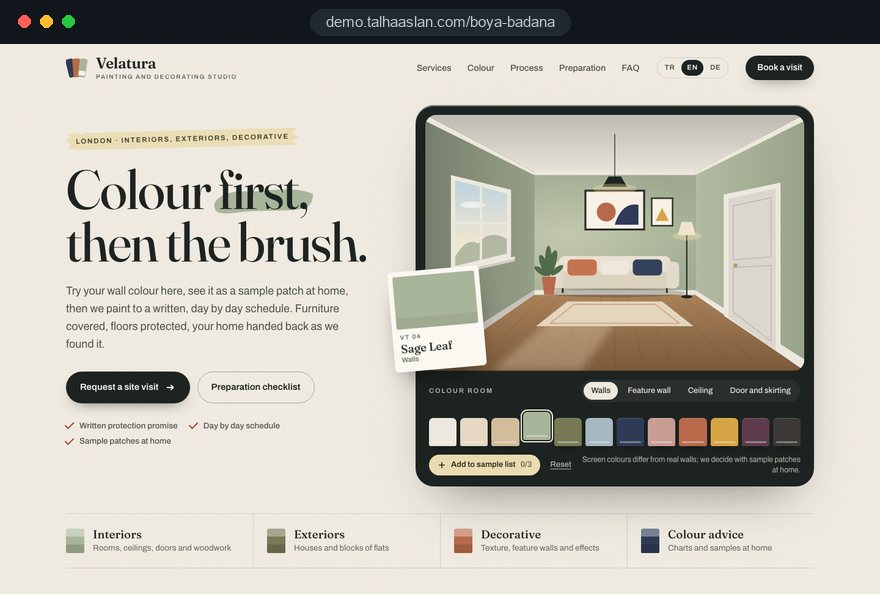
When people hire a decorator, the question that keeps them awake is rarely the price. It is the color: a shade that looked warm on the chart turns gray in a north facing living room, and they know it. A painter and decorator website earns its keep by giving that hesitant visitor the right information in the right order, until booking a survey feels like the obvious next step.
In this guide, Talha Aslan and team explain the decisions we make when planning sites for painting and decorating firms: how to present the color process, a quote form that asks for wall area rather than floor area, a schedule built on drying times, a written protection promise and an exterior pack for managing agents. Each section ends in something you can check or use this week.
01Answering color, time and mess on the first screen
The first screen on a phone should answer three worries in a few words and offer one clear action. Visitors want to see whether you do interiors or exteriors, whether you help with color and how their home will be protected; detail can wait.
Space is tight, so every element of a painter and decorator homepage needs a job:
- One line description: A heading such as "Interior, ceiling and exterior painting, with sample patches to help you choose color" that states the work and the difference in one sentence.
- Three short reassurances: Color advice, a day by day schedule and the protection promise, each a short line linking to its page.
- One main action: A "Book a survey" button, with click to call and WhatsApp beside it, but visually lighter, not three equal buttons.
- A real job photo: A finished room your own team painted, in honest light, instead of stock imagery.
A practical test: show the screen to a friend for five seconds. If they can then say what you do, that you help with color and how to book a survey, it works; if not, the usual culprits are too much text or lookalike buttons.
02Separate decision paths for interior and exterior
Interior and exterior work need separate pages because different people search for them, with different questions, on different timelines. A homeowner or tenant often decides on interior painting within days; an exterior job on a block is usually weighed by a managing agent or a homeowners' association over weeks.
When you split the pages, make sure each one carries different content on these four points:
- Who is searching: Homeowners and landlords for interiors; managing agents, residents' committees and house owners for exteriors.
- What they ask: Interiors bring questions about odor, furniture, staying at home and color; exteriors about access equipment, weather, duration and disruption for residents.
- What proof they want: Close ups of finished rooms and clean floors for interiors; building scale jobs and the order of work for exteriors.
- Which form they fill in: A room and wall form for interiors; a form asking about blocks, stories and elevations for exteriors.
Whether ceilings, woodwork, wallpaper hanging or decorative finishes deserve their own page depends on demand: if people have asked for that work specifically in recent months, write a short page; otherwise a paragraph on the interior page avoids thin pages that copy each other.
Close each page with a short bridge to the other: a homeowner having their flat painted may also sit on the residents' committee, and one line pointing to the managing agent form catches that second inquiry.
03Making the color decision easier on the site
A decorator who answers the color question meets customers before they start comparing quotes, so we recommend a section that walks through your color process step by step. The real fear behind every hesitation is choosing wrong and repainting the whole room.
Describe the process you actually follow on site, in order. A typical sequence looks like this:
- During the survey, note which way the room faces, how much light it gets during the day and the tone of floors and furniture.
- Bring the color chart to the home so the customer sees shades in their own light, against their own walls.
- Paint sample patches of two or three shortlisted colors on different walls.
- Let the customer look at the patches in morning and evening light, then record the choice in writing with the manufacturer's color reference.
- Carry that reference into the schedule and the materials order.
Say plainly on the site that screen colors never match the wall exactly. That honesty prevents disappointment and turns the sample patch into a meaningful step rather than an extra. When you pick the accent color for your own website, the HTML color codes tool is handy for testing codes; when advising customers on walls, use the chart name and number, not a screen code.
Base any room by room suggestions on light and use: how a pale, warm tone behaves in a dark hallway, or why a washable finish suits a child's bedroom.
04Gallery photos: true color and fast loading
In a decorating gallery, color accuracy matters more than a pretty picture; a filtered photo or a skewed white balance sells a shade the customer will never see on their wall. The gallery is also the heaviest part of the site, so accuracy and speed have to be planned together.
Rules your team can follow even with a phone camera:
- Light: Shoot in daylight with ceiling lights off where possible; mixed light shifts color.
- No filters: Turn off beauty modes and filters in the camera app.
- Same angle: Take before and after shots from the same spot and height.
- Color details: Caption each photo with the chart name of the shade and the direction the room faces.
- Detail shots: Add close ups of cutting in at the ceiling line, corners and around sockets next to the wide view.
On speed, images are resized to the size they are displayed at and converted to a light format such as WebP. Google treats LCP, which measures when the main content has loaded, as good at 2.5 seconds or less, and CLS, which measures how much elements jump while the page loads, as good at 0.1 or less. Declaring image dimensions in the gallery prevents that jumping. You can see how your current site behaves on a phone with our mobile friendly test in a few minutes.
05A quote form that asks for wall area, not floor area
The quote form should ask what your estimator checks first on a survey; otherwise you end up driving to every inquiry. The most common mistake is asking for floor area, when paint goes on walls and ceilings; the paintable surface of two homes with the same floor area varies widely with ceiling height, room count, doors and windows.
We split the form into three short steps:
- Type of work: Interior, exterior or both; empty or furnished; ceilings included or not.
- The space: Number of rooms, approximate ceiling height, and whether doors, frames and skirting boards are included.
- Wall condition and timing: Damp patches, cracks, flaking or old wallpaper; preferred start date and whether the household will stay in; optional photos.
Add one line explaining why each field is there; a note such as "Ceiling height tells us how much paint and what access equipment we need" reduces drop off. Customers mix feet and meters, so a unit converter is useful when you set up the fields and check their answers. If your estimator prices by room, we build the form around rooms; if by area, around wall measurements. Finish by stating when and through which channel you will reply.
06Photo surveys and personal data
Asking customers for wall photos lets you give a rough figure on small jobs without a visit and arrive prepared for larger ones. For that to work, you need to tell people exactly what to photograph.
Add a short brief next to the upload field:
- One wide shot of the whole room, taken from the doorway.
- A close up from about a hand's width away of any damp patch, crack or blistering.
- The corner where ceiling meets wall, and the area under the window.
- For exteriors, a view of the building from across the street and a close up of the problem area.
Photos taken inside a home can show people, family pictures or documents; treat them as personal data. Your privacy notice should explain in plain words what you collect through the form, why, how long you keep it and who sees it. In practice: ask customers to keep people and paperwork out of the frame, say photos are used only for the quote and when they are deleted, and store them where only authorized staff can see them.
07A day by day schedule built on drying times
A schedule page answers "How many days, and can we stay at home?" without a phone call; when that question goes unanswered, the decision gets postponed. Write it from a real job your team did, not from a general estimate.
For a typical interior job, the skeleton can look like this; take the durations from your own jobs and from the drying and recoat times on the technical data sheet of the paint you use:
- Furniture moved to the middle of the room and covered; floors and sockets protected.
- Filling cracks, sanding and removing the dust.
- Priming or mist coat and drying time.
- First and second coat, with the wait between coats.
- Touch ups, furniture back in place and the final clean.
Under the schedule, add two practical notes. First, which room must be cleared on which day, so a family can leave the bedroom for last and stay in. Second, what can change the plan: unexpected damp, extra filling or a delayed color decision. That openness prevents arguments when a job runs longer. For exteriors, also explain how customers are told when rain or temperature stops the work.
08Putting the protection promise in writing
Writing down the protection promise you usually give on the phone builds trust, but only write steps you really carry out. In the UK, the Consumer Rights Act 2015 requires every service to be performed with reasonable care and skill (section 49), and information a trader gives about the service, spoken or written, is treated as a term of the contract where the customer takes it into account (section 50).
So instead of a general "we work clean" line, sit down with your team and list what happens on site. A written protection page usually covers:
- Furniture: How it is moved and what it is covered with; what happens with items that cannot be moved.
- Floors: How carpet, wood or tiles are protected and with what.
- Sockets and fittings: Whether faceplates are removed or masked.
- Daily tidy: Where materials are stored overnight and whether a usable living area is left each evening.
- Final clean: The scope: paint marks only, or a general clean as well.
- If something goes wrong: Whom the customer contacts about a mark or damage, and how.
Before publishing, read the page with your lead decorator and ask of each line: do we do this on every job. Remove anything that is not routine or state when it applies. Have your terms checked by your own adviser.
09Being honest about paint and materials
Clear information about the paint you use speeds up decisions, especially for families with children or pets. Their questions are usually less about brands and more about odor, washability and when a room can be used again.
In the materials section, answer these questions in plain language:
- Where you use water based paint, where you use something else, and why.
- Whether you offer washable or moisture resistant finishes for kitchens, bathrooms and children's rooms.
- How long the smell lasts and when the room can be used, based on the manufacturer's technical information.
- How you handle a customer who wants to supply their own paint.
Avoid absolute wording such as "odorless" or "completely harmless" unless the product's technical documents say so, and never list brands you do not use as a badge of quality. If we name products, we only name brands you actually use. A line such as "We share the technical data sheets of our products during the survey" reassures more than a row of logos.
The materials section can also explain quality. A customer holding two quotes for the same room rarely knows the gap usually comes from paint grade, number of coats and preparation time. When a painter and decorator explains that calmly, customers start comparing what is in a quote, not just the total.
10An exterior pack for managing agents
On exterior jobs, the person reading your site rarely decides alone; a managing agent needs a summary they can take to a meeting. That is why we recommend adding a downloadable or printable scope summary to the exterior page.
The summary should answer what the board or the residents will ask:
- Scope: Facade cleaning, crack repair, primer and number of coats; whether roof or insulation work is quoted separately.
- Access and safety: How scaffolding or other access is set up and how entrances and parking are affected.
- Season: Which months you work on exteriors and how you pause for rain or cold.
- Impact on residents: Which days windows stay closed and when balconies need clearing.
The managing agent form should ask different questions from the homeowner form: number of blocks and stories, number of elevations, the meeting date and the role of the person inquiring. The meeting date tells you how much time you have to prepare the quote. Exterior painting and roof repair often come up in the same meeting, so our page on websites for roofing companies may give you ideas. If you show reference buildings, name only those whose management has agreed.
11Service area and Google Business Profile
A painter and decorator almost always travels to the customer, so set up your Google Business Profile as a service area business and keep it consistent with the areas listed on the site. Google allows service area businesses to hide their address; if you do not receive customers at your premises, not showing it is within the rules.
Keep profile and site aligned with these steps:
- Use your real business name as it appears on your van and invoices; Google's guidelines do not allow added keywords such as "cheap", "exterior painting" or a town name.
- Limit the service area to the towns and districts you actually cover and use the same list on the site.
- Add photos of finished jobs regularly, following the same color rules as the gallery.
- When asking for a review, invite the customer to mention something specific, such as how the home was protected; that is what the next customer wants to read.
If you are thinking about town pages, only create one where you have something original to say: real jobs there, the housing types you meet, typical exterior problems. Pages where only the town name changes do more harm than good in search. In our SEO work we balance local search and technical foundations page by page.
12Measuring by season and tuning ads
Demand for decorating shifts with the seasons, so without measuring which page brings surveys in which months, it is hard to spend an ad budget well. Exterior demand follows the weather while interior work runs all year; your measurement should make that difference visible.
Set tracking up on launch day and record these events separately:
- Each step of the quote form, and where people abandon it.
- Click to call and WhatsApp taps, together with the page they came from.
- Managing agent inquiries, kept apart from homeowner inquiries.
- Visitors who read the color advice section and then request a survey.
If you run Google Ads, create separate interior and exterior campaigns and send each ad to its own page. Quality Score has three components, expected click through rate, ad relevance and landing page experience; sending exterior searches to the interior page weakens two of them. Google describes Quality Score as a diagnostic tool, not a direct auction input, but a low score tells you page and search do not match.
Before raising spend ahead of the busy season, look at last year's form and call data. In the EU, cookie consent is needed before non essential tracking; check the rules where you work and plan the consent banner together with tracking.
13Common mistakes on decorators' websites, and what to do instead
Most mistakes we see on painter and decorator sites come not from design but from not anticipating the customer's question. These are the most frequent, each with the better alternative:
- Filtered gallery: Boosted colors create expectations the wall cannot meet; use unfiltered daylight photos captioned with the chart name instead.
- Floor area form: "How many square feet" does not give you wall surface; ask for rooms, ceiling height and whether ceilings are included.
- One page for everything: A flat interior and a block exterior on one page are weak for both searches; build two pages and two forms.
- Vague timing: "Quick turnaround" tells the customer nothing; publish a real schedule showing steps and drying waits.
- Promises not kept on site: Advertising protection steps the team skips is a risk; publish only steps your lead decorator has confirmed.
- Selling on screen color: Showing a palette and expecting people to choose from a screen leads to disappointment; present the sample patch as the decision step.
Checking your current site against these six points shows where you lose inquiries before you decide on a new build.
14Choosing a web partner and your next step
When choosing who will build your painter and decorator website, look less at design samples and more at how many questions they ask about your work. A team that does not ask about your survey process, your color advice and your protection steps in the first conversation will most likely install a generic trades template.
Questions worth asking any agency:
- Will you build the quote form around how my estimator measures, or use a stock form.
- How will you keep gallery colors accurate while keeping the pages fast.
- Who writes the protection promise, and how is it checked against what we do on site.
- Will form, call and WhatsApp tracking be live on launch day, and who reads the reports.
- Who makes the changes before each busy season once the site is live.
We do not yet have a live client project in painting and decorating, so we show our approach on the live demo linked on this page; you can see our work in other sectors on our references page. Our overall approach is described on our web design service page.
Fixed scope packages are listed in the pricing section of our web design page, and you can get in touch with us to talk through your interior and exterior mix, your survey questions and your protection promise. All we need from a painter and decorator is a clear picture of how you work today; we build the page structure and a written quote on that.