A pile of photos, no projects
Hundreds of images sit in one mixed gallery. Visitors cannot follow a kitchen project from start to finish, cannot tell which photo belongs to which home, and never learn what the problem was or how you solved it.

Your Windows contrast theme is on; colours come from your system.
Your device is set to reduce motion; animations are already off.
Your choices are saved in this browser only.
Industry-specific web design
People choose an interior designer by looking at the work: the room before, the decisions made, the finished space. We build interior design websites around project stories, a clearly written scope of work and a consultation enquiry, for studios in the UK and elsewhere working with a remote team, and we fit a shop into the same site if you sell furniture or accessories.
In short
An interior designer website shows projects by room and style, tells each one as a before and after story, states exactly what you take on and leads visitors to a consultation enquiry. If the studio sells products, the shop runs on the same site; in the UK, made to measure pieces fall outside the usual 14 day cancellation right, and the shop is planned with that in mind.
Talha Aslan and teamLast updated:
Why it needs its own approach
Clients discover an interior designer through images, but they decide once they understand the process. Most off the shelf portfolio themes show photos and stop there; they do not explain the story, the scope or the next step.
Hundreds of images sit in one mixed gallery. Visitors cannot follow a kitchen project from start to finish, cannot tell which photo belongs to which home, and never learn what the problem was or how you solved it.
However beautiful the finished room, your work is invisible if the starting point and the decisions are missing. Visitors cannot tell whether it was styling or a full replanning of the space.
There is only a phone number. Clients do not know where to describe the property, the rooms involved or the timeline, so the first messages always repeat the same questions.
Studios that also sell pieces put products and projects in the same menu. A shop that ignores the difference between stock items and made to measure pieces, and the cancellation rules that follow, invites disputes later.
The site does not say whether you offer advice, full design drawings or turnkey delivery. In the UK, the word architect is protected under the Architects Act 1997, so wording such as interior architect needs care unless an ARB registered architect is behind the work.
High resolution project photos are uploaded uncompressed. On a phone the gallery loads late, and visitors leave before they see your strongest work.
Sources: Architects Registration Board: use of the title architect
Our approach
We do not build an interior design website like a photo album; we build it in the order clients make decisions. First they see your style, then they read one project from start to finish, and finally they ask for a consultation about their own space. That is why every project has its own page, every service has a clear scope and every page ends in the same enquiry.
If you sell pieces, we build the shop apart from the projects but in the same design language and plan the details on the e-commerce side; if showing a curated range without checkout is enough, a catalogue structure is the lighter route. For campaigns, a single-goal landing page can go live without disturbing the main site.
Design, development and content sit in one team, so gallery, shop and forms are not patched together later. Talha Aslan sets the strategy and an experienced team handles delivery. We work remotely and in English with studios abroad, and studios in Istanbul can meet us in person.
Home
Every project page is proof of a style, and all of them lead into the same enquiry.
The right setup
All three start from the same foundation; whether you sell and how much of the work is delivery make the difference.
Design led
Clients look for the designer's signature, so the site is built on style and project stories.
Projects and shop
One brand takes on projects and sells pieces; each flow feeds the other.
Delivery
Clients care less about drawings than about getting it finished; the site puts process and team first.
Built for interior designers
These are the points studios decide on most often when we plan an interior design site together.
For each project: what the space needed, the design decisions, the materials and the finished result. Photos of private homes are published with the owner's permission and without addresses or personal belongings in view.
The old and new state, ideally shot from the same angle, side by side or as a slider, with short notes explaining what changed and why.
Design consultation, full design and drawings, sourcing, site supervision or turnkey delivery: what you do, and what is not included, is written out plainly.
A short form asking for property type, rooms involved, location and preferred start date; WhatsApp and click to call on every page, with enquiries measured by source.
Stock items and made to measure pieces are shown separately. Under regulation 28(1)(b) of the UK Consumer Contracts Regulations 2013, goods made to the consumer's specifications or clearly personalised are excluded from the cancellation rules; we structure product pages and terms around that split, and the final legal check belongs to you.
Project photos are converted to modern formats, served at the right size for each screen and loaded as visitors scroll, so quality stays high without keeping phone users waiting.
Sources: The Consumer Contracts Regulations 2013, regulation 28, legislation.gov.uk
Comparison
| Topic | Off the shelf portfolio theme | Site built for an interior designer |
|---|---|---|
| Projects | All photos mixed in one gallery | Each project on its own page, filtered by room and style |
| Transformation | Only the finished room | Before and after, the decisions made and the materials used |
| Scope | A general about us paragraph | Advice, full design and delivery scoped separately |
| Enquiries | A phone number only | An enquiry form asking property type and rooms, plus WhatsApp |
| Shop | A separate marketplace account | A shop in the same design language, made to measure kept apart |
| Speed | Large uncompressed images | Modern formats, sized per screen, a fast gallery |
Quick check
Must haves: does your site have them?
0 of 6 in place Tick the boxes to see where your site stands.
Added as needed
We choose which of these you need together during the scoping call.
Share a few of your strongest projects, the work you take on and whether you sell pieces; we will come back with a page structure and a written quote.
Process
We define your business, your audience and the site’s one-sentence job: who it sells what to, through which action. Scope and timeline are written from that answer.
The home page and key templates come to you as designs first; no code is written before your approval. We do not like surprises, and we do not cause them.
The approved design becomes fast, secure, maintainable code. You follow progress in the CRM and see every page in a staging environment before launch.
The site goes live with analytics, Search Console and conversion tracking connected; panel training is given, first-year hosting and maintenance included.
Search and speed foundations
Clients do not only search for an interior designer; they search for kitchen design, office fit out or a designer in their town. Service pages, project pages and the Google Business Profile are built to support each other.
Project photos get meaningful file names and descriptive alt text, so images found in Google Images lead back to the project page.
The gallery is designed for phone screens first, images are compressed and Core Web Vitals are measured before launch.
Enquiry forms, calls and WhatsApp clicks are tracked as conversions from day one, so you can see which project page brings enquiries.
Free tools
Before planning a new site, see how your current gallery loads on a phone, how heavy your images are and how your pages look when shared. The tools are free and need no sign up.
Tech SEO
Test whether a page works well on phones: viewport, font size, tap targets, a mobile screenshot and Core Web Vitals.
Image
Resize + compress photos and cut the KB; never leaves your device.
Image
Convert between JPG, PNG and WebP in one click or in batches; it detects the input format, lets you set quality and a background for transparency, and uploads nothing.
Sharing
Preview how your link looks on WhatsApp, Facebook, X, LinkedIn and Telegram, and find missing Open Graph tags and image problems.
Tech SEO
Scan any URL for title, meta description, headings, canonical, indexability and speed signals, and get an SEO score with a clear to-do list.
Conversion
Create a wa.me link with a preset message + embeddable button code.
Real projects
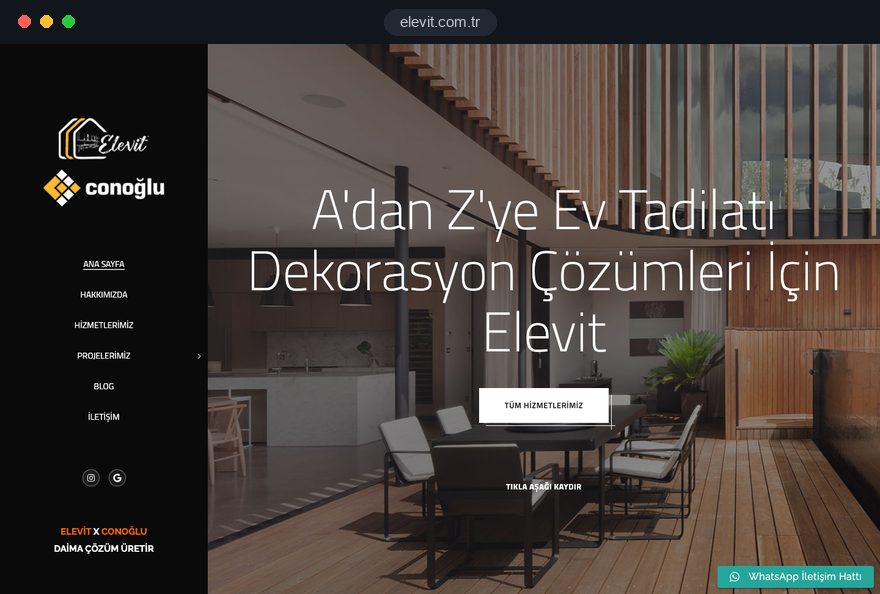
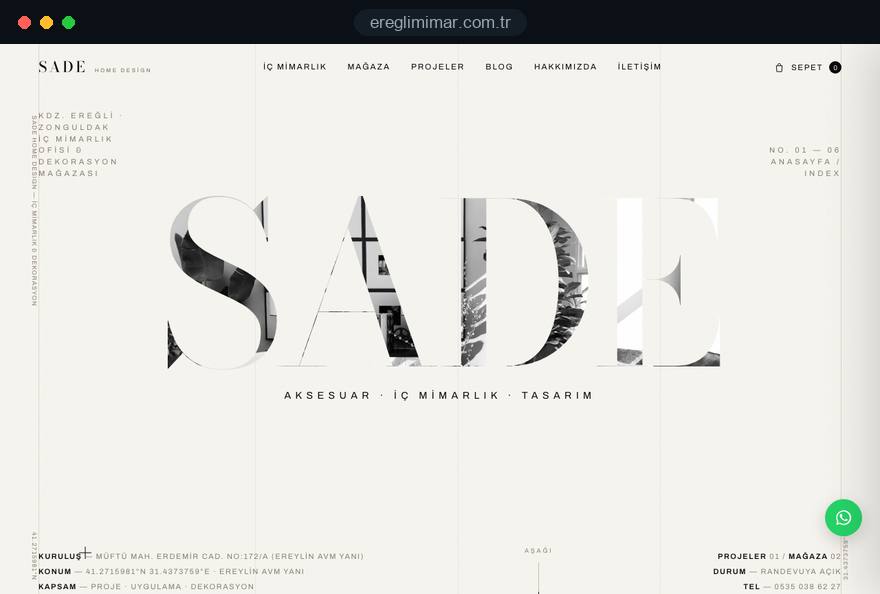
Our team designed and built these sites for firms in Turkey, and both are live. You can see more of our work on the references page.
Interior design studio and shop · web design, e-commerce, brand identity
Decoration and renovation · web design, SEO
Related pages
Industries
A separate setup for architecture practices working at building scale.
Industries
A service-led structure for renovation firms that sell delivery more than design.
Solutions
For studios that want to show furniture and accessories without a checkout.
Solutions
Let clients pick a consultation or showroom slot from a calendar.
 Professional Photography for Websites: What It Adds and How It Beats Stock PhotosRead article
 How to Optimize Images for Your Website: Format, Size and SEO SettingsRead article
 What Is Minimalist Web Design? How Simple Design Creates More ImpactRead article
 Lead Form Design for Booking, Quote and Demo Requests: UX Rules That Lift ConversionsRead article
FAQ
If your question is not here, write to us; we will send you an answer and a written quote.
Next step
In a free 15-minute call, in English, we will go through your projects, your scope of work and any plans to sell pieces, then send a written scope and quote.
In-depth guide
For an interior design studio, the website is the presentation that happens before the first call. A prospective client looks at two or three projects, tries to understand how you work and decides whether their own space is worth a conversation with you. What makes that decision easy is not the number of photos, but the order in which they are shown and the information around them.
In this guide, Talha Aslan and team walk through the decisions we make, in sequence, when planning sites for independent interior designers, studios with a shop and turnkey fit out firms. Each section gives you a criterion you can check on your current site today, a step you can take with your team or a question to put to any agency you are considering.
The first decision for an interior design website is not the palette or the typeface; it is which work you are actually selling. An independent designer offering consultations and a firm that takes a project from drawings to handover do not speak to the same client. One sells a signature, the other sells a finished space delivered on schedule.
A practical way to clarify this is to lay out the projects you accepted and the enquiries you turned down over the last year. The declined enquiries show which visitors the site should gently filter out. If you do not take single room styling jobs, saying so plainly changes the quality of the enquiries you receive.
Once these four answers exist, the menu, the home page headline and the questions on the enquiry form follow naturally. Replace a line any studio could use, such as "spaces that inspire", with something specific, for example "residential and boutique office interiors, from concept to installation".
Clients want to know who they are trusting with their home or business, so titles and credentials are the foundation of trust on the site. The goal is verifiable information, not an ornate biography.
In the UK, the title architect is protected under section 20 of the Architects Act 1997 and can only be used in business by someone on the register of the Architects Registration Board. That is why we use wording that matches your actual registration, usually interior designer, and avoid "interior architect" unless an ARB registered architect stands behind the work. Elsewhere, check the title rules with your professional body before launch; many countries treat design titles differently.
The portrait on the studio page is part of this trust as well. A simple photo of the designer in their own workspace, instead of a stock image, shows visitors who they will be speaking to and makes the first call easier to start.
The strength of an interior design site comes from how well each project is documented, not from how many are published. A few strong projects earn more trust than hundreds of mixed images.
Filter every candidate project with three questions: does it resemble the client I want to reach, do I have photos of the space before work began, and was the finished space professionally photographed. A project that fails two of the three can wait for a later update. For projects still underway, plan the shoot before handover, when the styling is in place and the owner has not yet moved in their own belongings.
The project page is the only place where a visitor can follow a piece of work from start to finish, so it is built as a short case study rather than an album. The reading order should follow the order of questions in the client's head.
At the top, a single line gives the property type, approximate size, location and the scope you delivered. Next comes the problem: a dark living room, an unused hallway, a kitchen without enough storage. Then the decisions you made and the reasoning behind them. The material and color palette, the finished photographs and a link to the matching service page complete the sequence.
This structure turns every project into evidence for a service and answers the question every visitor has: can this studio solve a problem like mine. Keep the text lean. Around 200 to 400 words spread between the images gets read; the same words in one long block above the gallery get skipped.
Before and after comparisons show your contribution more clearly than anything else on an interior design site, but they only build trust when they are honest. Two frames taken from different positions, in different light or in a different season exaggerate the change, and attentive visitors notice.
The problem we see most often is 3D visualizations presented as if they were photographs. Mixing renders and photos of finished rooms in the same gallery can set expectations that the real space never meets. If you use visualizations, label them clearly under the image. A stronger approach is to place the render next to the finished photo, which shows how faithfully the design was delivered on site.
If you have no photo of the original state, do not try to hide it; showing the original floor plan or a short written description is far more convincing than a staged comparison.
Filters let visitors find work similar to their own space within seconds, but too many filters make a gallery feel like a tax form. That is why we start with a short, controlled list of tags.
Three filter dimensions work well for interior designers: property type (home, office, retail, hospitality), room (kitchen, bathroom, living room, bedroom) and style. Choose style tags carefully; two labels as close as "modern" and "contemporary" only confuse people. Giving each project one property type, a few rooms and one or two styles keeps the system tidy as the portfolio grows.
In the project list, each card needs one strong cover image, the project name and a short version of the project facts. The sort order is a decision too: the newest project is not always the strongest, so you should be able to pin featured projects by hand in the admin panel.
Try a simple test: ask a friend to find an example of "a small kitchen renovation" on your site. If it takes more than three clicks, the filters or tags need simplifying.
Most clients arrive at the first meeting without knowing exactly what an interior designer does; service pages close that gap before the call. Each service gets its own page that states what is included and, just as clearly, what is not.
A consultation page explains how many sessions are involved and what the client keeps afterward: a color and material direction, or a layout plan. A full design page lists the drawings and schedules you deliver. A turnkey page explains which work your own team handles, which is done by trades and suppliers, and how the client is kept informed during installation.
You do not have to publish fees on these pages, but explaining what the fee depends on, such as floor area, scope or number of sessions, makes the first conversation faster.
The enquiry form is the preparation for your first meeting; when it asks the right questions, the first call starts with the project instead of repeating basics. The form should stay short, but it must collect what you genuinely need.
Property type, approximate size, location, the service needed and the preferred start date are the core fields. Letting clients attach a few photos of the current space helps you judge the scale of the work before visiting. Do not make the budget question mandatory; an optional range question feels more comfortable for most people and still gives you direction.
Tell visitors what happens after they submit: how quickly you reply, whether the site visit is charged and what they should prepare. If you want clients to choose a site visit or showroom slot from a calendar themselves, a website with online booking automates that step.
If your studio also sells pieces, the shop and the project work should live under one brand but follow separate paths; otherwise both product shoppers and project clients get lost. The shop has its own place in the menu, while project pages link naturally to the products used in them.
The most important split is between stock items and made to measure pieces. Under regulation 28(1)(b) of the UK Consumer Contracts Regulations 2013, goods made to the consumer's specifications or clearly personalized are excluded from the cancellation rules. A console built to size or a sofa upholstered in the client's chosen fabric is therefore marked separately from stock items on the product page and in your terms; the final wording should be checked by your legal adviser, and studios selling into other countries need to check local rules.
We plan payment, delivery and stock as part of the e-commerce setup and build the shop in the same design language as the project pages.
The biggest technical risk on an interior design website is that your strongest work sits on your slowest page. Files from a professional shoot are often several megabytes each, and uploaded as they are, they make the gallery crawl on a phone.
Among Google's Core Web Vitals, LCP (largest contentful paint, the time it takes the biggest element on the page to load) counts as good at 2.5 seconds or less. On a project page, the largest element is almost always the cover photo, so it has to load first and at the right size. CLS (cumulative layout shift, how much content jumps while loading) should be 0.1 or less; giving every image fixed dimensions in advance prevents most of that movement.
So that none of this has to be done by hand for every new project, the admin panel should convert and resize uploaded photos automatically.
Clients rarely search only for an interior designer; they search for what they need: kitchen design, office fit out, a small living room layout or an interior designer near their town. The way to appear for those searches is a substantial page for each service, linked to the project pages that prove it.
On your Google Business Profile, the business name must match your real world name, without added keywords; adding "interior design London" to the name breaks Google's guidelines. If clients do not visit your studio, you can register as a service area business and hide the address.
Image search is an underrated channel for interior design. Files named after the space instead of "IMG_4521", and alt text that describes what is in the frame in one plain sentence, let images bring visitors back to their project page. Rather than creating thin pages for every neighborhood, mention the area within real project pages; that gives a more honest local signal.
If you serve clients abroad, we build translated project pages as a multilingual website with correct language signals. To keep this foundation growing alongside your content, our SEO work extends service and project pages on a regular schedule.
Because the enquiry form collects names, phone numbers and often photos of someone's home, it processes personal data and needs a clear privacy notice. A link to that notice should sit directly under the form, and the notice should say that uploaded photos are used only to prepare a proposal and how long they are kept.
The purpose of measurement is not to count visitors, but to see which pages produce consultation requests. Form submissions, WhatsApp clicks and phone taps are set up as separate conversions from day one. For visitors in the European Union, consent is needed before non essential tracking, and Google requires consent mode for users in the European Economic Area; studios in the UK should follow the ICO's guidance on cookies.
These numbers also tell you where to invest your next photography budget.
Most mistakes come not from carelessness but from treating the site as a photo album. These six are the ones we see most often on interior design and decoration sites that come to us for a redesign.
There is also an invisible mistake: launching the site and never adding new work. A project list that has not changed in six months makes visitors wonder whether the studio is still active. A fixed date each quarter for adding one project is the simplest habit that keeps the portfolio alive.
When choosing a team for your interior design website, ask how they will tell your projects and how you will update the site yourself before you judge their visual taste. A good looking home page can be drawn in a few days; the real work is a project template, gallery and form that stay useful for years.
If you want to see how we answer these in practice, the sites we built for interior design and decoration firms are live among our references. You can read how scope is set on our web design service page and find the fixed packages in the pricing section.
Before deciding, review your current site once against the criteria in this guide: project pages, before and after stories, scope of work, enquiry form and gallery speed. Then share a few of your strongest projects, the work you take on and whether you sell pieces through our contact page, and we will work out the page structure and a written scope together.
Start a Project
Thanks {name}, we've received your brief. We usually reply within the same day.
What happens next?