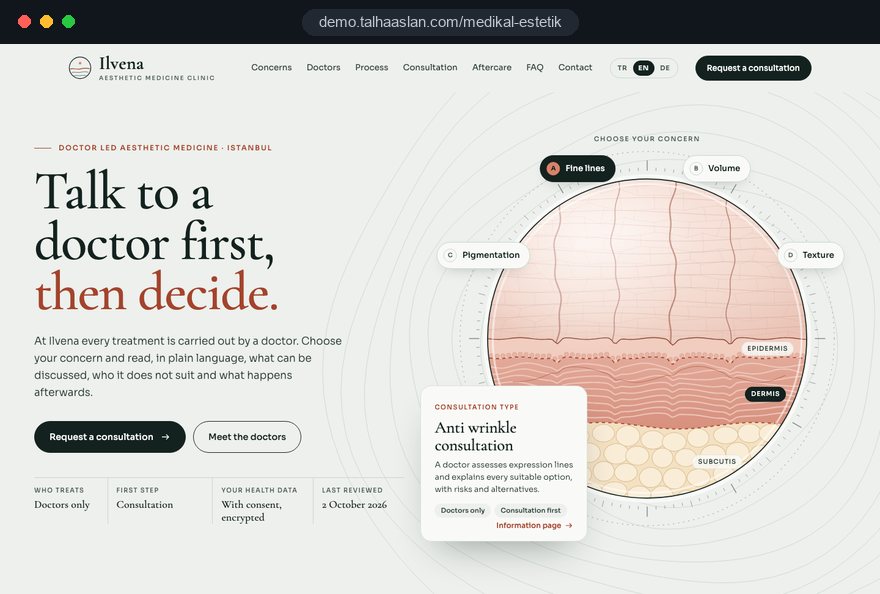
A medical aesthetics website has to explain nonsurgical, prescriber led treatments without sliding into either of two bad habits: the offer driven tone of a beauty salon, or the empty service list of a hospital. The visitor usually arrives from a social media video with three questions: who will treat me, is this suitable for me, and what happens afterwards.
This guide walks through the decisions a clinic or medspa makes in order: the treatment inventory, page structure, clinician titles, images, the consultation form, review reminders, audience rules, search and measurement. Where we refer to rules, we use UK sources: the Human Medicines Regulations 2012, the CAP Code and ASA guidance on cosmetic interventions, and UK GDPR. Clinics elsewhere should check the equivalent rules with their own advisers.
01Separate prescriber led treatments from beauty services
The first decision is which services the site presents as medical treatments and which as beauty or skincare services. Anything involving injections, prescription medicines or medical devices belongs in a section where every page names the clinician responsible, the consultation step and the aftercare.
Many medspas also offer facials, massage or nail care that need no prescriber. When both sit in one menu, the warm, promotional voice of the beauty side leaks into medical pages, and offers end up next to treatments that may not be promoted that way. If you want the beauty side planned properly, our guide to beauty salon websites covers it; here we focus on the medical side.
- Medical section: treatment pages linked to clinician profiles, a consultation request and aftercare information.
- Beauty section: its own menu heading, its own contact route and plain service descriptions without clinician claims.
- Shared areas: contact, privacy notice, clinic photos and directions.
- Borderline services: for treatments such as chemical peels, agree with your medical director which section they belong to before design starts.
Writing this split down before design makes every later decision easier: which pages show a clinician name, which form asks health questions, and where the consultation button appears. It also gives your team one clear answer when a new service is added.
02Build the treatment inventory with your prescriber
The structure of a medical aesthetics website comes from an honest inventory of what your clinicians actually do, not from what is trending. Creating a page for every treatment people talk about online brings the wrong enquiries and leaves a pile of content nobody has time to review.
We suggest working from a single spreadsheet. It later becomes the shared source for the pages, the consultation form and the reminder schedule.
- List every treatment the clinic performs under its clinical name, then add the everyday words patients use for it.
- Next to each treatment, note which clinician performs it and the training that supports it.
- Record when the treatment is not offered, based on the questions your prescriber asks at a first consultation.
- Mark the review appointment and repeat interval your clinicians actually advise, not an estimate.
- Group treatments by the visitor's concern: face, skin quality, hair and scalp, body areas.
Two things usually appear once the sheet is done: several treatments belong on one page, and a few should not be on the website at all. Both lead to a shorter, deeper site that is far easier to keep current.
03Name pages after the concern, not the medicine
A treatment page should be titled after the concern or the general type of treatment, never after a prescription only medicine or its brand. Regulation 284 of the Human Medicines Regulations 2012 prohibits publishing an advertisement likely to lead to the use of a prescription only medicine, and the ASA has issued an enforcement notice on exactly this kind of promotion.
In practice this changes the whole sitemap. Instead of a page named after a product, you publish pages such as "frown lines between the eyebrows" or "nonsurgical options for skin laxity", and the page explains that suitability and any medicine are decided at a consultation with a prescriber. Visitors search for what they see in the mirror anyway, not for a product catalog.
- Titles and URLs: the concern or area, never a medicine or device brand.
- Body text: describe the consultation and the concern; agree any reference to a medicine with your clinical team and advisers.
- Images: no photos where packaging, vials or brand logos are visible.
- Offers: no discounts, bundles or time limited deals attached to treatments that involve a prescription only medicine.
The same rule applies to everything that points to the site: social posts, search snippets and the clinic's listing names. A compliant website loses its value if the post linking to it names the medicine.
04Anatomy of a skin quality treatment page
A strong treatment page answers the questions a patient would ask the clinician, in the order they would ask them, and ends by preparing them for a consultation. Take a page on "injectable treatments to improve skin quality"; the same skeleton fits every other treatment page on a medical aesthetics site.
- What it is: two or three sentences, explaining any clinical term once, covering what the treatment does and does not do.
- Who treats you: the clinician's name with a link to their profile.
- Who it is not suitable for: pregnancy, certain medicines or skin conditions, as approved by your prescriber.
- On the day: how long it takes and what to avoid in the first hours.
- Possible side effects: common ones, and separately, the signs that mean the patient should call the clinic straight away.
- Review and repeat: the review appointment and repeat interval your clinicians advise.
Every page carries a last reviewed date and the name of the clinician responsible for its content. That small line does more for trust than any adjective and forces a regular review.
The button at the end reads "request a consultation", not "book now". It invites a conversation with a prescriber rather than a purchase, which matches how the treatment is actually decided.
05Clinician profiles: registration and careful titles
In medical aesthetics, the clinician profile is the page that earns trust, and it is also where wording mistakes cluster. ASA guidance on cosmetic interventions addresses when a doctor may describe themselves as a surgeon and how words such as qualified, specialist or leading are used, so titles need care.
The safe pattern is to separate the professional title from the training record. The title states the profession and registration; the training sits below as a dated list, never merged into a grander title.
- Avoid: "Dr Sarah Jones, Leading Aesthetic Specialist" or "Master Injector".
- Prefer: "Dr Sarah Jones, GMC registered doctor" with the registration number, or "Emma Clark, NMC registered nurse prescriber" with hers.
- Training: course name, provider and year, written as a training record, not a title.
- Treatments: a list of the treatment pages this clinician is responsible for.
A short section in the clinician's own words, describing how they approach a first consultation, is read far more than the certificates. We gather it in a brief interview and send the draft back for approval. The names above are only illustrations.
06Before and after images: an evidence and consent log
Image decisions are an ongoing record keeping process, not a one time design choice. ASA guidance on cosmetic interventions names exaggerated or unrealistic claims, including those made through before and after images, as a core problem; a photo is itself a claim, and it has to be genuine and representative.
For injectables the visible difference is often subtle enough that lighting alone can change it. If you use patient images at all, a log behind the gallery is what keeps it defensible.
- Record written consent for each image, including where it will be shown and how the patient can withdraw it.
- Shoot before and after under the same light, angle and distance, and record both dates.
- Publish without filters, retouching or makeup that was not present in the original setting.
- Choose images that reflect typical outcomes for that clinician, not the single strongest case.
- Name the person who removes an image from the site and social accounts when consent is withdrawn.
Many clinics decide the stronger route is a gallery of the clinic, the treatment rooms and the clinicians themselves. Whichever you choose, check the final gallery against your professional body's guidance or with a legal adviser before launch.
07Rewrite promotional copy as patient information
Copy is the part of a medical aesthetics site we edit most, because habits from social media collide with the rules on promoting cosmetic interventions. The aim is calm, factual information that lets a visitor decide whether a consultation is worth their time.
We work from a list of phrases and their replacements. The pattern is always the same: remove the pressure, keep the information.
- Instead of "summer glow offer": a clinician's note on why some treatments are scheduled around sun exposure.
- Instead of "permanent, natural results": a sentence that says effects fade over time and vary from person to person.
- Instead of "the most advanced device": a plain description of what the device does, without comparisons.
- Instead of "only three slots left": the normal waiting time for a consultation.
- Instead of a wall of hand picked reviews: a link to an independent review platform, checked so that nothing quoted names a prescription only medicine.
The same wording rules apply to the clinic's social accounts and to clinicians' personal accounts that mention the clinic. A careful website loses its point when the linked post says the opposite. A readability checker helps confirm that the rewritten pages are as easy to follow as the promotional versions they replace.
08Design the consultation form around health data
The consultation form is the most sensitive part of a medical aesthetics website, because facial photos, medication and allergies are health data. Under UK GDPR, data concerning health is special category data, which needs a lawful basis plus an additional condition and extra protection.
The principle is to collect only what the clinician needs before the first conversation. Every extra question raises both the risk and the chance the visitor gives up halfway.
- Step one asks only for name, contact details, the area of concern and the preferred contact channel.
- Health questions and photos sit in an optional second step with their own explicit consent.
- Photos upload over an encrypted connection, never become e-mail attachments, and live in a panel only authorized staff can open.
- The panel logs who opened each record, and records are deleted when the retention period ends.
- The confirmation explains that a clinician will be in touch and that a request is not a commitment to treatment.
Phrase the questions around concerns rather than products. "What bothers you most" gives the prescriber a better starting point than "which treatment do you want", and it keeps visitors from self prescribing. If visitors should pick a time themselves, the form can connect to a booking system tied to each clinician's calendar. Finalize the privacy notice and consent wording with your data protection adviser.
09Write review and repeat cycles, then remind with consent
Most medical aesthetics treatments are not one off; effects fade and clinicians advise reviews or repeats at set intervals. A clinic that never writes this cycle down answers the same phone questions every week, and patients arrive with the wrong idea about how long results last.
A timeline is a road map, not a promise. Instead of "lasts for years", write the first days, the review appointment and the repeat assessment as separate steps, and say plainly that timings vary. The consent conversation itself happens with the clinician at the clinic; a preparation page helps the patient arrive with their medication list and questions.
- First day and first week: what to avoid for the period your clinician specifies, expected temporary effects, and when to call the clinic.
- Review appointment: why it happens, how long it takes and what the clinician looks for before advising a repeat.
- Separate permissions: consent for aftercare reminders is never reused for newsletters or offers.
- Channel and content: the patient chooses the channel; reminders carry date, time and preparation only, with no treatment name in the notification preview.
- Opting out: every message includes a one step way to stop reminders.
Written once with your clinician, this text also feeds the printed aftercare sheet and the reminders, so clinic and site always say the same thing. Repeat intervals are presented as clinical follow up, never as a sales opportunity.
10Keep every channel away from under 18 audiences
Age is a rule for the whole funnel, not just the website. Since the November 2021 update, the CAP Code prohibits cosmetic interventions advertising from being targeted at under 18s, and that covers social posts, influencer content and the landing pages they lead to.
A website cannot verify age on its own, but it can avoid signals that attract a younger audience and make the clinic's position clear without sounding defensive. The practical work happens in the settings of every channel that sends traffic to the site.
- Audience settings: any paid social or search activity for cosmetic interventions excludes under 18 audiences, and saved audiences are checked before each campaign.
- Creative choices: no trends, sounds, characters or influencers that mainly appeal to teenagers, and no school or exam season hooks.
- Clinic policy: a clear statement on the site that the clinic does not treat under 18s for cosmetic reasons, if that is your clinical policy.
- Consultation form: a date of birth question in step one, so the clinic can respond appropriately before any health data is shared.
11Search visibility built on answers and reviewed content
For a medical aesthetics clinic, search visibility comes from answering the questions patients actually type, on pages a named clinician has reviewed. People search a treatment together with a question: how long does it last, who should avoid it, can I wear makeup afterwards. Each question becomes a subheading on the relevant page.
Our SEO work for clinics focuses on that question order and on helping search engines recognize who wrote and reviewed each page. Google's quality guidelines put extra weight on authorship and review for health topics.
- Author and reviewer: each page shows the clinician who reviewed it and the last reviewed date, both marked up as structured data; test your markup with our schema markup tool.
- Speed: Google treats LCP (how fast the main content loads) of 2.5 seconds or less, INP (how fast the page responds to a tap) of 200 milliseconds or less and CLS (how much the layout shifts) of 0.1 or less as good.
- Business Profile: the name matches the clinic's real world name, with no added keywords such as treatment names.
- Snippets: page titles and meta descriptions follow the same rule as the pages and never name a prescription only medicine.
12Measure enquiries without leaking health data
Measurement should show which treatment page leads to consultation requests, not who the visitor is or what they want done. The most common technical gap on medical aesthetics sites is a form field's content being sent as an event to an analytics or advertising tag.
We keep the setup narrow from day one. What gets counted is that a request arrived, from which page and from which source; the health details in step two never reach any measurement tool.
- Events: consultation request, tap on the call button, download of the preparation sheet; the only value passed is the page address.
- URLs: the thank you page address carries no treatment name or personal detail.
- Cookies: non essential analytics runs only according to the visitor's cookie choice.
- Monthly review: requests per page, reading depth and the form step where people give up.
Review the table with your clinician once a month. A page with many readers and few requests usually means the "who it is not suitable for" or "on the day" section is not answering the visitor's real question.
13Common mistakes on medical aesthetics websites
These mistakes usually come from adapting a salon or general practice template to a medical aesthetics clinic. Each one comes with the better alternative.
- Treatment menus built on medicine names: name pages after the concern or area, and agree any reference to a medicine with your clinical team and advisers.
- Training presented as a title: state the profession and registration in the title line, and list courses separately as dated training.
- Galleries without a consent log: link every image to written consent and dates, or switch to clinic and clinician photography.
- Health questions in step one: keep step one to contact details and move health data to an optional second step with its own consent.
- Reminders mixed with offers: collect separate permissions and hide treatment names from notification previews.
- Pages left alone after launch: give each page a responsible clinician and a last reviewed date, and review them with that clinician at least once a year.
The common thread is a site written apart from the clinic's daily practice. When the inventory sheet, page skeleton and reminder plan share one source, that gap largely closes.
14Choosing a team and the next step
The team you hire for a medical aesthetics website should treat the rules, the form and the measurement as part of the same project as the design. Put these questions to any agency before asking for a quote; the answers reveal how well they know the field.
- How do you handle medicine and brand names on treatment pages and in snippets?
- How do you word clinician titles and registration details?
- Where are consultation photos stored, and who can open them?
- How do you log image consent and handle a withdrawal?
- How do you verify that no health data reaches analytics tools?
We have not yet published a clinic project in this field, so we show our approach on a live demo site linked on this page. You can see our work in other sectors in our client references and the overall scope in our web design service.
The order of work is predictable: inventory and clinician documents first, then sitemap and page skeleton, then copy and clinician approval, and finally the form, reminders and measurement. Copy approval is usually the longest step, so the time your clinician can give each week shapes the schedule more than design does.
For a first call, bring a draft of your inventory sheet, your clinicians' registration details and your current form. Fixed packages are listed in our pricing section, and for a written scope tailored to your clinic, get in touch with us.