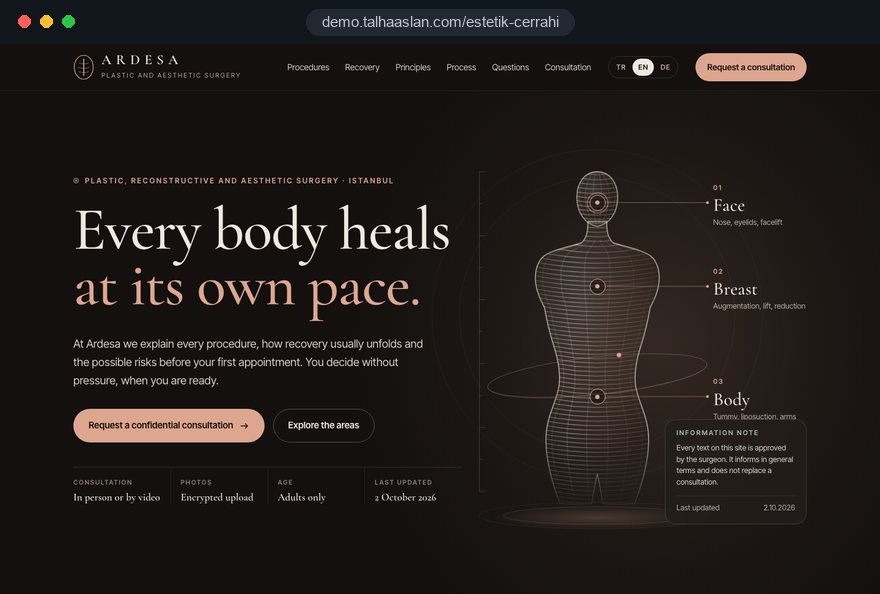
Cosmetic surgery is elective, usually considered for months and hard to undo. A cosmetic surgery website therefore has a different job from most medical sites: not to persuade, but to support a long period of thinking with honest, documented information.
This guide follows the decisions a surgeon or clinic makes when planning the site, in order, and shows how UK rules from the ASA, the CAP Code and the GMC shape each page. Every section gives you a criterion, a checklist or a question to apply.
01Turning your procedure list into a sitemap
The sitemap should come from the procedures the surgeon actually performs regularly; copying competitor menus produces thin pages that look alike. In the first call we fill in a simple three column list with the surgeon: the procedure, how often it was performed in the past year, and the questions patients ask most about it at consultation.
We use these criteria to decide whether a topic earns its own page:
- Separate decision: If patients consider the procedure on its own, such as eyelid surgery, it gets its own page rather than sharing one with a facelift.
- Separate recovery: If recovery differs clearly, as with breast augmentation and breast reduction, the two need separate pages.
- Combined procedures: Procedures that may be planned together are still explained separately, with a short subsection on when combining them is discussed.
- Reconstructive work: Burns, trauma and breast reconstruction sit in their own section with their own tone, apart from aesthetic procedures.
- Out of scope: Techniques the surgeon does not offer are not mentioned at all, even if they attract searches.
GMC guidance for doctors who offer cosmetic interventions requires published information to be factual and verifiable; a page about a technique you never perform cannot meet that standard. Leaving such techniques out keeps every page one the surgeon can stand behind.
02Anatomy of a procedure page: rhinoplasty as the example
Every procedure page should follow the same structure, so patients comparing two procedures know where to look and the surgeon reviews every text in the same order. Taking a rhinoplasty page as the example, we build it like this:
- What the operation aims to do, in two or three plain sentences with any medical term explained.
- Who it may suit, and when the surgeon may suggest waiting or not operating at all.
- What the consultation assesses, for example breathing and the internal structure of the nose as well as appearance.
- The day of surgery: arrival, type of anesthesia, roughly how the operation proceeds and whether patients go home the same day.
- The recovery timeline and follow up visits, followed directly by possible risks and how consent works.
- Frequently asked questions, the author and last reviewed date, and a single link to the consultation form.
Risks are not buried at the bottom but placed straight after recovery. People researching surgery will look for risks anyway; if your site does not explain them, a forum will.
Our team drafts the copy from what the surgeon tells patients at consultation, and the surgeon approves every paragraph. An eyelid or tummy tuck page then changes the content, not the headings.
03Who is not a candidate, and why waiting matters
The content that builds most trust on a cosmetic surgery website is the section that says plainly who a procedure may not suit. It does not reduce enquiries so much as reduce unsuitable ones, which protects the surgeon's consultation time.
Topics the surgeon may want to cover, in their own words:
- Why body contouring is usually discussed once weight has been stable, for someone still planning to lose weight.
- Why some procedures may be postponed for younger patients whose facial development is not complete.
- What the surgeon assesses before operating on smokers or people with certain chronic conditions.
- Why a patient under pressure from someone else, or rushing to be ready for an event, is given more time.
The GMC is explicit that doctors must give patients the time and information they need to reach a voluntary and informed decision, and that marketing must make clear when a medical assessment is needed before an intervention. A page that says “your surgeon will assess this at consultation” does both.
Avoid urgency anywhere on the site: no “book now”, “last slots” or countdowns. One gentle question on the first screen of the form, such as “How long have you been considering surgery?”, tells the surgeon where the patient stands before the first conversation.
04Writing the recovery timeline around real life
The recovery section should answer the practical questions patients plan their lives around, not offer a single line such as “back to normal in no time”. People want to know how much leave to book, when they can lift a child, and when they can return to the gym.
We structure the timeline by topic rather than by promised durations; the surgeon fills in timings from their own practice and adds that recovery varies from person to person:
- First days: Discharge, dressings, sleeping position, and the usual course of pain and swelling.
- Daily life: Showering, driving, returning to desk work and lifting.
- Movement: Walking, light exercise and the signs the surgeon looks for before full training resumes.
- Follow up: How often patients return for checks and how this works for those traveling from further away.
Patients arrive better prepared, and the answers the surgeon repeats every week become a written, approved source. We manage the timeline as a shared template rather than retyping it on each procedure page. When the surgeon updates a timing, the change happens in one place and the page's last reviewed date updates with it.
05Explaining risk and consent without alarm
The risk section exists so patients arrive at consultation informed, not frightened, and the way to achieve that is to group risks and describe them calmly and concretely. A long, unsorted list of complications either scares readers away or goes unread.
We group risks into four blocks: general risks of any operation, anesthesia, risks specific to this procedure, and the possibility of a further operation. Under each block, a short paragraph explains what the surgeon checks beforehand to reduce them.
The consent section explains the process; it never replaces it. GMC guidance says the doctor who will carry out the intervention must discuss it with the patient and seek consent personally, without delegating that responsibility. The page should therefore state clearly:
- That the detailed consent conversation happens at consultation, with the operating surgeon.
- That patients can read the consent form in advance, ask questions and take time before signing.
- Where and when the preparation checklist is provided, for example which medicines to report.
- Whom to contact, and through which channel, if something unexpected happens after surgery.
Two language rules apply throughout. The ASA says surgery should never be presented as safe, easy or risk free, because no surgery is without risk. And any statistic must be one the surgeon can source, since CAP Code rule 12.1 requires objective claims to be backed by evidence.
06The surgeon page: registration, training and hospitals
The surgeon page should consist of facts a patient could check: who will operate, what training they have and in which hospital the operation takes place. In cosmetic surgery this is often the deciding question.
For surgeons practicing in the UK, the ASA advises that claims such as qualified should only be made by surgeons on the GMC Specialist Register for a relevant surgical specialty, and the GMC requires doctors to be honest and never misleading about their skills, experience, qualifications and current role. Outside the UK, follow the equivalent register and title rules of your own regulator.
We build the surgeon page in this order:
- Name, registration details and specialty, written exactly as they appear on the register or certificate.
- Medical school and specialist training, with institutions and years.
- Current and previous posts, and the hospitals where the surgeon operates now.
- Publications, presentations and professional memberships, each with a verifiable source.
- A short statement of approach in the surgeon's own voice, without promises.
Hospital details are often missing, yet where the operation happens matters to patients; for several sites, a short list of which procedures take place where is enough. In a clinic with several surgeons, each one gets the same profile structure, and every procedure page links to the surgeons who perform it.
07Consultation photos of intimate areas
For breast, abdominal or genital procedures, consultation photos are the most sensitive data a patient can share, and the form has to be designed for that rather than adding an upload field to a contact form. Under UK GDPR Article 9, data concerning health is special category data and needs a valid Article 9 condition before you process it; explicit consent is one of those conditions.
We set up the flow in five steps:
- The patient first chooses the procedure of interest and the type of consultation; photos are optional and a video consultation is always offered.
- If photos help, a simple illustration shows which angles are needed and how to take them without the face in frame.
- The privacy notice and the explicit consent step come before the upload field.
- Files travel over an encrypted connection to a panel that only authorized staff can open, never to a shared inbox.
- The panel logs every access, and files are deleted automatically when the agreed retention period ends.
If the form sends an email alert, the alert says only that a new request has arrived, without photos or procedure names. And the clinic decides in writing who may view photos: reception may need contact details but not images. Agree retention periods and final wording with your data protection adviser.
08Before and after images: the evidence test
Before and after images are not banned in UK advertising, but the ASA has upheld complaints where clinics could not show that their images represented what patients could generally achieve. The first decision is therefore whether you can support each image with robust evidence; if you cannot, leave the gallery out.
If you do publish images, keep a record for every one of them:
- Consent: Written patient consent covering website use, stored with the image file and its date.
- Representativeness: A note from the surgeon on why this result reflects what patients can generally expect, not an exceptional case.
- Conditions: Matching lighting, angle and distance in both photos, with no retouching or filters.
- Context: The procedure, the time since surgery and a reminder that results vary, shown next to the image.
- Withdrawal: A simple way for the patient to withdraw consent and a process for removing the image promptly.
Other markets are stricter. Germany restricts comparative before and after images for cosmetic surgery, and Turkey allows them only with written consent, dates and a mandatory warning. If the site has language versions for patients from those countries, the stricter rule should shape the gallery. For most clinics we recommend starting without a gallery, and checking any image decision with your legal adviser before launch.
09Copy that informs: claims, urgency, prizes and audience
Copy on a cosmetic surgery site should inform rather than sell, and most problems appear in the overall framing of a page rather than in single words. Before launch we check every page against these questions, taken from the CAP Code, ASA rulings and GMC guidance.
- Evidence: Can every objective claim, about results, technique or recovery time, be supported? If not, it is removed.
- Urgency: Is there a seasonal sale, countdown or limited time offer? The ASA has ruled against cosmetic surgery ads that created urgency around Black Friday.
- Prizes: Is surgery offered as a prize or in a giveaway? GMC guidance says doctors must not provide their services as a prize.
- Audience: Could the imagery, tone or placement appeal mainly to teenagers? CAP Code rule 12.25 says cosmetic intervention ads must not be directed at under 18s through the selection of media or context.
- Results: Does any line suggest a certain result? The GMC says doctors must not mislead about likely results or imply results are certain.
Repeat the check for every update. The GMC also says doctors must not knowingly allow others to misrepresent them, so agency drafts still need the surgeon's review; the final judgment stays with the clinic.
10Aftercare pages and out of hours contact
Much of what a patient needs from the site begins after surgery: care instructions, follow up dates and who to call if something feels wrong at night. This section protects the trust of existing patients and spares the clinic phone many routine calls.
We build the aftercare area from these parts:
- A printable care guide for each procedure covering dressings, compression garments, showering and sleeping.
- A short “when to call us straight away” list, using the warning signs the surgeon defines.
- Contact channels during and outside opening hours, with how quickly each one is answered.
- A separate, short form for follow up appointments that never mixes with first enquiries.
These guides are the surgeon's own instructions, not generic search articles; each is updated when the surgeon changes it and shows its author and last reviewed date. The same guide can be handed to the patient in print at discharge.
A logged in patient portal is rarely needed at first. We suggest publishing the guides as open pages, then moving to a patient management tool when volume and follow up needs grow.
11Search visibility: procedure pages, data and speed
Organic search does most of the work for a cosmetic surgery website, because people research procedures long before they look for a clinic. Invest in the pages themselves; paid campaigns, if you run them, must follow the same CAP rules and exclude under 18s through targeting.
Our search engine optimization work for this field focuses on four points:
- One page per procedure: Each procedure gets its own address, title and questions, so a search such as “swelling after rhinoplasty” lands on the right section.
- Structured data: Surgeon and clinic details are marked up only where they appear on the page; you can check existing markup with our schema markup tool.
- Mobile speed: Aim for LCP, the time until the largest element loads, at 2.5 seconds or less, and INP, how quickly the page reacts to a tap, at 200 milliseconds or less. Our mobile friendly test shows your starting point.
- Business profile: Your Google Business Profile name must match the name you use in the real world, without added keywords such as procedure names.
Illustrations and clinic photos are usually the heaviest part of a page; resizing them with our image resizer before upload is the easiest speed gain. If many patients travel from abroad, the site needs a different structure, which our health tourism website guide covers separately.
12Measuring enquiries without leaking health data
Measurement should show which procedure page brings consultation requests without passing health information to third party tools. On a cosmetic surgery website, a default tracking setup can cross that line without anyone noticing.
The most common leak is a procedure name sent as a parameter to an analytics tag or advertising pixel when the form is submitted. An event called “breast reduction form sent”, tied to a browser identifier, can amount to sharing health data with a third party. For visitors in the European Economic Area, Google also requires consent mode for measurement and personalized advertising features, and cookie consent is needed before non essential tracking.
We set tracking up with these rules:
- Event names stay neutral: “request sent”, “call clicked”, “WhatsApp clicked”.
- Which page produced a request is seen in your own analytics by matching the page address; form content never goes to any tool.
- Non essential cookies and tags run only after the visitor agrees.
- Form data and analytics data are stored in separate places, with access given to different people.
You still learn which procedure pages are read most, how many readers reach the recovery section and which pages produce requests. A monthly look at those three numbers shows which page needs work next.
13Common mistakes on cosmetic surgery websites
Most mistakes on cosmetic surgery websites come from moving a generic clinic or beauty template into this field unchanged. Each one below comes with a better alternative.
- Surgical and non surgical in one menu: Filler and laser pages mix with operations, and visitors cannot tell which procedures are surgical. Keep them in a separate section, or build a dedicated medical aesthetics website.
- Stock photography: Model photos with no link to the clinic can read as results. Use illustrations, the clinic itself and real photos of the surgeon instead.
- Undated pages: Procedure copy written years ago and never reviewed. Show the author and last reviewed date on every page, and review each text with the surgeon at least once a year.
- WhatsApp as the only door: Every request lands on one personal phone and photos stay in chat history. Keep WhatsApp for first contact, but accept photos only through the encrypted form.
- Embedded social feeds: Posts with open comments are pulled onto the site. Use a curated selection of content you control instead.
- Unapproved blog posts: Generic articles produced quickly for search carry a real risk of error. Every post should be approved by the surgeon, or not published.
14Choosing a team and the next step
The team building your cosmetic surgery website needs to understand advertising rules, health data and medical copy approval as well as design; a few questions in the first call show whether they do. Not every agency offering general web design services is ready for those details.
We suggest asking any agency:
- Where are consultation photos uploaded, who can see them and when are they deleted?
- Who writes the procedure copy, and where does surgeon approval sit in the publishing workflow?
- If before and after images are used, how are consent, evidence and withdrawal recorded?
- Which tools receive form content or procedure names in the tracking setup?
When comparing proposals, check whether the approval workflow and data handling are written into the scope. We do not have a live client project in cosmetic surgery yet, so we show our approach on the live demo linked on this page; our work in other sectors is on our references page.
As a next step, send us your procedure list, whether you practice alone or as a clinic, and the hospitals where you operate through our contact form. We will reply with a written scope and quote; fixed packages are listed on our pricing page.