Nothing for the property manager
The site shows lift photos and a general list of services. A manager about to renew a contract cannot find what maintenance covers, how often engineers visit or how the contract works.

Your Windows contrast theme is on; colours come from your system.
Your device is set to reduce motion; animations are already off.
Your choices are saved in this browser only.
Industry-specific web design
The person looking for a lift company is usually a property or facilities manager: the maintenance contract is up for renewal, the last thorough examination flagged defects or an old lift keeps breaking down. We build lift company websites around separate pages for installation, maintenance, modernisation and breakdowns, a quote form written for managing agents, and plain explanations of inspection duties. We work with lift firms in the UK and elsewhere, remotely and in English.
Open the live demoA demo design we built for a fictional brand
In short
A lift company website gives installation, planned maintenance, modernisation and breakdown work their own pages, collects the number of lifts, floors served and current contract end date through a quote form for property managers, states real working hours and a separate emergency line, and explains thorough examinations in plain English. For elevator maintenance firms, accreditations and the brands you service are shown too. The goal is to win maintenance contracts, not only one-off callouts.
Talha Aslan and teamLast updated:
Why it needs its own approach
In the lift trade the buyer is rarely the person who rides the lift; it is a managing agent, facilities manager or residents' committee, and the decision is a contract that runs for years rather than a single repair. Generic trades templates do not know this buyer, so the real enquiry slips away.
The site shows lift photos and a general list of services. A manager about to renew a contract cannot find what maintenance covers, how often engineers visit or how the contract works.
New lift installation, routine maintenance and modernising an old lift share one paragraph. Developers, managers and people with a broken lift want different things, yet all land on the same page. For new lifts, the Lifts Regulations 2016 make the installer responsible for conformity assessment and the declaration of conformity, and developers want to see that process explained.
The form asks for a name and phone number only. Without the number of lifts, floors served, passenger or goods, current contractor and contract end date, the team has to visit the building before it can quote.
Under LOLER, lifts used for carrying people must be thoroughly examined by a competent person at least every six months, unless an examination scheme says otherwise. Managers search for what this means for them; if your site says nothing, they find the answer and often another contractor elsewhere.
Managing agents compare contractors on accreditations, insurance and the brands they can service. When none of this is on the site, the firm is judged on price alone.
Either there is no breakdown information at all or the site promises a response time nobody can keep. When it is unclear which number is staffed at which hours and what happens if someone is trapped, trust is lost.
Sources: The Lifting Operations and Lifting Equipment Regulations 1998 (LOLER), regulation 9(3) · The Lifts Regulations 2016, regulations 6 to 8 (installers: essential requirements, conformity assessment, declaration of conformity and marking)
Our approach
We build a lift company website for three different visitors. A property or facilities manager reads the maintenance page, the inspection guide and your accreditations, then fills in a quote form that asks for the number of lifts, floors served, lift type, current contractor and contract end date. A developer requests an installation quote with project details; someone with a broken lift sees the emergency line and its hours on the first screen.
A separate modernisation page explains which components are replaced in an older lift and how the work is phased to keep the building moving. For seasonal campaigns such as contract renewal periods, a single-goal landing page can go live without disturbing the main site.
Design, development and content sit in one team, so none of this is patched on later. Talha Aslan sets the strategy and an experienced team handles delivery. We work remotely and in English with lift firms abroad, through video calls and written sign off.
Home
Managers reach the quote form through the maintenance page and the inspection guide, developers through the installation page, and anyone with a breakdown reaches the emergency line from the first screen.
The right setup
All three start from the same foundation; who your client is and whether the decision is a contract or a project make the difference.
Maintenance
The client is a managing agent or facilities manager; the site explains contract scope, visit frequency and how defects are handled.
Installation
The client is a developer, architect or main contractor; the site covers lift types, the installation process and finished buildings.
Modernisation
The client is a building with an ageing lift and frequent breakdowns; the site explains what is replaced and how the work is phased.
Built for lift companies
These are the points a lift company has to decide on most often when planning its site.
Building address, number of lifts, floors served, passenger or goods, current contractor, contract end date and the last examination report. Your team can start the quote before visiting the building.
LOLER regulation 9 requires lifting equipment used for carrying people to be thoroughly examined at least every six months, or in line with an examination scheme. The guide explains in plain English what this means for duty holders and how your maintenance fits around it.
A page on what an engineer checks on a planned visit, how often visits happen under your contracts and how findings are recorded and reported to the manager.
Office hours and the emergency line are stated separately. We only publish the cover you genuinely provide; if there is no night team, the site says so and explains how trapped passengers are released and who to call.
Trade association membership, safety accreditations, insurance and the lift brands you are able to service. For installations, we also explain how you handle conformity assessment and the declaration of conformity under the Lifts Regulations 2016. We only publish what you hold and can document.
Your engineers travel to the building. Google asks businesses that do not serve customers at their own address to show a service area only; the site describes the same towns on their own pages.
Sources: The Lifting Operations and Lifting Equipment Regulations 1998 (LOLER), regulation 9(3) · The Lifts Regulations 2016, regulations 6 to 8 (installers: essential requirements, conformity assessment, declaration of conformity and marking) · Google Business Profile Help, Guidelines for representing your business on Google (service area businesses)
Comparison
| Topic | Generic business template | Site built for a lift company |
|---|---|---|
| Buyer | One home page for everyone | Separate paths for managers, developers and breakdowns |
| Quote | A general form with name, phone and message | A form asking for lifts, floors and contract end date |
| Services | One long list on one page | Installation, maintenance, modernisation and breakdown pages |
| Inspections | Not mentioned | Thorough examinations explained in plain English |
| Breakdowns | Vague or unrealistic promises | Real hours and a separate emergency line |
| Measurement | Visitor numbers | Which page brings maintenance contract enquiries |
Quick check
Must haves: does your site have them?
0 of 6 in place Tick the boxes to see where your site stands.
Added as needed
We choose which of these you need together during the scoping call.
Share the buildings you maintain, the questions managers ask before a quote and how breakdown calls reach you today; we will come back with a page structure and a written quote.
Process
We define your business, your audience and the site’s one-sentence job: who it sells what to, through which action. Scope and timeline are written from that answer.
The home page and key templates come to you as designs first; no code is written before your approval. We do not like surprises, and we do not cause them.
The approved design becomes fast, secure, maintainable code. You follow progress in the CRM and see every page in a staging environment before launch.
The site goes live with analytics, Search Console and conversion tracking connected; panel training is given, first-year hosting and maintenance included.
Search and speed foundations
Managers search for lift maintenance in Manchester or lift modernisation near me. Service pages, area pages and the Google Business Profile are built to support each other.
Searches such as how often must a passenger lift be inspected are a manager's moment of decision. The inspection guide answers that question and leads the reader to the contract quote form.
Company name, phone, opening hours and service area are marked up so search engines can read them; nothing is marked up that is not on the page.
Quote forms, calls and WhatsApp clicks are tracked as conversions from day one, so you can see which page brings maintenance contracts and which brings installation enquiries.
Free tools
Before planning a new site, see how your current one loads on a phone and appears in search; prepare structured data for your company details, and create a QR code for the lift car and a WhatsApp link managers can use. The tools are free and need no sign up.
Tech SEO
Test whether a page works well on phones: viewport, font size, tap targets, a mobile screenshot and Core Web Vitals.
Tech SEO
Scan any URL for title, meta description, headings, canonical, indexability and speed signals, and get an SEO score with a clear to-do list.
Tech SEO
Generate rich-result JSON-LD for Article, Product, FAQ, Local Business.
Image
Resize + compress photos and cut the KB; never leaves your device.
Conversion
Turn URLs, WhatsApp, Wi-Fi, vCard and text into a QR code in seconds; download high-res PNG or SVG.
Conversion
Create a wa.me link with a preset message + embeddable button code.
How we work
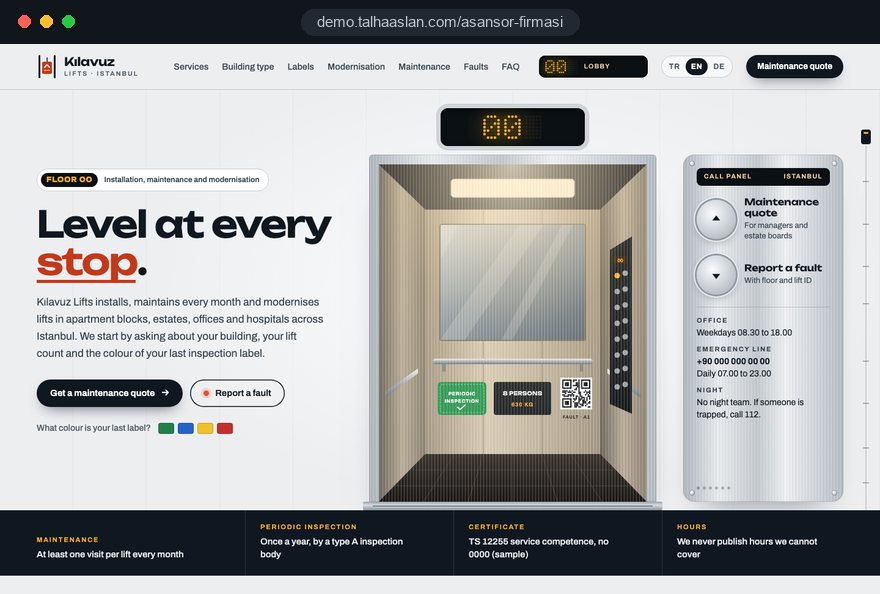
We do not have a live client project for a lift company yet, so we show our approach on a live demo site. The demo is not a client site. You can see our work in other sectors on the references page.
Live demo
For this field we built a one page demo site for a fictional brand, made only to show our approach. You can explore the design, the copy structure and the mobile view live in three languages.
Open the live demoBefore design starts, we talk through the buildings you maintain, when contracts usually come up for renewal and what managers ask before they request a quote.
We write down every detail your team needs to prepare a quote and build the steps of the maintenance and installation forms from that list.
We check inspection and safety points against the regulation text and explain them plainly; we never publish a claim you cannot document.
We track which page brings maintenance contracts and which brings installation enquiries, and update the relevant pages before renewal periods.
Related pages
Industries
A separate setup for appliance, boiler and home repair services.
Industries
For construction firms selling housing projects, the side you often work with on new installations.
Industries
A separate setup for occupational health and safety providers.
Solutions
A single-goal page for campaigns such as contract renewal periods or defect remedy work.
 Lead Form Design for Booking, Quote and Demo Requests: UX Rules That Lift ConversionsRead article
 How to Build a B2B Website: Site Structure That Generates Qualified LeadsRead article
 How to Build Trust on Your Website: Trust Signals That Turn Visitors into CustomersRead article
 How to Do Google Maps SEO: A Guide to Ranking Your Business Higher on the MapRead article
FAQ
If your question is not here, write to us; we will send you an answer and a written quote.
Next step
In a free 15-minute call, in English, we will go through your maintenance portfolio, the questions managers ask before a quote and your installation work, then send a written scope and quote.
In-depth guide
A lift or elevator company grows through maintenance contracts that renew year after year, not through single repairs. The person who signs that contract rarely rides the lift every day. It is a managing agent, a facilities manager, a residents' management company or the operations lead of an office building, and the website's real job is to make that person's decision easier.
This guide follows the decisions in the order a lift firm meets them: contract timing, maintenance scope, inspection duties, switching contractors, breakdowns, modernization and new installations. Where we mention legal duties, we refer to UK legislation such as LOLER and the Lifts Regulations 2016; if you work in another country, check the equivalent rules there before publishing anything.
On a lift maintenance contract, the person who requests quotes, the person who compares them and the person who approves them are often different, and the site has to serve all three. A managing agent gathers quotes, a board or residents' committee looks at them side by side, and a director or owner signs.
We therefore give the first screen of the home page three routes: a maintenance contract quote, an installation or modernization enquiry and the breakdown line. Each route leads to its own page and asks its own questions. On the maintenance page, a printable one page summary of scope, response arrangements and accreditations helps the committee member who compares three contractors on paper.
Maintenance enquiries do not arrive evenly through the year; they cluster around contract end dates and the timing of statutory examinations. Under LOLER regulation 9, lifting equipment used for carrying people must be thoroughly examined at least every six months, other lifting equipment such as goods only lifts at least every twelve months, or in either case in line with an examination scheme.
These two calendars decide which page matters when. After an examination report lands, your guide to examinations and your defect remedial page get read. Ahead of a renewal, the maintenance scope and the quote form do the work.
The website becomes part of the sales calendar. A manager whose contract ends in eight months may fill in the form today; capturing that date means your team can pick the conversation up again when the decision is actually made.
The most useful part of a maintenance page is a clear line between what a routine visit includes and what is quoted separately. Settling it in advance prevents disputes later.
UK contracts are usually described by the cover they offer, from a basic contract that covers routine visits and labour to a comprehensive contract that also includes most parts. Use the names your firm actually uses and define them in plain words. Then show exactly what an engineer does on a planned visit.
Add a section on records. Explain what the engineer leaves after each visit, how defects are reported to the manager in writing and whether reports are available online. A manager who has to answer to a board values a tidy record more than almost any other feature.
A plain English guide to thorough examinations is the information page most likely to bring a lift company new contracts, because managers search for it the moment a report arrives. Your guide should separate the maintenance contractor from the competent person who carries out the statutory examination.
LOLER regulation 10 sets out what happens after an examination. The person making it must notify the employer forthwith of any defect that is or could become a danger to persons and must make a written report. Where a defect involves an existing or imminent risk of serious personal injury, a copy goes to the relevant enforcing authority, and the equipment must not be used until the defect is rectified.
Close the guide with a short form where the manager can upload the latest report and ask for a remedial quote. Add a last updated date to the page and review it against the legislation once a year. Do not advise on whether LOLER applies to a particular building; leave that to the duty holder's advisers.
A good quote form asks, in order, every question your estimator would ask on the phone, and splits them into three short steps. A manager facing twelve fields on one screen often gives up; a form that asks a few questions per screen gets finished.
Offer an optional upload for the latest examination report and the current contract. With the report in hand, your team can see outstanding defects and shape the quote before anyone visits the building. Explain in one sentence why each optional field helps.
Keep the form honest about what happens next. A confirmation screen that says when you will reply and who will call sets expectations better than a generic thank you. The form also needs a clear privacy notice explaining what the data is used for.
Many new maintenance contracts come from managers who are unhappy with their current lift company, and a page that explains how switching works opens a separate door for enquiries. These managers worry about lost records, a gap in cover or a new firm unable to work on the existing equipment.
Answer those concerns in order. Explain the takeover survey you carry out at the start, what it covers and how you report its findings, including anything the outgoing contractor left unresolved. Be specific about the date on which responsibility passes from one firm to the other.
Be careful not to criticize competitors by name or to imply that a current contract can be broken without consequence. The page is most useful when it reads as a calm checklist the manager can use whichever firm they choose, with your quote form at the end.
An accreditations page should be a list of facts a manager can check, not a gallery of logos. Managing agents compare contractors on trade association membership, safety accreditations, insurance and the lift brands they can service.
Write the details as text that can be copied into a comparison sheet. An expired certificate does more harm than none at all.
Health and safety documentation also belongs here, briefly: how you handle risk assessments and method statements for work in shafts and machine rooms. Add a line explaining how to request any document that is not published, and keep the page under a review date so it never shows something you no longer hold.
The breakdown section should state who answers, at what hours and what happens next, without promising more cover than you provide. List office hours and the emergency line separately. If there is no night team, say so plainly; a response time you cannot keep costs a manager's trust at the first breakdown.
Trapped passengers deserve their own explanation. Under the Lifts Regulations 2016, lifts must be equipped with means enabling people trapped in the car to be released and evacuated, and cars must be fitted with two way means of communication allowing permanent contact with a rescue service. Managers want to know who answers that alarm line on their lifts and what the release procedure looks like.
Track QR reports as their own event. Over time they show which buildings report faults most often, which tells you when a modernization proposal will be welcome.
A modernization page should help a manager who is dealing with repeated breakdowns or examination defects understand what will be replaced, how the work runs and who decides. The board needs the difference between replacing a controller, upgrading doors and replacing the whole installation spelled out before it can approve a budget.
Use one worked example: an older passenger lift in a residential block with frequent door faults and a recurring advisory on the latest report. Show the options from targeted component replacement to full modernization, and what each changes for reliability, downtime and future maintenance.
Explain also how you assess whether the scope of a modernization triggers additional conformity or examination steps, and say that you will confirm this in writing for each project. A short modernization enquiry form should ask for the lift's age, the last examination outcome and the most frequent fault, so your first reply is already specific.
An installation page should show a developer which steps sit with you and which sit with them, from design to handover. If you often work with residential developers, it helps to see how construction company websites present their own projects and timelines.
The Lifts Regulations 2016 place clear duties on the installer of a new lift, including meeting the essential health and safety requirements, carrying out the conformity assessment, drawing up the declaration of conformity and affixing the required marking. LOLER also expects lifting equipment whose safety depends on installation conditions to be thoroughly examined after installation and before first use. A developer wants to see how you handle each of these steps.
Keep the installation enquiry form separate from the maintenance form, with an option to upload drawings so your team can carry out an initial feasibility review at the desk. A clear handover section helps the developer recommend you to the incoming managing agent.
A manager looking for a lift contractor runs two kinds of search: a service and place search, and a search for the answer to a specific question. Both should lead to the same contract quote form.
For place searches, your Google Business Profile is the starting point. Google asks businesses that do not serve customers at their own address to show a service area instead of an address, and the business name must match the real world name without added keywords. Area pages on your site should exist only for areas where you genuinely maintain lifts.
Pages that only swap a town name are tiring for readers and add nothing for search engines. Fill each area page with real work in that area instead. We can build the technical side of this foundation as part of our SEO service.
Managers often open your site on a phone between meetings or outside a building, so speed and measurement belong on the same checklist. Google measures page experience with Core Web Vitals: a page is considered good when LCP, which measures how quickly the largest content loads, is 2.5 seconds or less, INP, which measures responsiveness to taps and clicks, is 200 milliseconds or less, and CLS, which measures visual stability, is 0.1 or less.
On lift company sites, the usual culprits are large photos of cars and machine rooms and heavy image sliders. Running your current site through a mobile friendly test shows where the problem lies.
Without this split, breakdown calls inflate the conversion count and hide which pages actually bring contracts. If measurement uses cookies, the consent banner and privacy notice should be in place from the first day, especially if you also serve clients in the European Economic Area.
Most of these mistakes come from building the site without knowing who buys a maintenance contract, not from poor design. Each has a better alternative.
Each of these costs a few hours to avoid at the start and a rebuild to fix later.
To choose the right team, look first at how well they understand the maintenance contract buyer and the inspection language, and only then at design samples. The questions below show quickly how a team will approach the work.
We do not have a live client project in the lift sector yet, so we show our approach on the live demo linked on this page. You can see our work in other sectors on our references page. Because design, development and content sit in one team, our web design service plans forms, guides and measurement together from the start.
If you plan a focused campaign for renewal season, a dedicated landing page can run alongside the main site. You can compare packages in our pricing section, or get in touch to talk through your maintenance portfolio and the questions managers ask before requesting a quote; we follow up with a written scope and quote.
Start a Project
Thanks {name}, we've received your brief. We usually reply within the same day.
What happens next?