Survey requests stuck on the phone
The site offers a phone number and a generic form. Floor area, number of rooms, building type and existing equipment are asked again on every call, and planning the survey takes longer than it should.

Your Windows contrast theme is on; colours come from your system.
Your device is set to reduce motion; animations are already off.
Your choices are saved in this browser only.
Industry-specific web design
People commissioning air conditioning or ventilation rarely want a single unit; they want a solution. How will three bedrooms stay cool, how will an office get fresh air, how will a restaurant kitchen be ventilated. They ask for a site survey first, then check your credentials and past installations. That is why our team builds HVAC company websites around the survey request, clear service paths and maintenance contracts.
Open the live demoA demo design we built for a fictional brand
In short
An HVAC company website gives installation, planned maintenance, repairs and ventilation work their own pages, separates homes from commercial projects and leads visitors to a site survey request with floor area, building type and photos. In Great Britain, anyone installing or servicing equipment containing F gas needs their own qualification, so credentials should be easy to find, and maintenance contracts and energy efficiency are explained without overstatement.
Talha Aslan and teamLast updated:
Why it needs its own approach
HVAC work is closer to a project than a call out: survey, sizing, installation and years of maintenance. Generic templates do not explain that sales path.
The site offers a phone number and a generic form. Floor area, number of rooms, building type and existing equipment are asked again on every call, and planning the survey takes longer than it should.
A homeowner looking for a split system and a facilities manager looking for VRF and fresh air units read the same service list. Neither finds their own need, and search engines cannot tell which work you do.
In Great Britain, GOV.UK guidance says you must hold your own qualification to install, service, leak check or recover gas from equipment containing F gas, even if you work for someone else. When certificate details are missing, customers decide without being able to check.
Planned maintenance is only discussed on the phone; scope, visit frequency and who it suits are not written anywhere. Shops, offices and managing agents cannot compare, so they do not even leave an enquiry.
On one side, savings percentages with no source; on the other, no explanation at all. Customers want to read in plain language what sizing, inverter technology and heat pumps mean for them.
Installation enquiries rise in spring and heating checks in autumn, but the site never changes with the season. Nobody measures which page brings in surveys, so the return on peak season advertising stays invisible.
Our recommended structure
We build an HVAC website in the order the sale actually happens. Visitors first find their situation, home or business, new installation or maintenance, then read the page that describes it and leave a survey request in a few fields. There is a quick contact route for breakdowns too, but the heart of the site is the survey and the quote.
Split system installation, VRF systems, heat pumps, kitchen and car park ventilation each get their own page, and commercial clients such as shops, offices and restaurants get their own section. For seasonal work such as a pre summer installation campaign, a focused landing page can go live without touching the main site.
Design, development and search visibility work sit in one team, so this structure is not patched on later. Talha Aslan sets the strategy and experienced members of our team carry out the build.
Home
Every service and solution page answers its own search, and every one carries the same survey request button.
The right setup for you
All three start from the same foundation; what changes is your customer type, the size of your projects and how much of your income comes from maintenance.
Homes
A company fitting split systems or heat pumps in flats and houses; the site helps customers size correctly and book a survey.
Commercial projects
A company delivering office, retail, restaurant and industrial projects; the site explains system types and the project process.
Maintenance led
A company earning most of its income from maintenance contracts; the site sets out scope and process clearly.
Built for HVAC
This list comes from the decisions that come up most often in our work with installation and project based service companies.
A short form with building type, approximate floor area, number of rooms, existing equipment and a photo field. Your team understands most of the job before the visit, and commercial clients can upload drawings.
New installation, planned maintenance, repairs and regassing, and ventilation each have their own page. Every page answers its own question and leads to its own enquiry route.
What the contract covers, how often you visit, who it suits and a request form, all on one page. Commercial clients find what they need to compare without picking up the phone.
GOV.UK guidance says anyone installing, servicing, leak checking or recovering gas from equipment containing F gas must hold their own qualification from an approved body. We show your engineers' certificates and any company accreditation you hold; please confirm which rules apply to you, as they differ between Great Britain, Northern Ireland and other countries.
Sizing, inverter technology, heat pumps and the effect of maintenance on efficiency are explained in plain language. We do not publish savings figures without a source; where manufacturer data is used, the model and source are named.
Photos of your own installations instead of stock images, with building type, system type and a short description. Client names appear only with their permission.
Comparison
| Topic | Generic business template | Website built for HVAC |
|---|---|---|
| Enquiry | Name, phone and message | Survey form asking for building type, area and photos |
| Services | Every job in one list | Installation, maintenance, repairs and ventilation on their own pages |
| Customer type | Same text for everyone | Separate paths for homes and commercial projects |
| Credentials | Missing or just a logo | Certificate type and number clearly shown |
| Maintenance | A line saying we also do servicing | Contract page with scope and frequency |
| Energy | Unsourced savings claims | Sizing and technology explained, sourced data |
Quick check
Must haves: does your site have them?
0 of 6 in place Tick the boxes to see where your site stands.
Added as needed
We choose which of these you need together during the scoping call.
Tell us what you install, how your work splits between homes and commercial projects, your maintenance contracts and your credentials; we will work out the right page structure and send a written quote.
Process
We define your business, your audience and the site’s one-sentence job: who it sells what to, through which action. Scope and timeline are written from that answer.
The home page and key templates come to you as designs first; no code is written before your approval. We do not like surprises, and we do not cause them.
The approved design becomes fast, secure, maintainable code. You follow progress in the CRM and see every page in a staging environment before launch.
The site goes live with analytics, Search Console and conversion tracking connected; panel training is given, first-year hosting and maintenance included.
Search and speed foundations
Customers search with very different words: air conditioning installation, VRF system, heat pump or kitchen extraction. When every service and system type has its own page, each of those searches lands on the right one, and your Google Business Profile is set up to match.
Business name, phone number, service area and the services you offer are marked up so search engines can read them; nothing that is not on the page is marked up, and no rating that is not real.
A large share of survey requests come from phones. Pages are designed for the phone screen first, project photos are compressed and Core Web Vitals are measured before launch.
Survey requests, maintenance contract enquiries, calls and WhatsApp messages are tracked as conversions from day one, so you can see which service page brings in work through the season.
Free tools
Before planning a new site, test the one you have; the tools that help your customers with sizing and running costs are here too. They are free and need no sign up.
Cooling
Find the air conditioner size a room needs from area, ceiling height, sun, people and appliances, in BTU/h, kW and tons, plus an estimate of monthly running cost.
Energy
Turn an appliance's watts and hours of use into kWh and running cost per day, month and year, add standby power and total several devices at once.
Tech SEO
Test whether a page works well on phones: viewport, font size, tap targets, a mobile screenshot and Core Web Vitals.
Tech SEO
Scan any URL for title, meta description, headings, canonical, indexability and speed signals, and get an SEO score with a clear to-do list.
Tech SEO
Generate rich-result JSON-LD for Article, Product, FAQ, Local Business.
Conversion
Create a wa.me link with a preset message + embeddable button code.
How we work
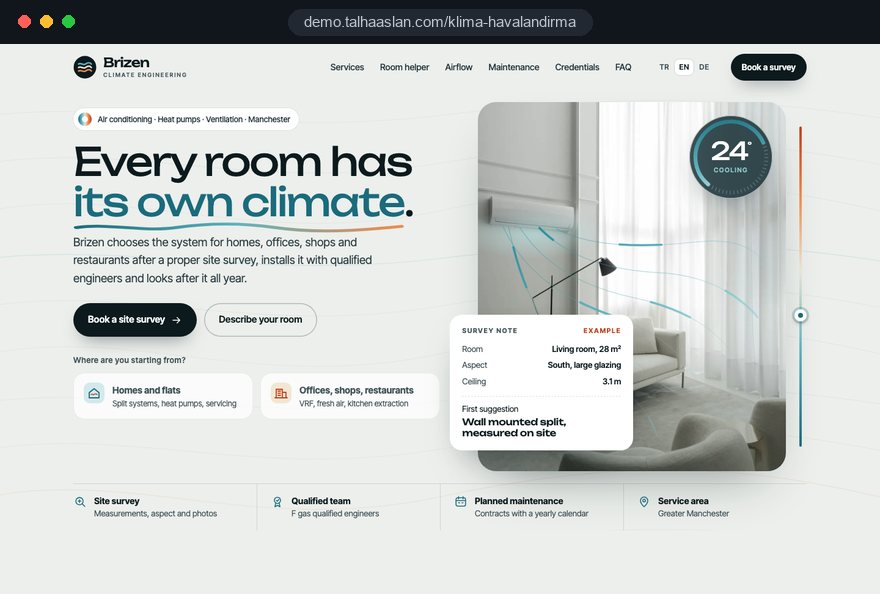
We do not have a live client website for an HVAC company yet, so we show our approach on a live demo site. The demo is not a client site. You can see our work in other sectors on the references page.
Live demo
For this field we built a one page demo site for a fictional brand, made only to show our approach. You can explore the design, the copy structure and the mobile view live in three languages.
Open the live demoWe list the questions your team asks most often on surveys and on the phone, then build the survey form and service pages around them.
We confirm which certificates your engineers and your company actually hold and show only those, with their numbers.
We use photos of your own installations and projects instead of stock images, and help plan a shoot if there is no archive.
We track which pages bring in surveys and maintenance enquiries, and update pages and emphasis for the cooling and heating seasons.
Related pages
Industries
For repair services that fix washing machines, fridges and boilers as well as air conditioners.
Industries
For plumbing firms handling leaks, blockages and water supply work.
Industries
A separate sector page for firms that combine heat pumps with solar systems.
Solutions
A single goal page matched to ads for seasonal campaigns such as pre summer installation.
 How to Build Trust on Your Website: Trust Signals That Turn Visitors into CustomersRead article
 How to Build a B2B Website: Site Structure That Generates Qualified LeadsRead article
 Website CRM Integration: How to Track Form Leads AutomaticallyRead article
 How to Do Keyword Mapping: A Step by Step Guide to Assigning Keywords to URLsRead article
FAQ
If your question is not here, write to us; we will send you an answer and a written quote.
Next step
In a free 15 minute call, we will go through your services, your customer mix, your maintenance contracts and your credentials, then prepare a written scope and quote.
In-depth guide
For an HVAC company, the website is rarely the number someone dials in a breakdown. It is the first step of a sale that can take weeks: the visitor tries to understand their situation, asks for a site survey, compares quotes and, after installation, either comes back to you for years of servicing or quietly goes elsewhere.
This guide walks through the decisions we make when building a website for an air conditioning and ventilation business, in the order the sale actually happens. Every section gives you something to apply to your own site: a criterion, a checklist or a question to put to an agency.
Start planning an HVAC website with the stages your customer goes through, not with a list of pages, because each stage raises a different question and needs a different page to answer it. For a homeowner the journey may take a few days; for a commercial fit out it can stretch over months, but the stages are the same.
A useful exercise before any design work: sort last quarter's jobs into these four stages and note where you lost people. If you survey but lose at the quote, your trust pages are weak; if the phone barely rings, the understanding stage lacks content. That diagnosis sets the site map's priorities.
The survey form collects the questions your team asks on the first call without wearing the visitor out, so keep required fields to four or five. A long form looks thorough on a desktop screen, but on a phone it gets abandoned halfway.
Add one line under the photo field telling people what to shoot: "the balcony or wall where the outdoor unit would go, and the wall for the indoor unit." The commercial version adds an upload for drawings and specifications. Place a short privacy notice next to the form explaining how photos and details are used, because pictures often show the inside of a home and sometimes people.
The value of a form is decided in the hours after it is sent; if nobody tracks who received the enquiry, when they called and whether it became a quote, part of the work the site brings in disappears without a trace. That is why we set up a simple follow up flow alongside the form on every HVAC project.
A small team can run this in a shared spreadsheet. When enquiry volume grows, connecting the form directly to a CRM through custom software and integration work becomes worth it. After a few months, the lost reasons tell you which part of the site to strengthen: "price" points to how you explain scope, "unreachable" to response speed.
A sizing guide catches the visitor searching "what size air conditioner do I need" and prepares them for the survey; its job is not to give a final answer but to show which factors change the calculation. Written well, it answers part of the survey conversation in advance, and customers meet your engineer better informed.
The guide should explain at least these factors:
Linking to a BTU calculator gives visitors a first estimate; directly underneath, a sentence such as "this is a starting point, we confirm the exact capacity on survey" and the survey button. If you install heat pumps, say clearly on this page that heating demand is a separate calculation, otherwise customers decide on the cooling figure alone.
Homeowners and commercial buyers ask different questions, search with different words and decide in different ways, so the first screen of the home page should send each down their own path in one tap. Homeowners care about noise, looks and running costs; on the commercial side, the decision is often shared between an owner, a facilities manager and an architect or consultant.
The language changes too. A home page answers everyday questions such as "how much balcony space does the outdoor unit take, and will the neighbors hear it"; a commercial page covers the project timeline, working while the business stays open and the handover documents. Two large cards on the home page are enough: "For my home" and "For my business or project".
The split also helps search engines understand which page answers which search, and keeps the two audiences from diluting each other.
A commercial client is not looking for a product but for a system that fits their building, so VRF, fresh air units, kitchen extraction and car park ventilation each deserve their own page built on the same skeleton. These pages should not copy a manufacturer brochure; they should prepare the decision maker for the next step.
Explain abbreviations once in a single clause: VRF, variable refrigerant flow, a system where one outdoor unit feeds many indoor units with a varying flow of refrigerant. A kitchen ventilation page can also answer "who does not need this"; a small café with one warming counter may need something much simpler. That honesty tells a commercial buyer your quote will not be padded.
Maintenance contracts are the recurring income that fills the gaps between seasons for an HVAC business, and the site should describe them more clearly than any phone call does. Retail chains, offices and managing agents put several proposals side by side; a company without a written scope never makes it into that comparison.
Instead of a fixed figure, use a short contract request form: number of units, unit types, brands, number of sites and whether another company currently maintains them. Those details usually let your team quote after one conversation. Sending this page to installation customers when their first service falls due is a natural route into a contract.
For an air conditioning installer, credentials are not decoration but visible proof of a legal requirement, so show certificate type and number rather than a row of logos. In Great Britain, GOV.UK guidance says anyone who installs, services, leak checks or recovers gas from equipment containing F gas must hold their own qualification, even when working for someone else.
Credentials live on their own page, and every service page links to it with one short line such as "Our installations are carried out by F gas qualified engineers." Rules differ between Great Britain, Northern Ireland and other countries, so confirm with your certification body which requirements apply to your work. We publish only what you actually hold; implying a credential you lack carries far more risk than any trust it could earn.
Energy efficiency is one of the strongest topics in air conditioning sales, but savings percentages without a source damage trust and risk misleading consumers; the sound approach is to explain what actually drives energy use. Customers do not want a headline number; they want to understand what will make a difference in their own building.
Where you need figures, quote manufacturer data with the model name and source rather than generalizing. An electricity cost calculator lets visitors do their own sums by entering the unit's power and daily hours of use. The claim then rests on the visitor's own numbers, not on your sentence.
Apply the same discipline to heat pumps: efficiency depends on outdoor temperature, insulation and the heating system they feed. Stating those conditions avoids the impression that every home will see the same result, and quietly explains why a survey is needed.
The gallery answers the question a buyer asks at quote stage, "has this company done something like my building", so build it as short project cards filtered by building type and system, not as a pile of photos. Stock images do not answer that question; they only postpone it.
Give your installers a simple habit: at the end of every job, the same three angles, landscape, in daylight. If there is no archive, plan to revisit a few finished jobs in the first month. Every card should lead back to the matching system page and to the survey form; the gallery exists to move people forward, not to keep them browsing.
HVAC demand moves through the year: installation enquiries rise in spring, heat pump and heating checks in autumn, and if the site and ads ignore that calendar, peak season budget is spent with little to show. Build the calendar from your own figures rather than guesswork.
For short campaigns such as pre summer installation offers, a focused campaign landing page is cleaner than reworking the main site. When Google Ads management pairs ads with that page, we watch the three Quality Score components: expected click through rate, ad relevance and landing page experience. Google describes Quality Score as a diagnostic tool, not a direct input in the ad auction.
Being found starts with every service and system type having its own page; if "air conditioning installation", "VRF system" and "kitchen extraction" share one page, none of those searches is served well. We plan this inside search engine optimization with a keyword map, so every group of searches has one target page.
In short, LCP measures how quickly the main content appears, INP how quickly the page responds to a tap, and CLS how much elements jump around while loading. Because a large share of survey requests come from phones, pages are designed for the phone screen first, the survey button stays fixed at the bottom, and these values are measured before launch.
Most of these mistakes come from building the site on a generic business template; each has a better alternative you can apply.
If your current site shows more than two of these, content and page structure need attention before any redesign. A new look alone moves the same problems into a nicer shell.
The right partner talks through your sales path before talking about design; asking the following questions before you collect quotes makes them much easier to compare. The answers show how far the site will really be built around your business.
With us, the process starts with a short call about your services and customer mix, followed by a written scope and quote. We do not yet have a live client site for an HVAC business, so we show our approach on the live demo linked on this page; you can see our work in other sectors among our client references.
You can read about our approach on the web design service page and see the fixed price packages in the web design pricing section. For a scope tailored to your HVAC company, simply fill in the quote form.
Start a Project
Thanks {name}, we've received your brief. We usually reply within the same day.
What happens next?