A patient abroad who chooses treatment in Turkey is trusting a team they have never met with both their health and their savings. A health tourism website is where most of that decision is made: before writing to a coordinator, the patient wants to understand the treatment, the provider, the package and the process in their own language.
In this guide, Talha Aslan and team walk through the decisions facilitators and hospital international patient units face when planning a site, in the order they come up. Each section gives you a criterion to check on your current site, a task for your team or a question to put to any agency you talk to.
01Settle your business model first
Your sitemap, brand voice and enquiry flow all depend on your business model, so the first decision is the model, not the design. A facilitator working with several hospitals and the international unit of a single hospital make very different promises to the same patient.
For a facilitator, your company is the brand: patients trust you to route them to the right provider, so partner hospitals get their own pages and coordination is the core service. For a hospital unit, the institution is the brand; international patients get their own path inside the main site, linked to the department pages. A brand focused on one treatment needs few pages, each covering the treatment in real depth.
Before the first meeting, write down answers to these questions:
- How many providers do you work with: The more partners, the more the hospital and doctor pages need to be a section of their own.
- Which treatments bring most of your patients: These get deep pages in the first phase; the rest can follow.
- Who talks to the patient first: A coordinator, a doctor or a sales team; this decides where the form lands.
- What is your registered trade name: Turkish rules require the name on the site to match your authorization certificate, so check it before choosing a logo or domain.
Hospital units should also agree who owns the main site and whether the international pages run from the same admin panel or a separate subdomain. Design that starts before these answers usually means rebuilt menus a few months later.
02Choosing markets and the order of languages
Decide on languages by where your patients actually come from today, not by ambition. Every new language means more than translation: a coordinator who speaks it, a WhatsApp line, written confirmations and legal texts. Opening a language you cannot staff leaves patients stranded halfway.
Use these steps to set the order:
- Count the last twelve months of enquiries by country and language; the top two markets form the first phase.
- Check that you have a coordinator who speaks the language of each of those markets.
- Ask your coordinators for the ten questions each market asks most, in writing.
- Launch the language that satisfies the Turkish requirement for a foreign language option, then schedule the rest.
On the technical side, each language lives at its own URL and links to the others with hreflang. Hreflang tells Google which language and regional versions of a page exist; each version must reference itself and all the others. We explain this setup on our multilingual website page, and you can generate and check the markup with our hreflang generator.
One language can serve several markets. A German speaker may come from Germany or Switzerland, and the answers on flights, insurance and follow up differ between them. Plan a short country guide for each market covering flight time, visa needs, how much time off to take and how aftercare continues at home, written from your coordinator's notes rather than translated.
03Treatment pages that inform rather than sell
A treatment page is there to help the right patient recognize themselves, not to persuade everyone. A hair transplant page that says plainly who is not a candidate cuts down unsuitable enquiries and frees your coordinators for real patients.
A strong treatment page covers these points in order:
- What the treatment is: A plain definition approved by a doctor, with any medical term explained the first time it appears.
- Who it suits and who it does not: Which information the assessment looks at and when the treatment is not recommended.
- How many days in Turkey: The flow from arrival to departure, and when the patient is cleared to fly.
- What happens at home: Whether checks are remote or need a second visit, and which documents the patient takes to their own doctor.
- Risks and recovery: General information written by the doctor; anything personal is left to the assessment.
Starting the copy from the questions coordinators answer every day works well. A patient who has researched the same procedure at home keeps reading when they see their own question on the page. All medical wording should be approved by the responsible doctor before launch, and you should keep a record of who approved it and when.
End the page with one action, the assessment form. Three different buttons leave the patient undecided.
04Package pages that show exactly what is included
The question patients ask most is not about the treatment itself but about what the package covers. The package page should answer it before the patient ever reaches a coordinator; every unclear line becomes a message, and every message costs a day.
Make these points visible at a glance on every package page:
- Included: Treatment, number of hotel nights, airport and hospital transfers, interpreter, follow up appointments.
- Not included: Flights, visa, additional tests, accommodation for a companion, listed separately.
- The patient's own steps: Booking flights, uploading documents, pausing certain medication beforehand.
- Who delivers each service: The name of the licensed travel agency handling hotel and transfers.
That last point matters beyond trust. Turkey's 2025 regulation requires facilitators to provide accommodation, transport and transfers through licensed travel agencies, so showing that relationship tells the patient who is responsible for what. If your partner agency also needs a new site, our travel agency website page covers that side.
Whether to publish package prices is a separate decision. A price before the treatment is confirmed sets expectations; no price means more questions. Either way, the contents of the package should always be spelled out.
05Licence, accreditation and doctor details
A patient who does not know you can only build trust on information they can verify. Turkey's 2025 regulation requires the organization name and trade name on the website to match the authorization certificate, and health facilities to publish their accreditation or certificate on the site.
We recommend placing this information as follows:
- Footer: The full trade name and certificate details, visible on every page.
- About the provider: Accreditation or certificate, with the issuing body and validity.
- Doctor profiles: Specialty, training and a short introduction the doctor has approved.
- Partner facilities: Only providers with a written agreement, removed when the agreement ends.
Base every statement on a document. Do not describe a doctor's specialty, a hospital's accreditation or the scope of a partnership without paperwork behind it; correcting it later is hard for both trust and compliance. Name one person responsible for this information and put certificate expiry dates in a calendar.
Doctor photos and bios fall under the same advertising rules. Instead of praise, give patients what helps them decide: which treatments the doctor performs, which languages they speak and whose files they review during assessment.
06Designing the medical assessment form
The assessment form is where the site converts; it must collect everything a coordinator needs for the first reply without overwhelming the patient on the first screen. Breaking it into short steps works better than one long page.
The flow we recommend:
- Treatment and country: The patient picks a treatment, and country and preferred language are suggested automatically.
- Time frame: Not exact dates, just the month or week they are considering.
- Documents: Reports, test results or photos; the step can be skipped, but the patient is told what is still missing.
- Contact preference: WhatsApp, email or phone, and the time zone they want to be reached in.
- Privacy notice and consent: The text on processing health data, with a separate consent box.
For treatments that need photos, add a simple guide showing the angles and lighting required. An unclear photo means the coordinator has to ask again.
After submission, the patient should see a confirmation in their own language stating that the request arrived and when and how they will hear back. Test on several phones before launch that the form works one handed and that file upload works in mobile browsers.
07Protecting health data under KVKK and beyond
A site that collects reports and photos processes health data, which Turkey's data protection law KVKK (Law No. 6698) treats as special category data, so security and legal texts are part of the form, not an afterthought. The law also requires an information notice for the person whose data you collect.
Check these points on the technical and organizational side:
- Where files are stored: Uploaded reports belong in an area only authorized users can open, never in a public folder.
- Who has access: Each coordinator sees only files for their language or treatment, and access is logged.
- How long files are kept: Set a retention period for enquiries that never became treatment and delete them when it ends.
- Where files travel: Prefer secure links over email attachments.
The privacy notice must be in a language the patient reads; a Turkish only text does not inform a foreign patient. For patients from the EU or the UK, their own data protection rules may also apply, so review this with your legal adviser.
The same care applies to daily habits. Downloading a report to a personal phone or posting a screenshot to a group chat undoes every safeguard on the site. A short written internal rule protects as much as the technology does. Ask your agency where form files are stored, where backups live and how access logs can be viewed.
08An enquiry flow that survives time zones
International patients often write in their own evening and lean toward whoever answers first. The site's job is to route each enquiry to the right person, correctly tagged and without delay, so nobody goes unanswered outside office hours.
Turkey's regulation expects facilitators to have a setup that can answer calls 24/7 in at least two foreign languages. The site does not replace that team, but it organizes the path to it:
- Language and treatment tags: Each form submission lands directly with the coordinator who speaks that language, and on their WhatsApp line.
- Automatic confirmation: The patient gets a message in their language saying when to expect a reply.
- Source data: The page and country each enquiry came from are recorded.
- Backup person: A rule in the system decides who receives enquiries when a coordinator is away.
Set internal targets: how many hours to a first reply, and how soon a report reaches a doctor. The site can measure these times, and seeing which language has the slowest replies helps directly with staffing.
09Deposits and payments across currencies
The most reassuring way to take a deposit from a patient abroad is a payment page in their language that accepts foreign currencies, rather than bank details sent by chat. When and why payment is requested should be explained on the site from the start.
Because treatment is only confirmed after a doctor's assessment, this order works for most providers:
- The patient submits the assessment form.
- A doctor reviews the documents, and the coordinator sends a personal quote in the patient's language.
- If the patient accepts, they receive a personal payment link.
- After payment, a confirmation and a list of next steps go out in their language.
Spell out refund terms, what happens if dates change and what happens if the doctor decides against treatment, at the quote stage rather than on the payment page.
When choosing a payment provider, ask about collecting in foreign currencies, accepting foreign cards and how 3D Secure verification works with banks abroad. Never present health services with discounts, gifts or giveaways. Payment modules and patient portals can be planned as part of our web design and development service.
10Content rules for health advertising
Every line on a health tourism site can be read as advertising, so the copy should be built on informative language from the start. In Turkey, article 8 of the regulation on promotion and information in health services of 12 November 2025 sets the rules for health tourism.
Promotion must run on a separate site or account aimed at patients abroad, state that health tourism services are offered and carry the HealthTürkiye logo; promotion aimed at people living in Turkey is banned. Offering health services as gifts, prizes or incentives stays banned, and before and after images need consent, matching conditions and dates. If you also advertise to UK patients, the CAP Code requires objective health claims to be backed by evidence. Within these limits we write by a few distinctions:
- Inform, do not promise: Describe the steps and the recovery instead of "perfect results in no time".
- Avoid campaign language: No limited time discounts, free procedures or gift packages.
- Choose images carefully: Photos of the facility, team, rooms and process inform; comparative result images carry risk.
- Document consent for testimonials: On the site for patients abroad, patient stories and reviews are allowed only with documented explicit consent; get legal advice before publishing.
Sponsored promotion is only allowed in languages other than Turkish and aimed at audiences abroad, and the rules of the patient's country apply when you promote there. We draft within this framework; the final legal assessment belongs to your organization. Any decision on paid promotion should come after the content is approved, together with your legal adviser.
11Speed abroad and visibility in search
Patients open your site from another country, usually on a phone and sometimes on a weak connection; a heavy page loses them before they reach the treatment. Speed and search visibility are two foundations to measure before launch.
Google's Core Web Vitals use these "good" thresholds, met at the 75th percentile of visits:
- LCP: Largest contentful paint, how fast the main content loads, 2.5 seconds or less.
- INP: Interaction to next paint, how fast the page responds to a tap, 200 milliseconds or less.
- CLS: Cumulative layout shift, how much the page jumps while loading, 0.1 or less.
Compress clinic and room photos, and load videos and maps only on click. Ask your agency how the server and content delivery network respond from your target countries. You can check mobile rendering with our mobile friendly test.
In search, patients look for treatment in their own language, often adding the destination country. Each language version should use the words people in that market actually type, and the provider's name and contact details should be marked up with structured data, the code that labels page content for search engines. Nothing should be marked up that is not on the page. Our SEO service page describes this work.
12Measuring by country, language and treatment
Total visits say almost nothing about a health tourism website; what matters is which country, language and treatment page brings assessment requests. Build the measurement plan around that question before launch.
Track these from day one:
- Form steps: Where patients drop out; heavy loss at document upload points to unclear instructions or a technical fault.
- WhatsApp and call clicks: Split by language and page.
- Enquiry to patient: Which enquiries became treatment in your coordination system, matched to the source the site recorded.
- Source: Visits from social media, partners abroad and email newsletters, kept apart.
Add UTM parameters to links you give partners abroad; a UTM is a tag that tells your analytics where a click came from. Our UTM builder creates them in seconds.
For visitors in the European Economic Area, no non essential tracking should start before cookie consent, and Google requires consent mode for measurement and personalized advertising features for users there. Visitors who decline will be missing from the data, so read the numbers with that in mind.
Review the figures with your team once a month. Traffic without enquiries in one language usually points to content or the form; enquiries that do not become patients usually point to reply times or how quotes are written.
13Common mistakes on health tourism websites
These mistakes come up again and again in health tourism projects; each one comes with a better alternative. Reviewing your current site against this list before a rebuild shows what can move across and what needs rewriting.
- Publishing machine translation of the Turkish text: Patients notice in the first paragraph. Have each language written or edited by a native speaker and approved by a doctor for medical wording.
- Relying on a generic contact form: Coordinators then ask for everything again. Use a stepped form that asks for treatment, country, dates and documents.
- Leaving the package contents vague: A vague package creates new questions daily. Show what is included, what is not and the patient's own steps in separate lists.
- Passing reports around by email and WhatsApp: Health data is left unprotected. Use secure upload with restricted access.
- Attracting patients with a before and after gallery: Turkish rules allow such images only with consent, matching conditions and dates. Show the process, the team and the recovery steps instead.
- Using a trade name that differs from the certificate: Brand and legal name get mixed up. Use the exact certificate name in the footer and on the provider page.
14Choosing a partner and your next step
When choosing an agency for a health tourism website, look beyond the visual portfolio to how they handle languages, health data and advertising rules. A polished design will not make up for a broken language setup or an insecure form.
Ask these questions in the first call:
- Who translates: Native speakers or machine translation, and is that written into the quote.
- Where documents live: Storage location, access rights and deletion period for uploaded reports.
- How hreflang is set up: Does each language have its own URL, with reciprocal annotations.
- Who approves content: Is there a step where a doctor approves medical wording.
- What happens after launch: Which measurements are set up and who updates the pages.
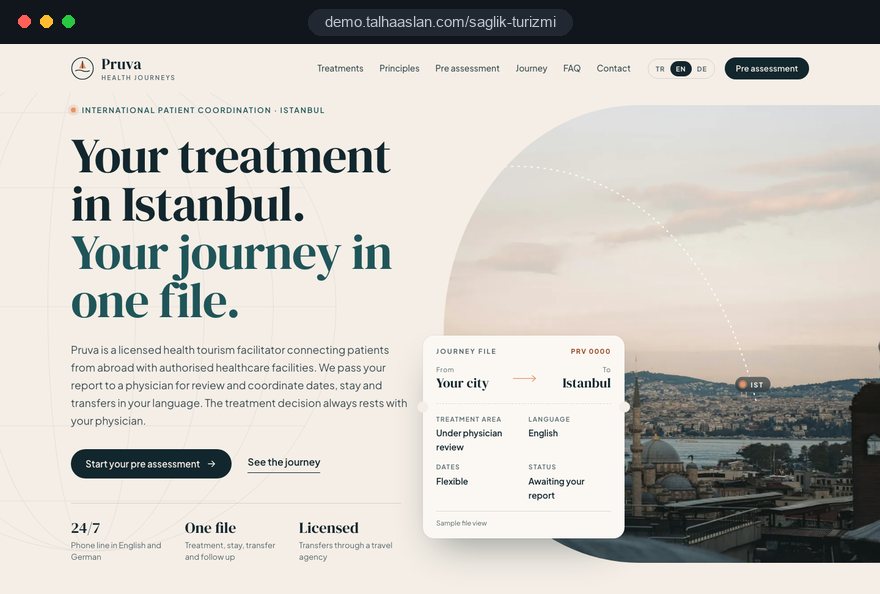
We do not yet have a live client project in health tourism, so we show our approach on a live demo site linked on this page. You can see our work in other sectors on our references page.
Share your target countries, your focus treatments and your partner providers, and we will work out the language and page structure with you; just get in touch with us. To see how scope affects cost, visit the web design pricing section, or use the Get a quote form for a written quote based on your organization.