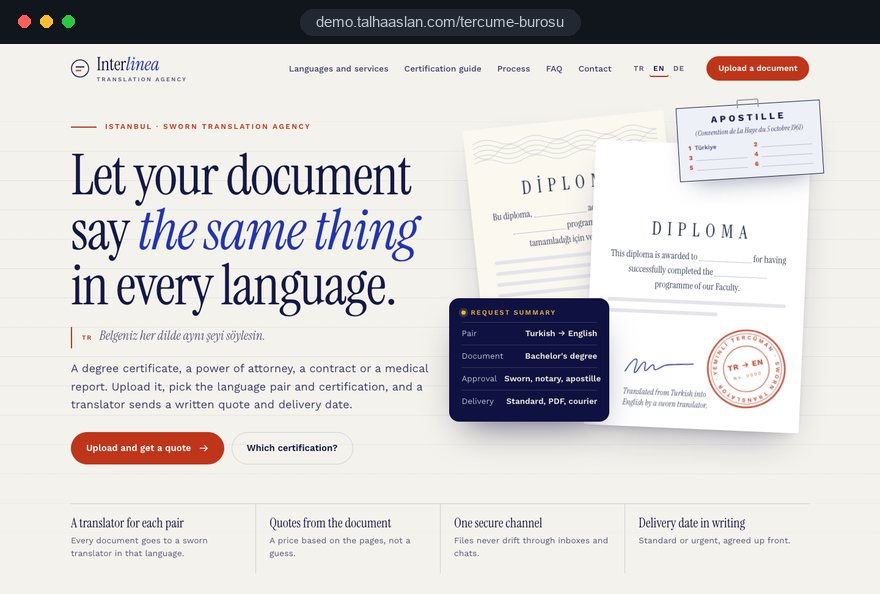
A translation agency website does not work like a brochure. Most visitors have a document that has to reach an authority, a university or a court this week, and the site's job is to take them quickly to the right language pair page, the right certification information and a form where they can leave the file safely.
This guide follows the decisions an agency owner makes in order: which pages to build, what the quote form asks, how uploaded files are protected, how certification is explained, what to measure and how to choose a web partner.
01Four decisions to settle before any design
Before design starts, write down where your work actually comes from, because the sitemap changes with the answer. An agency that mostly certifies official documents and a company doing technical translation for manufacturers cannot share the same home page order.
- Work mix: rank official document translation, contract work for businesses and interpreting by rough share; the first screen of the home page belongs to the largest share.
- Real language list: list the pairs your staff and regular freelancers can deliver with the certification clients need; mark separately the languages you only subcontract now and then.
- The document's route: note how files reach you today, by email, messaging apps or in person, and who prepares the quote.
- Final approver: decide who inside the agency signs off the certification guide, the confidentiality statement and every foreign language page.
With these four answers on one page, a web partner can quote real scope instead of guesses. In agencies with several partners, one person collecting feedback protects the schedule; comments on the same draft arriving through three channels are the most common cause of delay we see.
02What belongs on a language pair page
A language pair page should answer "will this agency handle my job" on one screen; flags and general praise do not answer it. Take a Turkish translation page as an example: it lists which documents are translated into and out of Turkish and which forms of certification are available for each.
- Document types: birth and marriage certificates, degree certificates and transcripts, powers of attorney and court decisions, each with the certification it usually needs.
- Specialisms: which of legal, medical, technical or commercial texts you have specialist translators for in this pair.
- Direction: whether you translate both from English into Turkish and from Turkish into English.
- Process summary: how to send the document, how certification affects timing and how the translation is delivered, with a pointer to the certification guide.
- A page specific quote button: one that opens the form with the language pair already selected.
Repeating the same paragraph on every pair page with only the language name swapped looks thin to readers and to search engines. The difference comes from detail specific to that language: a Turkish document going to a Turkish authority may need notarisation in Turkey, and names in Arabic or Russian documents must be spelled exactly as in earlier official translations.
03Choosing which pairs get their own page
Rather than building a page for every language, choose the pairs that deserve one with four criteria. Dozens of thin pages make a weaker site than a handful of strong ones, and they are harder to keep current.
- Incoming work: whether the pair appears regularly in the last twelve months of quote requests.
- Certification capacity: whether you have a translator who can provide the certification your clients need in that pair; if not, an official documents page for it misleads visitors.
- Search demand: whether people search for the language and document together; someone looking for a Russian diploma translation and a company looking for Russian manual translation are different audiences.
- Original content: whether the page can carry several paragraphs specific to that language, beyond the general text.
Languages that miss the criteria go on an "All language pairs" page, each with a short note on whether certified translation is possible. That page means visitors with rare pairs are not turned away. When demand grows, promoting a language to its own page is easy; closing pages that never brought work means setting up redirects.
04The fields of a document upload quote form
The quote form should collect exactly what your team needs to give a price and timing in one reply, and nothing more. Every unnecessary field makes more people abandon the form; every missing one means a call back.
- File: PDF, JPG, PNG and Word files, several files at once and a clearly stated size limit; taking a photo with the phone and uploading it directly should also work.
- Source and target language: two fields, prefilled when the visitor arrives from a language page, and easy to change.
- Certification: certified, notarised, apostille and "not sure"; the last option shows a short note linking to the guide.
- Turnaround and delivery: standard or urgent; email, post or collection.
- Contact: name, phone and email, plus the preferred channel for the reply.
The "not sure" option looks minor, but it stops visitors abandoning the form because they cannot name the certification. During upload, the file name and size should appear on screen, and an error message should state the cause plainly, for example "this file is over the size limit, please upload the pages separately".
After submission, the visitor should receive an automatic confirmation email with a reference number, the names of the uploaded files and when to expect a reply within your working hours.
05Securing uploaded files and setting retention
Document upload should not go live until you have decided where files are stored and when they are deleted. A folder holding passports, ID cards and medical reports is the most sensitive part of a translation agency site.
- Private storage: files are kept outside the public folders of the site, cannot be opened by a direct address and are shown only to signed in team members.
- Encrypted connection: uploads and panel logins run only over HTTPS with a valid SSL certificate.
- Role based access: the person preparing quotes and the assigned translator see only the files they need, and every access is logged.
- Automatic deletion: files that never became a job are deleted after an agreed period; the retention period for completed work is stated separately.
Data protection law in the UK and the EU expects a clear privacy notice where personal data is collected, and medical reports contain health data, which those laws treat as a special category with stricter conditions. Keep access to medical translation files narrower than to other jobs. We place the privacy and confidentiality texts after your legal adviser has approved them.
You can check the certificate of your current site with our SSL checker in a few seconds. An expired certificate makes the browser show a security warning on exactly the page where clients are asked to upload a passport.
06Explaining certified translation, notarisation and apostilles
The certification guide is not there to teach law; it is there to help the visitor pick the right option, so it should open with "where is your document going" rather than with definitions. Once the receiving body, the country and the document type are known, the certification needed is usually clear.
- Destination: a government office, a university, a court abroad or a private company.
- What the receiver asks for: a certified translation, notarisation, an apostille as well, or a sworn translation made in the destination country; if the client is unsure, suggest asking the receiver in writing.
- Certification in the UK: GOV.UK guidance says the translator confirms in writing that it is an accurate translation of the original, with the date and the translator's full name and contact details; the guide shows what your statement contains.
- Apostille: the 1961 Hague Apostille Convention replaces the chain of legalisation between member states with a single apostille certificate; countries outside the convention need a separate legalisation route.
- Documents for Turkey: under article 96 of the Turkish Notary Regulation, a notary must be satisfied that the translator knows the language and cannot have a translation made by anyone whose oath record is not on file.
End the guide with three or four sample scenarios, such as "a degree certificate for a university abroad" or "a power of attorney for a property sale in Turkey", each with typical steps. Because requirements change, every scenario should tell the client to confirm the final requirement with the body that asked for the document. We write the guide around your actual process and you approve it before launch.
07Describing turnaround and delivery honestly
Instead of promising fixed dates on the site, explain what determines turnaround; that protects both the client and the agency.
- Length and legibility: handwriting and poor scans add reading time before translation starts.
- Certification: notarisation and apostilles are extra steps after translation and depend on the opening hours of the notary or the issuing authority.
- Language pair: for rarer languages, the availability of the right translator decides.
- Urgent work: under which conditions urgent jobs are accepted and that this is stated in the quote.
Delivery needs the same clarity. A scanned translation sent by email and a signed, stamped and notarised original are different things, and some receivers accept only the original. If the site does not make this distinction, a client may print the PDF from your email, take it to the authority and be sent away.
For postal delivery, state who receives the parcel; for collection, give your opening hours and whether ID is required. If an original document has to be sent to you, explain how it travels and how it is returned. Clients who do not want to part with a passport or a degree certificate will not request a quote until they see that information.
08The agency's own language versions
A translation agency's German or Turkish pages are the first sample of its translation quality, so they should never be published through a machine translation plugin. International clients read those pages before asking for a quote and judge the agency by the language.
A language version does not have to be a word for word copy either. A local client asks about certification for a domestic authority, while a client abroad asks how to submit a document to an authority in your country; the foreign language page should answer the second question.
- Separate URLs: each language lives on its own address; instead of forcing visitors into a version based on browser language, offer a visible language switcher.
- Reciprocal mapping: with hreflang, every version references the others and itself; annotations without a return link may be ignored by Google.
- Language switcher: language names instead of flags, in the same place on every page.
- Local details: phone numbers in international format and opening hours with the time zone.
You can test your current mapping with our hreflang generator. We explain URL structure and language versions in detail on our multilingual website page; this section covers only what is specific to an agency.
09Specialism and quality pages for business clients
Agencies that translate regularly for companies need a section that speaks to procurement and legal teams rather than to individual clients. These readers ask about process, confidentiality and consistent terminology before they ask about price.
- Industry pages: pharmaceuticals, energy, law or machinery, only where you really work, each with typical document types.
- Quality process: translation, revision and final check, and who does each step.
- Terminology: how client glossaries and previous translations are used to keep terms consistent.
- Non disclosure agreements: that you sign one on request, and with whom files are shared.
- Certifications: a standard such as ISO 17100 with its certificate number and scope if you hold it; otherwise no mention at all.
For companies that send work every month, a client area shows past jobs in one place and lets them upload new files without entering contact details again. That area is custom software work and is not needed in the first version; get the quote flow right first, then add the client area as business volume grows.
Client logos appear on industry pages only with written permission. Without it, an anonymous description such as "operating manuals for an automotive supplier" still shows the reader what kind of work you handle.
10A separate route for interpreting requests
Interpreting requests cannot go through the document upload form; they need their own short form, because date, place and duration decide price and availability. Squeezing both into one form tires visitors and your team alike.
- Type: consecutive, simultaneous, whispered or remote interpreting, each with a one sentence explanation.
- Date, time and duration: start time and expected length, with half day or full day options.
- Location: city and venue, or an online meeting option.
- Topic and preparation: an upload option for slides, agendas or glossaries.
- Equipment: who provides booths and headsets for simultaneous work.
The interpreting page should state how far in advance the interpreter needs preparation material and what the cancellation terms are. For appointments with a notary, a court or a registry office, advise clients to confirm with that office beforehand which qualifications it requires from the interpreter.
Interpreting requests land in the same panel as document quotes but with their own label, so whoever manages the calendar sees them in date order and never books one interpreter twice. For conferences running over several days, let the form take separate times for each day; that avoids misunderstandings in the quote and the schedule.
11Being found for document and language searches
Clients search for the job, not the agency name, so visibility comes from language pair and document pages, from searches for an agency nearby and from a fast mobile experience.
- Google Business Profile: the business name must match your real world name without added keywords such as a district or a service; opening hours and the contact page must agree.
- Structured data: agency name, address, phone and services are marked up only with information that actually appears on the page.
- Mobile speed: Google rates as good an LCP, the time until the largest content appears, of 2.5 seconds or less, an INP, the response time to taps, of 200 milliseconds or less, and a CLS, the amount of layout shift, of 0.1 or less.
- Internal links: the certification guide links to the relevant pair pages, and pair pages link back to the guide.
If you advertise, send campaigns for clear intent searches such as "certified Turkish translation" to the matching pair page. Landing page experience is one of the three components of Google Ads Quality Score, so sending ads to a general home page can weaken it. Our SEO service and Google Ads management plan search and advertising together.
12Measuring and improving the quote flow
Measurement is about seeing which language page and which channel bring real quote requests, not about counting visitors. A few events defined before launch are enough.
- Upload started: forms where a file was chosen but never sent; a high number points to a long form or upload problems.
- Request completed: submissions saved with language pair and certification type.
- Calls and messages: taps on the call button on mobile, with the page they came from.
- Guide reading: whether people who read the certification guide go on to request a quote.
In the EU, consent is needed before non essential tracking runs, and Google requires consent mode for measurement and personalized advertising features for users in the European Economic Area. For an agency with clients abroad, the cookie banner is therefore a precondition for measurement, not decoration.
A monthly comparison of the requests in your panel with the analytics data is enough. Share our word counter with the team for quotes; when everyone counts the same way, the same document never gets two different prices.
Data only helps when it leads to a decision. If the Arabic translation page gets steady visits but no requests, review its certification information and quote button first, note the change and look at the same figures again a month later. Changing several things at once hides which fix worked.
13Common mistakes on translation agency websites
These mistakes come up again and again on translation agency sites; each one comes with the better alternative.
- Listing languages you cannot deliver: a long list does not build trust and forces you to turn work away; list only what you deliver and add "on request" for the rest.
- Sending documents to an inbox: "email us your document" piles files up in a mailbox nobody controls; use a secure upload form with automatic deletion rules.
- Covering certification in one sentence: "we offer certified and notarised translation" does not help anyone choose; write a guide that starts from where the document is going.
- Promising fixed turnaround: notaries and apostille offices are outside your control; explain what affects timing on the site and give the date in the quote.
- Adding an instant price calculator: document type and certification change the price, so the figure misleads; outside standard jobs, use the upload and quote flow.
- Unverifiable trust signals: certifications you do not hold, invented reviews or logos used without permission surface at a business client's first check; show only what you can document.
14Questions to ask a web partner and your next step
When you choose a web partner, asking how they will design the document's journey tells you more than looking at design samples. A team that answers the following questions clearly and in writing has already thought about the hard part of the project.
- Where will uploaded files be stored, who will access them and when will they be deleted?
- Who writes the certification guide, and who in the agency approves it?
- How will the foreign language pages be written, and how will the hreflang mapping be tested?
- In which panel do quote requests arrive, and how are they assigned inside the team?
- After launch, who adds a new language pair page, and how?
For an agency focused on official documents, a few strong language pair pages, the certification guide and the upload quote form are enough for a first version; a business client area and many industry pages can follow later. We do not have a live client project in this field yet, so we show our approach on the live demo linked on this page.
See the scope of our web design service and the fixed packages in the pricing section. Share your language pairs, the documents you receive most and how files reach you today through our contact form, and we will prepare a page list and quote flow with a written scope.