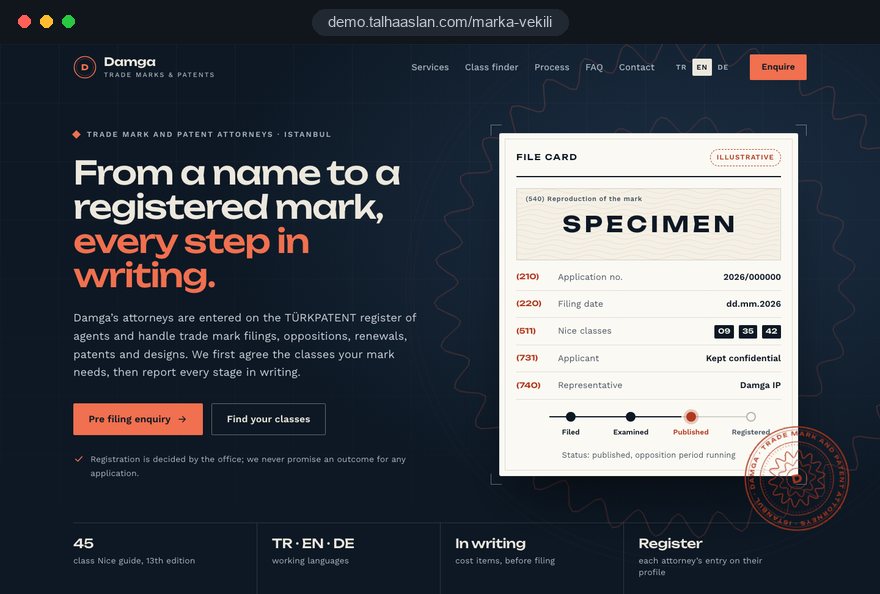
Most people who land on a trade mark attorney website are not clients yet. They have a name in mind, perhaps a logo, and a handful of questions; when the site answers those questions in the right order, the first call starts with real advice instead of a list of missing details.
This guide walks through the decisions an IP firm makes when planning its site, in the order they come up: the limits set by professional rules, process pages, a Nice class guide, the enquiry form, foreign applicants, search visibility and measurement. The final word on every legal statement stays with your attorneys; we build the structure and the wording around it.
01Map who arrives and with which question
Group your visitors before you write a page list, because each group enters through a different door and decides on different information. On a trade mark attorney website, five groups usually stand out, and each first question points to a different page.
- Founder choosing a name: Asks whether the name is taken and which classes to file in; the search step and the class guide speak to them.
- Growing business: Wants to extend an existing mark to new products or new countries; looks for additional class and international filing pages.
- Owner facing a conflict: Has spotted a similar application or received an opposition; needs the opposition process page and a fast way to reach someone.
- Foreign company or correspondent firm: Needs a local agent and wants the national procedure explained in English with a direct contact.
- Existing client: Comes back for a renewal, an assignment or a change of address; a short, visible contact route is enough.
For each group, note the entry page, the second page and the form they finish on. If a route takes more than three clicks, change the sitemap rather than adding copy. The home page then needs one sentence per group, each pointing to the right door.
02Read the publicity rules before the first draft
Copy and design decisions should follow the publicity rules of your regulator, not the other way round. For UK firms, the IPReg Code of Conduct requires publicity to be accurate, fair and not misleading, expects clients to receive clear information about the work and its costs, and keeps client affairs confidential unless the client consents.
Agencies in Turkey work under the 2021 regulation for patent and trade mark agents, which ties publicity to being truthful, impartial, honest and consistent with professional confidentiality and bans disclosing a client's identity without explicit consent. Elsewhere, check the rules of your own bar or professional body. Before drafting, we agree a short checklist with the firm:
- Outcome language: Describe the work, such as preparing the filing and managing the process, instead of promising registration.
- Client names: Logos, names or matter summaries only with written consent, with the date and scope of that consent kept on file.
- Numbers: Filing volumes or similar figures only when they can be documented and do not set up a misleading comparison.
- Titles: The exact regulated title for each attorney; words like "specialist" only where there is a clear basis.
- Costs: Official fees shown separately from professional fees, with what is included spelled out.
UK firms should also place their regulatory status and complaints procedure where clients can find them without searching.
03The anatomy of a service process page
Every service deserves its own process page built on the same skeleton, so a client who has read one page knows where to look on the next. For trade mark filing, oppositions, renewals, assignments, patents and designs, we suggest this order:
- A one sentence definition: What the service is and who needs it, without jargon.
- Who it does not suit: For example why a purely descriptive word is hard to register; this section builds trust and filters out unsuitable requests.
- Information and documents needed: The representation of the mark, applicant details and any power of attorney, listed item by item.
- The steps: Filing, examination, publication, the opposition period and registration, noting where the client has to act.
- Common questions: The five questions your team answers most often by phone or email, in your attorneys' own words.
- Next step: The enquiry form, opened with the page topic already selected.
How you present timescales and costs is a separate decision. Keeping official periods and fee items in one place with a "last reviewed" date is safer than repeating figures across pages. On patent pages, add a note asking inventors to speak to you before showing the invention at a trade fair, on social media or in an investor pitch.
04Writing a Nice class guide people can use
The class guide answers the founder's "which classes" question and brings them to you prepared. It should follow the 13th edition of the Nice Classification, in force since 1 January 2026, and say at the top which edition it is based on.
Copying the official class headings is not enough, because readers do not recognize their business in them. Explain each class with two or three example goods or services and a short business scenario. A café that roasts and sells its own coffee, for instance, needs class 30 for the coffee and class 43 for the café service; filing in one class leaves half the business uncovered.
Give commonly confused classes their own section:
- 9 and 42: Downloadable software versus software provided as a service, often confused for subscription apps.
- 25 and 35: Clothing itself versus the retail services of selling clothing.
- 30 and 43: Food products versus services for providing food and drink.
- 41 and 44: Education and training versus medical or beauty services, a frequent overlap for practices that also teach.
End each class page with a short note that class selection stays with the attorney, followed by the enquiry form. Set a fixed date each year to check the headings that changed when WIPO publishes a new version.
05Enquiry form fields that save the first call
The enquiry form should collect everything needed before the first conversation in one go, without tiring people with fields they cannot answer. Instead of a generic contact form, build a short form that adapts to the topic.
- Mark and type: Word, logo or both, with a logo upload and the accepted file formats stated.
- Business activity: Free text; the client does not need to know class numbers, only to describe what they do.
- Intended classes: Optional, and prefilled when the visitor arrives from the class guide.
- Target countries: Home market only or further countries, with a route to the international filing page.
- Applicant: Individual or company; full details can wait for the call.
- Preferred contact: Phone, e-mail or WhatsApp.
Route the form by topic. An opposition enquiry needs the publication date and the conflicting mark; a renewal needs the registration number. Those fields only add clutter to a new filing form, so show them when they matter.
Show a privacy notice at the point of collection, as UK and EU data protection law expects, encrypt the connection, and decide in writing where uploaded logos and documents are stored, who can see them and for how long. The thank you page should say when and through which channel you will reply.
06Building a trade mark search step responsibly
A search step meets the client's first curiosity on your site, but it does not replace a legal clearance search, and the page must say so plainly. Our team built the free trademark search tool and the trademark class finder on talhaaslan.com, so we know where a first screening helps and where it can mislead.
Finding an identical name is easy; the real risk lies in marks that sound or mean something similar and in related goods and services within the same class. A quick screening will not always catch these. The result screen should therefore contain three things:
- A clear note: "This is an initial screening, not legal advice; your attorney assesses similarity."
- Official sources: A pointer to the relevant official registers, such as UKIPO, EUIPO, the WIPO Global Brand Database or TÜRKPATENT, depending on your market.
- A next step: A button that carries the searched name and class into the enquiry form, so nobody types the same details twice.
Place the search step in the main navigation rather than burying it in a blog post; someone choosing a name looks for exactly this. Before launch, test it with known registered marks and misspelled variants. The wording of the result note deserves the same sign off as any legal page, because it is the sentence the client remembers.
07Attorney profiles that build trust
Clients hand their matter to a person, so attorney profiles are among the most read pages and should contain plain, verifiable information. Use the same headings on every profile:
- Title and register entry: Trade mark attorney, patent attorney or both, with the regulatory status or register entry that applies in your country.
- Areas of work: Filing, oppositions, patents or designs, limited to work the attorney actually does.
- Languages: The languages the attorney can correspond in with foreign clients.
- Background: Education and professional experience in a few sober sentences.
- Direct contact: An e-mail address that reaches the attorney or their team.
On the patent side, the technical field, such as mechanical engineering, chemistry or electronics, helps clients find the right person quickly.
Marking up profiles with structured data helps search engines connect each attorney to the firm, but nothing should be marked up that is not visible on the page. For a sole practitioner, the profile is effectively the home page: clients usually arrive by name or referral and want to confirm the person first, so put registration details, phone and e-mail on the first screen. When an attorney leaves, remove the profile the same day and redirect the old address to the team page.
08Showing experience without naming clients
Because client affairs stay confidential unless the client consents, the references area starts with consent and, where there is none, is built around the type of work instead.
For references with consent, we suggest these steps:
- Decide which client and which element you want to show: the name, the logo or a short description.
- Ask the client for written consent with a defined scope and duration.
- Have the text approved by the client and by the responsible attorney.
- Record the date of consent and what happens if it is withdrawn.
- Review the references area once a year and remove anything whose consent has lapsed.
Without consent, use an anonymous case format: a heading such as "Opposition against a similar filing for a food manufacturer", followed by the problem, the work done and the lesson. If sector, city and date together would identify the client, remove detail until they do not.
Describe outcomes through how the process was handled, not through promises, since registration is always decided by the office. If you show Google reviews on the site, state that they are the reviewers' own words, shown unedited, and ask for consent before highlighting a review that names a client's mark.
09Serving foreign applicants and correspondent firms
For many IP firms, English pages aimed at foreign applicants are a core part of the site rather than an extra. In Turkey, for example, applicants resident abroad can act before TÜRKPATENT only through a registered trade mark or patent agent, so foreign companies and the correspondent firms that advise them search in English for an agent there.
Build the English section around this reader's questions, not as a literal translation of your national pages:
- The national filing process: Steps, documents and power of attorney requirements in plain English.
- A page for correspondent firms: How to send instructions, the reply channel and the working language.
- International filings: Your role when a Madrid System application designates your country.
- Contact: An address handled in English, with your time zone stated.
Technically, each language version needs its own URL and hreflang annotations that reference every other version and itself; without reciprocal annotations, Google cannot pair the versions reliably. An automatic translation plugin does not do this job. We explain the planning in more detail on our multilingual website page.
Add further languages, such as German or Arabic, only when real demand arrives. On English profiles, state the correspondence language and a realistic note on response times; correspondent firms compare agents on exactly these details.
10Showing up for question searches and on the map
Clients do not only search for a trade mark attorney; they also search "how to register a trademark", "logo registration" or a class number, and the site needs a separate page for each of these questions. Process pages and the class guide meet these searches, while the home page introduces the firm and its attorneys.
- One page, one question: "Trade mark opposition" and "someone opposed my trademark, what now" are different intents; the second deserves its own section on the process page.
- Internal links: Each class in the guide links to the relevant service page, and each service page links to the form.
- Google Business Profile: The business name must match the real world name with no added keywords; keep category, opening hours and services current.
- Structured data: Firm name, address, phone and attorneys marked up exactly as they appear on the page.
- Author and date: Guide articles show the attorney who wrote them and the last reviewed date.
With little room for promotional tactics, visibility here comes mostly from organic search, so content should explain rather than sell. We describe how we approach search on our SEO services page. Before publishing, check that no other page already answers the same question; two pages competing for one search weaken each other.
11Speed, mobile use and security basics
Many visitors open the site on a phone, often the moment a name comes to mind, so pages must load quickly on mobile and the form must be easy to complete with a thumb. Google's Core Web Vitals give concrete thresholds, assessed as good when 75 percent of visits meet them:
- LCP of 2.5 seconds or less: Largest contentful paint measures how quickly the biggest element, such as the hero image, loads.
- INP of 200 milliseconds or less: Interaction to next paint measures how fast the page responds to a tap or click, which matters for class selection.
- CLS of 0.1 or less: Cumulative layout shift measures how much content moves while loading; a cookie banner that appears late above the form can ruin it.
On the class guide, list the headings and reveal detail in expandable sections instead of loading all 45 classes as one block. State the maximum file size on the logo upload, since someone on mobile data trying to upload a large file may give up halfway.
Monitoring the security certificate, protecting the admin area with two step login and keeping regular backups belong to the same foundation. You can see how we build the technical side on our web design services page.
12Measurement, consent and a content calendar
Measurement should be in place from day one and content should follow a fixed review calendar. The key events are few but clear.
- Form submissions: Recorded with the service page or class page they came from.
- Phone and WhatsApp clicks: Mobile visitors often choose these over the form.
- Use of the search step: How many people run a search and how many then move on to the form.
- Enquiries from English pages: Tracked separately, so you can see whether the work for foreign applicants pays off.
In the UK and the EU, cookie consent is needed before non essential tracking, and analytics should respect that choice; for visitors from the European Economic Area, Google also requires consent mode for its measurement and advertising features. On the content side, a yearly calendar keeps the guide trustworthy:
- When official fees change, update every cost statement on the site in the same week.
- When a new Nice version takes effect, update the changed headings in the class guide.
- When rules or case law change, correct the process page and its review date.
- Each quarter, reread the five most visited pages with an attorney.
13Common mistakes on trade mark attorney websites
Most mistakes come not from bad intent but from applying a generic business template to a regulated profession. Here are the ones we see most often, each with the better alternative:
- All services listed on one page: Give each service its own process page with steps, documents and questions.
- A wall of client logos without consent: Show only clients who agreed in writing and describe the rest as anonymous cases.
- Promising registration: Use language that describes your work and accepts that the office decides.
- A form with name, e-mail and a message box only: Ask for the mark, logo, business activity and target countries, routed by topic.
- An undated class guide: State the Nice edition and the last reviewed date at the top of the page.
- Machine translated English pages: Write separate pages around the foreign applicant's questions and connect them with hreflang.
To audit your current site, mark each item yes or no; two or more misses point to a structural issue, so start from the sitemap. A redesign of a trade mark attorney website should be decided by this audit; new colors or fonts do not fix a structural gap.
14Choosing a partner and the next step
Choose the team that builds your trade mark attorney website by how prepared it is for professional rules and process content; design samples alone are not enough. Ask to see how they have set up a class guide, an enquiry form and a disclaimer before, and ask these questions in the first call:
- Do you review our publicity rules before the first draft or after it?
- Who prepares the structure of the class guide, and who approves the class descriptions?
- Where are files uploaded through the enquiry form stored, and for how long?
- Do you plan the English pages as translations or as separate content?
- How do we work together on class and rule updates after launch?
We do not have a live client project in this field yet, so we show our approach on a live demo site built by our team, linked on this page. You can see our work in other sectors on our references page, and if your firm works alongside litigators on trade mark disputes, our law firm website page covers the related structure.
The price depends on the number of service pages, the depth of the class guide, the search step and the number of languages; fixed packages are listed in the pricing section of our web design page. To talk through your services and where your clients come from, get in touch with us, and we will put the scope and quote in writing.