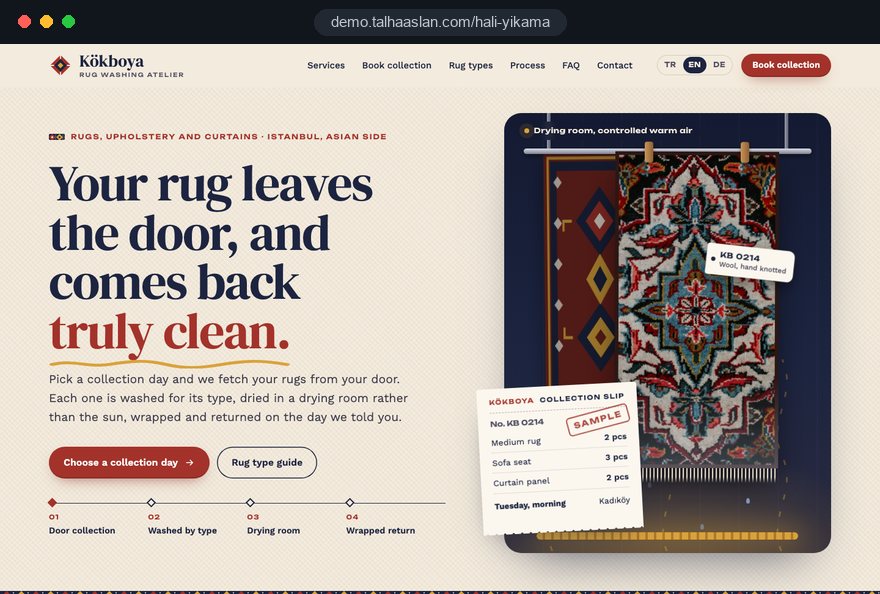
A carpet cleaning business runs a loop that starts and ends at the customer's door: request, collection, intake at the plant, washing, drying, wrapping and return. At every step of that loop, a website can answer the customer's question in advance, or leave it to the phone, to an argument on the doorstep and to a poor review.
In this guide, we at Talha Aslan and team follow that loop in order: a collection form built from the van's route, the areas and days table, rug type pages that say when you decline, turnaround written with its conditions, intake records, a separate flow for upholstery, the busy season, legal wording, map search and measurement. Our general project process is described on our web design service page.
01Map the journey of a rug before any page
Start planning with the journey a rug takes through your business, not with a list of pages; each step of that journey becomes a piece of information or a button on the site. A design drawn before this map exists may look polished, yet it leaves the real questions unanswered.
A typical loop for a carpet cleaning firm, and the job the website does at each step:
- Request: the customer checks whether you cover their area and fills in the collection form.
- Collection: the customer knows in advance which day and which time window the van arrives.
- Intake: the rug is measured, photographed and given a ticket number.
- Washing and drying: the customer wonders which stage the rug has reached.
- Return: delivery, payment and a joint check happen together.
- Afterward: a review request and a reminder for next season.
Next to each step, write two notes: what customers ask most at this point, and who answers that question today. Every step where the answer still comes from you on the phone is a place the site should handle first.
02Design the collection form from the van's route
The fields of the collection form come from what the person planning tomorrow's route needs; every detail you do not collect becomes a phone call later. That is why we write the form with the driver or operations lead who plans the route, not only with whoever handles marketing.
Asking that person what they need usually produces these fields:
- Location: postcode or ZIP code first, then the full address; structured input makes grouping requests by area easy.
- Load: number of rugs and rough sizes, to reserve space in the van and see the workload at the plant.
- Type: machine made, hand knotted, wool, viscose or shaggy, so rugs that need special handling are flagged early.
- Time: preferred day and a morning or afternoon window.
- Access: a short note on floor, elevator, parking and who will hand the rug over.
Split the form into two steps: location and day first, rug details and contact second. When customers see on the first step that you collect in their area on a given day, they are far more likely to finish. An optional photo field lets you see a stained or damaged rug before the van leaves.
The form must be easy to complete on a phone; run your current site through our mobile friendly test to check button sizes and keyboard behavior. In Google's Core Web Vitals, the good threshold for LCP, which measures how quickly the largest element on the page loads, is 2.5 seconds or less.
03Keep the areas and collection days table current
The areas table is the most read and least updated part of a carpet cleaning website; a table showing the wrong day creates more complaints than no table at all. So decide up front not only what goes in it, but who updates it and when.
A good areas table gives each town or district its own row with these details:
- Collection days: which weekdays you come, with a time window if you have one.
- Same day collection: whether you offer it, on what condition and for requests made before what time.
- Turnaround: an approximate normal season time, if it differs for that area.
- Drop off: the plant or a partner location where customers can bring a rug themselves, with opening hours.
We build the table as editable rows in the admin panel, so adding a town or changing a day takes five minutes and no developer.
If you are thinking about separate town pages, the test is simple: a page makes sense when there is real information specific to that town, such as a different collection day, a drop off point or regular requests from apartment buildings. Copies where only the town name changes tell neither customers nor search engines anything.
04Rug type pages that say when you decline
For the owner of a valuable rug, the most reassuring detail is when you refuse to wash one; a clear decline rule shows that you actually know rugs. So we build rug type pages that describe limits as well as methods.
A sample outline for a hand knotted wool rug page:
- Intake check: knot density, fringes, edges and earlier repairs noted on collection.
- Dye test: a small area tested for color bleeding before washing, and the method chosen by the result.
- Method: your approach to water temperature, hand work versus machine work and how detergents are chosen.
- Drying: why wool takes longer and is dried under controlled conditions.
- Decline rule: why a rug with running dyes, dry rot or fibers too weak to wash is refused, and what you suggest instead.
Viscose and shaggy pages answer different questions: why viscose can lose its sheen when wet, why long shaggy pile takes time to dry. On each page, describe only methods you really use; a machine or treatment you do not have will show on return.
These pages also shorten sales conversations. When someone calls to ask whether you can handle a vegetable dyed antique rug, sending a link to the right page replaces a long explanation.
05Write drying and turnaround times with conditions
Turnaround should never be a single number; it should come with the conditions that stretch it, because customers forgive delays they were warned about and resent the ones they were not. On a rug cleaning site, we give turnaround in three layers.
- Normal season time: roughly how many working days pass from collection to return, separately for machine made and hand knotted rugs.
- What stretches it: wet and humid weather, the busy weeks before holidays, stubborn stains and repairs.
- How you notify: which channel you use, and when, if the time runs longer.
A sentence like "our drying room works regardless of the weather, but wool rugs can take longer to dry" describes your real equipment and its limit at the same time.
Manage the figures from a single place. If the areas table, a rug type page and the FAQ show different numbers, customers remember the shortest one. Defining turnaround as one field in the panel and pulling it into every page means a single change keeps everything current during the busy season.
06Intake records, ticket numbers and status lookup
Explaining how a rug is recorded when it enters your plant is the most concrete protection against disputes about stains and damage. Customers hand over a valuable rug more readily when they know it is measured, photographed and tracked by a ticket number.
An intake record usually holds:
- Identity: ticket number, customer name and collection date.
- Size: measured dimensions and area.
- Condition: existing stains, worn fringes, loose edges and earlier repairs.
- Photos: an overall shot plus close ups of any visible defects.
State on the site how you measure: whether fringes are included, which measurement applies to round or irregular rugs, and that the measured size appears on the return ticket. Since customers give rough sizes in the form, saying in advance that the measured size may differ heads off the "that is not what I told you" conversation at delivery.
Ticket lookup is optional but effective: customers enter their number and see whether the rug is collected, in washing, drying or ready for return. Its value depends entirely on being current. If your staff cannot record each stage change with one tap, postpone this feature; a half working screen is worse than none. In that case, a WhatsApp or text message sent as the return date approaches meets the same need.
07Upholstery cleaning as a separate onsite flow
Upholstery cleaning is a different job from rug cleaning: the work happens in the customer's home, it takes up a crew's time, and the questions focus on fabric and drying time. It deserves its own page, its own form and its own booking logic.
What the upholstery form asks differs clearly from the rug form:
- Set: number of seats and pieces, and whether there is a sectional.
- Fabric: velvet, linen, leather or microfiber, plus a photo of the care label if available.
- Condition: pets, stains or odor problems.
- Timing: a suitable day and time window for the crew.
A short preparation section helps customers get ready: clear space around the sofa, what the crew needs in terms of water and power, how long the job takes and when the furniture can be used again. Honest drying times by ventilation and fabric help a customer expecting guests that evening pick the right day.
If you also clean mattresses, dining chairs or car seats, subheadings on the upholstery page are enough for most firms. Because upholstery cleaning is searched for on its own, a separate page also helps you appear for those searches independently of your rug pages.
08A separate flow for peak weeks and bulk pickups
The weeks before major holidays and the change of seasons need to be managed differently from the rest of the year; during these periods the site should help you manage capacity rather than simply collect more requests. A site that keeps taking bookings after you are full produces rugs returned weeks late and angry customers.
Tools that help on the site during peak weeks:
- Notice bar: current turnaround and the last collection date shown at the top of the home page, switched on and off from the panel.
- Closing days: collection days that are full can no longer be selected in the form.
- Early booking: customers can reserve a collection day weeks before the holiday.
Apartment buildings, property managers, hotels and offices need their own bulk pickup form. It asks for the number of units, total rugs, a suitable date and the manager's contact details; collecting many rugs from one address makes for an efficient route day.
If you run ads during peak weeks, a single goal campaign landing page keeps the main site intact and makes measurement simpler.
09Cancellation consent and duty of care in the form
If you serve domestic customers in the UK and the contract is made at a distance, through your site or by message, the Consumer Contracts Regulations 2013 apply to how you start work. Regulation 36 says a trader must not begin supplying a service before the cancellation period ends unless the consumer makes an express request, and that request must be on a durable medium for off premises contracts.
In practice, a customer who wants collection tomorrow is asked to tick a separate box requesting that the service start within the cancellation period. Under the same regulation, a customer who then cancels pays an amount proportionate to what was already supplied, and nothing if the trader failed to give the required cancellation information.
The Consumer Rights Act 2015, section 49, also includes a term in every service contract that the work is done with reasonable care and skill. Your site can show what that care looks like in your plant:
- Intake inspection: condition notes and photos taken at collection.
- Dye testing: the check made before any rug is washed.
- Fringe handling: how fringes and edges are protected during washing.
- Stain limits: a plain statement that not every stain comes out.
The form also collects names, phone numbers and addresses, so a clear privacy notice belongs next to it, along with cookie consent before non essential tracking where you serve customers in the EU. Keep the consent tick box separate from the privacy notice. Your final terms remain your legal responsibility; we build the structure and placement.
10Showing up correctly on maps and town searches
Most people looking for carpet cleaning search by town or with "near me" and look at the map first, so your Google Business Profile and your site must say the same thing in the same way.
A checklist for map visibility:
- Use your real world business name; Google's guidelines do not allow keywords such as "rug cleaning Croydon" added to the name.
- If your plant does not receive customers, set up as a service area business, hide the address and define your areas.
- Choose the category and service list based on what you actually do: carpet cleaning, rug cleaning, upholstery cleaning and other real services.
- Keep the site's areas table identical to the service areas in your profile.
- After each return, send a short review link and answer reviews calmly, negative ones included.
On the site, business name, phone, opening hours and areas served are marked up with structured data; nothing is marked up that does not appear on the page. You can check whether the markup reads correctly with our structured data tool.
Longer term search work, meaning content planning, technical audits and internal linking, is the subject of our SEO service. For a carpet cleaning site, the most valuable content is usually the rug type pages and area information that carries real detail.
11Show your plant and crew in real photos
Customers are handing a rug to a place they have never seen; real photos of your plant, wash line and drying room build that trust far faster than stock images.
A shot list for a single photo day:
- Entrance: the building with readable signage and the area where rugs are received.
- Dusting: the machine or process that removes dry soil.
- Wash line: the crew at work and the equipment you use.
- Drying: the drying room or hanging system.
- Wrapping and van: a wrapped rug and a van showing your company name.
If you show stain removal examples, use only your own work, with the customer's permission and without exaggeration. Saying on the same page that not every stain comes out makes the examples more believable. We do not yet have a live client project in rug cleaning, so we show this approach on a demo site; you can see our work in other sectors on our references page.
12Measure which area and channel brings requests
What matters on a carpet cleaning site is not visitor numbers but which area and which channel produce collection requests; those two facts shape your routes and your ad budget. Setting up measurement before launch is far easier than hunting for data afterward.
Events to track as conversions from day one:
- Collection form submission: together with the chosen area and rug type.
- Click to call: including the page the call came from.
- WhatsApp click: a chat opened with a prepared message.
- Form drop off: the step where people abandon the form.
Setting up the WhatsApp button with our WhatsApp link generator and a prepared message lets you see from the first line which page a chat started on. A QR code on the van, door hangers and the wrapping of returned rugs shows how many requests offline channels bring; use a separate code for each.
One table reviewed monthly is enough: requests by area, completed collections and the form step abandoned most often. An area with many requests but few collections usually points to a wrong collection day or a turnaround that is too long.
13Common mistakes on carpet cleaning websites
Most mistakes on carpet cleaning websites come not from design but from the site drifting away from daily operations. These are the ones we meet most often in planning, each with the better approach:
- Claiming to cover everywhere: list only the areas where you really collect, with their days, instead of a long list of places you never visit.
- Stating one turnaround figure: replace "back in two days" with normal and peak season times plus what stretches them.
- Asking only for name and phone: a short form creates callbacks; use a two step form asking for area, number of rugs, type and preferred day.
- Burying upholstery in the rug list: describe this onsite service on its own page with its own form.
- Starting work without the express request: collect the separate consent tick before booking a collection inside the cancellation period.
- Taking bookings when full: close full days in the form during peak weeks and show the current turnaround in a notice bar.
The shared fix is to keep the carpet cleaning site in step with your plant after launch, with areas, turnaround and capacity managed from one place in the panel.
14Choosing a partner and your next step
When you choose who builds your carpet cleaning website, look first at whether they ask questions to understand your routes and plant workflow; a proposal that starts with a page count leaves most of the decisions above to you. In a first call, these questions from an agency are a good sign:
- Which areas do you cover on which days, and who plans the route.
- Which questions do you hear most on the phone.
- Which rug types do you wash, and which do you turn away.
- How does capacity change in peak weeks, and who will update turnaround.
- Through which channels do requests arrive today, and who answers them.
In the proposal, check three things: whether you can update the areas table and turnaround yourself, whether measurement is set up from launch day, and how the privacy notice and consent tick sit inside the form. A proposal that does not answer these in writing leaves the hardest part of the work until after launch.
A link to a live demo site we built for this field is on this page; there you can see how the collection form, areas table and rug type pages work. The demo is not a client site; it was built to show our approach in concrete form.
When you are ready, send us your areas, collection days, the rug types you wash and your turnaround through our contact page, and we will put the scope in writing. Fixed price packages and online purchase are in the web design pricing section, and for a scope tailored to your rug cleaning business, the Get a quote form is enough.