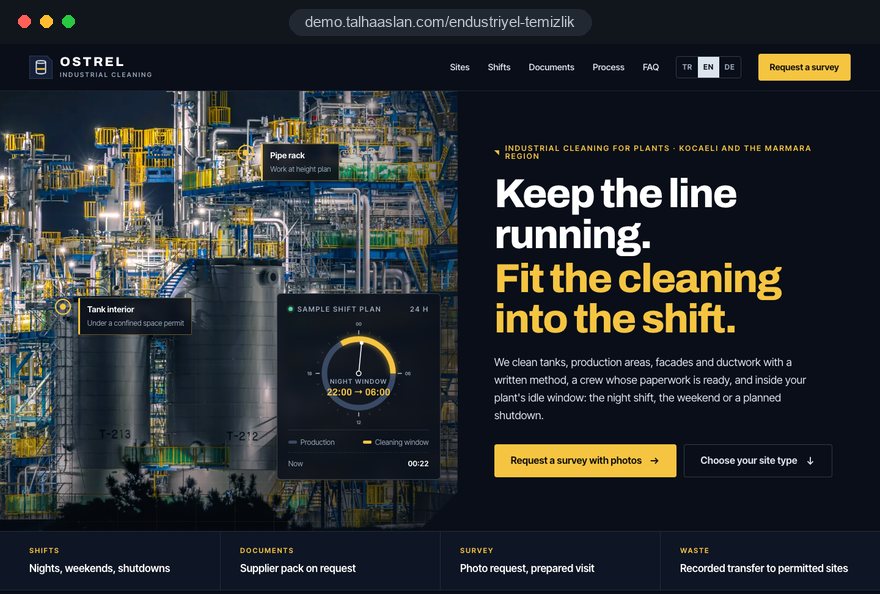
A plant rarely chooses an industrial cleaning contractor after one visit to a website. The maintenance engineer reads the method, the health and safety lead looks for paperwork, and procurement checks scope and timing; each of them arrives on a different day through a different page. The site's job is to answer each of those people on their own terms.
This guide walks through the decisions you make, in order, when planning a website for a contractor that works inside factories and industrial sites: which jobs earn their own page, how to write a method page, what goes public in your supplier pack and what stays private, how to prepare for shutdown season and how to use photos taken inside a client's plant. Every section ends with something you can check or ask your agency.
01Turning the plant's approval process into pages
Before any design work, write down the steps a plant goes through before adding you to its approved contractor list; your page structure comes straight from that list. In a large site, buying industrial cleaning services is rarely one person's decision.
- Need: A maintenance or production manager describes a problem: a tank with hardened residue, an oily line, a blocked extraction duct. They usually run the search and land on a work page.
- Method check: The same person looks at how you do the job. If the method is not visible, you do not make the shortlist.
- Safety review: The safety team asks about training, insurance, risk assessments and method statements (often called RAMS) and who supervises on site.
- Commercial review: Procurement compares scope, timing and past work, then asks for a survey or a quote.
- Site induction: Once approved, the first job is planned under the plant's permit to work and induction rules.
Compare this sequence with a real supplier questionnaire a client has sent you. Every heading on that form should have an answer somewhere on the site.
02Deciding which jobs deserve their own page
A job deserves its own page when a different person searches for it, it needs different equipment or it carries a different risk. Tank cleaning and facade cleaning may be done by the same company, but they are not bought by the same person; one is found by a process engineer, the other by a facilities or property manager.
Use these criteria when you decide:
- Different buyer: A production manager looking for factory cleaning and a facilities manager looking for ductwork cleaning will not meet on the same page.
- Different method: High pressure water jetting, vacuum recovery, dry ice blasting and rope access each need their own explanation.
- Different risk: Confined space entry, work at height and jobs involving chemical residue each need their own safety section.
- Different frequency: An annual shutdown clean and a weekly line clean lead to different contract types.
- Real track record: Do not open a page for work your crews have not actually done in the last couple of years; it shows at the first survey.
List the jobs that pass this filter and fold the rest into a paragraph on the closest page. Six strong pages bring more inquiries than fifteen thin ones. Link every work page to the same survey request and the same safety documents page, so whichever page someone lands on, the next step is one click away.
03Writing method pages like a public method statement
A good method page is a plain language, public summary of the method statement you would send to a client's safety team. After reading it, a maintenance engineer should be able to picture how the job will run on their floor.
Give every method page these headings:
- Suitable surfaces: Which materials and types of contamination the method suits and which it does not, for example what you use around sensitive electrical panels.
- Sequence: Isolating the area, locking out energy, cleaning, recovering residue and handing the area back.
- Equipment: The type and capacity of the machines you use, and whether they are your own or hired.
- What the plant provides: Water, power, compressed air, a waste staging area and the permit to work.
- When you say no: The conditions under which you will not take the job or will ask for extra controls.
The last heading is missing from most contractor sites, yet it builds more trust than anything else on the page. A line such as "we do not enter vessels that held this product without a prior analysis" tells procurement you take risk seriously. Write the method with your site supervisor; generic office written cleaning copy undermines it.
If one method serves several jobs, dry ice blasting for both molds and electrical cabinets for instance, explain it once on its own page and link to it.
04Explaining tank cleaning and confined space entry
A tank cleaning page should explain safety before method, because a plant's first question about this work is how you enter a confined space. With tanks, silos and vessels, the danger lies less in the cleaning itself than in entry, ventilation and rescue.
In the UK, the Confined Spaces Regulations 1997, regulation 4, allow entry only where the work cannot reasonably be done another way, and then only under a safe system of work. That is why a good tank cleaning page also says which jobs you can do from outside the vessel, for example with remote nozzles or vacuum recovery, before it describes entry.
From your own procedures, answer these questions on the page: who tests the atmosphere before entry and with what kind of instrument; how the person inside communicates with the attendant outside; who is responsible for rescue; and how your procedure fits the client's permit system. Do not paste regulation text onto the page; say what you do and have your health and safety adviser check the wording.
Separate tank types as well. A stainless storage tank in a food plant and a fuel or chemical tank need different methods, equipment and waste routes.
You do not need to name clients here.
05Safety documents and the supplier pack: public versus on request
The purpose of a safety documents page is not to publish documents but to show what you hold and to get it to the right person quickly. Under COSHH regulation 6, an employer must not carry out work liable to expose employees to hazardous substances without a suitable and sufficient risk assessment, which is why client safety teams ask for paperwork early.
Split the page into three layers:
- Public: The list of document types, insurance cover types, the role of the site supervisor and how you keep risk assessments current.
- On request: Insurance certificates, company documents, method statements and a completed supplier questionnaire, through a protected link or by email.
- Never published: Staff medical records and training records that carry personal details.
Health information is among the most sensitive categories of personal data under data protection law; it belongs neither on an open page nor in a public download folder, and it is shared only with the client who needs it, only as far as needed.
Plants owned by international groups are often assessed by a head office abroad. Translating the work, documents and survey pages may be enough; a full multilingual website makes sense once you serve several countries.
06Two separate doors: planned surveys and emergency callouts
A survey request for planned work and an emergency call after a spill or a blockage should never go through the same form. One needs detail, the other needs speed; a form that tries to do both serves neither.
The survey form can be detailed as long as it is split into steps. Step one asks for site type and location, step two for area or tank dimensions and the product inside, step three for working height and access windows, and the last step for photos and specifications. Make clear that dimensions can be entered in square or cubic meters or in imperial units; procurement often has the data in whatever unit the plant drawings use.
The emergency door should ask for no more than three things: address, what happened and a callback number. On a phone it sits at the top of the page with a click to call button. If you do not offer emergency response, say so plainly; a night call for a service you do not provide wastes everyone's time.
On the thank you page shown after submission, state when and who will get back to them. Buyers want to know how long to wait, and once that time passes they call the next contractor.
07Putting shutdowns and shift work up front
Showing that you can work without stopping production comes before price on an industrial cleaning website. Procurement often opens the first call with "do you work nights or weekends", and if the answer is not on the site, it may already have marked you as unsuitable.
Build a separate shutdown planning page and describe the steps like this:
- Early notice: State how many months before an annual shutdown you need the dates to reserve a crew.
- Pre shutdown survey: List the visit you make to confirm scope and the information you need from the plant.
- Crew and shift plan: Say how many shifts, how large a crew and which hours you can cover.
- Daily reporting: Explain how you keep the plant's shutdown coordinator informed while the work runs.
- Handover: Describe how the area is checked and returned and how waste leaves the site.
Add a sentence or two on how you handle lighting, noise and communication during night work when few plant staff are around.
Shutdowns cluster in certain months depending on the industry. Updating a short section that invites early booking ahead of the season helps you reach procurement's list in time; show it as one line on the home page as well.
08Describing waste handling clearly and accurately
Where the sludge, oil and chemical residue from a job ends up is a question plants ask more and more often. The site should answer it with your actual process rather than a general promise of responsible disposal.
Instead of listing regulations, walk through your process step by step: how waste is segregated on site, which containers it goes into, how it is labeled, where it is staged within the client's site and who carries it away. Which party is legally responsible for the waste and who arranges the transfer can differ from contract to contract, so do not phrase it as a blanket claim. Write it as "depending on the contract we work in one of these two ways".
Ask your team these questions before you write a word:
- Which licensed carriers and disposal sites do we use, and can we share that information on request.
- Which transfer documents do we hand to the client when the job is done.
- How do we collect wash water from jetting, and does it go to the plant's own treatment.
- How do we deal with the waste from cleaning our own equipment.
Leave out any sentence that your paperwork does not support. Have an environmental consultant review the legal wording, since waste rules differ between countries and regions.
09Using photos from inside a client's plant
Site photos are the strongest proof an industrial cleaning website can offer, but not every photo taken inside a plant can be published. Many sites restrict photography; machines, production lines and product labels can reveal things competitors should not see.
Run through this check before you shoot or publish:
- Written permission: Get the client's written consent to use images online, ideally as a clause in the contract.
- Anonymize: Choose angles or crops that hide logos, product names, machine plates and signage.
- People: Keep client staff out of frame and get consent from your own crew as well.
- Before and after: Shoot from the same angle in the same light; a single after photo does not show the difference.
- Context: Caption each photo with the method and the surface.
If you cannot name the client, "filling line cleaning at a food production site" is enough and honest. Compress photos before uploading; an eight megabyte image can stop the page from opening on a phone at the plant gate.
For jobs without site photos, clean shots of your equipment in your own yard work well. A clear image that shows the machine's size, attachments and the crew's protective equipment says more than a blurry site picture.
10Job reports and a client area for contract customers
For a plant on an annual contract, the value of your site does not end at the quote; reaching every job report in one place makes the contract easier to renew. Many industrial cleaning contractors still email reports as attachments that nobody can find six months later.
A simple password protected area for contract clients can hold the date and scope of each job, before and after photos, the method used, the supervisor's signed checklist and the waste transfer documents.
Watch two things when you build it. First, each plant must see only its own records; if access rights are not set up correctly from the start, fixing them later is costly. Second, the report must be easy to complete on a phone; the crew should take photos and tick the checklist at the end of the job, not retype everything back at the office.
A ready made form tool can work for a handful of sites. Once contracts multiply and you want work orders, crew planning and reports in one place, a client area built as custom software is the sounder choice.
11Showing up in engineers' searches and measuring inquiries
Searches for industrial cleaning are rarely generic; they name a job and a method, such as "silo cleaning contractor", "dry ice blasting for injection molds" or "factory cleaning during night shifts". Each work and method page title should answer one of those searches directly.
Area pages are tempting, but copies where only the town name changes do not earn value in search. If you genuinely work across a particular industrial estate or region, one page describing the plant types there and how you mobilize is more useful. In your Google Business Profile, use your real business name; adding keywords like "tank cleaning" to the name breaks the guidelines. Regular SEO work builds on that foundation.
If you want search ads before shutdown season, a small, job focused Google Ads campaign that sends each ad to the matching work page rather than the home page is usually enough.
Set up measurement from day one and count these as conversions:
- Survey form submissions, and the step where people drop out.
- Call and WhatsApp clicks, with the emergency button tracked separately.
- Requests for the supplier pack.
- Quotes that turn into annual contracts, logged in your CRM with the source page.
In the EU, cookie consent is needed before any non essential tracking; check the equivalent rules wherever your site's visitors are.
12Pages opened on a phone on site, and quote emails
Your industrial cleaning website is opened by procurement at a desk and just as often by a maintenance engineer on a phone in the plant, so speed and simplicity are requirements, not polish.
Google's Core Web Vitals treat these values as good: LCP, which measures how quickly the main content loads, at 2.5 seconds or less; INP, which measures how fast the page responds to a tap, at 200 milliseconds or less; and CLS, which measures how much the layout jumps while loading, at 0.1 or less. Have these measured before launch, and check your current site today with our mobile friendly test.
Keep the downloadable supplier pack light as well. A scanned PDF of hundreds of pages opens slowly and cannot be searched.
Quote emails are part of the same chain. Corporate mail servers can send messages from domains with missing authentication straight to spam. Make sure SPF, DKIM and DMARC records are set correctly on your domain; if procurement goes silent after you send a quote, this is the first place to look. You can check it in seconds with the free SPF, DKIM and DMARC checker.
13Common mistakes on industrial cleaning websites
These mistakes look unrelated, but they share one root: the site puts the contractor's wish to talk about itself ahead of the plant's questions. Each comes with a better alternative.
- Using a domestic cleaning template: A template built for home cleaning pushes prices and bookings; use a structure built around surveys and supplier approval instead.
- Putting every document in one public PDF: Personal data ends up exposed; keep the list public and share the documents on request.
- Listing work you do not really do: It surfaces at the survey and damages trust; open pages only for work your crews do regularly.
- Publishing plant photos without permission: It puts the client relationship at risk; get written consent and hide logos and labels.
- Burying the emergency line inside a long form: Nobody fills in five steps during a spill; make the emergency door three fields and one tap to call.
- Forgetting the site during shutdown season: An outdated notice suggests the business is not active; keep a pre season update schedule.
Most of these are content decisions rather than design decisions. Go through the list with your agency before you see the first draft.
14Choosing the right team and your next step
When choosing an agency for an industrial cleaning website, the first thing to watch is whether the team tries to understand your approval process, for instance by asking for your supplier questionnaires and site procedures in the first meeting.
Ask these questions in that meeting:
- How will you decide the steps of the survey form, and will you speak to our site team.
- Who will write the safety and waste wording, and who will check it.
- What do you suggest for jobs we have no photos of.
- How will we see which page an inquiry came from and whether it became a contract.
- Who updates the content ahead of shutdown season.
If you are curious how the manufacturers you work for build their own sites, our manufacturer website page offers a useful comparison. A live demo we built for industrial cleaning is also linked on this page; it shows the structure as an example, not as a client site.
You can read about our general approach on our web design service page and see fixed scope packages in the web design pricing section. To talk through your list of services and the documents plants ask you for, request a free initial call, and we will come back with a written scope and quote.