The collection lives on Instagram
Gowns disappear in the feed. A bride looking for an A line or backless dress cannot filter by silhouette, fabric or sleeve, and your shop never appears when she searches for a style on Google.

Your Windows contrast theme is on; colours come from your system.
Your device is set to reduce motion; animations are already off.
Your choices are saved in this browser only.
Industry-specific web design
Brides usually start looking for a wedding dress many months before the day, scrolling through gowns on their phone. Once a silhouette clicks, they want a fitting, and then they want to know whether a made to measure gown will be ready in time. We build bridal websites in that order: searchable gown pages, fitting requests that arrive with every detail, and a timeline read backwards from the wedding date. We work remotely with bridal shops in the UK and elsewhere.
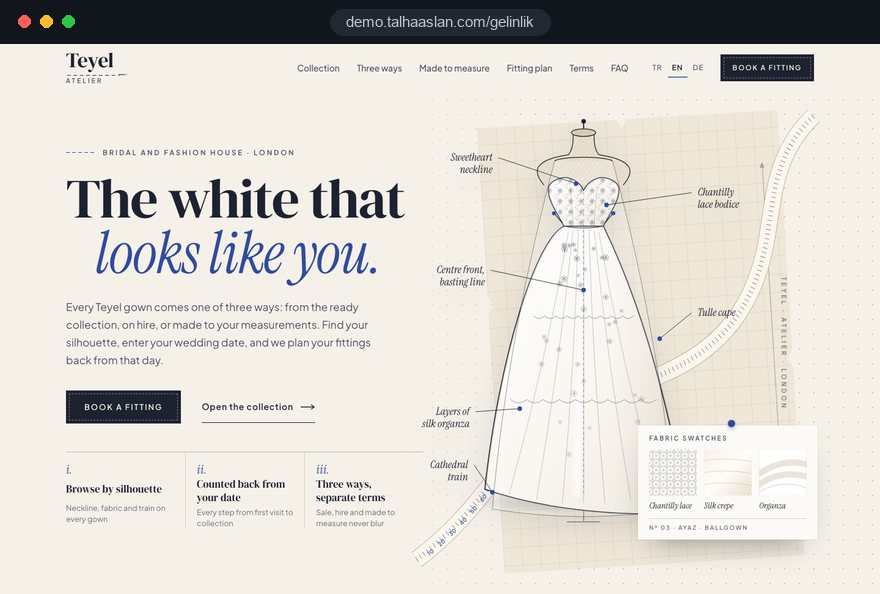
Open the live demoA demo design we built for a fictional brand
In short
A bridal shop website shows the collection gown by gown, invites the bride to a fitting through one form and explains the made to measure process against her wedding date. It should separate gowns for sale, for hire and made to order. In the UK, goods made to the consumer's specifications are excluded from the right to cancel a distance sale, and the shop must say so before the order.
Talha Aslan and teamLast updated:
Why it needs its own approach
A wedding dress is a once in a lifetime purchase that takes months. Brides want to see the gown, book a fitting and be sure it will be ready; a generic shop template supports none of these steps.
Gowns disappear in the feed. A bride looking for an A line or backless dress cannot filter by silhouette, fabric or sleeve, and your shop never appears when she searches for a style on Google.
Requests are split across DMs, calls and WhatsApp, and the wedding date, size range and number of guests coming along all have to be asked again. Saturday fittings clash and some requests never get an answer.
Brides do not know how early to order, how many fittings to expect or when they will collect the dress. Without that on the site, they arrive too late or put the decision off.
It is not clear which gowns are for sale, which are for hire and which are made to measure. The same photo creates three different expectations, and half the first appointment goes on explaining it.
For shops that take orders online or by phone, the UK Consumer Contracts Regulations 2013 exclude goods made to the consumer's specifications or clearly personalised from the right to cancel, and the trader must tell the consumer before the order. When this is missing, arguments about deposits start at collection.
Brides search for a bridal shop near me or add their town. If the address, opening hours and Google Business Profile are not backed up by the site, they miss a shop a few streets away.
Sources: Consumer Contracts (Information, Cancellation and Additional Charges) Regulations 2013, regulation 28, legislation.gov.uk · Consumer Contracts Regulations 2013, Schedule 2 (o), legislation.gov.uk
Our approach
We do not build a bridal website like a lookbook; we build it around the bride's journey. First she finds a gown close to what she has in mind, then she asks for a fitting, and finally she learns how the dress will be ready for her day. That is why every gown has its own page, every page ends in the same fitting request and the made to measure process has a page of its own.
If brides should pick their own fitting slot, an online fitting calendar is connected to the site; for a large collection, gown pages become filterable with a catalogue structure. A single goal landing page can launch a new season without disturbing the main site.
Design, development and content sit in one team, so collection, fittings and terms of sale are not patched on later. Talha Aslan sets the strategy and an experienced team handles delivery, working remotely and in English with shops abroad.
Home
Each gown page answers its own search, and all of them lead into the same fitting request and timeline.
The right setup
All three start from the same foundation; how you sell and what sits at the center of the brand make the difference.
Ready collection
Brides choose on the site and try on in store; sale and hire run side by side.
Made to measure
The brand is the designer's name; the site tells the story of signature pieces and the making.
Remote orders
The bride may never visit; measuring, video fittings and shipping are written on the site.
Built for bridal
These are the points that need the most decisions when we plan a bridal shop or fashion house website.
Front, back and detail photos on each gown's own page; silhouette, neckline, sleeve, fabric and train; and a clear note whether the gown is for sale, for hire or made to measure. Whether to show prices is a decision we make together with the shop.
Wedding date, preferred fitting day, size range and how many people are coming are asked in one form. Requests are collected in one place with their source, and a WhatsApp button sits on every page.
Order, measuring, fittings and delivery are explained backwards from the wedding date. We write the durations from your atelier's real schedule, so brides know when to come in before their first visit.
Under regulation 28 of the Consumer Contracts Regulations 2013, goods made to the consumer's specifications or clearly personalised are excluded from the right to cancel, and Schedule 2 requires telling the consumer this before a distance or off premises contract. We give deposits, alterations and delivery their own page; the legal check of the wording belongs to your shop.
Wedding photos of your own brides are far stronger proof than stock images. We use only shots cleared for publication and suggest keeping a record of each permission in the shop.
Address, map, parking and public transport, opening hours and fitting days. Brides who know the way before they set off are less likely to postpone a fitting.
Sources: Consumer Contracts (Information, Cancellation and Additional Charges) Regulations 2013, regulation 28, legislation.gov.uk · Consumer Contracts Regulations 2013, Schedule 2 (o), legislation.gov.uk
Comparison
| Topic | Generic shop template | Site built for a bridal shop |
|---|---|---|
| Collection | One gallery of uncaptioned photos | A page per gown: silhouette, fabric, detail shots |
| Fittings | A general contact form or just a phone number | A fitting request with wedding date and size range |
| Made to measure | Not explained at all | Order, measuring, fittings and delivery on a timeline |
| How it is sold | Sale and hire in the same photo | Sale, hire or made to order shown per gown |
| Terms of sale | Deposits and returns agreed verbally | Pre contract information and deposit terms in writing |
| Measurement | Visitor numbers | Which gown and which page bring fittings |
Quick check
Must haves: does your site have them?
0 of 6 in place Tick the boxes to see where your site stands.
Added as needed
We choose which of these you need together during the scoping call.
Share how many gowns you carry, your balance of sale and hire and your fitting days; we will come back with a page structure and a written quote.
Process
We define your business, your audience and the site’s one-sentence job: who it sells what to, through which action. Scope and timeline are written from that answer.
The home page and key templates come to you as designs first; no code is written before your approval. We do not like surprises, and we do not cause them.
The approved design becomes fast, secure, maintainable code. You follow progress in the CRM and see every page in a staging environment before launch.
The site goes live with analytics, Search Console and conversion tracking connected; panel training is given, first-year hosting and maintenance included.
Search and speed foundations
Brides search for an A line wedding dress, a simple registry office dress or a bridal shop in their town. Gown pages, the shop page and the Google Business Profile are built to support each other.
Shop name, address, phone and opening hours are marked up so search engines can read them; nothing is marked up that is not on the page.
A bridal site lives on photography. Images are converted to modern formats and sized, load only when they come into view, and Core Web Vitals are measured before launch.
Fitting requests, calls and WhatsApp clicks are tracked as conversions from day one, so you can see which gown leads to a fitting.
Free tools
Before planning a new site, see how your current one opens on a phone, how heavy your photos are and how it looks when shared. The tools are free and need no sign up.
Tech SEO
Test whether a page works well on phones: viewport, font size, tap targets, a mobile screenshot and Core Web Vitals.
Image
Resize + compress photos and cut the KB; never leaves your device.
Image
Convert between JPG, PNG and WebP in one click or in batches; it detects the input format, lets you set quality and a background for transparency, and uploads nothing.
Sharing
Preview how your link looks on WhatsApp, Facebook, X, LinkedIn and Telegram, and find missing Open Graph tags and image problems.
Conversion
Create a wa.me link with a preset message + embeddable button code.
Conversion
Turn URLs, WhatsApp, Wi-Fi, vCard and text into a QR code in seconds; download high-res PNG or SVG.
How we work
We do not yet have a live client website in bridal, so we show our approach on a live demo site. The demo is not a client site. You can see our work in other sectors on the references page.
Live demo
For this field we built a one page demo site for a fictional brand, made only to show our approach. You can explore the design, the copy structure and the mobile view live in three languages.
Open the live demoWe list with you what brides ask most at the first fitting and answer size, timing, alterations and delivery on the site upfront.
We group your gowns by silhouette, fabric and how they are sold, and write a short, honest description for each one.
Order, measuring, fitting and delivery times come from your atelier's real schedule; the site never promises a time you cannot keep.
We track which gowns bring fittings and bring the new collection and key styles forward ahead of wedding season.
Related pages
Industries
For the venue side of the wedding: halls, capacity and date checks.
Industries
A portfolio led structure for wedding photographers.
Solutions
Let brides pick their own fitting slot from a calendar.
Solutions
Show a large collection as a filterable catalogue.
 Lead Form Design for Booking, Quote and Demo Requests: UX Rules That Lift ConversionsRead article
 Professional Photography for Websites: What It Adds and How It Beats Stock PhotosRead article
 Why Is My Instagram Ranking Above My Website on Google? How to Win Back Your Brand SearchRead article
 How to Do Google Maps SEO: A Guide to Ranking Your Business Higher on the MapRead article
FAQ
If your question is not here, write to us; we will send you an answer and a written quote.
Next step
In a free 15-minute call, in English, we will go through your collection, your fitting routine and your made to measure process, then send a written scope and quote.
In-depth guide
A bridal shop website quietly does three jobs at once: it is a product catalog, an appointment book and the place where the terms of sale are explained before anyone pays a deposit. The bride looks at gowns first, then asks for an appointment, and only then wants to know how made to measure, deposits and collection work. When one of those three jobs is missing, your consultants end up explaining it from scratch in the first appointment.
In this guide, Talha Aslan and team walk through the decisions we make, in the order we make them, when we plan sites for bridal boutiques, fashion houses and design ateliers. Each section ends in something you can check or change in your shop or on your current site this week.
The structure of a bridal website is set by where your revenue comes from, not by a design trend. A shop that mostly hires out gowns and a house that only makes to measure need different menus; built on the same template, both attract brides with the wrong expectations.
Before any planning, open last season's records and work out three numbers for yourself: how many gowns you sold off the rack, how many you hired out and how many you made from scratch. We never publish these numbers; we use them only to find the center of gravity of the site.
Writing this decision down shortens every later discussion. It tells the photographer which gowns to shoot, tells us which questions belong on the appointment form and sets how detailed the terms of sale page has to be.
Treat every wedding dress as a product record with fixed fields; a defined set of fields is what makes filtering and search visibility possible. Information typed freely into Instagram captions turns inconsistent once it moves to a site: if one gown says "A line" and the next says "A shape", the filter breaks.
Once the number of gowns grows, this becomes a catalog style website. These are the fields we recommend for each record:
Avoid dates and season codes in gown names; "Collection 2026 No. 14" tells the bride nothing and looks dated the moment the season turns. A short name that is easy to say, followed by two honest sentences, is enough. Instead of "dreamy", say what the gown does well: a skirt that moves freely, sleeves suited to a church ceremony, a short train that copes with an outdoor venue.
Bridal photography for a website is sales photography: instead of one beautiful frame, each gown needs a consistent set shot from the same angles. When brides compare gowns side by side and the angle and light keep changing, they end up judging the photo rather than the dress.
That many photos put speed at risk on a phone. Lace needs to stay sharp when zoomed, but the first view must not download heavy files. We use small compressed images on listing pages, files matched to screen size on gown pages and a high resolution version that loads only when the bride taps to zoom. In Google's Core Web Vitals, the good threshold for LCP, which measures when the largest image or text block has loaded, is 2.5 seconds or less, and for CLS, which measures layout shift, 0.1 or less.
You can check how heavy your current photos are with our image resizer before they go online. Putting the gown name and cut into file names and alt text helps both accessibility and image search.
How prices appear on the site is a brand decision, and it changes the layout of every gown page. There are three common options, and each one shifts what the main call to action should be.
Whichever you choose, naming what drives the price keeps the bride's question from hanging in the air: fabric, amount of handwork, train, changes to the pattern and delivery time. For hire, spell out what the hire fee covers, such as cleaning, minor adjustments and the collection day.
One warning for shops that keep prices off the site: "DM for price" sends the bride back to Instagram and cuts the request off from your website. Write the form at the end of each gown page so that it also handles price questions; that way the request stays measurable.
The bridal appointment form is a short pre consultation that lets the shop meet the bride prepared, but every extra field raises the chance she abandons it. We keep required fields to a minimum and make the rest optional.
Putting the wedding date near the top lets the shop prioritize: a bride marrying in a few weeks and one marrying next year should not wait in the same queue. Under the form, add a one line link to your privacy notice and a short sentence about what happens next, such as "We will call to confirm your appointment."
For brides who prefer to message, the WhatsApp button on each gown page can open with a prefilled text that includes the gown name, so the chat starts with the dress rather than "hi, price?". Requests from the form and from WhatsApp should land in the same list; otherwise two channels hand out the same Saturday slot.
Bridal appointment capacity is squeezed into a few days a week, and the site can help spread demand instead of piling it onto Saturdays. The way to do that is not to expose your raw calendar but to define appointment types and lengths clearly.
If you want brides to pick a time themselves, an online appointment booking setup can be built, but only if one calendar is the single source of truth. Keeping slots in a paper diary and on the site separately leads to double bookings. Shops with few consultants often do better with a request form and a confirmation call, adding self booking as a second step once requests grow.
The job of the made to measure page is to answer "when should I come in" before the first visit. The clearest way to do that is to list the steps backwards from the wedding date.
We never take durations from industry averages or competitors' sites; the time on the page is the time your atelier can commit to. If you depend on imported fabric, say so. A bride who understands why she is waiting accepts the collection date more easily.
Link this page from every gown that can be made to measure. One tap from the gown to the timeline answers "will this dress be ready for my wedding" without a message.
If you sell to brides who cannot visit, the site has to do your consultant's job in writing. The flow has three parts: measurements, a video consultation and shipping.
When brides abroad become a real share of your orders, translating the menu is not enough. Measurement units, shipping and customs notes and your contact hours need writing for each target country. If that demand is growing, planning a multilingual site structure from the start is far less work than copying pages later.
Keep every remote order in one record. If measurements, the approved gown and change requests are scattered across chats, disputes follow at delivery.
For a bridal shop that takes orders online or by phone, the terms of sale page is not a formality; it is the document that prevents arguments at collection. In the UK, regulation 28 of the Consumer Contracts Regulations 2013 excludes goods made to the consumer's specifications or clearly personalised from the right to cancel a distance or off premises contract, and Schedule 2 requires the trader to tell the consumer this before the order.
The exclusion covers goods made to her specifications. How a ready gown shipped in a standard size, or a hire, is treated is a question for your legal adviser, and the site should explain these three cases under separate headings. Outside the UK, check the consumer rules of each country you sell into. The page should cover at least:
We build the structure of this page and the confirmation checkbox before the order; the legal check of the wording belongs to your shop. Real bride photos need the same care: publish only shots with written permission from the bride and the photographer, keep the records in the shop.
Collections change every season, but deleting old gown pages throws away the search traffic they have built. A rule decided in advance for discontinued gowns turns season changes into routine work.
If you want a page out of search results, do not block it in robots.txt; keep it crawlable and add a noindex tag, because Google cannot read the noindex on a page it is blocked from crawling. Checks like this sit in the seasonal checklist of our SEO service.
Tie the season change to a calendar so there is time for the collection shoot, entering the new gown records and deciding on old pages.
Brides do not only search for "bridal shop"; they add their town, a silhouette, or related items such as bridesmaid dresses, veils and civil ceremony dresses. Each of those searches needs a page to land on, or your shop does not appear for them.
For local visibility, your Google Business Profile and your site should say the same thing. Google's guidelines require the business name on the profile to match your real world name without added keywords; a name like "Shop Name Bridal Wedding Dresses Downtown" risks suspension. Keywords belong in the category, the description and the pages on your site, not in the name.
Creating several pages for the same silhouette backfires, because near duplicates compete with each other in search. Make sure each page answers one search and leads to an appointment in one tap.
On a bridal website, success is not the visitor count; it is which gown and which page bring in appointments. Without that, decisions about the collection shoot, next season's buying and promotion are made on instinct.
Step four happens outside the site, but it is where the value lies. A gown that gets many requests and few orders suggests its photo or description is setting the wrong expectation. If you have visitors from the European Economic Area, remember that in the EU cookie consent is needed before non essential tracking, and Google requires consent mode for measurement and personalized advertising features for those users.
Once this is in place, choosing which gowns go on the home page next season stops being a debate and becomes a question your records can answer.
Most of the problems we see on bridal websites come not from design but from shop knowledge that never made it onto the site. These are the ones we meet most often, each with what to do instead:
If three or more of these apply to your current site, fixing the content structure will make a faster difference than a visual redesign. To see how your current site behaves on a phone, start with our mobile friendly test.
When you choose a team for your bridal website, look less at how pretty their portfolio is and more at whether they ask how your shop actually works. If nobody asks about your sales mix, your appointment routine or your atelier's lead times in the first meeting, you are likely to get a generic store template.
We answer these in writing together with the quote. We do not yet have a live client site in bridal, so you can see our approach in the live demo linked on this page and look at our work in other sectors in our client references. The full scope of what we build is on our web design service page.
Fixed packages are in our pricing section; for a written scope and quote based on your shop, get in touch with us.
Start a Project
Thanks {name}, we've received your brief. We usually reply within the same day.
What happens next?