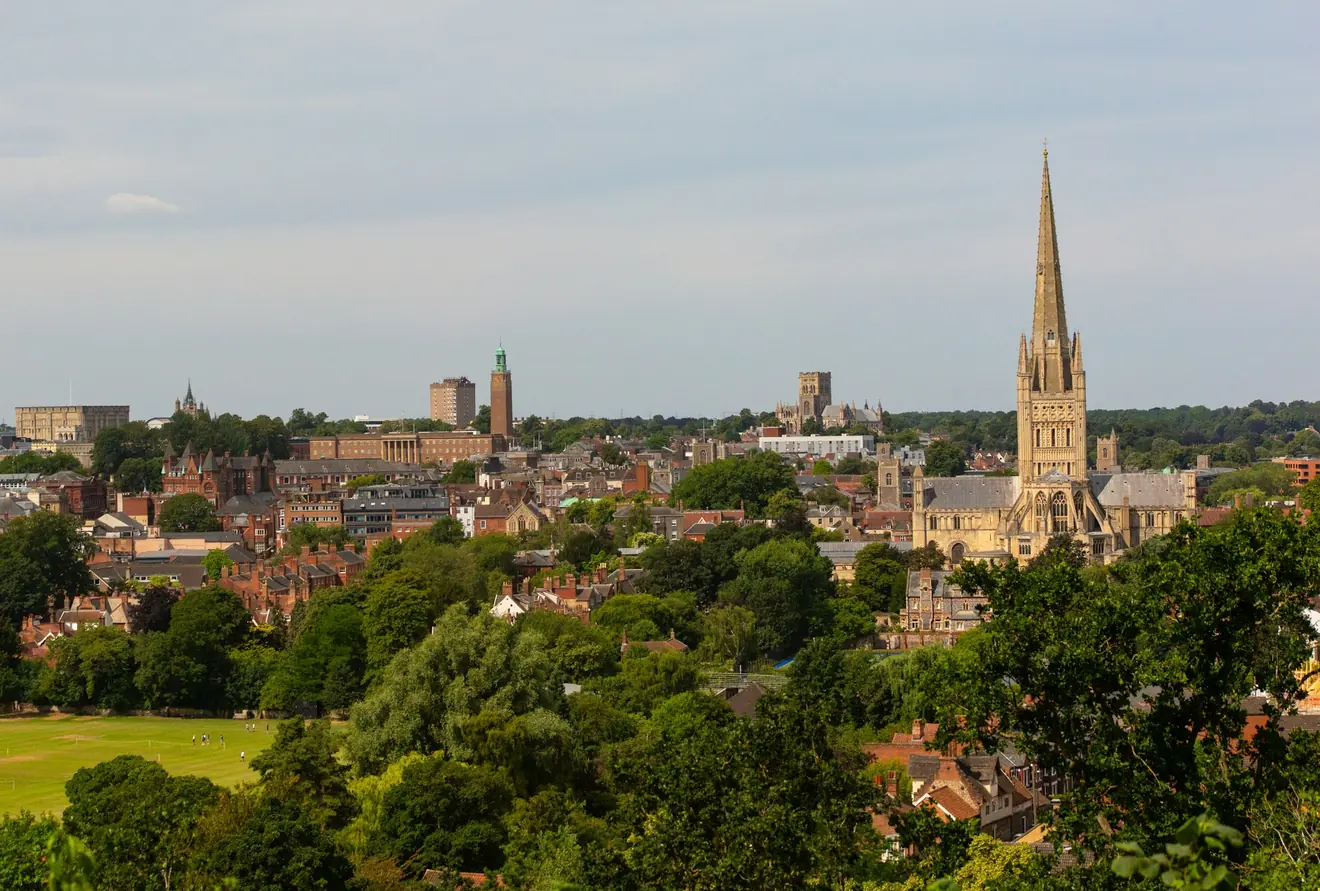
Norwich packs an unusual mix of readers into a compact city. An adviser near the Aviva offices on Surrey Street, a spinout at the Research Park in Colney and a guest house close to Tombland all compete for attention on the same small phone screen, often from people who have never met them.
This guide is for owners about to commission a site or replace one that has fallen behind the business. It follows the order in which decisions really arrive, and every section leaves you with a task: a criterion to apply, a question for any studio or a choice worth putting in writing.
01What a Website Has to Do in Norwich's Economy
A Norwich website usually has to earn trust from a cautious buyer and attention from a young one at the same time. The ONS put the city at 145,676 residents in mid 2025, and 15.5 per cent of them were aged 18 to 24, close to double the English share of 8.3 per cent. The median age of 35.6 sits five years below the national figure.
Four forces decide who reads a typical site here:
- Insurance and financial services: the Norwich Union Fire Insurance Society dates from 1797, and its successor Aviva still has its registered office in the city, so careful, compliance minded readers are common.
- Life sciences: the Research Park brings together UEA, the John Innes Centre, the Quadram Institute, the Earlham Institute, The Sainsbury Laboratory and the hospital, which creates technical buyers and investors.
- Students and young residents: they arrive by phone, often from a shared link, and decide in seconds.
- Visitors and the literary scene: the cathedral, the City of Literature title and the Broads bring readers who plan before they travel.
Rank these four for your own business before anyone sketches a homepage. The top one sets the tone of the copy; the second decides which secondary route the menu offers.
02Who Searches in Norwich, and With Which Words
Search behaviour in Norwich follows the academic year, the visitor season and the slower rhythm of financial decisions. Each pattern needs different pages, so it pays to write them down before a site map exists.
- Term start searches: in September, new students and staff look for rooms, haircuts, gyms, bike repairs and part time work, usually with "near me" or "near UEA".
- Neighbourhood searches: residents type "dentist Eaton", "electrician Thorpe Hamlet" or "nursery Lakenham", and the map pack answers before any website does.
- Considered searches: people choosing a pension adviser or a broker compare three or four firms over weeks, reading about pages and fee explanations closely.
- Visitor searches: "things to do near Norwich Cathedral", "boat hire Broads" or "Elm Hill café" peak at weekends, in school holidays and around the Norfolk and Norwich Festival in spring.
Choose the two patterns that bring you paying customers and list five real phrases for each. Any phrase that lacks its own page today goes straight into the scope. That list is a sounder starting point for web design Norwich decisions than any competitor's homepage.
03Hiring a Studio in Istanbul: The Tests to Apply
A remote studio is a sound choice only when every agreement is written and every stage can be inspected. For web design Norwich clients the point matters: our team has no office, agent or employee in Britain, so a Norwich firm should hold us to stricter standards than an agency a few streets from the Guildhall.
Questions worth putting to any studio, near or far:
- Who exactly attends each call, and do written notes arrive the same day?
- Can our staff open the protected preview from the office network at any hour?
- Who drafts the British English copy, and who checks regulated wording before it goes live?
- How are changes requested after sign off, and where are they recorded?
Istanbul keeps UTC+3 all year. During British Summer Time our clocks run two hours ahead of Norfolk, and in the GMT months the gap is three hours, so a call at nine in your morning lands at eleven or noon for us. All our finished work is in Türkiye, with live sites on our project references; we have no UK client yet, so open a few of them on your phone and judge for yourself.
04Owning the Domain, Hosting, Code and Logins
Every asset your website depends on should sit in the company's name, never in a designer's account or a former manager's inbox. In regulated finance, a lost login can delay an urgent wording change; in a spinout, it can stall due diligence when an investor asks who controls the domain.
- Domain: .co.uk suits firms serving Norfolk and the rest of Britain; .com makes sense for research companies with partners abroad. Either way, the registrant should be the business itself, with a shared mailbox as contact.
- Hosting and DNS: the hosting contract is yours, including the DNS panel that points the domain at the server and at your email.
- Code and design files: delivered on launch day, together with font and image licences and written permission to reuse the design.
- Google accounts: Business Profile, Search Console and analytics created under a company account; the studio joins as a removable user.
Ask for a one page access register at handover listing each service, its owner and its renewal date. Put a reminder in your calendar for the domain renewal, because a lapsed domain takes your email down with it.
05From First Video Call to Launch, Step by Step
A web design Norwich project run remotely stays calm when every stage ends in something you can click, test and sign off. Norwich projects run entirely from Istanbul; should you travel to Türkiye, we are glad to welcome you at our office in Ataşehir, though nothing in the schedule depends on such a visit.
- Briefing call: we discuss your readers, from Golden Triangle residents to procurement teams at the Research Park, and the one result the site must deliver first.
- Signed scope: pages, functions, languages, who supplies which content and the sign off dates, all in a single document.
- Site map and wireframes: menu, service pages and enquiry routes walked through together on screen.
- Design in a browser: real copy and real photographs, viewed on your own phone and laptop rather than in a static mockup.
- Build and testing: forms, consent, speed, accessibility and redirects checked before switch over.
- Handover: a recorded walkthrough so the person who edits the site can work alone.
Plot sign off dates against your own year. A broker's renewal season, a grant submission or the week before Freshers' Week will absorb your staff, and a skipped review slows a project more than any coding task.
06Local Search Across the Wards and the NR Area
Local visibility in Norwich rests on a correct Business Profile and on pages that describe the places you truly serve. The city council area is small, with 13 wards, while suburbs such as Hellesdon, Sprowston and Costessey belong to Broadland and South Norfolk.
- Business Profile: use your real trading name without extra keywords; mobile trades may hide a home address and name the areas they cover.
- Ward and neighbourhood wording: mention jobs in Nelson, Wensum or Bowthorpe naturally on case pages rather than building a near empty page for each ward.
- Beyond the boundary: if you also cover Wymondham, Dereham or Great Yarmouth, write one detailed coverage page with travel times; copied town pages look like doorway pages to Google.
- Directories: keep Yell and trade association listings identical to the website in name, address and phone number.
Reviews weigh heavily with students and newcomers, who have no word of mouth to rely on yet. Send a review link the day a job is finished and answer each review briefly and politely. If nobody on your side has time for this routine, our SEO service can run it month by month.
07British English First, Then Turkish or German With a Reason
British English stays the lead language for nearly every Norwich site, written so that international students and visiting researchers can follow it without a dictionary. Short sentences and spelled out abbreviations help them as much as a native reader skimming on a bus.
Add another language only when a specific group will read it:
- Turkish: for firms whose customers, suppliers or partners are based in Türkiye, or for services aimed at Turkish speaking students and families in Norfolk.
- German: for agritech, food science or engineering suppliers whose distributors, investors or parent company operate in the DACH countries.
- Any other language: only when a named person will keep that version current after launch.
Every language version deserves separate URLs and a switcher that lands the reader on the equivalent page, not the homepage. hreflang tags signal which version serves which reader, and each version must point to its siblings and to itself. Our web design service builds this in from day one, so a Turkish or German section never becomes unchecked machine translation.
08Speed and Security for Phones, Trains and Corporate Networks
Norwich readers often open a site on a phone between lectures, on the train to London Liverpool Street or behind a strict insurer's firewall. Each situation punishes slow pages and outdated security in its own way.
Google measures page experience with three Core Web Vitals, assessed at the 75th percentile, which means three out of four visits should meet each target:
- Largest contentful paint (LCP): the main image or text block should appear within 2.5 seconds.
- Interaction to next paint (INP): a tap or click should get a visible response within 200 milliseconds.
- Cumulative layout shift (CLS): elements should barely move while the page loads, with a score no higher than 0.1.
Pick a server in Britain or elsewhere in Europe, so British visitors get quick replies and personal data stays under familiar rules. Resize cathedral and room photographs before upload, keep video off the homepage unless it truly sells, and host fonts alongside the site itself.
Insurer and hospital networks may refuse pages with a lapsed certificate or old scripts. Let HTTPS renew itself, patch plugins on a fixed day each month and give admin rights only to named staff with two step login.
09Page Structures for Norwich's Own Sectors
The page structures that work in Norwich mirror its real industries. Each example names what the visitor must find within a few seconds.
- Broker or financial adviser: status and registration details in the footer, a plain explanation of how you are paid, a complaints route and a call back form; the insurance agency website guide sets out this layout.
- Research spinout: a one sentence problem statement, a technology page a non specialist can follow, the team with real affiliations and separate routes for investors and partners, as described on the startup website page.
- Agritech or food science supplier: application notes, data sheets and a named contact per product line, aimed at the plant and food researchers who cluster at Colney.
- Author, illustrator or translator: a page per title, a press kit, an events list and reading samples with clear rights notes.
- Guest house or tour operator: room or route pages, a seasonal calendar, a map to the Lanes or the river and a short enquiry form.
Firms that also sell into Cambridge can compare with our Cambridge web design page, since both research economies share many buyers. Choose the example nearest to your firm and note every element your current site is missing; those notes form the core of a strong web design Norwich brief.
10UK Legal Points a Norwich Site Should Cover
A handful of legal duties apply to almost every site in England, and each is easy to satisfy when planned before design. Treat the points below as orientation only; a solicitor should review the final wording.
- Trading disclosures: under regulation 25 of the 2015 Names and Trading Disclosures Regulations, a company's site must state its registered number, its place of registration within the UK and its registered office.
- Cookies: the ICO's PECR guidance requires clear consent before any non essential cookie, for example an analytics or ad tag, is stored.
- Privacy notice: UK GDPR and the Data Protection Act 2018 expect you to explain why you collect personal data, how long you keep it and what rights people have.
- Selling online: under the Consumer Contracts Regulations 2013, consumers can usually cancel a distance purchase within 14 days, and your checkout and terms should say so.
- Regulated sectors: financial firms must follow their regulator's rules on status disclosure and promotions; let your compliance lead approve that wording.
Record who signed off each legal page and when. When your firm moves premises, changes name or adds a product, that record tells you exactly which pages to revise.
11Rebuilding Without Losing the Rankings You Have
Rankings usually drop after a rebuild because old addresses vanish without redirects, not because the design changed. Many Norwich firms have years of links from UEA pages, festival programmes, council listings and trade bodies, and those links should keep working.
- Download from Search Console and analytics a list of every address that earned visits or backlinks over the past year.
- Pair each old address with its nearest new equivalent and set a permanent 301 redirect; our redirect mapping tool shortens this work.
- On pages that already rank, keep the title and the main heading recognisably similar.
- Avoid launching during your busiest weeks, such as Freshers' Week for student services or Easter for visitor businesses.
- Submit the new sitemap, then review indexing and not found reports weekly for a month.
Ask partners and festival organisers to update links that send real traffic. And remember that blocking a page in robots.txt stops Google reading its noindex tag, so a page you want removed must remain crawlable with noindex in place.
12Mistakes Common on Norwich Business Websites
Several avoidable errors recur across Norwich sites, and most damage credibility rather than appearance. Each item pairs the problem with a better approach.
- Science without a summary: a spinout homepage full of terminology loses investors; open with the problem solved, in everyday language, and leave detail for the technology page.
- Hidden regulatory status: a broker whose authorisation details sit in a PDF; show them in the footer and on the about page.
- Stale event dates: guest houses and venues still showing an old festival calendar; assign each seasonal page to a person who checks it every quarter.
- Photos that break the layout: large cathedral or riverside images that push text around on a phone; size them in advance and reserve their space.
- One page per Norfolk town: copied pages for Cromer, Lowestoft and Wymondham; write one honest coverage page instead.
- Tracking before consent: analytics firing as soon as the page opens; hold every tag until the visitor has made a choice.
Browse your site as a stranger arriving from Eaton would, correct the first three problems you spot, and only then plan new features.
13What Moves the Budget, Without Numbers
Scope, never the postcode, sets the cost of a web design Norwich project, and understanding the drivers lets you compare offers fairly. Offers that seem far apart frequently price two different projects.
- Distinct templates: a team page, a product page and a case study each need their own layout, while further pages reusing a layout add little.
- Copy and imagery: writing, editing scientific or financial text with your specialists and commissioning photographs take time that some offers leave out.
- Functions: bookings, downloadable reports, a client login or a shop each bring extra build and test hours.
- Connections: CRM, booking engines or practice software must be linked and verified on both ends.
- Accessibility and languages: contrast reviews, keyboard testing and each extra language add steady work; our colour contrast checker shows where your current site stands.
Give every studio the identical written scope and request an itemised offer that names what is excluded. Our packages and prices describe each option in full; for bespoke work we prepare a written quote once we have spoken.
14The First 90 Days and Your Next Step
The first three months after go live decide whether the new site starts paying for itself, so schedule them before the build ends. A steady routine suits most Norwich firms:
- Days 1 to 30: test every form, phone link and WhatsApp button, confirm consent and analytics cooperate, and repair broken links Search Console flags.
- Days 31 to 60: publish one substantial page every two weeks, such as a client guide, a method note or an events roundup tied to the Norwich calendar.
- Days 61 to 90: compare enquiries by channel, add fresh photos to the Business Profile and see which queries bring people who actually make contact.
Watch three figures from launch day: genuine enquiries each month, calls placed from the map result and how many visitors use a phone. Together they reveal more than raw visitor totals.
If web design Norwich is on your plan for the coming months, tell us your current address and the audience that matters most through our contact form. You receive a written reply with our questions, a first outline of pages and our earliest start date, so you can weigh the proposal calmly before committing to anyone.