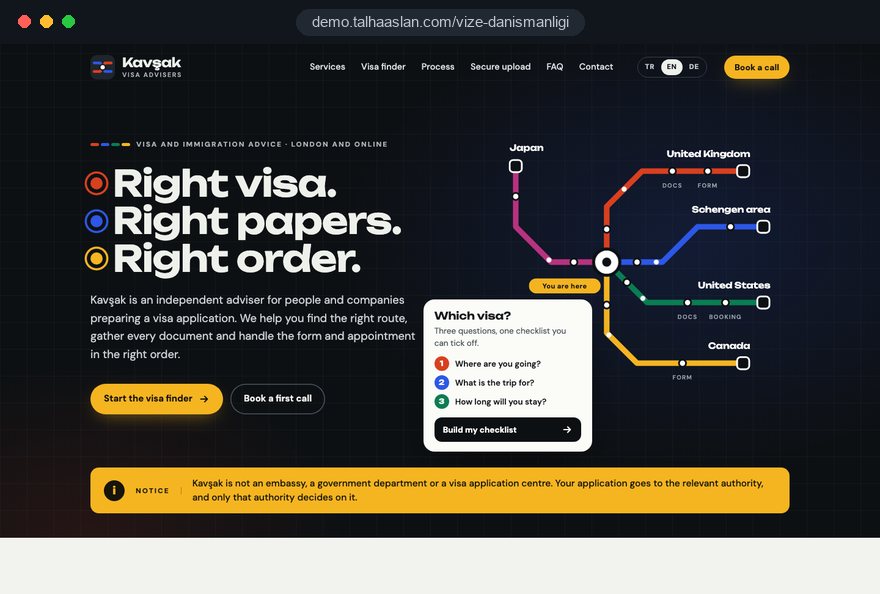
Mistaken for a government body
Flags, embassy photos and official crests make visitors think they are applying directly to a government. The wrong expectation turns into complaints, and nowhere does the site say that the firm is independent.

Your Windows contrast theme is on; colours come from your system.
Your device is set to reduce motion; animations are already off.
Your choices are saved in this browser only.
Industry-specific web design
People looking for visa help usually search for a country and a route first: a UK Skilled Worker visa, a Schengen visa for a business trip, a family visa. We build visa and immigration adviser websites around those route pages, document checklists and a secure way to send documents, and we show your regulatory status clearly instead of borrowing the look of a government site.
Open the live demoA demo design we built for a fictional brand
In short
A visa and immigration consultant website explains each country and visa route on its own page, gives the document checklist up front and collects passport scans through a secure form. In the UK, only qualified persons may give immigration advice, so the site shows the adviser's regulatory details and makes no success rate claims. Agencies outside the UK use the same structure with the rules of their own market.
Talha Aslan and teamLast updated:
Why it needs its own approach
A visa adviser's website has to earn trust through openness, not by looking official, and in the UK it also has to reflect who is allowed to advise. Generic business templates handle neither.
Flags, embassy photos and official crests make visitors think they are applying directly to a government. The wrong expectation turns into complaints, and nowhere does the site say that the firm is independent.
Someone researching a Skilled Worker visa reads the same paragraph as someone after a visitor visa or a spouse visa. Search engines cannot tell which page answers which route, so the firm is missing from those searches.
Clients learn what to prepare over the phone. Where a checklist exists, it carries no review date, so people prepare from an old list.
Passport scans, bank statements and payslips pile up in chat apps and personal inboxes. Under UK GDPR you need a lawful basis and a clear privacy notice for this data, which is hard to show when documents arrive through scattered channels.
Section 84 of the Immigration and Asylum Act 1999 says no person may provide immigration advice or services in the UK unless they are a qualified person. Clients want to check that before they pay, yet many sites hide the registration number or the authorising body.
Headlines like guaranteed visa or a near perfect approval rate attract clicks, but the Immigration Advice Authority's Code of Standards tells regulated advisers not to promote their success rates, and the decision always rests with the authorities.
Sources: Immigration and Asylum Act 1999, section 84, legislation.gov.uk · Immigration Advice Authority: Code of Standards 2024
Our approach
We build a visa adviser website in the order clients ask their questions: first which route fits them, then what they need to prepare, and finally how to request an assessment. Every country and route page follows those three steps in the same layout.
If your clients read in different languages, we plan separate pages per language from day one; for a seasonal push, such as student or visitor visa enquiries before summer, a single-goal landing page can go live without touching the main site.
Design, development and content sit in one team, so secure uploads and privacy wording are not patched on later. Talha Aslan sets the strategy and an experienced team handles delivery. We work remotely and in English with advisers abroad.
Home
Each country and route page answers its own search, and all of them lead to the same checklist and assessment flow.
The right setup
All three start from the same foundation; the number of countries and the length of the process make the difference.
Sole adviser
Clients want to hand their file to a person they know, so the site puts the adviser first.
Many countries
The brand is the agency, and country and route pages form the backbone of the site.
Long stays
Work, settlement and family routes take months and are explained step by step.
Built for visa advisers
These are the points that need a decision when you plan a visa or immigration adviser website.
For each route: who can apply, how the process works in general and common questions. We note that official requirements change and link every page to the relevant official source.
Printable checklists per country and route, each with its last review date, so clients see what to prepare before they call.
The IAA Code of Standards asks regulated advisers to display their registration number where appropriate, to use the IAA logo only as approved and not to promote success rates. We place these details in the footer and on adviser profiles, and link to the official register where one exists.
A short, clear line on the home page and next to every form: the firm is not an embassy, a government department or a visa application centre, and decisions are made by the authorities. No official crests or imagery that suggests otherwise.
Passports and bank documents are uploaded over an encrypted connection to a panel with restricted access, and a privacy notice explains purpose, recipients and retention. The final legal check of the notice belongs to your firm.
Name, real photo, the routes each adviser works on and, where it applies, their regulatory level and registration, so clients know who handles their file.
Sources: Immigration Advice Authority: Code of Standards 2024, codes 6.1 to 6.5
Comparison
| Topic | Generic business template | Site built for a visa adviser |
|---|---|---|
| Country content | Every country on one services page | Each country and route on its own page |
| Documents | A call us prompt | A dated, printable checklist |
| Official look | Flags and crests that blur the line | A plain independence statement |
| Personal data | Passports by WhatsApp or email | Encrypted upload and a privacy notice |
| Claims | Guaranteed visas and approval rates | Wording that explains the process, no outcome promises |
| Measurement | Visitor numbers | Which route page brings enquiries |
Quick check
Must haves: does your site have them?
0 of 6 in place Tick the boxes to see where your site stands.
Added as needed
We choose which of these you need together during the scoping call.
Tell us which countries and visa routes you work on and how you collect documents today; we will come back with a page structure and a written quote.
Process
We define your business, your audience and the site’s one-sentence job: who it sells what to, through which action. Scope and timeline are written from that answer.
The home page and key templates come to you as designs first; no code is written before your approval. We do not like surprises, and we do not cause them.
The approved design becomes fast, secure, maintainable code. You follow progress in the CRM and see every page in a staging environment before launch.
The site goes live with analytics, Search Console and conversion tracking connected; panel training is given, first-year hosting and maintenance included.
Search and speed foundations
People rarely search for a visa consultant alone; they search for a spouse visa document list or a Schengen business visa from their country. Route pages are built to answer those searches one by one.
Every route page links to the relevant official source, which helps visitors and shows search engines that the content is grounded.
Applicants check checklists on their phones. Pages are designed for phone screens first and Core Web Vitals are measured before launch.
Form submissions, document uploads and WhatsApp clicks are tracked as conversions from day one, so you can see which route page brings enquiries.
Free tools
Before planning a new site, test the speed, security and language setup of the current one; you can also share our date calculator with clients who need to count the days of a stay. The tools are free and need no sign up.
Tech SEO
Scan any URL for title, meta description, headings, canonical, indexability and speed signals, and get an SEO score with a clear to-do list.
Tech SEO
Test whether a page works well on phones: viewport, font size, tap targets, a mobile screenshot and Core Web Vitals.
Security
Check an SSL certificate's validity, expiry date, issuer, hostname match, certificate chain and TLS versions in seconds.
Tech SEO
Correct hreflang tags for multilingual sites; x-default automatic.
Conversion
Create a wa.me link with a preset message + embeddable button code.
Calculator
Days, weeks and working days between dates; add/subtract from a date.
How we work
We do not have a live client project for a visa or immigration adviser yet, so we show our approach on a live demo site. The demo is not a client site; it shows how we build a visa adviser website. You can see our work in other sectors on the references page.
Live demo
For this field we built a one page demo site for a fictional brand, made only to show our approach. You can explore the design, the copy structure and the mobile view live in three languages.
Open the live demoIn the first call we write down the countries and routes you cover, your regulatory status and what your service does not include; the sitemap grows out of that list.
We draft the checklists from your current knowledge and give each one a review date; none goes live without your approval.
Promises, imagery that looks official and the upload flow are reviewed before launch, and we flag anything we are unsure about.
We track which route pages bring enquiries and update checklists with you when official requirements change.
Related pages
Industries
A separate structure for agencies focused on student placement and school choice.
Industries
Document and quote flow for agencies translating visa paperwork.
Industries
For travel agencies that offer visa support alongside tours.
Solutions
Pages per language for applicants from different countries.
 How to Build Trust on Your Website: Trust Signals That Turn Visitors into CustomersRead article
 How to Build a GDPR and KVKK Compliant Website: A Business GuideRead article
 Multilingual Website SEO: How to Reach Global CustomersRead article
 Lead Form Design for Booking, Quote and Demo Requests: UX Rules That Lift ConversionsRead article
FAQ
If your question is not here, write to us; we will send you an answer and a written quote.
Next step
In a free 15-minute call, in English, we will go through the routes you cover, how you collect documents and the clients you want to reach, then send a written scope and quote.
In-depth guide
A visa and immigration adviser's website is often the first place someone brings a plan that matters a great deal to them: a business trip, a partner they want to live with, a job offer abroad. They want three answers quickly: which route fits them, what they need to prepare, and who will handle their passport and how.
This guide follows the decisions a visa or immigration practice makes during a website project, in the order they come up: authorization and scope, independence wording, the route page tree, checklists, secure document intake, enquiry forms, adviser profiles, languages, speed, search, measurement and choosing a partner. Nothing here suggests approval promises or success rates; decisions always rest with the authorities.
Before any design work, write down exactly what your firm is allowed to do and what it chooses to do, because the page tree, the forms and the tone of every page follow from it. In the UK, section 84 of the Immigration and Asylum Act 1999 says no person may provide immigration advice or services unless they are a qualified person, so a UK practice's website must reflect who is qualified and for what.
This list becomes the draft of a "What we do and do not do" page. Clients understand what they are paying for, and your team stops repeating the same explanation on every call.
A visa adviser's home page should say in one plain sentence that the firm is not part of any government; trust comes from openness, not from looking official. Flag collages, embassy photos and logos that resemble a crest make visitors think they are applying directly to an authority.
We place the independence line in three places: the first screen of the home page, the footer and directly above every form. A workable pattern reads: "We are an independent firm, not an embassy, government department or visa application center; applications are made to the relevant authority, which makes every decision." The IAA Code also requires advisers to identify themselves clearly and says a firm name must not have the potential to confuse or mislead clients, so avoid names that sound like an official service.
Give everyone who writes for the site a short claims checklist:
The page tree should follow countries and visa routes, but not every combination deserves its own page. A UK Skilled Worker page and a Schengen business visa page answer different questions; an empty page for a country you rarely handle weakens the whole site.
We decide whether a page gets built with four tests:
In practice a three layer structure works well. A country page gives the general frame, a route page carries the checklist and the process, and longer immigration routes such as work, family and settlement sit in their own section, explained step by step over the months they take.
A route page should follow the visitor's own questions: is this route right for me, what do I need, and what happens next. A page that opens with a general paragraph about the firm loses people on the first screen.
Using one template keeps maintenance simple, but the content must not be duplicated with the country name swapped. What makes each page useful is information specific to that route: what an invitation letter must contain for a business visit, or which financial evidence a family route expects.
Close each page with a two sentence note that the information is general and that personal circumstances are assessed in a consultation. Keep it short and point it to the assessment form rather than a wall of disclaimers.
The checklist is the most read and fastest aging part of a visa site, so every list needs an owner and a review schedule. A list without a review date can send a client to an appointment with the wrong documents.
Storing checklist items in the content panel as reusable entries saves a lot of work. When the same document appears on several lists, such as six months of bank statements, you edit its description once and every list updates. The panel also records who published which version, so if a client complains you can show which list was live on which date.
Passport scans, bank statements and payslips should not pile up in chat apps and personal inboxes; they belong in an encrypted upload to a panel with restricted access. With scattered channels nobody can say who opened which document or when it will be deleted.
Under UK GDPR you need a lawful basis for this data and a privacy notice that explains purpose, recipients and retention. We place the notice next to the upload form and state plainly that documents will be passed to the relevant authority or visa application center. The final legal check of the notice belongs to your firm. You can confirm the connection is encrypted with our SSL checker.
A per document status in the panel, such as uploaded, checked or missing, also helps: clients see what is outstanding without another round of messages.
The first enquiry form should be short and should not ask for documents; its job is to give an adviser enough to call back with the right question. Asking for a passport in the first message collects data you do not need yet and puts people off.
Under the form, one sentence should say what happens next: who will reply, through which channel and roughly when. If you use WhatsApp, prefill the message with the country and route; our WhatsApp link generator builds such a link in seconds.
For IAA regulated firms the next step after the enquiry is formal: the Code asks advisers to give every prospective client an effective client care letter and to keep a record of the client's agreement, either signed and dated or as electronic evidence. The website can support that step with a secure page where the client reads the letter and confirms it, with the time of agreement stored in the case file.
Clients hand their file to a person, not a logo, so adviser profiles are the strongest trust element on an immigration website. Stock photos and lines like "expert team" do not answer the question of who will actually handle the case.
Link each registration to the official register where one exists, so visitors can check it themselves in a few seconds.
If you show client reviews, use genuine reviews from your Google profile with their source, and do not curate a wall of approval announcements. Reviews that describe how the process felt show your way of working more honestly. Be careful with referral campaigns as well: the Code bars regulated advisers from offering or accepting inducements for referring or recommending a client, so a "refer a friend for a discount" banner is not something we would build for an IAA regulated firm.
If your clients read in different languages, each language needs its own URL with fully translated pages; an automatic translation widget causes misunderstandings exactly where precision matters, in document lists. A UK practice serving Turkish or Arabic speaking families often needs those languages as much as English.
The independence line, the privacy notice and the client care letter must be translated too. A client should not have to understand an English legal notice to know why they are handing over their passport. Right to left pages in Arabic need separate testing of form fields, tick boxes and checklists.
We explain the technical side of language versions on our multilingual website page.
Applicants usually read checklists on their phones, sometimes in the queue at the visa center, so pages must be designed for small screens first and measured before launch. Google's Core Web Vitals give clear "good" thresholds at the 75th percentile: LCP, which measures how fast the largest content loads, at 2.5 seconds or less; INP, which measures how quickly the page responds to a tap, at 200 milliseconds or less; and CLS, which measures layout shifts, at 0.1 or less.
Demand moves through the year: visitor visas before summer, business visas around trade fairs, study routes with the academic calendar. Adding short cuts to the relevant routes on the home page for each season adapts the site without a redesign.
You can see how your current site performs on phones with our free mobile friendly test.
People rarely search for "immigration adviser" on its own; they search by country and route, so visibility depends on each route page answering that search directly. Someone typing "spouse visa document list UK" should land on the page that answers exactly that.
Be cautious with paid ads. Google's advertising policy restricts ads that promote direct acquisition of government documents and services, such as electronic travel visas and authorizations, to governments and authorized providers. Ad copy for an advisory service must never suggest that you issue visas or take the application yourself. The IAA Code also forbids touting for immigration business, which rules out cold approaches dressed up as outreach. We plan long term visibility on content and technical foundations through our SEO service.
Measurement should show which country and route pages bring real enquiries, not just visitor numbers. That tells you where to invest writing time, which checklist to review first and what to feature before a busy season.
A page that brings out of scope enquiries usually means its wording sets the wrong expectation, for example refused applicants calling about appeals you do not handle.
Set analytics up with consent in mind. For visitors in the European Economic Area, Google requires consent mode for measurement and personalized advertising features, and non essential tracking must wait for cookie consent; for UK visitors, follow the ICO's guidance on cookies. Describe the same tools in the same words in your privacy notice and cookie notice so the two never contradict each other.
Most mistakes are not bad intent; they come from applying a generic business template to a field with its own rules. Here are six we see often, each with the better alternative:
If your current site shows two or three of these, quick fixes such as the independence line and a secure upload flow can reduce complaints even before a redesign.
When choosing an agency for a visa or immigration website, ask how it handles document security and claims before you look at design samples. A site that looks good but collects passports by e-mail will cause problems at the first complaint or audit.
We do not yet have a live client project in this field, so we show our approach on the live demo linked on this page. You can see our work in other sectors on our references page, and our full way of working is described on our web design service page.
Fixed scope packages are listed in the pricing section. Before a first call, prepare your list of routes, your current enquiry flow and any checklists you already use. Send them through our contact form and we will come back with a page structure, a schedule and a written quote.
Start a Project
Thanks {name}, we've received your brief. We usually reply within the same day.
What happens next?