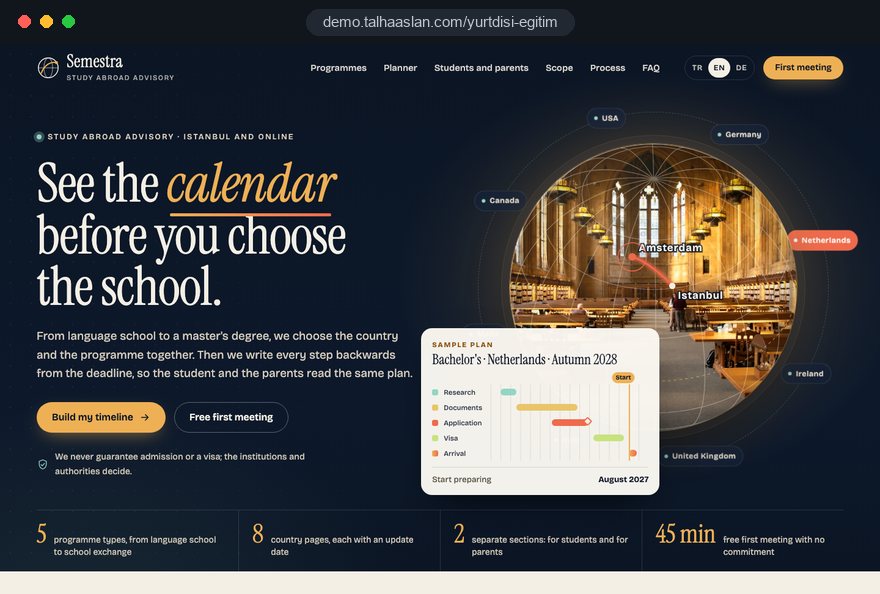
Nobody decides to study abroad over a weekend. A student first lands on an agency site while searching for a language school or a master's program, comes back several times over the following months, talks it through with parents, visits an education fair and only then books a consultation. If the site offers nothing useful at each of those stops, the decision gets made on another agency's site.
This guide covers the decisions behind a study abroad agency website, in order: service scope, country and program pages, sources, a backwards calendar, the long decision cycle, the parent section, honest claims, visa and recognition information, fairs, search, measurement, common mistakes and choosing a partner.
01Write down your service scope before anything else
The first decision on a study abroad website is not the design but exactly what your help covers. Students and parents compare agencies on this point more than any other; when scope is vague, they cannot compare, and your counselors answer the same question in every call.
Build a list that breaks your service into stages and mark each one as included, available as an extra, or the student's own responsibility:
- Choosing a school and program: How many options you present, which criteria you use and the fact that the final choice is the student's.
- The application: Your role in the personal statement, references and translated documents; the student writes, you guide.
- Visa paperwork: Checking the document list and helping with appointments, while the application is the student's own and the decision belongs to the authorities.
- Accommodation and arrival: Residence halls, homestay or shared housing, airport pickup and first week support.
- During the program: Who the student contacts while abroad and which issues you help with.
This list becomes its own "What we do" page, linked from every country page. State at the bottom that it matches your written service agreement; when the site and the contract say different things, the loss of trust comes from the site.
Add a short "what we do not do" block as well. Saying plainly that you do not write personal statements for students, or that students register for English tests themselves, removes wrong expectations before the first call.
02Decide country and program pages with a grid
Choose which pages to build by crossing destinations with program types in a single grid. A general page per country is easy; the real decision is which country and program combination deserves a page of its own.
Fill in the grid in this order:
- List the countries where you actually place students as rows, and program types such as language schools, high school and exchange year, undergraduate, postgraduate and summer schools as columns.
- In each cell, note roughly how many consultations that combination produced over the last two intakes.
- Mark whether the combination has information of its own: a different calendar, a different English test expectation, different housing arrangements.
- Cells with real demand and their own information become separate pages; the others stay as sections on the country page.
A college program in Canada and a high school year in Canada belong on separate pages, because the student's age, the person who decides and the timeline all differ. Language schools in two nearby cities can share one page.
Do not publish pages for countries where you do not place students. A thin, generic page suggests experience you do not have. Reopen the grid after every intake: open a page when you start placing students somewhere new, and redirect a page whose demand has ended to the closest related page so its links are not wasted.
03Source and review rules for country pages
A country page is only as valuable as the source of its information and the date it was last checked. Entry requirements, English test expectations and deadlines change from year to year; outdated details break a student's plan and damage the agency's credibility.
Apply these rules to every country and program page:
- Source rule: Institution and program details come only from what the institution itself publishes; forums and other agencies' sites never count as sources.
- Date rule: A "last checked" date sits at the top of the page and updates automatically whenever a change is saved in the admin panel.
- Owner rule: Each country has a named counselor who reviews the page from top to bottom at the start of every intake.
- Uncertainty rule: A date the institution has not announced is never estimated; the page says "not yet announced by the institution".
The body of the page covers the education system, entry requirements, the expected English level, accommodation and questions specific to that destination. Write it around the student's decisions rather than as a tourism brochure: "Can I start a bachelor's degree directly here, or do I need a foundation year?" helps far more than the country's history.
Showing the review date can feel risky, yet families trust dated information more than undated information.
04Let the site calculate a backwards calendar
An application calendar should count backwards from the start date the student is aiming for. When a student says "I want to start in September", a site that shows what must be finished by which month is worth far more than a list of deadlines.
Build the calendar logic in these steps:
- Define a template per program type: the application deadline, when English test results must be ready, how long documents take and how much time to allow for the visa.
- Your team enters these durations in the admin panel; values can differ by country and institution.
- The student picks a country, a program and a target intake; the site shows the latest date for each step.
- Any step that falls in the past is flagged, and the next possible intake is suggested.
- If the student wants the personal plan by e-mail, the plan is attached to the consultation request.
Students then notice they are late before the call, and counselors see each student's timeline before they pick up the phone.
Do not present the durations as commitments. Under every plan, state that the institution's and the authorities' own dates prevail and that the plan is a preparation tool. For the UK, GOV.UK says applicants outside the UK can apply for a Student visa up to 6 months before the course starts; the visa step in the plan should follow official timing like this, with its source and review date shown.
05Bridge the months between first visit and consultation
Study abroad decisions often take months between the first visit and the first call, so the site needs intermediate steps that keep the student connected. A single "book a consultation" button only speaks to students who have already decided.
Offer a different step at each stage:
- Researching: A downloadable document checklist per country and program, sent by e-mail, which also tells you which destination the student is considering.
- Comparing: Registration for an online information session that gathers students with the same questions into one hour.
- Deciding: A free consultation request; if students should choose their own slot, an online booking system connects to this step.
The consultation form should ask only what makes the call productive: target countries, program type, target intake, English test status and preferred contact method. Passport details are not needed at this stage. For students under 18, add a field that shows a parent is completing the form.
A privacy notice belongs next to every form, written for the data protection law that applies to your agency. If you want to send marketing to addresses collected through checklists or session sign ups, ask for that with a separate checkbox that is not ticked in advance.
06Build the parent section as a decision file
Families usually fund and approve a study abroad plan, so the parent section should not be a subheading on the student pages but a decision file that can be read on its own. Parents tend to open the site separately from the student, at a different time and with different questions.
The parent section should answer:
- Process and timeline: The steps from application to arrival and what the family does at each one, such as preparing financial evidence.
- Welfare and supervision: For high school and exchange programs, how homestays are selected and who the student's contact person abroad is.
- Emergencies: Who to call if the student falls ill or wants to change program, and what happens next.
- Contract terms: Which document holds payment, cancellation and refund terms; a summary on the site, the detail in the contract.
- After graduation: How the qualification will be treated at home and which check should happen before choosing a program.
Give parents their own contact route, such as a separate phone line or WhatsApp link, for questions they would not ask in front of their child.
Keep the tone measured; parents look for predictability, not excitement. Before launch, ask a parent to read the section and note what is still unanswered; questions such as how to send spending money or where the student stays during school holidays often surface this way.
07Honest claims, student stories and the AQF
The largest legal and reputational risk on a study abroad agency website is a claim you cannot back up. Offers are made by institutions and visa decisions by the authorities; for the UK Student route, applicants need a place on a course with a licensed student sponsor among other conditions, and no agency can promise either outcome.
Before launch, rewrite risky lines like this:
- Instead of "assured admission": "We prepare your application against the institution's requirements; the institution decides."
- Instead of "visa without problems": "We check your documents against the official list; the decision belongs to the authorities."
- Instead of unverified success rates: what your help covers and the steps of the process.
- Instead of "partner university": the relationship as it really is, and only where you hold written evidence of it.
If you work with UK providers, the Agent Quality Framework, produced with the British Council and sector bodies, sets standards for agents through its National Code of Ethical Practice. Show your training or commitment factually and link to the official source; never imply an endorsement you do not hold.
Student stories build trust when they come with consent and accuracy. Get written consent for each story, from a parent for students under 18, and keep the record. Tell the story through the process: the question the student came with, the options weighed, the difficulty met. Date every story and make it easy to remove when consent is withdrawn. The final legal view on your wording belongs to you and your adviser.
08Point visa and recognition questions to official sources
On visas and recognition of qualifications, the site's job is not to replace official information but to send the student to the right official source in the right order.
Build the visa guide page on these principles:
- A separate section per destination naming the official application page; the document list is taken from there and shown with its review date.
- The steps in order: offer or confirmation from the institution, financial evidence, application, appointment, decision.
- The steps where your agency helps, described in the same words as your scope page.
- A clear line at the top stating that the decision belongs to the authorities of the destination country.
Recognition matters most on undergraduate and postgraduate pages. A student who plans to return home and work needs to know, before choosing a program, whether the institution and the degree will be recognized there. Add a short information box to those pages: "Before choosing this program, check with the recognition body in your home country whether the institution and degree are recognized." Keep the wording general, because each student's case is assessed individually, and repeat the box in the parent section, since parents usually ask this question first.
09Connect fair and seminar leads to the same pipeline
Education fairs and seminars are among the busiest lead sources for a study abroad agency, and those leads must land in the same list as site enquiries.
Set up fair and seminar periods like this:
- Open a single goal campaign page for each fair: the date, the destinations covered at your stand, seminar times and one form.
- The tablet or phone at your stand uses that page's form, so fair leads land in the same list as site leads.
- Put a QR code linking to the page on leaflets and posters; a QR code generator lets you create a separate code per fair.
- Add a campaign tag carrying the fair's name to each link; a UTM builder is enough for this.
- On the first working day after the fair, sort its leads by destination and pass them to each country owner.
Keep the fair form short: name, phone, destination and program type; the rest comes in the first call.
After a fair, redirect its page to the next fair or archive it; a past fair page still showing in search suggests nobody watches the site.
10Showing up in country and program searches
Students researching study abroad may start with a broad search, but they quickly move to searches that combine a country and a program; a site becomes visible when each of those searches has its own page to land on. The pages you chose with the grid are therefore also your search plan.
Apply these criteria on the search side:
- Titles and URLs: Each page title carries the country and the program together, and no two pages target the same search.
- Question blocks: The questions you hear most in calls appear at the end of the relevant country page with short answers.
- Internal links: Country pages link to programs, program pages link to the calendar and the parent section.
- Speed on phones: LCP, the time until the largest element loads, at 2.5 seconds or less; INP, the response to a tap, at 200 milliseconds or less; CLS, how much the layout shifts, at 0.1 or less.
City and campus photos are what slow country pages down most. Resize images to the screen, move galleries lower on the page and load campus videos only when tapped.
If your site also needs to reach students in other markets or partner institutions abroad, you need a multilingual setup. Each language version must reference itself and every other version with hreflang so search engines understand the set; a hreflang generator helps you prepare the tags. We cover the full search setup in our SEO service.
11Measurement across a long decision cycle
Measurement for a study abroad agency has to follow a path that can run for months between the first visit and enrollment. A report that only counts form submissions cannot show which country page or which fair actually brings students.
Set it up in this order:
- Define each conversion separately: checklist download, session registration, consultation request, call and WhatsApp click.
- Attach the country and program to every conversion so reports read at the level of "Germany, postgraduate".
- Keep a stage for every lead: consultation held, application in progress, application submitted, enrolled, dropped out.
- Store the source of the first visit with the lead, so an enrollment months later still connects to where it began.
- At the end of every intake, compare enrollments by country, program and source.
If counselors do not update stages after calls, the report is stale within a month. In the European Economic Area, Google requires consent mode for measurement and personalized advertising features, and non essential tracking needs consent first, so your figures may sit below real visitor numbers; trends and ratios are what matter.
A country page with many checklist downloads but no consultations points to a content or timing problem; a fair that brings many leads but few enrollments points to the wrong audience. Judge any paid campaigns by the same stages rather than by form counts.
12Common mistakes on study abroad agency websites
Most mistakes in this field come from building the site like a catalog and not thinking about how it will live through each intake. These are the ones we see most often, with the better alternative:
- Using institution logos without permission: A logo implies a relationship; show only the logos of institutions you have written permission from, and mention others in text.
- Undated institution details: Last year's requirements mislead students; show the source and the last checked date on every page.
- Sending every lead to one counselor: A Canada question that reaches the Germany specialist waits; route leads by destination to the country owner.
- Burying parents inside student pages: Parents who cannot find their answers call or give up; give them their own section and contact route.
- Explaining the calendar only on calls: Students learn they are late during the consultation; keep the backwards calendar open on the site.
- Success lists as marketing: Names and photos without consent carry legal and reputational risk; use dated, consented stories that describe the process.
Before launch, walk through one full intake on paper: a student downloads a checklist, joins a session, books a consultation, applies, and receives or does not receive a visa. At each step, write down what must change on the site and who will change it.
13Choosing a partner and the next step
When choosing a team for a study abroad agency website, look less at design samples and more at whether they can explain how the calendar, the scope page and the lead flow will work. Ask these questions and get the answers in writing:
- Can we update country and program pages, calendar durations and fair dates ourselves in the admin panel?
- Which fields will the backwards calendar use, and how will a student's personal plan reach us?
- Will fair, session, form and WhatsApp leads land in one list with their source?
- How will wording with promises or numbers be checked before launch?
- In whose name will the site, the domain and the content be registered?
We do not have a live client project in this field yet, so we show our approach on the live demo linked on this page. Our work in other sectors is on our references page.
Before the first call, prepare three things: your list of destinations and programs, your service scope and your intakes. Once you have them, get in touch with us and we will work out a written scope and quote together. Fixed price packages are listed under web design pricing. If the site must be live before a fair or an intake, mention the date in the first call and we will plan backwards from it.