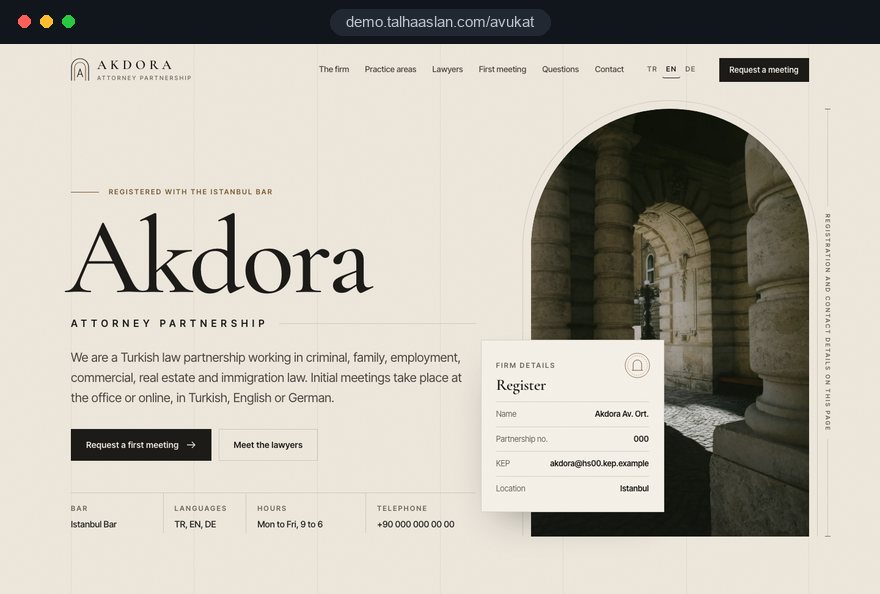
A prospective client rarely contacts the first firm they find. They open three or four sites, look for a named lawyer who handles their kind of problem, check whether the firm is properly regulated and decide whether they feel safe sending a first message. Law firm website design is the work of making that check easy while staying inside the professional rules that govern what a lawyer may say in public.
This guide sets out how we plan a law firm website section by section, from regulatory pages to first contact and measurement. It is written for solicitors in England and Wales, firms in other jurisdictions and Turkish firms with international clients.
01What a law firm website has to prove quickly
A law firm website has three jobs, in this order: show that the firm handles the visitor's type of matter, show who the responsible lawyers are, and offer a safe way to make contact.
A useful test is to give the home page to someone outside the firm for ten seconds and ask what they remember. If the answer is a slogan about excellence and a stock photo of a courthouse, the page has not done its work. If the answer is "they do employment and family matters, the partner is called so and so, and there is a phone number", it has.
- Scope: the practice areas are named in plain words near the top, each linking to its own page.
- People: at least one real lawyer with a name, a photo and an admission detail is visible without scrolling far.
- Status: the regulator, registration number or bar membership is stated, so a visitor can verify the firm independently.
- Contact: phone, email and a short inquiry form are reachable from every page, with opening hours stated.
- Restraint: nothing on the page claims a result, a ranking or a status the firm cannot document.
02Advertising rules differ by jurisdiction, so start there
Before any wording is drafted, identify which conduct rules apply to every lawyer named on the site, because a sentence that is acceptable in London can be a disciplinary matter in Istanbul. A firm with lawyers admitted in several countries must satisfy each set of rules on the pages concerning those lawyers.
In England and Wales, paragraph 8.8 of the SRA Code of Conduct requires that publicity, including information about charges, is accurate and not misleading. That leaves room for marketing, including paid search campaigns, as long as every claim is true and fairly presented. In Germany, § 43b BRAO allows advertising only where it gives factual information about professional activity, and § 6 BORA adds detail on what that means in practice.
Turkey sits at the strict end. Since the amendment published on 9 August 2024, the Turkish bar's advertising regulation bans references and client information on lawyer websites, online advertising and keyword or redirect setups aimed at winning work.
Every firm follows its own regulator or bar, and we ask the firm to name the rules that apply and the person who signs off compliance. That list goes into the project brief, and every design and copy decision is checked against it.
03Practice area pages that answer one situation each
Each practice area deserves its own page written for the person who has that problem, not for other lawyers. Someone who has just received a dismissal letter searches differently from a company director reviewing a supplier contract; one page cannot serve both.
We structure practice area pages around the questions a prospective client asks before calling. A strong example is an employment page that states at the top whether the firm acts for employees, employers or both, because that single sentence saves wasted calls on both sides.
- Who it is for: the typical clients and situations, and the ones the firm does not take on.
- What the firm handles: the main types of matter in plain words, with legal terms explained in one clause.
- How a matter usually runs: the stages from first call to conclusion.
- What to have ready: the documents worth gathering before a consultation, without asking anyone to send them yet.
- Cost and next step: a link to price information where the rules require it, then the inquiry form.
Write in short sentences, avoid Latin and courtroom drama, and never imply an outcome. Have the responsible lawyer approve the final text, since the firm carries the professional risk for every statement on it.
04Lawyer profiles that a client can verify
A lawyer profile should let a careful client confirm, from outside sources, that the person is who the site says they are.
Start with the essentials: full name, current role, the jurisdiction or jurisdictions of admission and the year, the regulator or bar and any registration number, academic qualifications, languages and the areas the lawyer actually works in. Add a recent, natural photograph; a stock image on a lawyer profile undermines everything around it.
Titles need particular care. "Specialist", "expert" and their equivalents carry regulated meanings in several countries. In Germany, a Fachanwalt title may only be shown by those who hold it, and § 7 BORA restricts how other areas of focus are described. In Turkey, practice areas may be described only in a way that does not suggest specialization. In England and Wales, any such word must simply be accurate. When in doubt, describe what the lawyer does rather than what they are.
For a multi partner firm, link profiles and practice area pages in both directions, so readers of the residential property page see who handles it and readers of a profile see that lawyer's areas. Ask each lawyer to review their own profile once a year.
05Articles and legal updates without liability traps
Articles can help prospective clients understand their situation, but every article is a public legal statement with a date on it, so treat publishing as a professional act rather than a marketing habit.
Every article we template carries a visible set of facts that protect both the reader and the firm.
- Jurisdiction: state which country or legal system the article covers in the first lines.
- Dates: show the publication date and a "last reviewed" date, and update the second only after a real review.
- Author: name the lawyer who wrote or approved it and link to their profile.
- Scope note: a short statement that the article is general information and not advice on any individual matter.
- Review cycle: a named owner and a review interval, so articles on fast moving topics are revisited or withdrawn.
Rules on articles also differ. The 2024 Turkish amendment removed the provision that had expressly permitted lawyers to publish articles and prohibited general publications made in order to win work, so Turkish firms should take their bar's reading before starting a publications section. Where articles are allowed, publish fewer and keep them current.
06An inquiry flow that protects confidentiality
The first message from a prospective client should contain only what the firm needs to reply, because case details sent through a website form arrive before any conflict check and before any retainer exists. Paragraph 6.3 of the SRA Code requires solicitors to keep the affairs of current and former clients confidential; collecting less at first contact makes that duty easier to meet.
We build the flow in five steps:
- Short form: name, phone or email, a practice area chosen from a list, a one line topic and a preferred time to be contacted.
- Clear instruction: a sentence above the form asking people not to include case details, names of other parties or documents.
- No uploads: the form accepts no attachments; documents are exchanged later through a channel the firm controls.
- Restricted delivery: submissions go to a shared inbox with named access, over an encrypted connection, not to a personal address.
- Defined retention: unconverted inquiries are deleted after a period the firm sets in writing, and the privacy notice says so.
The automatic reply should confirm receipt, state when the firm usually responds and repeat that no details should be sent until someone has been in touch. Test the whole flow from a phone before launch, including what happens when someone submits twice.
07Regulatory pages: SRA details, Impressum and bar data
Regulatory information is part of the site's structure, not a footer afterthought, and the requirements depend on who regulates the firm.
For firms regulated by the SRA, the Transparency Rules set out several requirements. Price information for the listed services must be clear, accessible and in a prominent place on the website.
- Costs: the total cost or, where not practicable, the average cost or a range, plus the basis of charges such as hourly rates or fixed fees.
- Extras: likely disbursements and their cost, and whether fees or disbursements attract VAT and how much.
- Scope: what the price includes, the key stages and likely timescales, and what might be expected but is not included.
- People: the experience and qualifications of those doing the work and of their supervisors.
- Complaints and status: the complaints procedure, including how and when to complain to the Legal Ombudsman and the SRA, and the SRA number and digital badge displayed prominently.
The same rules require letterhead and emails to show the SRA authorization number and the words "authorised and regulated by the Solicitors Regulation Authority", so we set up email signatures alongside the site. Lawyers practicing in Germany need an Impressum under § 5 DDG that names the chamber, the legal job title with the state that granted it and the professional rules. Turkish firms list their bar and Union of Turkish Bar Associations registration numbers and a registered electronic mail (KEP) address. Your compliance lead signs off the final wording in every case.
08Trust signals you are allowed to show
Trust on a law firm website comes from verifiable facts and clear process, not from badges or bold claims. The useful question for every element is whether a skeptical visitor could check it, and whether your rules permit it at all.
Generally safe signals, subject to your own regulator:
- Verifiable status: registration numbers, the regulator's badge where one exists, and a link the visitor can follow to confirm it.
- Real people: recent photographs, genuine qualifications and the languages each lawyer actually works in.
- Clear process: what happens after an inquiry, who calls back and how soon.
- Fee transparency: how charging works, even where publishing prices is not required.
- Physical presence: a real office address, a map and opening hours, consistent everywhere the firm is listed.
Client reviews and case results need jurisdiction specific handling. In Turkey, the 2024 amendment rules out references and client information altogether. In Germany, naming clients or mandates requires their express consent under § 6 BORA. In England and Wales, any review or result shown must be genuine and must not mislead about what a new client can expect. We never write testimonials, never draft reviews for clients to post and never place awards or memberships the firm does not hold.
09Serving international clients in their own language
A firm that advises clients abroad needs complete pages in each client language, not a translation widget. Machine translation can quietly change legal meaning, and widget output is rarely indexed as a proper language version.
We give each language its own address and connect the versions with hreflang annotations, which tell search engines which page serves which language; each version must reference the others and itself. A multilingual site structure planned from the start avoids rebuilding the navigation later.
- Translation: a professional legal translator drafts each page and a lawyer fluent in that language approves it.
- Jurisdiction: every language version states clearly where the lawyers are qualified, so a reader abroad knows which law they can advise on.
- Contact: the inquiry form, auto reply and privacy notice exist in each language, and someone can answer in it.
- Same rules: pages in a second language remain subject to the firm's home conduct rules, so a Turkish firm's English pages carry no references or advertising claims.
Decide early which languages you can actually support after launch. A German page whose inquiries nobody can answer in German does more harm than no German page.
10Local search, directories and your firm's name
Many clients find a lawyer by searching a practice area with a town name, or by looking up a firm someone recommended, so a law firm website should be built to support both searches. The firm's name, address and phone number must be identical on the site, in the Google Business Profile and in every register or directory where it appears.
Google's Business Profile guidelines require the business name to match the name used in the real world, without added keywords. A profile called "Smith and Co Divorce Lawyers Manchester" when the firm is "Smith and Co" risks suspension. Choose accurate categories and keep the photographs real.
On the site itself, practice area pages carry clear titles that combine the area and, where relevant, the location the firm actually serves. Structured data, the code that helps search engines read facts such as address and opening hours, should describe only what is visible on the page.
For Turkish firms, keep page names and addresses plain, since keyword tactics aimed at winning work are prohibited. Our search engine optimization work for regulated professions starts from those limits rather than working around them. Ask any search provider to list, in writing, the techniques they will not use on your site.
11Speed, security and accessibility for anxious visitors
People contacting a lawyer are often stressed and reading on a phone, so the site has to load quickly, feel secure and work for everyone.
Google treats a page as good on Core Web Vitals when, for 75 percent of visits, the largest contentful paint (the time until the main content appears) is 2.5 seconds or less, interaction to next paint (how quickly the page responds to a tap) is 200 milliseconds or less and cumulative layout shift (how much content jumps while loading) is 0.1 or less. Lean pages and few third party scripts reach those figures more reliably than heavy page builders.
Security goes beyond the padlock. A current certificate, which you can confirm with an SSL checker, protects form submissions in transit. Email authentication matters even more for law firms, because criminals impersonating a firm to redirect client payments are a known risk, especially in property matters. SPF, DKIM and DMARC make spoofing your domain harder; an SPF, DKIM and DMARC checker shows where you stand today. Many firms also publish a short notice that they will never change bank details by email.
Accessibility follows the same logic: sufficient color contrast, readable text sizes, visible focus states for keyboard users and form labels that screen readers can announce.
12Measuring inquiries without collecting sensitive data
A law firm should know which pages lead to inquiries, but analytics tools must never receive names, contact details or anything about a matter. Measure events, such as a submitted form or a tapped phone number, never content.
In the EU, non essential tracking requires consent before it runs, and Google requires consent mode for measurement and personalized advertising features for users in the European Economic Area. UK firms should check the equivalent requirements that apply to them. Whatever the jurisdiction, we configure measurement on the same principles:
- Events, not fields: record that a form was sent and from which page, never the values typed into it.
- Clean addresses: make sure thank you pages and search results never place names or topics in the URL, where analytics would capture them.
- No session recording on forms: heatmap and replay tools are either excluded from inquiry pages or not used at all.
- Practice area as the only label: an inquiry can be tagged "employment" for reporting, which tells you enough without revealing anything about the person.
- Limited access: analytics accounts are owned by the firm, with named users and two step sign in.
Review the reports quarterly rather than daily. Inquiry numbers are usually modest, so a quarter shows which practice area pages draw contact far more reliably than a week.
13Six common mistakes on law firm websites
Most problems we see on law firm websites come from treating the site as a brochure rather than a regulated publication.
- Copying a competitor's claims: phrases like "leading" or "award winning" lifted from another firm. Instead, describe what your firm does and let verifiable facts carry the weight.
- A free text case box: asking visitors to "tell us what happened". Instead, ask for a topic and a callback time, and take details after the conflict check.
- Stock photography of lawyers: models in suits standing in for the team. Instead, commission simple, natural photographs of the real people.
- Prices buried in a PDF: SRA price information hidden several clicks deep. Instead, link it from each relevant practice area page and the main navigation.
- Undated articles: guides with no publication or review date that outlive the law they describe. Instead, show both dates and remove pieces nobody is willing to review.
- One set of rules for every market: a site built for one jurisdiction reused for lawyers admitted elsewhere. Instead, map each lawyer to their regulator and check their pages against those rules.
14How to choose a web partner and what to prepare
Choose a partner who asks about your regulator before talking about colors, and who accepts that your lawyers have the final word on every legal statement.
Ask any agency these questions before signing:
- Which conduct rules will you check our pages against, and who on your side does that check?
- What exactly will the inquiry form ask, where do submissions go and how long are they kept?
- Will analytics ever receive personal data, and how will you prove that it does not?
- Who owns the domain, hosting, analytics and content after launch?
To be transparent about our position: we do not yet have a live law firm project to show. Our work in other regulated fields, including the platform of a licensed insurance agency, shows how we handle claims, disclosures and approvals under rules. Our web design service covers design, development and content structure in one team, while legal content stays with your lawyers.
Before a first call, prepare a list of practice areas, the lawyers who will have profiles, the regulators involved and the languages you serve. Then send us a short brief and we will reply with a page structure and a written quote. Fixed packages are described in the pricing section of our web design page.