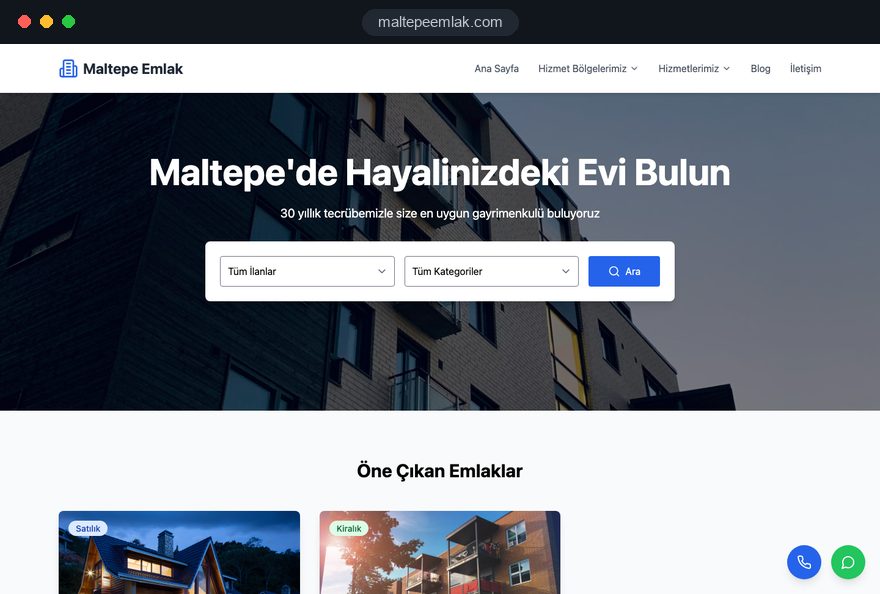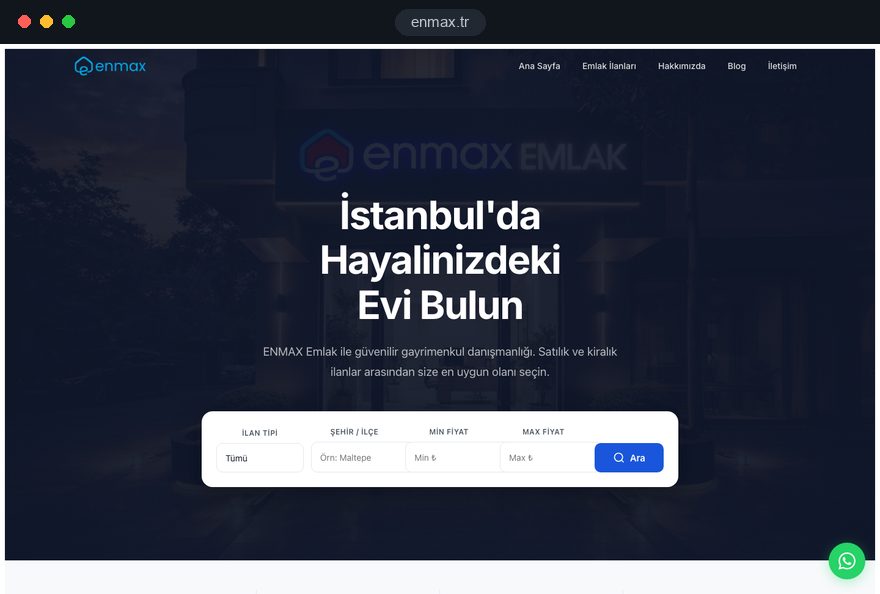
Listings cannot be searched
If visitors cannot narrow by budget, bedrooms and area, they glance at a few properties and go back to the portal. A list with no filters and no map hides the portfolio instead of showing it.

Your Windows contrast theme is on; colours come from your system.
Your device is set to reduce motion; animations are already off.
Your choices are saved in this browser only.
Industry-specific web design
Buyers and tenants often spot a property on a portal, then search for the agency by name. The site they land on should show current stock, the agent behind each listing and a one-tap way to get in touch. We build estate agency websites around filterable listings, property pages and enquiries tied to each listing, for agencies in the UK and elsewhere that work with a remote team, and for agencies and developers in Turkey selling to international buyers.
In short
A real estate agency website shows the portfolio as filterable listings on a list and a map, gives every property its own page and records each enquiry against the listing it came from. Sold and let properties come off quickly. In the UK, listings are expected to carry material information such as price, council tax band and tenure. For developers, the same foundation grows into development pages with floor plans.
Talha Aslan and teamLast updated:
Why it needs its own approach
An agency site has to keep pace with the portals and still meet the listing rules of its market. Generic business templates treat a property like a blog post, with no filters, no status and no enquiry tracking.
If visitors cannot narrow by budget, bedrooms and area, they glance at a few properties and go back to the portal. A list with no filters and no map hides the portfolio instead of showing it.
Someone asking about a flat that sold weeks ago loses trust in the agency, and updating status by hand across several pages is exactly what gets forgotten. In Turkey, the real estate regulation even sets a three day limit for ending a listing after a sale, a letting or the end of the mandate.
Calls, forms and WhatsApp messages arrive without a property reference. The agent starts by asking which home the caller means, and the agency cannot see which listings attract interest.
UK consumer law expects listings to show what a buyer or tenant needs to decide, and National Trading Standards guidance lists details such as price, council tax band, tenure, property type, rooms, utilities and parking. A template without these fields publishes every listing incomplete.
When the same description runs on the portal, the agency site and social media, search engines choose which page to show, and they usually choose the stronger portal. The agency's own site can disappear even for its own listing.
Buyers want to know who they will deal with. Without each agent's area, focus and direct contact details, trust waits for the first call and every enquiry piles up on one switchboard number.
Sources: National Trading Standards: full material information guidance published
Our approach
We do not build an agency site like a brochure; we build it around the way people look for a home. First they filter by budget and area, then they study the property and where it sits on the map, and finally they contact the agent responsible. That is why every property has its own page, every agent has a profile and every enquiry is stored with the listing it came from.
If you sell to buyers abroad, we set up a multilingual structure from day one; if viewings should be booked into a calendar, a booking system is connected to the site. When a new development launches, a single-goal landing page can go live without disturbing the main site.
Design, development and content sit in one team, so the listing admin, the page templates and the measurement are planned together. Talha Aslan sets the strategy and an experienced team handles delivery. We work remotely and in English with agencies abroad, and agencies in Istanbul can meet us in person.
Home
Each property page answers its own search; area pages exist only for areas the agency actually covers.
The right setup
All three start from the same listing foundation; portfolio size and the center of the brand make the difference.
Local agency
People find the agency by area name and word of mouth, so the site shows local experience and current listings together.
Large portfolio
As listings grow, filters, the map and routing each enquiry to the right agent start to decide results.
Developer
Buyers want to trust the project and the company before a single unit; the site explains the development, the process and completed work.
Built for estate agents
These are the points agencies and developers decide on most often when we plan a site together.
Properties are added from the admin panel, with sale, rental, commercial and land types, filters for budget, bedrooms, size and area, and a map view ready from the start. Everyone in the office enters listings with the same fields, so the grid stays consistent.
Photo gallery, key features, location, agent card and an enquiry form tied to the listing. The description is written in the agency's own words, not copied from the portal, and the listing reference travels with every enquiry.
National Trading Standards guidance groups material information into price, council tax and tenure; details every property should have, such as type, rooms, utilities and parking; and issues that apply only where relevant, such as flood risk or building safety. We build these fields into the template; the legal check stays with the agency.
Status changes in one click and the property leaves active listings at once; old links redirect to similar properties instead of a dead page. In Turkey, the real estate regulation requires a listing to end within three days of a sale, a letting or the end of the mandate.
Exporting listings to portals such as Rightmove or Zoopla, or importing from them, depends on the feed options each portal and your membership offer. We confirm what is possible at the start and write it into the quote.
A profile for every agent with their own listings, a valuation and instruction request form for owners, and WhatsApp messages that open with the listing reference. Enquiries are collected in one place with their source and measured as conversions.
Sources: Turkey: Regulation on Real Estate Trade, article 14 (official legislation database) · UK: National Trading Standards, material information guidance
Comparison
| Topic | Generic business template | Site built for an estate agency |
|---|---|---|
| Listings | Photos and short text added to a page | Filters for budget, bedrooms and area, plus a map |
| Property page | Gallery and a general contact form | Features, location, agent card and an enquiry tied to the listing |
| Sold or let | Stays online until someone deletes it | Removed in one click and redirected to similar properties |
| Listing details | Fields added ad hoc, often incomplete | Required details built into the template |
| Content | A copy of the portal description | The agency's own copy and pages for areas it truly covers |
| Measurement | Visitor numbers | Which listing and which agent bring enquiries |
Quick check
Must haves: does your site have them?
0 of 6 in place Tick the boxes to see where your site stands.
Added as needed
We choose which of these you need together during the scoping call.
Share how many listings you carry, how many agents you have and the areas you cover; we will come back with a listing structure and a written quote.
Process
We define your business, your audience and the site’s one-sentence job: who it sells what to, through which action. Scope and timeline are written from that answer.
The home page and key templates come to you as designs first; no code is written before your approval. We do not like surprises, and we do not cause them.
The approved design becomes fast, secure, maintainable code. You follow progress in the CRM and see every page in a staging environment before launch.
The site goes live with analytics, Search Console and conversion tracking connected; panel training is given, first-year hosting and maintenance included.
Search and speed foundations
Portals dominate broad searches such as flats for sale; an agency site wins on brand, area and specific property searches. Area pages are created only for areas you genuinely cover and are built together with the Google Business Profile.
Canonical tags and a clean URL structure stop one property from appearing under dozens of filter and sort URLs, and the description is written separately from the portal version.
Listing photos are compressed and served at the right size, galleries open quickly on phones and Core Web Vitals are measured before launch.
Calls, form submissions and WhatsApp clicks are tracked as conversions from day one with the listing reference, so you can see which property and which channel bring enquiries.
Free tools
Before planning a new site, see where the current one stands; the mortgage calculator and the image resizer are also handy to share with buyers or to prepare listing photos. The tools are free and need no sign up.
Tech SEO
Test whether a page works well on phones: viewport, font size, tap targets, a mobile screenshot and Core Web Vitals.
Tech SEO
Scan any URL for title, meta description, headings, canonical, indexability and speed signals, and get an SEO score with a clear to-do list.
Image
Resize + compress photos and cut the KB; never leaves your device.
Mortgage
Work out your monthly mortgage payment with property tax, insurance and PMI, see the full amortization schedule and how much extra payments save in interest.
Conversion
Create a wa.me link with a preset message + embeddable button code.
Conversion
Turn URLs, WhatsApp, Wi-Fi, vCard and text into a QR code in seconds; download high-res PNG or SVG.
Real projects
Our team designed and built these sites for real estate and construction firms in Istanbul, and all of them are live. You can see the project details on the references page.
Real estate agency · web design, listing management, SEO
Real estate agency · web design, listing management, local SEO
Construction and urban renewal · website, SEO
Related pages
Solutions
A single-goal page for a new development, matched to its ad campaign.
Solutions
A page structure per language for agencies and developers selling to buyers abroad.
Solutions
Let buyers pick their own viewing slot from a calendar.
Locations
For agencies in Istanbul: a site structure built around district searches.
 Duplicate Content: What Is It and Does It Hurt SEO?Read article
 How to Do Google Maps SEO: A Guide to Ranking Your Business Higher on the MapRead article
 Website CRM Integration: How to Track Form Leads AutomaticallyRead article
 Professional Photography for Websites: What It Adds and How It Beats Stock PhotosRead article
FAQ
If your question is not here, write to us; we will send you an answer and a written quote.
Next step
In a free 15-minute call, in English, we will go through your portfolio, your agents and the areas you cover, then send a written scope and quote.
In-depth guide
Most people meet your stock on a portal first, so your own real estate agency website is rarely where a search begins. It is where a serious buyer, tenant or seller checks who you are, studies a property more closely and decides whether to call you or the agency down the street.
This guide is written for estate agents, real estate brokerages and developers' sales teams in any market, with the UK and Turkey as worked examples for listing rules. It reflects how we, Talha Aslan and team, plan agency sites within our web design service: what to build and which decisions to settle before design starts.
Portals rent you reach, but they do not build your brand, keep your data or show sellers why they should instruct you. A portal page presents your listing beside a competitor's, under the portal's branding, with its own enquiry form and its own rules about what you may display.
Your own site is the one place where the agency, its agents and its track record come first. Owners judge it too: a landlord choosing between two agencies notices how quickly let properties disappear. Give the site jobs the portals cannot do:
Rank these jobs before discussing design; the order changes the home page and the navigation.
Listing search should follow the few questions buyers ask first, not every field your CRM happens to store. For most residential real estate agencies that means sale or rent, location, price and bedrooms; everything else belongs behind a "more filters" control so the first screen stays usable on a phone.
A practical order for settling the structure:
Every filter combination creates a new URL, and a modest portfolio can generate thousands of near identical result pages. Point those variations to one clean version with a canonical tag, a line of code telling search engines which address is the original, and keep each property page on one permanent address that does not change when the price or the title does.
Each market sets its own rules for property adverts, and the website template either enforces them or forgets them. Build the required details as fields a listing cannot be published without, not as text an agent might type into the description.
Two markets show how different the rules look:
Show these fields in the same block on every property page, so buyers and inspectors always know where to look. Give "not applicable" its own value, so a deliberate answer never looks like a forgotten one. The legal check on wording stays with your agency; the template simply makes gaps visible.
An agent profile should answer one question: why would I trust this person with my home or my search? A headshot and a phone number do not; the same structured fields for every agent do, and agents will share a page like that themselves.
Fields worth agreeing on before anyone writes copy:
Plan for staff turnover from day one. When an agent leaves, reassign their listings to a colleague in the admin, take the profile down and redirect its address to the team page, so old links from reviews or social posts still lead somewhere useful.
Ask for recent photos taken in consistent light; a team page mixing studio portraits with holiday snapshots looks careless to a seller comparing agencies.
Every enquiry should arrive with the listing reference already attached, whatever channel the person chose. It spares agents the opening question and shows which properties attract interest.
On a property page, offer three routes and connect each one to the listing:
Keep the viewing form short. Questions about mortgage status or a buyer's chain can wait for the follow up call. Route each enquiry to the listing agent and copy a shared inbox, so nothing stalls when someone is on leave.
Agree response rules in advance, such as who answers out of hours and how fast a viewing is confirmed, and let the form tell visitors when to expect a reply.
A valuation page exists to win instructions, so it deserves as much care as the listing search. Sellers and landlords bring the stock every other page depends on, yet many agency sites give them a single contact form tucked at the end of the menu.
A useful valuation request asks for the address, property type, bedrooms, timing and whether the owner wants to sell, let or simply understand the market. It then explains what happens next: who will call, whether the valuation is in person or remote, and what the owner should have ready.
Be careful with instant online estimates. An automated figure based on thin data can anchor the owner to a number your agent then has to argue down. If you offer one, present it as a broad indication and make the visit by an agent the clear next step.
Support the form with proof that matters to an owner: how you photograph and describe a property, how you run viewings and how you report back after them. Track valuation requests apart from buyer enquiries, because they are worth more to the business and need a faster reply. If you run paid campaigns for instructions, send them to this page rather than the home page; planning those campaigns is part of our Google Ads management.
Treat your website as the master record for each listing and send data outward to the portals, rather than copying portal text back onto your site. Automation depends on what each portal and your membership allow, so confirm the feed format and direction before scoping.
The bigger risk is wording. When the description on your site matches the portal word for word, search engines usually pick one version to show, and the portal tends to win. Write the site version with the details a portal format squeezes out: the walk to the station, the afternoon light in the living room. Keep the portal text factual and shorter.
Questions to settle with your developer and your CRM provider:
In Turkey, portals verify ownership or the agency's mandate before publishing a listing, a requirement added by a 2023 amendment to the regulation, so an automated feed does not skip that step. Plan for that delay rather than promising instant publication.
Create an area page only when your agency has listings, sales history or local knowledge there that a buyer could not find on a portal. A page per postcode filled with the same paragraph and a swapped place name helps nobody, and search engines treat such pages as thin content.
A strong area page reads like the briefing an experienced local agent gives a relocating client. It covers the housing types and who they suit, schools and transport, streets that behave differently from their neighbors and the agency's current listings there, pulled in automatically. Add the agents who cover it.
Use this test before publishing one:
If any answer is no, mention the area on a broader page instead. Agencies selling to buyers abroad should plan area pages per language within a multilingual site structure, where each version points to the others and to itself with hreflang tags, which tell Google which language and region a page serves.
Property photos sell the viewing, but unoptimized photos are also the usual reason an agency site feels slow on a phone. The fix is a pipeline, not a reminder to agents: the site should resize, compress and serve every image in a modern format automatically.
Speed has measurable targets. Google's Core Web Vitals call a page good when, at the 75th percentile of visits, LCP (largest contentful paint, the time until the main image or text block appears) is 2.5 seconds or less, INP (interaction to next paint, how quickly the page responds to a tap) is 200 milliseconds or less and CLS (cumulative layout shift, how much the layout jumps while loading) is 0.1 or less.
On a property page the hero photo is usually the LCP element, so it should load first while the rest of the gallery waits.
Until the pipeline is in place, agents who prepare photos by hand can use our image resizer to keep uploads at a sensible size.
Remove sold and let properties from search results quickly, but do not let their pages become dead ends. The status change should be one action in the admin, and search results, the map, agent profiles and portal feeds should follow automatically.
What happens to the page itself depends on the stage:
Check local rules on timing. In Turkey, the regulation requires advertising to end within three days of a sale, a letting, a withdrawal or the end of the mandate. Wherever you work, make same day status changes an office habit.
For an agency, local search starts with the Google Business Profile, the listing that appears in Google Maps and local results. The business name must match the name on your office sign and paperwork, without keywords such as a town name or "houses for sale" added to it.
Agencies with an office that receives visitors should show the address. Google lets service area businesses, which only visit clients at their locations, hide it, but most estate agencies are not in that position. Each branch needs its own profile and its own page on the site, with matching name, address and phone number.
A short routine keeps the profile useful:
Your website supports the profile by matching it exactly and by ranking for brand and area searches in its own right. Building that visibility over months is the work of our SEO service.
Measure enquiries at the level of the listing and the agent, not just total visits. The useful question is which properties produced viewing requests, through which channel, and whether anyone followed up.
Set up these events before launch, each carrying the listing reference and the agent:
Pass the reference into the CRM with each lead so you can later see which enquiries became viewings, offers and completed deals. If you advertise, Google Ads Quality Score, a diagnostic built from expected click through rate, ad relevance and landing page experience, will show how well each property or development page matches its ad.
Visitors in the European Economic Area must consent before non essential tracking starts, and Google requires consent mode there for its measurement and personalized advertising features. Build the consent banner into the measurement plan rather than adding it after launch, or your numbers will shift on the day it appears.
Struggling agency sites tend to share the same handful of faults, each with a straightforward alternative.
A useful exercise is to open your current site on a phone, find one property you know well and try to enquire about it in under a minute. Wherever you hesitate, a buyer hesitates too.
Choose a partner who asks about your listings, your CRM and your market's rules before showing you designs.
Questions worth asking any agency, including us:
Developers launching a single scheme often need less than a full agency site. A focused landing page for each development, with floor plans and one enquiry form, can go live first and move into a larger site later. Sites we built for estate agencies and a construction firm are on our references page.
When you are ready, send us your listing count, your agents, the areas you cover and any portal or CRM you use through the contact form, and we will reply with a written scope. Fixed packages are listed in the pricing section of our web design page; anything beyond them is quoted in writing.
Start a Project
Thanks {name}, we've received your brief. We usually reply within the same day.
What happens next?