Credentials hard to check
The site says 'qualified valuers' but never names who signs reports or how they are registered. A lender's panel manager or a solicitor has to look it up elsewhere, and some simply move on to a firm that makes it obvious.

Your Windows contrast theme is on; colours come from your system.
Your device is set to reduce motion; animations are already off.
Your choices are saved in this browser only.
Industry-specific web design
Clients, lenders and solicitors choose a valuer on credentials first: who will sign the report, under which standards and with which registration. We build property valuation websites around visible credentials, a page for each type of valuation, separate routes for corporate and private instructions and a way to verify that a report is genuine, for valuation firms in the UK and elsewhere working with a remote team, and for licensed firms in Turkey.
Open the live demoA demo design we built for a fictional brand
In short
A property valuation website shows who signs the reports and how they are registered, explains each type of valuation on its own page, takes corporate and private instructions through separate forms with document uploads, and lets third parties verify a report. For RICS firms it also explains what a Red Book valuation is and when a client needs one, so enquiries arrive with the right purpose and scope.
Talha Aslan and teamLast updated:
Why it needs its own approach
A valuation website has to prove credentials, take the right instruction with complete details and stand behind the report. Generic business templates do not do all three.
The site says 'qualified valuers' but never names who signs reports or how they are registered. A lender's panel manager or a solicitor has to look it up elsewhere, and some simply move on to a firm that makes it obvious.
Secured lending, probate, matrimonial, tax, lease renewal and portfolio valuations share one block of text. Someone looking for a probate valuation and a fund manager with forty assets land on the same page, and neither finds an answer.
A portfolio instruction from a company and a question about one flat arrive through the same contact form. Purpose, basis of value and property details are missing, so quoting takes several calls.
Clients do not know what happens after they instruct: inspection, searches, drafting and delivery of the report. When the steps are invisible, 'when will my report be ready' calls go up.
Reports travel as PDFs between buyers, lenders and lawyers, with no simple way to confirm that a document really came from your firm and has not been altered.
Clients rarely know what a Red Book valuation is or which standard a report follows. RICS published a new edition of its Red Book Global Standards in December 2024, effective from 31 January 2025, which requires valuers to record relevant ESG data; a site that never explains its standards leaves clients guessing.
Sources: RICS: New RICS Global Red Book updates mandatory standards for data management, technology and ESG · RICS: Valuer Registration frequently asked questions
Our approach
We build a valuation website in the order clients build trust: first they see that the firm is qualified and who will sign the report, then they find the valuation that fits their purpose, and finally they send property details and documents for a quote. That is why credentials are one click away from every page and instructions split into a corporate and a private route.
For a campaign around one service, such as probate valuations, a single-goal landing page can go live without disturbing the main site. If you also serve clients in other languages, the extra version runs from the same panel with a multilingual setup.
Design, development and content sit in one team, so the instruction flow, verification page and tracking are not patched on later. Talha Aslan sets the strategy and an experienced team handles delivery; we work remotely and in English with firms abroad.
Home
Each valuation page answers its own search, and all of them lead into the same instruction flow and credentials page.
The right setup
All three start from the same credentials and instruction foundation; who your clients are and how many regions you cover make the difference.
Mostly private clients
Clients need a value for probate, divorce, a purchase or a tax return, so the site explains the process simply.
Mostly corporate
Much of the work comes from banks, companies and investors, so credentials and terms are complete.
Several regions
Inspections run in several regions, and clients look for the area where the property is.
Built for valuation firms
These are the points that most often need a decision when a valuation website is planned.
Under RICS rules, members undertaking valuation work must join the Valuer Registration Scheme, with listed exceptions, and Registered Valuers appear in the RICS Find a Member directory. The site names your valuers and their status so clients and lenders can check it themselves.
Secured lending, probate and tax, matrimonial, lease and rent review, commercial and portfolio valuations each get a page with purpose, documents needed and the steps involved. Whether to publish fees is a decision we make together with you.
The corporate form asks for the company, number of assets, purpose and intended use of the report; the private form asks for the address, purpose and contact details. Title documents, plans and leases can be uploaded with the instruction.
A reference number or QR code on the first page of the report opens a verification page that confirms the report came from your firm, its date and the signing valuer. The verification page never shows the report's content or personal data.
A short page explains which standards your reports follow, what a Red Book valuation is and when a client needs one. The current Red Book Global Standards took effect on 31 January 2025; we agree the wording with you, and the final professional review is yours.
Firms authorised by the Capital Markets Board must publish trade registry details, current shareholding and management structure, the latest articles of association and five years of financial reports on their corporate website. For these firms we build that section so it can be updated from the panel.
Sources: RICS: Valuer Registration frequently asked questions · Official Gazette of Turkey, 31 August 2019, no. 30874: Communiqué III-62.3 on real estate valuation firms, article 26
Comparison
| Topic | Generic business template | Site built for valuation firms |
|---|---|---|
| Credentials | A line about qualified valuers | Named valuers with their registration |
| Services | Every valuation in one list | A page per purpose with documents and steps |
| Instructions | A general contact form | Separate corporate and private forms with uploads |
| Reports | PDFs sent by email | Verification by reference or QR code |
| Standards | Not mentioned | Red Book and other standards explained |
| Measurement | Visitor numbers | Which valuation type and channel bring instructions |
Quick check
Must haves: does your site have them?
0 of 6 in place Tick the boxes to see where your site stands.
Added as needed
We choose which of these you need together during the scoping call.
Tell us which valuations you offer, how much of your work comes from corporate clients and how instructions arrive today; we will come back with a site structure and a written quote.
Process
We define your business, your audience and the site’s one-sentence job: who it sells what to, through which action. Scope and timeline are written from that answer.
The home page and key templates come to you as designs first; no code is written before your approval. We do not like surprises, and we do not cause them.
The approved design becomes fast, secure, maintainable code. You follow progress in the CRM and see every page in a staging environment before launch.
The site goes live with analytics, Search Console and conversion tracking connected; panel training is given, first-year hosting and maintenance included.
Search and speed foundations
Clients search by need: a probate valuation, a valuation for divorce, a rental valuation for a lease renewal. Each valuation type gets its own page to answer those searches, and branch pages work together with each branch's Google Business Profile.
The firm's name, address, contact details and services are marked up so search engines can read them; nothing is marked up that is not on the page.
Pages stay light, document uploads run over an encrypted connection and Core Web Vitals are measured before launch.
Corporate and private instructions, calls and WhatsApp clicks are tracked as separate conversions, so you can see which valuation type and which channel bring work.
Free tools
Before planning a new site, see how the current one loads on a phone and whether your SSL certificate and email domain authentication are set up properly; you can also create the QR code for your reports here. The tools are free and need no sign up.
Tech SEO
Test whether a page works well on phones: viewport, font size, tap targets, a mobile screenshot and Core Web Vitals.
Tech SEO
Scan any URL for title, meta description, headings, canonical, indexability and speed signals, and get an SEO score with a clear to-do list.
Security
Check an SSL certificate's validity, expiry date, issuer, hostname match, certificate chain and TLS versions in seconds.
Why do your emails land in spam? Check a domain's SPF, DKIM and DMARC records, find the errors and get a corrected record to copy.
Tech SEO
Generate rich-result JSON-LD for Article, Product, FAQ, Local Business.
Conversion
Turn URLs, WhatsApp, Wi-Fi, vCard and text into a QR code in seconds; download high-res PNG or SVG.
How we work
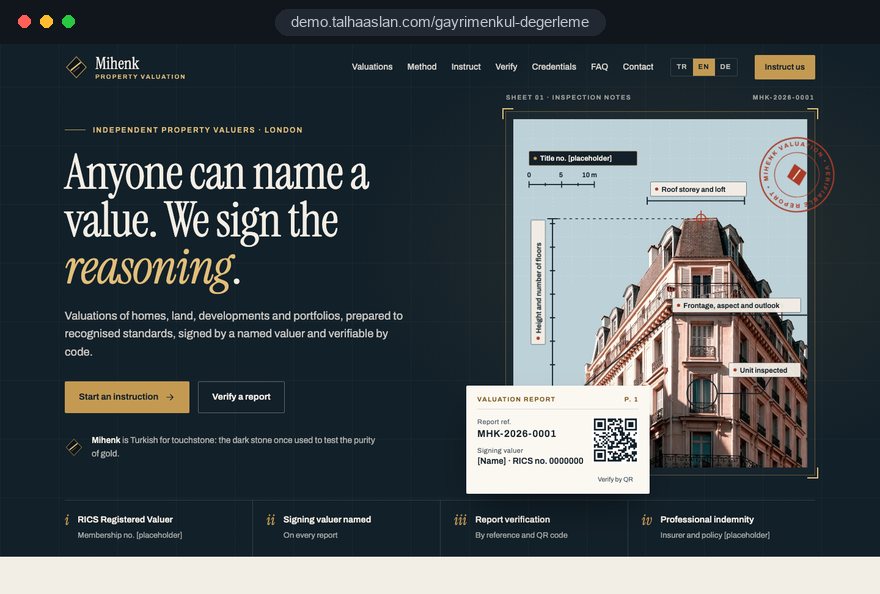
We do not have a live client project for a property valuation firm yet, so we show our approach on a live demo site. The demo is not a client site. You can see our work in other sectors on the references page.
Live demo
For this field we built a one page demo site for a fictional brand, made only to show our approach. You can explore the design, the copy structure and the mobile view live in three languages.
Open the live demoRegistration, standards and valuer details come only from documents you give us; we do not publish a claim without proof behind it.
We list what you need to prepare a quote and keep the instruction forms short but complete.
We agree with you where the reference and QR code sit on the report and what the verification page shows.
We track which valuation type and channel bring instructions and where clients drop out of the form, then adjust the structure.
Related pages
Industries
For estate agents: searchable listings and agent-focused property pages.
Industries
For developers and builders: project portfolio and sales-focused pages.
Industries
For vehicle inspection businesses: packages and slot selection.
Solutions
A single-goal page matched to an ad for one valuation service.
 How to Build a B2B Website: Site Structure That Generates Qualified LeadsRead article
 How to Build Trust on Your Website: Trust Signals That Turn Visitors into CustomersRead article
 Lead Form Design for Booking, Quote and Demo Requests: UX Rules That Lift ConversionsRead article
 Website Data Security for Business Sites: Encryption and Secure Data Handling GuideRead article
FAQ
If your question is not here, write to us; we will send you an answer and a written quote.
Next step
In a free 15-minute call, in English, we will go through your valuation services, your clients and how instructions arrive today, then send a written scope and quote.
In-depth guide
A property valuation website has two audiences. One is the client who instructs you. The other is the lender, solicitor, buyer or fund manager who receives your report, has never spoken to you and opens your site to check two things: is this firm qualified to sign this report, and did the report really come from here. This guide orders the planning decisions with both readers in mind.
Each section gives you a criterion, a checklist or a question to put to your agency. Regulatory statements rely only on published RICS material and, for firms in Turkey, the Capital Markets Board communiqué; the final professional and legal review always stays with your firm.
The first decision on a property valuation website is to treat the instructing client and the report reader as separate people with separate tasks. The client wants a service, a process and a quote; the report reader wants credentials, the signing valuer and proof that the document is genuine.
This split shapes the navigation. Services and instructions lead the main menu for clients, while credentials, valuers and report verification sit one click away on every page for readers. A site that mixes the two shows clients paperwork and shows lenders marketing.
Before any design, answer these questions from your own files:
A question without an answer on the site is usually a missing page.
The credentials page is the most checked page on a valuer's website, and every line on it should be traceable to a document. Under RICS rules, members undertaking valuation work must join the Valuer Registration Scheme, with listed exceptions, and Registered Valuers appear in the RICS Find a Member directory. Inviting readers to check this themselves is stronger than any adjective.
A structure that works for most firms:
When the team changes, the page must change the same day. We keep each valuer as a separate record in the panel and mark leavers as inactive instead of deleting them, so verification records for older reports stay intact.
For firms in Turkey the logic is the same with a different register: firms authorized by the Capital Markets Board are added to a public list of authorized firms, and each report is signed by at least one responsible valuation expert. Question for your agency: who will update valuer details, from which screen, and how long will it take.
Clients search by purpose, not by valuation method, so service pages should be split by why the valuation is needed. A family settling an estate, a couple dividing assets, a borrower whose lender asked for a report, a tenant facing a rent review and a fund with forty assets all arrive with different questions.
Use the same skeleton on every purpose page so readers and your content team both know where to look:
Whether to publish fees is a separate decision. Even without figures, a page can explain what drives the fee: number of properties, property type, purpose and the level of reporting needed.
One warning: copying the same text onto six pages and changing only the heading gives readers and search engines empty pages. If a purpose page has no document, risk or question unique to that purpose, it does not deserve to exist on its own; cover the service as a section inside a related page instead.
A private instruction form should collect everything needed to quote in one pass and nothing beyond that. Start from the questions your team asks on the phone today before it can give a price.
Fields we often use for a single property:
Conditional fields keep the form short. If the purpose is a lease renewal, the form asks for the current lease; if it is probate, it asks for the valuation date the executors need; a client valuing a flat for a purchase never sees either.
End the form by telling the person what happens next: who receives the instruction, when they will be contacted and which document to have ready. Send the same lines by email as well.
A corporate instruction is a different workflow, not a longer private form. A company, fund or lender wants several properties valued at once, the contact person often sits in finance or procurement, and the quote has to pass an internal approval.
Elements that help on the corporate route:
Corporate instructions should go straight to the person responsible for those relationships and never queue behind private enquiries. Next to the form, link the pages corporate clients check most: credentials, signing valuers, standards and terms of engagement.
Firms with several regional offices face one more choice. When a portfolio spans regions, the instruction should land with one central contact who distributes the work. Corporate clients usually want one contact and one proposal, even when the work is split internally.
The upload area is the most sensitive part of a valuation site, because title documents, leases, plans and identity details collect there. It should be easy for the client and closed to everyone else.
Ground rules we apply:
A privacy notice belongs next to the form and should say clearly why uploaded documents are processed and for how long they are kept. If you serve clients in the European Economic Area, remember that cookie consent is needed there before any non essential tracking runs.
Reports and quotes usually travel by email, so your domain's email identity is part of security too. A fake report sent from a lookalike address damages your name, not the sender's. SPF, DKIM and DMARC records tell receiving servers which mail is genuinely yours; you can check them in seconds with our email authentication checker.
A process page answers "where is my report" before anyone picks up the phone. After instructing, the client goes through inspection, searches and enquiries, analysis and delivery; a client who cannot see these steps treats every pause as a problem.
Build the page in the order the client lives it and state at each step what is expected of them. At inspection, say who provides access to the property; at the research stage, which documents you may still request. If you mention timing, list what extends it instead of quoting one number: access delays, missing planning records or a complex title.
A short section on what the report contains belongs on the same page. Readers who have never seen a valuation report want to know its headings and why it is so detailed:
This is also the natural place for a plain note on standards. RICS published a new edition of its Red Book Global Standards, effective from 31 January 2025, which requires valuers to record relevant ESG data. Explaining which standards you follow, and when a client actually needs a Red Book valuation, sets expectations early; agree the exact wording with your own professional lead.
A verification page should confirm that a report came from your firm and never reveal what the report says. A lender or buyer types the reference from the first page or scans the QR code; the screen shows the firm, the report date, the signing valuer and whether the report is still current.
Decisions to make while building it:
Decide the QR code's position with whoever maintains your report template. A code shrunk into a margin will not scan on a phone, and printing a short verification address next to it gives readers without a camera a second route. You can create test codes with our QR code generator and scan them on a printed draft to check size.
The verification page is not a marketing page. Keep it free of offers, pop ups and chat bubbles; show only the result, the firm's details and a way to report a problem.
If your firm is authorized by Turkey's Capital Markets Board, a corporate information section on the website is an obligation, not a design option. Article 26 of the communiqué on real estate valuation firms lists trade registry details, the current shareholding, management and organization structure, the latest articles of association with the date and issue of the Trade Registry Gazette and five years of financial reports.
Build it as an organized archive, not a pile of files:
The same communiqué requires professional liability insurance for valuation reports, and complaints about reports outside the capital markets go to the Turkish valuation experts' association. How to present both points is something we settle with you, and we recommend confirming scope with your adviser.
UK and other firms without this duty can still borrow the idea: a firm information page with registered details, regulation status, insurance and complaints information answers the questions a lender's panel manager asks before adding a new firm.
A valuer's website should never sound like a sales brochure, because readers are looking for a firm that sets value independently of who benefits. Lines such as "we help you get the value you need" or "reports that make lending easier" send the wrong signal to the lender or court that will rely on the report.
Limits we suggest for every page and post:
Professional rules may set further limits. Check every claim on the site against current RICS guidance or the rules of whichever body regulates you, and let your own compliance lead sign off the final wording.
The blog is where this discipline is tested most. Instead of commentary on where prices are heading, choose topics that help readers act: what a probate valuation is used for, which documents to prepare for a lease renewal, or why a report is tied to a specific valuation date.
Property valuation searches usually combine a purpose with a place: a probate valuation in a named town, a rental valuation for a lease renewal, a valuer near a postcode. Purpose pages answer the first half of those searches; region or branch pages answer the second.
Open a region page only where you really inspect, and give it content unique to that area: which districts you cover, the local contact and the valuations most requested there. Each branch's Google Business Profile should use the real business name; adding keywords such as "cheap valuations" to the name breaks Google's guidelines.
Technical checks before launch:
If you serve overseas owners or investors, translate the credentials, process and document upload pages first, because these readers ask about little else; a multilingual site with reciprocal hreflang annotations then shows each reader the right version. For ongoing work on rankings, our SEO service can run alongside the build.
Measurement should show which valuation purposes and which channels bring real instructions, not how many people visited. Define private instructions, corporate instructions, call clicks, WhatsApp clicks and verification lookups as separate events.
Verification lookups are not conversions, but they are a useful signal. Knowing which lenders or regions verify your reports most often can show where professional relationships are growing. Keep it in its own view so it never inflates instruction numbers.
Watch where people abandon the form. If many leave at the upload step, try moving uploads after the instruction and compare the two versions over a few weeks.
Run a monthly review with three questions:
If you plan paid campaigns for one service, such as probate valuations, set up tracking first and send the traffic to a focused landing page instead of the home page.
Most mistakes on valuation sites come from building on a generic business template. The ones we see most, each with the better alternative:
What these mistakes share is that the report reader was forgotten. Before launch, ask a colleague who has never used the site to verify an unfamiliar reference number and to find the signing valuer from the credentials page. If either task takes longer than a minute, your property valuation website still has a gap on the trust side.
When choosing a partner for a property valuation website, look at how the agency handles credentials, documents and verification before you look at design samples. Questions worth asking in the first call:
Another test is what the agency asks of you. A project that starts without requesting your registration evidence, report template and the questions you ask before quoting will most likely end as a generic business site. A property valuation project built for the sector begins with that list.
We do not have a live client site for a valuation firm yet, so we show our approach on a live demo linked on this page. Our work in other sectors is on the references page, and our general approach is on the web design service page.
Fixed price packages are in the pricing section. To talk through your valuation services, the balance of corporate and private work and how instructions arrive today, get in touch with us; we will come back with a site structure and a written quote.
Start a Project
Thanks {name}, we've received your brief. We usually reply within the same day.
What happens next?