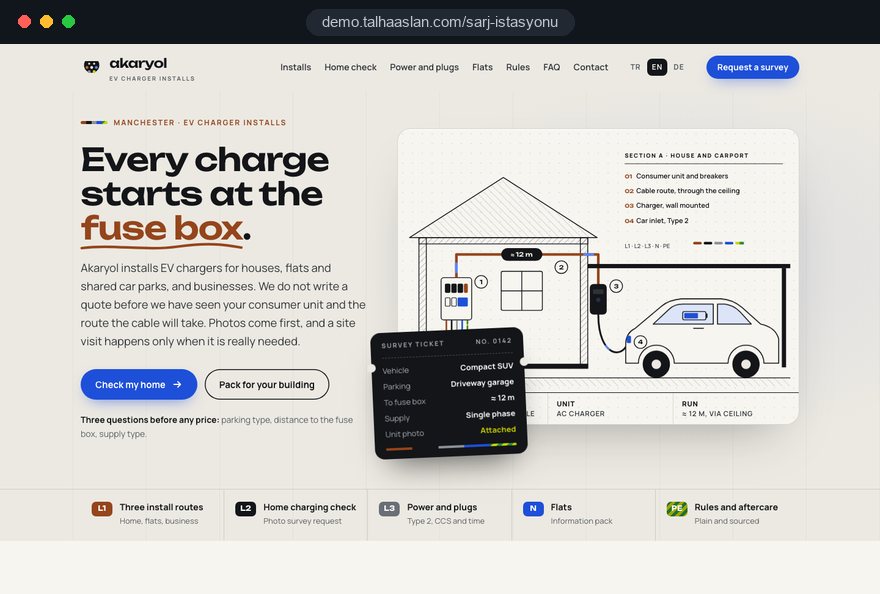
Most people who land on an EV charger installer's website have a date in mind: the day their car arrives. Before then they want to know whether a charger can go on their driveway or in their building's car park, who has to agree, and how many steps stand between them and a working unit. A good installer site answers those questions in order, honestly, and without making promises the survey has not confirmed yet.
This guide looks at the site from your installation team's point of view: the suitability questions to ask before the form, how to get usable photos, how to write about power, the smart charge point rules, grants, flats, fleet briefs, product pages, handover and aftercare, search and measurement. Each section ends in something you can apply directly.
01Meeting the buyer before the car arrives
An EV charger enquiry usually comes with a short decision window, so the first screen must show the process and the next step. Someone who has ordered a car wants the charger ready before delivery; someone who already has it is charging from a three pin plug and is getting impatient. Both need a clear route and fast first contact.
Four facts are enough above the fold: which install types you do, which areas you cover, how surveys work and what the first step is. An optional "expected delivery date" field in the form lets your team prioritise; ask for it as planning information only, never as a date you commit to.
- Process strip: request, quick review, photo or site survey, install, handover; five steps on one line.
- Install type doors: three clear buttons for houses, flats and shared car parks, and business or fleet.
- Fast contact: click to call on mobile and a WhatsApp button with a prefilled message.
- Coverage: the postcodes or counties you cover, stated plainly, so out of area requests sort themselves out.
If you work with dealers selling electric cars, a QR code handed over with the keys can point straight to this page; the handover flow we design for car dealer websites is the other end of that partnership.
02A three question suitability check before the form
Asking three short questions before opening a long form clarifies things for the visitor and keeps unsuitable requests away from your surveyors. Most of the time lost in charger installation goes into discovering, at survey stage, that a job was never a fit.
- Where do you park: your own driveway or garage, a shared car park, a workplace car park, or on the street.
- Who controls the property: you own it, you rent it, a freeholder or managing agent, or a business.
- How many vehicles: one, two to five, or more than five.
The answers send each visitor to one of three outcomes. An owner with off street parking goes straight to the photo survey form. A flat resident or renter first sees the page on permissions and the information pack, then the form. Anyone with more than five vehicles lands on the business brief.
The check becomes far more useful when its answers are carried into the form automatically, so nobody is asked twice and your team sees which path the request came through. Write the wording with your surveyors; terms like "supply type" need a short hint about where to find them. In our web design service we put this kind of filter in front of the form in every sector, and for charger installers it is where most time is won back.
03Teaching customers to photograph the consumer unit
A photo survey only works when the customer is shown exactly what to photograph; "upload a photo of your fuse box" on its own is not enough. Blurred, dark or badly framed pictures send your surveyor back to a site visit anyway.
Put a sample image and a one line instruction next to each upload field. State the safety note clearly: the customer must not remove any cover and should photograph only what is normally visible. That sentence protects you and signals that you take the work seriously.
- Consumer unit: cover closed, with every breaker and label readable in one frame.
- Meter and main fuse area: a close shot where the meter label is legible, without touching anything.
- Parking space: the wall or post where the charger would go, with the car's usual position.
- Cable route: one or two shots of the path from the consumer unit to the parking space, including doors and walls.
- Driveway and boundary: enough of the surroundings to see whether a cable would cross a path or a shared area.
Phone photos are large; resizing them during upload keeps the form fast for visitors on mobile data. Photos can contain personal data, so the privacy notice should state why you keep them and for how long, and the files should sit somewhere only your installation team can open.
04Writing power and charging time with assumptions
The aim of the power page is an accurate expectation; a single kW figure in large type does the opposite. Charging time depends on charger output, single or three phase supply, the car's own AC charging limit and battery size, and any time quoted without those four variables is a promise.
Explain power options the way a table would: for each row, the supply type, the charger output and a note that reads "if your car accepts this rate". Many cars accept less AC power than a 22 kW charger offers, so a customer may see no difference from a more powerful unit. Saying this plainly also cuts requests for supply upgrades that would not help.
- Put the battery size and power assumption next to every time you mention.
- Use "approximately" and avoid exact hours; firm figures belong in the quote after the survey.
- Add a short note showing where the car's AC charging limit appears in its handbook or specification.
- Skip savings and running cost claims; point customers to a tool where they can run their own numbers.
For the last point, linking an EV charging cost calculator works well: customers calculate with their own tariff and car, and you never put a savings figure in writing.
05Explaining the smart charge point rules plainly
If you install in Great Britain, the site should say briefly and accurately that home and workplace chargepoints sold there must meet the Electric Vehicles (Smart Charge Points) Regulations 2021. Customers otherwise meet these features for the first time at handover and wonder why the charger starts later than they expected.
The regulations require smart functionality, preset default charging hours outside peak times that the owner can change, a randomised delay before charging starts and a set of security measures. You do not need to reproduce the legal text. A short explainer box, written in your own words and linked to legislation.gov.uk, is enough.
- What it means for the customer: the charger connects to an app and can schedule charging.
- Default hours: the unit arrives with off peak defaults that the owner can adjust at handover.
- Randomised delay: a short, variable delay before charging starts is a feature, not a fault.
- Security: passwords and updates matter, which is one reason aftercare exists.
Keep public and rapid charging outside this explainer, since they sit under different arrangements, and show the date you last checked the wording. Put the explainer in one place and link to it from product and install pages; when the rules change, you edit one block instead of hunting through the whole site.
06Grant pages that point to GOV.UK, not amounts
Grant information builds trust when it explains the process and names your status, not when it quotes figures that may change. GOV.UK describes the route for the EV chargepoint grant for renters and flat owners: the customer gets a quote from an OZEV authorised installer, gathers the written permission needed from a landlord, freeholder or property manager, and completes the online application. After the work is done, the installer claims the grant on the customer's behalf.
- State whether you are an OZEV authorised installer, and only if you are.
- List the schemes you currently work with, by name, with a link to each GOV.UK page.
- Explain what the customer prepares, such as written permission and the documents GOV.UK lists.
- Describe what you do: the quote, the install and the claim after completion.
- Show the date the page was last checked and tell customers to confirm eligibility on GOV.UK.
Do not publish grant amounts, deadlines or eligibility shortcuts copied from older articles. Schemes open, change and close, and an outdated figure on an EV charger site turns into a difficult conversation at quote stage. A short sentence such as "check the current terms on GOV.UK before you apply" does more for credibility than any headline number.
07An information pack for freeholders and managing agents
For flats and shared car parks the job is usually decided by the building, so giving residents a tidy pack to send on makes that decision easier. Keep it to two or three pages, describe your technical process in plain language and leave any legal view to the building's own advisers.
- Summary: where the charger goes, what work is involved and roughly how many working days it takes.
- Cable route: the path from the supply to the parking bay, how it crosses shared areas and how it is concealed.
- Metering and billing options: the technical difference between connecting to the resident's own supply and a shared or separately metered arrangement.
- Impact on shared areas: drilling, containment, signage and parking use.
- Future residents: how the infrastructure could be extended if others want chargers later.
Offer the pack as a downloadable PDF and track downloads; each one is an early signal of a possible building wide project. A separate contact route for managing agents also pays off, because someone thinking about the whole car park asks very different questions from a single resident and expects a different proposal.
08A project brief form for fleets and workplaces
A business decision maker buys a project rather than a product, so the business form should work like a project brief. Fleet managers, hotel operators and facilities teams want to see on first contact that they are being taken seriously.
- Vehicle profile: number of vehicles, models and planned additions.
- Parking pattern: how long vehicles stay, overnight or daytime, and shift patterns.
- User access: who will use the chargers and whether RFID cards or app authorisation are needed.
- Reporting: whether consumption reports per vehicle or per user are needed, and who receives them.
- Site supply: what is known about the existing connection and whether load management is wanted.
Explain load management, meaning several chargers sharing the available supply without exceeding it, with a simple diagram rather than a paragraph of specifications. The business page should also show a sample project path: brief, site assessment, proposal, install and commissioning. Leave an upload field at the end of the brief, so a business with a car park plan or a single line diagram can share it straight away.
If you have completed workplace installs, give each one a short page with the number of vehicles, the charger type and the problem solved. Use a client's name only with their written permission.
09Charger model pages that add installer knowledge
Showing the brands you are approved for is valuable, but copying the manufacturer's product text does not set you apart from every other installer selling the same unit. A model page earns its place when it adds what only the person fitting it knows.
- Who it suits: house, flats or business; single unit or a group of chargers.
- Install notes: wall or post mounting, outdoor protection, tethered or socketed, cable length options.
- Smart features: app, scheduling, card authorisation and load management compatibility.
- Documents: download links for the manufacturer's datasheet and user manual.
If you build a comparison page, organise it around customer situations rather than headline specifications: "shared car park with one supply and several users" tells a reader more than a column of maximum outputs. If you prefer not to show prices, end each model page with the survey form and carry the model name into it automatically.
Many customers buy a unit online or with the car and only need fitting and commissioning. If you install chargers you did not supply, say so on a short page of its own; it is a door many EV charger installer sites leave closed.
10Handover, aftercare and fault requests
Explaining handover day in advance lowers anxiety and shortens your team's time on site, and a structured fault form keeps the relationship going afterwards. Send the preparation page as a link once the quote is accepted.
- Before the install: clear the parking space, make the consumer unit accessible and have any building permission ready.
- On the day: mounting, cable run, protective devices, testing, and how long the power will be off.
- Commissioning: a first charge, the app installed on the customer's phone, default hours explained and cards set up.
- Handover pack: a short user note, the aftercare contact, the serial number and manufacturer support details.
The fault form then asks for what your engineer would ask on the phone: make, model and serial number with a picture showing where the label sits, light colour or error code, when the problem started, a short video of the unit's lights, and when the parking space is accessible. Above the form, list safe checks the customer can try alone, such as the car's charging settings and the app connection, each with a clear "do not open the unit" warning.
Route fault requests to a separate inbox or WhatsApp line so existing customers do not wait behind new quotes. Check the handover and fault pages with a mobile friendly test; customers will open them on a phone, standing next to the charger.
11Being found for vehicle and install searches
People looking for a home charger often add their install type, their car model or their town to the search, so the content plan should cover all three. A single "our services" page is not strong enough for any of them.
- Install type pages: separate, detailed pages for houses, flats and shared car parks, and business and fleet.
- Vehicle guides: plain articles on a specific model's AC charging limit and which units suit it, using brand names for information only.
- Area pages: only for areas you genuinely cover, describing the install types you do there.
- Answer blocks: short, sourced answers to questions like whether a typical home supply can take a 7 kW charger.
Mark up the business name, service area, contact details and frequently asked questions with structured data, build it with a schema markup generator and make sure it matches the visible text exactly. Keep the Google Business Profile service area to the places you really work; as a service area business you can hide your address. Our SEO service treats the content plan and the technical base as one piece of work.
12Measuring the path from survey to installed charger
The number that matters is not form submissions but where the path from enquiry to quote to installed EV charger breaks. A submitted form is a start; the useful insight is which install type actually turns into work.
- Record each suitability answer and each form step as a separate event.
- Watch drop off at the photo step; if it is high, make photos optional or allow them later.
- Pass source, install type and area with every request into your CRM or job sheet.
- Mark enquiry, survey, quote and install in the same sheet and review monthly which source becomes installs.
- Send completed installs back to your ad account as offline conversions.
The last step matters for anyone running ads: if the ad platform only sees form counts, it treats requests from areas you do not cover or from unsuitable properties as success. If you build a separate campaign landing page for a home charger offer, connect its form to the same measurement. In Google Ads management we set up this feedback loop as part of the build.
13Six recurring mistakes on EV charger websites
Most of these mistakes come from planning the site apart from the installation team's workflow rather than from poor design. Each one has a better alternative.
- Promising a fixed charging time: instead, state battery size and power assumptions, give an approximate figure and confirm after the survey.
- Listing every product on one page: instead, build pages per install type and link the relevant models from them.
- Asking for photos without instructions: instead, provide sample images, a safety warning and a short step by step photo guide.
- Quoting grant amounts: instead, explain the process, state your installer status and link to the current GOV.UK page.
- Leaving flat residents to deal with the building alone: instead, offer a downloadable information pack and a separate route for managing agents.
- Forgetting the customer after handover: instead, publish a preparation page, a fault form and a servicing page.
You do not have to fix everything at once. For most installers a sensible order is the form and photo guide first, then the install type pages, then the rules and grants explainers, and finally aftercare.
14Questions for a web partner and how to decide
The right partner plans an EV charger website as a tool that takes over the work your team does before a survey, not as a product showcase. Ask these questions in the first call and expect concrete answers.
- Will you define the survey form fields together with our surveyors?
- Which official sources do you use for the smart charging and grant wording, and how is that shown on the page?
- Where are uploaded photos stored, and who can access them?
- How will you measure the path from form to installed charger, and how will you report it?
- How will fault requests be kept apart from new sales enquiries?
Then ask yourself two questions: which install type brings most of your enquiries, and how many survey visits turn out to be unnecessary? For a business focused on houses, the photo form and the power page come first; for one focused on flats and fleets, the information pack and the project brief do.
A live demo built for this field is linked on this page; it is not a client site and is there to show the structure. You can review scope and packages in our pricing section, and to talk through your install types and coverage, get in touch with us. In the first call we list the questions your team asks before every survey and build the page structure and written quote from that list.