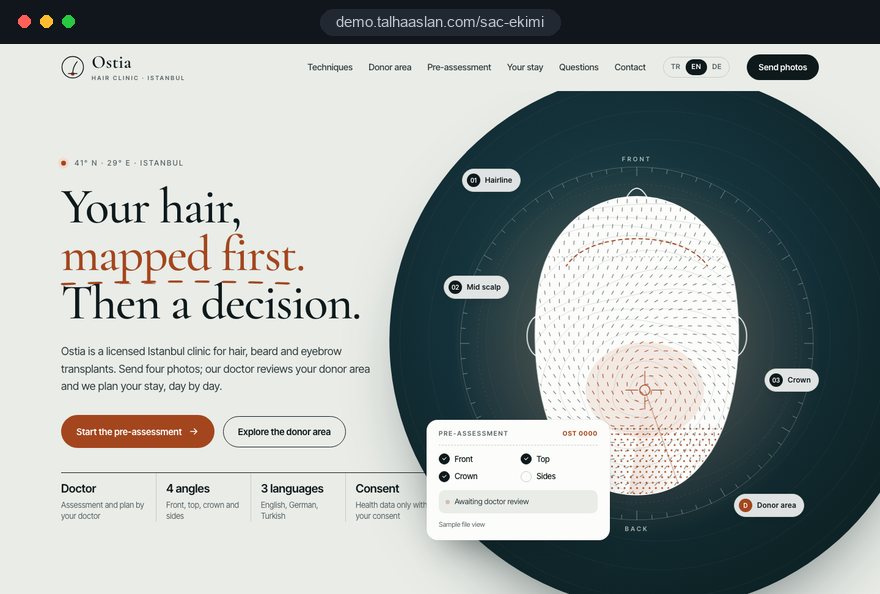
A hair transplant clinic website is where a prospective patient returns again and again over months of research, usually with the same four questions: which technique, how many grafts, who operates, and how do I send my photos. A site that answers each of these at page level takes pressure off your inbox and puts a cleaner assessment file in front of your doctor.
This guide follows the decisions a clinic owner makes in order: the technique inventory, the graft explanation, the photo form, data protection, advertising rules in the UK and in Türkiye, language pages, speed and measurement. Each section ends in something you can check or decide.
01Turn your technique list into a sitemap
Your sitemap should come from an honest list of the methods your clinic actually performs, not from every term you have seen on a competitor's menu. Copying that menu produces thin pages that repeat each other.
In the first workshop we fill in a simple table with your lead doctor: method, instrument, treatment area, and whether patients search for it on its own. These rules decide whether a topic earns a page:
- A separate choice: If patients genuinely choose between two options, such as FUE and DHI, each gets its own page.
- A separate area: Beard, eyebrow and moustache transplants raise different concerns and deserve their own pages.
- An instrument, not a technique: The type of blade or implanter pen used becomes a subheading on the relevant technique page.
- Out of scope: Methods you do not perform, or that are not established medical practice, are not mentioned at all.
Every technique page then follows the same skeleton: what it is, who it may suit, how planning works, the procedure day, aftercare, questions, and a visible last updated date with the name of the approving doctor. A shared structure lets patients compare pages and tells your team what to update when a protocol changes.
02Answer the graft question without quoting a number
The graft page exists to explain how the number is decided, not to give one. Once a patient understands that, they see for themselves why photos and a doctor's assessment come before any plan.
The page should cover these points in plain language:
- What a graft is, and that one graft is a follicular unit that may hold more than one hair.
- Why the donor area, the back and sides of the scalp where grafts are taken, sets the limit.
- How the size of the area, hair thickness and hair color change the plan.
- Why a careful doctor keeps donor capacity in reserve for areas that may thin later.
- That a personal plan is given in writing after the doctor has reviewed the case.
We advise against the graft calculators that appear on many clinic sites. A tool that turns a handful of answers into a precise figure is a promise made about someone the doctor has never seen, and when the real plan differs, trust drops. In the UK it also becomes an objective claim that would need evidence under the CAP Code. If you want something interactive, a short visual guide that shows which photo angles are needed sends the same curiosity in a useful direction.
03Candidacy and the donor area: when surgery is not advised
A page that explains when a hair transplant is not the right step builds more trust than any claim, and it filters out enquiries your coordinators would otherwise spend hours on. Your doctor decides its content; we make it readable and place it before the photo form.
With your doctor's approval, the page can address situations such as these:
- A donor area that cannot support the coverage the patient hopes for, and the alternatives the doctor may discuss.
- Diffuse thinning across the whole scalp rather than a defined pattern.
- Hair loss that is still progressing quickly, and why a doctor may suggest waiting.
- Scalp conditions that need treatment before any procedure is considered.
Two or three short questions at the start of the form, such as how long the hair loss has been going on and whether there was a previous transplant, give the doctor context before opening the photos. Keep these to a minimum: every extra question is extra health data, and data you never collect is data you never have to protect.
Keep the tone inviting rather than rejecting. Close the page by stating clearly that the online review is a first opinion and that the final decision follows an in person consultation.
04Build a photo assessment form patients can finish
The photo form is the working heart of a hair transplant website, and whether it works depends on how clear the angle guidance is. At every step the patient should see an example of the photo you need, and the form should flag a missing angle before submission, not after.
We build the form in this order:
- A few context questions and the language the patient wants the reply in.
- One upload slot per angle: front, top, crown, right side and left side, each with a sample silhouette.
- Short shooting tips: dry hair without styling products, daylight, a plain background.
- In browser compression of large phone images, with a visible progress bar.
- The privacy notice, explicit consent and a confirmation screen that explains what happens next.
iPhones often save photos as HEIC files, which some systems cannot open, so the form should convert them to a common format. On a weak mobile connection an interrupted upload must keep the angles already sent rather than forcing a restart. The confirmation screen should say how and roughly when the reply will come, so the patient does not send the same photos again over WhatsApp.
Before launch we complete the form end to end on different phones and on a throttled connection.
05Treat scalp photos as health data
Scalp photos sent for a medical assessment can count as health data, which UK GDPR treats as a special category under Article 9, and which Türkiye's KVKK also classes as special category personal data. Where the files live, who opens them and when they are deleted therefore has to be designed, not left to defaults.
These are the controls we put into the photo workflow:
- Strip location data: Phone photos can carry the coordinates of where they were taken; this metadata is removed before the file is stored.
- Private storage: Files are written to an area only signed in staff can reach, never to a folder with a public web address.
- Expiring links: The notification to the doctor contains a short lived viewing link, not the file itself.
- Access log: Every opening of a file is recorded with who and when.
- Retention: Files are deleted automatically when the period agreed with your legal adviser ends.
The privacy notice sits directly above the upload, and explicit consent is a separate, unticked checkbox. If the team then forwards photos as e-mail attachments or keeps them on personal phones, every one of these controls is undone, so internal sharing has to run through the same panel. We also write down, before launch, the steps for handling a patient's request to delete their data.
06Surgeon, team and who does each step
When a patient asks who will perform the procedure, the answer should be on the site, step by step: who plans the hairline, who extracts the grafts, who opens the channels and who places them. Vagueness here is the doubt patients researching a hair transplant raise most often.
Write this from your clinic's real division of work, then check titles against the rules of the market you serve. In the UK, use only the registrations and titles your doctors actually hold and that their regulator recognizes. For clinics in Türkiye, the 2025 promotion regulation forbids specialist titles based on certificates outside the specialties defined by law, while training, registered certificates, publications and society memberships within the doctor's diploma specialty may be listed.
A doctor profile we recommend includes:
- Full name, recognized specialty and academic title.
- The stages of the procedure this doctor performs and the days they see patients.
- Registered certificates, publications and memberships as a plain list.
- The pages this doctor has reviewed and approved.
Profiles can also be marked up for search engines; a structured data generator helps you check that every field matches information actually visible on the page. Marking up a title that is not shown on the page is misleading and risky. Keep profiles current when the team changes.
07Write the procedure day and recovery timeline
A page that walks through the procedure day hour by hour and the following weeks stage by stage does more to calm patients than any reassurance, and it improves attendance at follow up appointments. Every line follows your doctor's own protocol; generic timelines copied from elsewhere do not belong here.
Split the content in two. The procedure day covers arrival, hairline planning, local anesthesia, extraction, placement and the instructions given before the patient leaves. Recovery covers the first wash, sleeping position, scabs shedding, the temporary shedding phase and check up appointments. At each stage, separate "this is expected" from "call us if this happens".
Practical additions that make this section work:
- Printable aftercare sheet: A one page version the patient can keep at the hotel or at home.
- Language versions: The aftercare instructions in the patient's language, translated and then approved by your doctor.
- After the procedure: Who to contact at which hours, and which number to call outside them.
- Follow up reminders: Check up dates the patient can add to their own calendar.
When describing when results appear, give your doctor's general framework and state that it varies from person to person instead of naming a date. Use the same wording as the written plan patients receive after their assessment.
08Claims and images under UK advertising rules
If your hair transplant clinic markets to UK patients, the CAP Code applies to the claims on your website, and the ASA has ruled against hair transplant ads for unsubstantiated claims. The safest copy is factual, specific and supported by evidence you can produce on request.
The points that most often shape hair transplant pages for UK audiences:
- Evidence for objective claims: Rule 12.1 requires evidence for objective claims, so statements about growth, density or natural results need support or rewording.
- No targeting of under 18s: Rule 12.25 says ads for cosmetic interventions must not be directed at people under 18, which affects imagery, wording and social placements.
- No holiday framing: The ASA has objected to ads that present surgery as part of a holiday, so stay and transfer pages describe logistics, not leisure.
- No time pressure: The ASA has also objected to time limited offers, so countdowns and "book this month" banners stay off the site.
For images, accuracy is the test: no retouching and nothing that implies every patient gets the same result. We flag doubtful copy and images before launch; the final legal check remains with the clinic.
09Clinics in Türkiye: the 2025 rules and a separate international site
For clinics based in Türkiye, the Regulation on Promotion and Information Activities in Health Services published in the Official Gazette on 12 November 2025, no. 33075, replaced the 2023 regulation and changes both the image rules and the site architecture. The first decision is whether you run one site or two.
For domestic promotion, the regulation bans prices, discounts, campaigns and promotions, advertising based on patient thanks, and paid sponsored search placement. Patient images need explicit consent on the regulation's own form, the patient may withdraw it at any time, before and after images must be taken in the same setting and conditions with the procedure and photo dates stated, no retouching is allowed, and domestic images carry a warning that results vary from person to person.
Article 8 gives facilities holding a health tourism authorization more room, provided they promote abroad through a separate website or account that clearly declares health tourism services, in languages other than Turkish:
- The health tourism authorization certificate is published on the site, and the HealthTürkiye logo is used.
- The facility name, title and domain match the name on the facility's licence.
- No demand is created among people living in Türkiye.
- Patient stories and reviews appear only when explicit consent is documented.
If packages, payments and facilitators carry most of the weight, our health tourism website approach is the better starting point.
10Localize language pages, do not just translate them
A language page is the Turkish or English original rewritten in the terms that country's patients use, not a translation of it. A UK patient searches for "hair transplant Turkey" and talks about grafts, a German patient types "Haartransplantation Türkei", and an Arabic speaking patient expects a layout that reads from right to left.
What we check on every language version:
- A term glossary: Graft, donor area, channel opening and similar terms are fixed once per language and used identically everywhere.
- Medical review: A health professional who reads that language, or your doctor, checks the translated medical text last.
- Right to left layout: On Arabic pages the menu, the form and the angle guide are mirrored, including the order of the photo slots.
- Channels and hours: Each language shows its WhatsApp number and reply hours in the patient's time zone.
We plan a multilingual site structure from day one, because retrofitting languages means rebuilding URLs. Each version must reference itself and every other version with reciprocal hreflang annotations; a hreflang generator lets you build them and spot missing pairs on your current site.
The reply matters as much as the page: the language chosen in the form should appear in the coordinator panel, and someone fluent in it should answer.
11Mobile speed on photo heavy pages
Patients researching a hair transplant use your pages and your form mostly on a phone, so speed targets have to be met on mobile, not just on a desktop test. Google's "good" thresholds at the 75th percentile are an LCP of 2.5 seconds or less, an INP of 200 milliseconds or less and a CLS of 0.1 or less.
We map each of these to the problems typical for a hair transplant site:
- LCP, how fast the main content loads: The large image at the top of technique pages is served in a modern format at the right size, without a heavy slider.
- INP, how quickly the page responds to a tap: Photo compression runs in the background so the interface never freezes.
- CLS, how much the layout jumps: Space for upload slots and previews is reserved in advance, so buttons do not move when an image appears.
- Video: Doctor explainer videos load as a still image first and start the player only on tap.
A mobile friendly test shows in minutes how your current site behaves on a phone; run it on your most visited technique page and on the form, not only on the home page.
12Measure where patients drop out of the form
The number that matters on a hair transplant clinic website is not visits but the step at which patients give up between a technique page and a completed assessment. Once the form is split into steps, each step becomes its own event and the problem shows itself.
The measurement chain we set up:
- A view of a technique or graft page, and the click that opens the form.
- The first photo uploaded, and all five angles completed.
- The form submitted, plus WhatsApp and phone clicks.
- The outcome the coordinator marks in the panel: assessed by the doctor, consultation booked.
A big loss at step two usually points to the angle guide or the upload; a loss at step three often means the consent text is too long or trust is missing. Step four happens outside the website, so a quick mark by the coordinator is essential; without it you cannot see which language and which technique page actually bring patients.
Tracking tags run only after consent: in the European Economic Area, Google requires consent mode for measurement and personalized advertising features, and cookie consent is needed before non essential tracking. Form answers and photos are never sent to any analytics tool. Watching which searches your technique pages appear for is the core of ongoing SEO work.
13Common mistakes on hair transplant websites
Most of these mistakes come from not planning the rules and the patient journey up front rather than from design, and each has a better alternative.
- Copy written for old rules: Pages that still cite Türkiye's 2023 regulation and lack the required warning should be reviewed against the 12 November 2025 regulation instead.
- Promised graft numbers: Instead of a calculator that outputs a figure, explain how the doctor decides and invite photos.
- Undated, edited galleries: Instead of retouched images without consent records, use dated images under consistent conditions linked to consent, or no gallery at all.
- One upload box: Instead of a single field where patients drop five random photos, give each angle its own slot with an example.
- Holiday style packages: Instead of beach imagery and countdowns, describe the stay as a factual plan of days, transfers and check ups.
- Raw machine translation: Instead of auto translated pages, publish versions based on a glossary and reviewed by a doctor.
14Choosing a partner and your next step
Choose the team for your hair transplant clinic website by how it handles advertising rules, photo data and multilingual structure, not by its design portfolio alone. The questions you ask in the first call reveal that difference quickly.
- How will the image rules of each target market be enforced in the software, not just in a style guide?
- Where are photos stored, is location data removed, and who can open them?
- Who writes the medical text, and at which stage does the doctor approve it?
- Will international pages run on a separate site, and who checks the translations?
- How will we see the step at which patients drop out of the form?
We do not have a live client project in this field yet; the live demo linked on this page shows how we would build your site. Our work in other sectors is on the references page, and the full scope of our web design service is described on the service page.
Send us your techniques, your doctors and the countries your patients come from, and we will set up a short call through the contact page. Fixed packages are listed in the pricing section; for a written quote based on your clinic's scope, fill in the Get a quote form. The price depends on technique pages, languages and the scope of the photo form, never on your city.