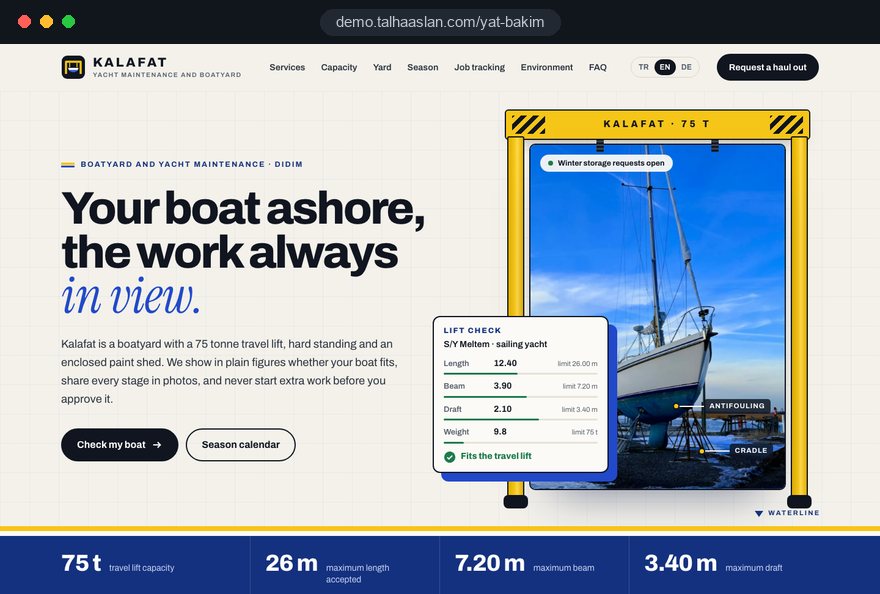
A yacht maintenance website exists to help an owner decide where to leave a boat for weeks or months. That owner often decides from another country without visiting, judging only real capacity figures, a season calendar and photos of real work. On a yacht maintenance site, the order of information matters before the visual design does.
The sections below follow the order in which we make decisions on a boatyard or yacht maintenance project. Each one ends in a criterion you can apply to your current site or a question you can put to any agency you are talking to.
01Decide what your yard actually sells
The first decision is whether you sell space, labor or both, because that choice sets the main button, the menu order and the questions on the quote form. A yard with winter storage leads with "reserve a place"; a mobile crew working in marinas leads with "request a quote for a job".
In Turkey the facility type has a legal definition. The regulation on shipyards, boat building and haul out yards defines a haul out yard as a facility providing maintenance, repair, alteration and winter storage for vessels up to sixty meters overall, and construction up to twenty four meters. Whatever type you are, the wording on the site should match the wording on your permit; outside Turkey, follow the permits and licenses you actually hold.
Before the planning call, we ask yards to answer three questions in writing:
- Where revenue comes from: Storage and time on the hard, or maintenance and repair labor.
- Who owns the facility: Your own lift and yard, or work carried out at someone else's yard or marina.
- What you turn down: Which lengths, hull types or jobs you decline; that list belongs on the site as well.
Saying clearly what you do not do filters out borderline requests early and cuts phone time for the team. If you also build or carry out major refits, give commercial project enquiries their own route from the home page, so a private owner and a company buyer are not reading the same page.
02Build a capacity card owners can check against their papers
Capacity should not be a sentence such as "we handle large yachts"; it should be a set of fixed fields an owner can hold up against the boat's registration papers. The owner should answer "can you lift my boat" without picking up the phone.
The card should include at least:
- Lifting: Travel lift or crane capacity in tonnes and the usable width between the slings.
- Size limits: Maximum length overall, beam and draft, plus any mast height limit.
- Space on the hard: Rough number of boats in storage, cradle or stand types, and whether covered storage exists.
- Access: Depth at the lift dock and whether lifts go ahead in strong wind.
Owners from different countries think in feet or meters, pounds or tonnes. Showing both units saves them a trip to a unit converter, but check each conversion yourself: a rounding error is a wrong answer for a boat sitting at the limit.
Under the card, add one rule for borderline boats, for example "boats within one meter of our maximum length, please send the tonnage certificate with your request". Your team then judges edge cases on documents.
03Make every service page help the owner decide
A strong service page does more than describe the job; it puts the owner's own decisions in front of them. Someone reading the antifouling page should come away knowing which paint type to choose, how many days the boat will stay out of the water and which time of year suits the job.
An antifouling page could follow this order:
- When the job is due: growth on the hull, loss of speed, higher fuel use, time since the last coat.
- What happens at the yard: lifting, pressure washing, surface preparation, primer where needed, coats and drying time.
- The owner's choice: paint types for the cruising area and the boat's speed, and the question your team asks before recommending one.
- Duration and what it depends on: weather, humidity, hull condition and the queue.
- Three or four common questions, then a quote button that collects boat details.
Use the same pattern for gelcoat repair, engine and shaft servicing, propellers, teak and electrics, but write the content from interviews with your own technicians. End each page with one line drawn from your experience, such as "if we suspect osmosis, we take moisture readings first and send you the results with photos".
04Explain lift day step by step
For a first time customer, lift day is one of the least clear parts of the process; describing it on the site means the owner arrives prepared and the lift dock runs on time.
A lift day page should cover, in order:
- When and where to bring the boat, who meets it, and how to call ahead on VHF or by phone.
- What the owner does beforehand: fuel level, loose gear, keys, and whether sling points are marked.
- What happens during the lift: slings, pressure wash, placement on a cradle or stands.
- The first inspection: when the initial notes and photos of hull, propeller, shaft and rudder reach the owner.
- How the same list runs in reverse on launch day.
Publish this page with your location in two forms. Owners arriving by sea need coordinates, owners arriving by road need directions; a coordinate converter helps you publish the position in the format sailors use. Put the number to call on arrival near the top of the page as a click to call button.
05Turn the season into weekly blocks with a closing date
A season calendar is the shortest route to stopping autumn lifts and spring launches from piling into the same few weeks. Build it in weekly blocks, each marked open, nearly full or full.
The decisions we make together when setting it up:
- Unit: Days or weeks; for most yards a weekly block is closer to how the team actually plans.
- Capacity: How many boats can be lifted per week, entered by you according to lift hours and crew.
- Closing date: When winter storage requests close, stated above the calendar.
- Priority: Whether boats with a storage contract are placed first, or requests are taken in order.
If owners should pick their own week, an online booking system can be connected; if not, the calendar only informs and the request form records the preferred week.
A calendar set up once and left alone damages trust. Name one person to update it weekly during the season, and give them a simple admin screen they can open on a phone.
06Write winter storage terms as clearly as the contract
Winter storage asks an owner to trust you from a distance for months, so the terms on the site should be as clear as those in the contract. Every vague point can turn into an argument in spring.
Questions the storage page should answer:
- What is included: Cradle or stands, shore power, water, permission to work on board, routine checks.
- Outside contractors: Whether owners may bring their own technician, under which rules and at which hours.
- Owners doing their own work: Whether sanding or painting by owners is allowed, where and with what precautions.
- Access: Which days owners can visit, and how ladders and the dock are used.
- Insurance and documents: Which papers you ask for at quote stage; your own contract and adviser decide the details.
When we write these points, we take them from your contract draft so the site never contradicts it, and the legal review stays with you. The storage contract request form belongs at the end of this page, so an owner can apply with boat details right after reading the terms.
If you offer both covered and open storage, describe them under separate headings. The limited number of covered places, the tallest boat that fits inside and whether the mast must come down should each be a line of their own; with those three facts, owners can tell which option suits them and tick the right one when they ask for a quote.
07Design the quote form around your foreman's first questions
The quote form should collect what your foreman asks on the first call, so the first reply is a real assessment rather than a list of questions.
The fields we recommend for boat and job details:
- Boat: Make and model, length overall, beam, draft, approximate displacement, hull material.
- Engine: Make, model, engine hours and date of the last service.
- Work requested: A checklist plus free text, with the date of the last antifouling as its own field.
- Place and time: The marina where the boat is now and the preferred week.
- Photos: An upload field for a few photos of damage or the problem area.
Splitting the form into two steps reduces drop off caused by length: boat and contact details first, jobs and photos second. Test it on a phone, because owners often fill it in on the dock next to the boat. A link to your privacy notice and one plain sentence about how the data is used belong right under the form.
The confirmation the owner receives is part of the form. It should say that the request arrived, who will reply and by when, and how to add missing details. On the yard side, every request should land in one list with boat name and preferred week, and a second message about the same boat via WhatsApp should join that entry rather than open a new one.
08Keep a job log and a handover report for remote owners
An absent owner's biggest worry is not seeing what is happening to the boat, and a properly kept job log answers it. Each boat gets a password protected page where job items, stages and dated photos build up over the stay.
The value of the log comes from a photo standard. Ask technicians to photograph every job item from the same spot at the start and at the end, and fix three angles for the hull: stern, midships and bow. Owners then see the difference without an explanation.
At the end of the season the log becomes a handover report: work done, names of products used, issues noted but not addressed, and recommendations for next season. That report serves twice. The owner has an orderly maintenance history to show a buyer or an insurer, and you prepare next season's quote from it. Send a copy to the owner by e-mail as well, so an owner who forgets the password still has the record.
Approval for extra work found during the job also runs through this page, but the real difference is that the owner can follow the boat without standing next to it. A system like this is more than a web page; once it grows, we plan it as a separate module within our web design and development service.
09Write for international owners in their language and units
On many cruising coasts yards serve owners from several countries, and for those owners language means more than translation: it also means units, time zones and the channel they use. An owner who cannot read your services and storage terms in their own language moves on to a yard that can explain the job to them.
We decide on languages in this order:
- Pull owner nationalities from the last two seasons of customer records; the first extra language comes from there.
- Publish capacity, service, season and storage pages in each language first; blog posts and news come later.
- Write technical terms the way owners in that language use them, and do not let workshop shorthand pass through untranslated.
- Decide who reads incoming forms in each language, in which language replies go out, and state your reply hours in local time under the form.
Technically, each language needs its own address and hreflang annotations pointing to the other versions in both directions, with each version also referencing itself. We explain the details on our multilingual website page. A mistranslated storage term does more harm than a missing one.
10Give service, marina and area searches their own pages
Owners rarely type only "yacht maintenance"; they search for antifouling, gelcoat repair, winter storage or a nearby marina by name. A separate page with genuinely different content for each of these is the only structure that can answer them.
We plan four things together:
- Service pages: Each with its own title, questions and photos, never copies of one another.
- Area pages: Only for marinas you really serve, explaining how boats get from there to your yard or what you can do on site.
- Business Profile: The name matches your real business name with no added keywords; location, hours and phone match the site.
- Structured data: Business details and services marked up only where the page actually states them.
We do not promise rankings; we build this structure and watch in Search Console which pages gain visibility, with deeper work running under our SEO service. If you need enquiries quickly before the autumn lifts, short Google Ads campaigns can help, as long as each ad lands on the page for the service it advertises.
Before opening an area page, run one test: if the text still reads true after swapping in another marina's name, the page is not ready. It becomes useful once it holds facts specific to that place, such as how boats are brought over, which jobs can be done in the water and which need a lift.
11Test speed on a phone and measure enquiries before launch
Job photos are the heaviest load on a yacht maintenance website, and owners often view them on a phone over a weak marina connection. Speed and measurement therefore belong on the checklist before launch, not after.
Google's "good" thresholds apply at the 75th percentile of visits: LCP, which measures how long the largest element takes to load, at 2.5 seconds or less; INP, which measures how quickly the page responds to a tap, at 200 milliseconds or less; and CLS, which measures how much the layout shifts while loading, at 0.1 or less. Converting photos from the yard to lighter formats with an image converter before publishing is a cheap first step toward those numbers.
What should be measured from launch day:
- Quote form: Each submission recorded as a conversion, along with the service page it came from.
- Click to call and WhatsApp: Tracked separately, so you can see which pages produce calls.
- Calendar interaction: Which weeks get the most clicks, which helps plan next season's capacity.
- Form abandonment: How many people start the two step form but never reach the second step.
Read these numbers before the busy season; a fix made after the rush begins comes too late.
12Base environmental and legal pages on documents
An environmental practice page gives owners and marinas a ready answer when they ask, but it should describe only what really happens at your yard. In Turkey, the regulation on environmental management of shipyards, boat building and haul out yards bans uncontrolled sanding, painting, scraping and cutting over the sea surface without proper measures; yards elsewhere follow their own environmental rules.
Before writing, we ask you how sanding dust and paint residue are collected, where wash water goes, how waste oil is separated and what you expect from owners who work on their own boats. What we write reflects your practice; the final regulatory assessment and confirmation of your permit status stay with you and your adviser.
The minimum set of legal pages:
- Privacy notice: Covering data collected through the quote form and job tracking, written under the privacy law that applies where you operate; in Turkey this is the information notice under Article 10 of KVKK, Law No. 6698.
- Cookie consent: For visitors from the EU, non essential tracking should not start before consent, and Google's consent mode should be set up for them.
- Facility and permit details: Facility type and permit, in the wording of the document.
Job tracking pages hold owner names, phone numbers and photos of boats, so they must sit behind a password and stay out of search engines.
13Common yacht maintenance website mistakes
Each of these pushes an owner to phone or look elsewhere; the better alternative sits next to each item.
- Describing capacity as "large yachts welcome": Give tonnes, length, beam and draft as numbers, and add a documents rule for borderline boats.
- Setting the calendar once and forgetting it: Name a weekly owner for updates; if nobody can keep it current, take it down rather than show wrong weeks.
- Piling every service onto one page: Give each job its own page, starting with the ones that bring most requests; rare jobs can share a general page.
- Using stock photos: Show your own travel lift, storage area and technicians; owners want to recognize the place when they arrive.
- Switching on languages through machine translation: Write capacity, service and storage pages with a native speaker first and add the rest later.
- Leaving job photos inside chat apps: Collect them on one dated page per boat, so the handover report writes itself at season end.
Most of these can be fixed on your current site today.
14Choosing the right partner and the next step
The right team for a yacht maintenance website asks about your yard, your season and your owners before talking about design.
Questions to ask in that meeting:
- Who updates the capacity card and season calendar, from which screen, and does that cost extra.
- How the job tracking page is protected, where photos are stored and how the season report is produced.
- Who writes the foreign language pages and who checks the technical terms.
- Which conversions will be tracked on launch day and when the first report arrives.
Scope depends mainly on the number of services and languages, on whether the calendar informs or takes bookings, and on whether you want job tracking for owners. A small mobile crew can start with capacity, service and quote pages and add tracking and languages in a second phase. A larger yard should plan the calendar and job log from day one, because systems bolted on later rarely fit the existing structure.
We do not yet have a live client site in this field, so a live demo showing our approach is linked on this page. You can review packages and scope in our pricing section, and get in touch with us for a written quote for your yard. Share your lift capacity, services and where your owners come from, and the first call can go straight to page structure.