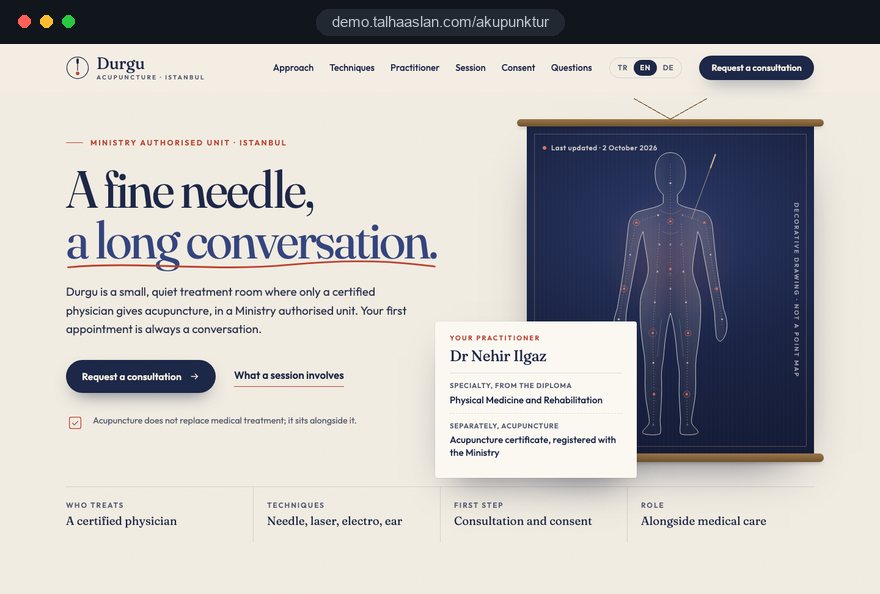
People who look up acupuncture usually arrive with curiosity and a quiet worry about needles. A good acupuncture website takes both seriously: it shows who will treat them, which techniques the clinic actually uses and what the first appointment looks like, in plain and unhurried language. In the UK, where much of the clearest advertising guidance for acupuncture comes from, the words on that site are also judged against the ASA and CAP rules.
In this guide, Talha Aslan and team walk through the decisions we make with an acupuncturist when we plan a site, in the order you will face them. Regulatory notes come from the ASA advice on acupuncture and the CAP Code, section 12. They describe the UK position; practitioners elsewhere should check their own regulator, and the final compliance call always belongs to your clinic.
01Standalone site or a section of your practice site
The first decision is about position, not technology: is acupuncture your whole practice, or one service next to a main profession such as medicine, dentistry or physiotherapy? The answer decides whether you need a separate domain or a clearly built section inside an existing site.
We use these questions to make the call:
- Where enquiries come from: do acupuncture patients mostly come from your existing patient list, or from new people searching for acupuncture directly?
- Who treats: one practitioner, or several acupuncturists working under one clinic name?
- Where you work: one treatment room, or rented rooms in two or three different clinics?
- Who maintains it: who will keep two sets of profiles, legal pages and contact details in step if you run two sites?
A doctor or dentist who offers acupuncture alongside core care is usually better served by a dedicated section within the main site, so reputation builds in one place; the core specialty can sit on a doctor website structure. A physiotherapist can do the same within a physiotherapy website. An independent acupuncturist, or a clinic where acupuncture is the main service, generally benefits from a standalone acupuncture website with the practitioner at the center.
02Showing training, membership and register status
Because acupuncture has no compulsory regulation in the UK, the profile page carries more weight than it would for a statutorily regulated profession. The ASA advice notes that CAP understands no compulsory regulation exists for acupuncture practitioners, and that membership of a body with appropriate accreditation, such as the Professional Standards Authority Voluntary Register Scheme, may be accepted as evidence of suitable qualification.
We build every acupuncturist profile in the same order:
- Name and main profession, for example acupuncturist, or GP who practices acupuncture.
- Acupuncture training: where it was completed and what level it reached, written as facts, not adjectives.
- Professional body and, where it applies, membership of an accredited register, with a membership number patients can check.
- Any separate statutory registration, such as a doctor, nurse or physiotherapist, shown on its own line with its own register.
- Where the practitioner treats and on which days.
Keeping statutory registration and acupuncture membership on separate lines matters. A patient reading "registered" next to acupuncture might assume a legal license that does not exist. We avoid titles that imply a specialist status the practitioner cannot document, and in a multi practitioner clinic every profile uses the same template so no one looks less qualified simply because their page was written in a hurry.
03A page template for each technique
Acupuncture is a family of techniques, and the site should name only the ones your clinic really uses. Needles, electroacupuncture, laser, ear seeds and cupping can all sit under one word on a typical site, leaving a needle anxious patient to imagine the worst. A consistent template lets visitors move between technique pages and find the same kind of answer in the same place.
Every technique page we write follows this pattern:
- What it is: two or three plain sentences, no jargon, describing the technique itself.
- What is used: the needles, device or seeds; if you use single use sterile needles, say so plainly.
- How a treatment runs: the position the patient lies or sits in, roughly how long the needles stay in, and whether the practitioner stays in the room.
- Why it might be chosen: why the practitioner may pick this technique or prefer another, described as a clinical judgment made at the consultation, not as a result.
- Review line: the date the page was last reviewed and the practitioner who approved it.
Leave out techniques you do not offer, even if they attract search traffic; a visitor who comes for laser and finds none is a lost appointment and a frustrated phone call. When you stop using a technique, we remove its page and redirect the address to the general acupuncture page.
04Answering needle anxiety in short questions
A nervous visitor is reassured by short answers in the right place, not by a long essay. We add a block of three or four questions to the end of each technique page, specific to that technique. The questions come from what reception hears on the phone; the practitioner writes or approves every answer.
The question types we use most often:
- Sensation: what a patient may feel as the needle goes in and while it stays, in the practitioner's own plain words.
- Size: how fine acupuncture needles are, compared with something familiar such as a hypodermic needle.
- Control: that the patient can tell the practitioner at any point if they are uncomfortable, and the treatment can stop.
- Afterwards: whether they can drive or go back to work, and who to contact if something unexpected happens.
Keep these answers free of outcome language. "Most people find it relaxing" is already a claim about experience, so the practitioner should only write what they can stand behind. Plain, short sentences matter here more than anywhere: you can check the reading level of a draft with our readability checker before it goes live.
05Writing condition copy within ASA accepted wording
Condition copy is where acupuncture websites most often cross the line, and the safest approach is to start from the ASA's own list rather than from what patients ask for. The ASA advice lists a small number of conditions it has accepted evidence for, almost all qualified as short term or temporary relief. Examples in its wording include short term relief of chronic low back pain, short term relief of tension type headaches and temporary adjunctive treatment for osteoarthritis knee pain.
We apply these rules when writing any page that names a condition:
- Use the list, not a paraphrase: conditions appear only as they are worded in the ASA advice, or where you hold robust evidence of your own.
- Keep the qualifier: "short term relief" stays in the headline, the body and the meta description; dropping it turns an acceptable claim into a misleading one.
- Leave out rejected areas: the ASA reports that claims about fertility support, anxiety, depression and addiction went beyond the evidence, so we leave them out by default.
- No appearance claims: the advice also warns against claims about skin appearance or slowing aging, so cosmetic acupuncture copy stays factual about the procedure only.
If you see patients who come for other reasons, the site can say factually that you offer consultations without naming outcomes. One general page, with a note that suitability is decided at the consultation, answers that search intent more honestly than a page per condition. How we structure the search side is explained on our SEO service page.
06Placing the medical care note where it counts
CAP rule 12.2 says marketers must not discourage essential treatment for conditions that need medical supervision, and the place where you say this matters as much as the words. The note should appear in context wherever a decision is being made.
We place it in four spots:
- General acupuncture page: in the first paragraph, a sentence saying acupuncture is offered alongside, not instead of, advice from a GP or specialist.
- Technique pages: after the treatment description, a reminder to keep taking prescribed medication and tell the practitioner about it.
- FAQ: an answer to "Should I stop my medication when I start acupuncture" that sends the decision back to the prescribing clinician.
- Enquiry form: one line above the submit button saying current treatments will be discussed at the consultation.
The wording can vary, but the meaning must not. If one page says "alongside" and another says "an alternative to medication", visitors see a contradiction. Before launch we search the whole site for words such as "alternative", "instead of", "drug free" and "cure", and the same check applies to social media bios and posts, which are marketing too.
07Reviews and testimonials without hidden claims
A testimonial can carry a claim the clinic would never write itself, so reviews need the same care as your own copy. A patient who writes that acupuncture cured their anxiety has made a claim the ASA advice says the evidence does not support. Republishing that sentence on your website turns it into your marketing.
Our approach to reviews:
- We do not build a scrolling wall of handpicked testimonials on the home page.
- Where reviews appear, we choose ones about the experience: the welcome, the explanation, the punctuality, the room.
- Reviews that mention a condition or an outcome are left on the review platform, not quoted on the site.
- We link to your Google Business Profile so visitors can read reviews in full, in their original context.
- We document which reviews were chosen and why, so the selection can be checked later.
This approach may feel restrained, but it protects the clinic and still shows visitors what it is like to be treated there. When you reply to reviews on the platform, avoid repeating any health outcome the patient mentions.
08Local search when you work from several rooms
Many independent acupuncturists treat from rented rooms in two or three clinics, and local search needs to reflect that without creating confusion. Patients search for acupuncture near me, add a town or look up the practitioner by name; Google matches those searches against your Google Business Profile, your contact page and the locations on your site.
The checks we run for a practitioner with several locations:
- Business name: the profile name matches your real world name exactly, with no added town or technique keywords, as Google's guidelines require.
- One location page each: each room gets its own short page with address, days you are there, access notes and a map.
- Profile eligibility: before creating a separate profile for a rented room, check Google's rules for practitioners who share a location, so profiles do not conflict.
- Structured data: name, address, phone and opening hours are marked up per location; nothing that is not on the page, and no health claim, is marked up.
You can check whether the markup reads correctly with our schema markup tool. Name, address and phone should be identical on the site, the profile and any directories you appear in. When you leave a room, remove its page, update the profile and redirect the address on the same day.
09Multi therapy clinics: one clear structure
When acupuncture sits alongside massage, osteopathy or other therapies, the site must show each therapy and each practitioner in its own place. The most common problem we see is a single long page listing every therapy, where nobody can tell who does what. Visitors either enquire about the wrong service or give up.
We build the structure in this order:
- A section for each therapy, opening with the practitioners who provide it.
- One profile per practitioner, listing every therapy they are trained in and the relevant membership for each.
- A shared enquiry form with a "therapy you are interested in" field, feeding one clinic inbox.
- Routing to the right practitioner handled by reception, so the site never has to guess.
Rules differ by therapy. Chiropractors and osteopaths, for example, have statutory registers in the UK under their own Acts while acupuncturists do not, so credentials are described differently on each page. We keep a short note per section recording which body's rules apply. If patients should pick their own slot, online scheduling can be added to the shared flow.
10Articles written with the practitioner
Short articles signed by the practitioner build trust over time, but an unplanned blog can bring condition claims back in through the side door. We tie articles to a simple publishing plan and limit topics from the start. The goal is not to chase traffic but to answer the questions a new patient brings to the first appointment.
Topics we consider safe and useful for an acupuncture website:
- Process: how to prepare for a first appointment, what the consultation covers and why consent is discussed.
- Technique: the practical difference between ear acupuncture and body acupuncture, without naming outcomes.
- Standards: what training, membership and accredited registers mean, and how a patient can check them.
- Safety: how needles are handled, how the room is prepared and what a patient should mention before treatment.
Every article shows the author or approving practitioner and the date it was last reviewed. Before publishing, we read each headline against the claims rules: an article headline is advertising copy just as much as a home page banner, and a single overstated word in a title can undo a carefully worded page.
11Speed, mobile layout and cookie consent
Most visitors read an acupuncture website on a phone, often in a spare moment and a little uneasy, so the page must load fast and stay still. Google's Core Web Vitals describe this with three measures, and the "good" thresholds apply at the 75th percentile of visits:
- LCP, how fast the largest element appears: 2.5 seconds or less; practitioner photos and room images are sized for phone screens.
- INP, how quickly the page responds to a tap: 200 milliseconds or less; the enquiry form and FAQ toggles are not slowed down by heavy scripts.
- CLS, how much the layout shifts while loading: 0.1 or less; the cookie banner and WhatsApp button are placed so they do not push content around.
Consent is part of the same job. In the European Economic Area, Google requires consent mode for measurement and personalized advertising features, and cookie consent is needed before non essential tracking. In the UK, check the current ICO guidance on cookies before deciding what runs without consent. We build the banner as a slim bar with accept and reject given equal weight, so it never hides the practitioner's name or the call button.
You can see how your current site performs on a phone in a few minutes with our mobile friendly test. On a new site we measure all three values before launch and again whenever a technique page or article is added.
12Measuring enquiries without touching health details
Knowing which pages bring enquiries tells you where to invest effort, but the measurement must never carry health information. Patients often describe symptoms in a contact form or WhatsApp message, and that information belongs in your clinic records, not in an analytics tool. Treat health details as sensitive data and confirm your data protection duties with your adviser.
We set up measurement in these steps:
- Count form submissions, call button taps and WhatsApp taps as separate events.
- Attach only the page name to each enquiry; the content of the message field is never sent to analytics.
- Group pages into practitioner profiles, technique pages, the general acupuncture page, articles and location pages.
- Review once a month which groups bring enquiries and which technique pages are read and then abandoned.
- Improve abandoned pages first through the question block, then through loading speed.
If the ear acupuncture page is read often but brings few enquiries, the usual cause is uncertainty at the end of the page: the visitor cannot see the next step. A line above the form saying a name, phone number and short note are enough, and that health details will be discussed at the appointment, keeps both the data and the measurement clean.
13Common mistakes on acupuncture websites
Most mistakes we see on acupuncture websites are habits borrowed from other health or wellness sites. Use the six below as a checklist for your current site; each comes with the better alternative.
- A list of conditions as the menu: replace pages named after conditions with one general page and condition wording taken only from the ASA list.
- Dropping "short term": keep the qualifier in every headline, meta description and social post where an accepted condition is named.
- Vague credentials: instead of "fully qualified", state the training, the professional body and the accredited register with a checkable number.
- Listing techniques you do not use: show only the techniques actually offered in your rooms, each on its own page.
- Testimonials with outcomes: replace quoted recoveries with reviews about the experience, and link to the full review platform.
- Medical care left out: put the "alongside your GP's advice" note in the first paragraph of the general page and on every technique page, not only in the footer.
If three or more of these apply to your site, rebuilding the page structure usually takes less effort than correcting text line by line.
14Choosing a partner and your next step
When choosing a team for an acupuncture website, look past the design portfolio and ask how they would handle credentials, technique pages and claims within the rules. A good looking interface is something many teams can deliver; the difference lies in turning advertising guidance into site structure. We suggest asking these questions on the first call:
- How would you show my training and membership if acupuncture is not statutorily regulated?
- Which template would you use for each technique we offer?
- How do you handle condition copy, and which source do you check it against?
- How do you keep health details out of analytics and enquiry tracking?
- Who approves clinical text before it goes live, and how is that recorded?
If the answers stay general, the team may not have worked within these rules yet. To see our approach, take a look at the live acupuncture demo linked on this page; it is not a client site, it shows the structure we build. You can find our work in other sectors on the references page.
Once the scope is clear, compare fixed packages in our web design pricing section, or share your practitioners, training and techniques through the contact form for a written quote. No clinical text goes live without the practitioner's approval.