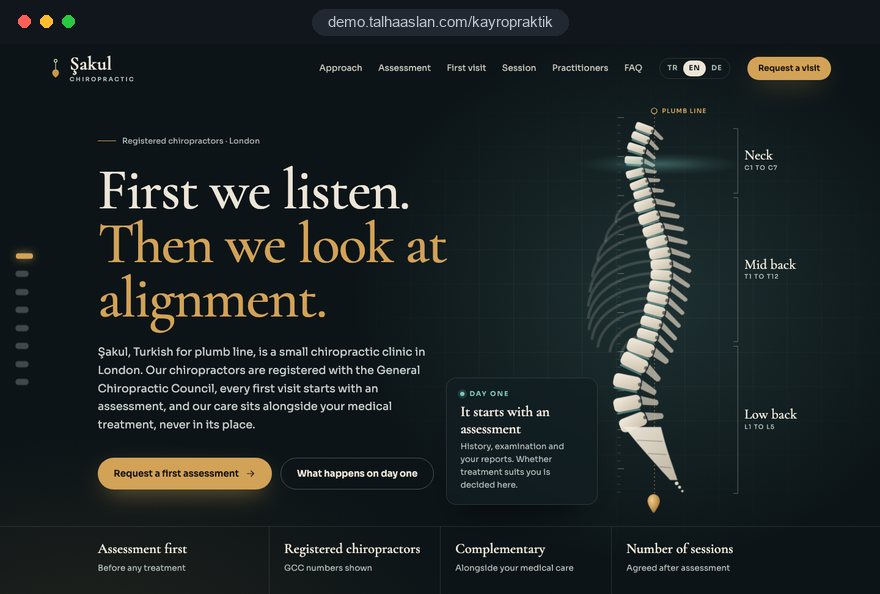
Nobody books a chiropractor they know nothing about. Before a patient lets a stranger work on their spine or neck, they want to see who that person is, how they are licensed or registered, and what will happen in the first half hour. A chiropractor website earns the enquiry by answering those questions plainly, not by praising the method.
This guide follows the decisions a clinic owner makes, in the order we at Talha Aslan and team work through them when we build a chiropractic site. Where rules matter, we use the UK as the reference point: the Chiropractors Act 1994, the CAP Code and the ASA's guidance on chiropractic. If you practice elsewhere, your regulator's rules apply, and the final compliance check always belongs to your clinic.
01Collect the registration chain before any design
The first draft of a chiropractor website comes from documents, not from a design file. In the UK, section 32 of the Chiropractors Act 1994 means only a registered chiropractor may describe themselves as a chiropractor; in the US, the equivalent reassurance comes from a license issued by a state board. Patients look for that link between a named person and a registering body, and the site should make every link visible.
Before the first call with us, gather the following in one folder:
- Practitioner list: each person's full name, profession and the exact way their qualifications are written on their certificates.
- Registration details: GCC registration for UK chiropractors, or the license number and issuing board where you practice.
- Other clinicians: physiotherapists, massage therapists or doctors working in the same clinic, with their own registrations, so nobody is shown under the wrong title.
- Clinic details: the legal name of the business, its address and the hours each practitioner is actually on site.
- Update owner: the person responsible for changing the site when someone joins, leaves or changes their days.
02Practitioner profiles and the Dr title
The practitioner profile is the most read page on a chiropractor website, and the Dr title is where most profiles go wrong. The ASA guidance accepts that registered chiropractors may use the courtesy title Doctor or Dr, but only when it is qualified so it does not mislead, for example as Doctor of Chiropractic. A bare "Dr Smith" next to a photo in a white coat can suggest a medical doctor.
We build each profile in the same order:
- Name with a qualified title: "Dr Jane Smith, Doctor of Chiropractic", or simply "Jane Smith, chiropractor".
- Registration: "Registered with the General Chiropractic Council" plus the registration number, or the state license details.
- Qualifications: degree, institution and the country where it was obtained.
- Days and location: which days this person works at which clinic.
- Professional memberships and further training, only where you can show the certificate.
Photos should show the practitioner in the real treatment room, in what they actually wear at work. Avoid words such as "specialist" or "expert" unless your regulator recognizes that status; patients read these words as formal credentials.
03Map the first assessment step by step
The first visit page should read like a route map from the front door to the treatment table. Visitors who do not know what the assessment involves either call with a long list of questions or do not call at all. Laying out the steps also sets expectations: the first appointment is an assessment, and treatment may or may not happen that day.
We describe the first visit in these steps:
- Arrival and paperwork: what details the reception will ask for and roughly how long it takes.
- Case history: the questions about your symptoms, past injuries, operations, medication and general health.
- Examination: what the chiropractor looks at, such as posture, movement and simple neurological or orthopedic tests, explained in plain words.
- Findings and options: how the practitioner explains what they found, whether treatment is suitable and whether a referral to your doctor is the better next step.
- Consent and plan: treatment starts only after you have agreed, and the number of sessions is agreed after the assessment.
Next to each step, add a short "bring with you" note: previous reports, scans, a list of current medication. End the page with a link to the FAQ rather than straight to the booking form, so a hesitant visitor has one more place to find an answer before they decide.
04Prepare patients for the consent conversation
Consent happens in the clinic, but the website can prepare people for it so the conversation feels familiar rather than formal. Chiropractors explain the proposed treatment, its benefits and risks, and the alternatives before asking for agreement; your professional code sets the exact standard. A page that tells patients this conversation is coming lowers anxiety and filters out people who expected a quick fix.
A "Before your first treatment" page can cover:
- What will be explained: the technique the chiropractor proposes and why, in everyday language.
- What you can ask: any question about the treatment, including what happens if you would rather not have a particular technique.
- Your right to stop: you can pause or stop treatment at any point, including during a session.
- Information we need from you: current medication, diagnosed conditions and recent operations, because they affect the practitioner's decision.
We do not publish your consent form itself unless you want to; what matters is that the site describes the same topics the form covers. The wording comes from your clinical team and is approved by the treating chiropractor before launch.
05A page on when chiropractic may not be suitable
A page that explains when chiropractic may not be the right choice is rarely written, yet it builds more trust than almost any other page. When patients see that a clinic does not try to accept everyone, they believe the rest of the site more. The CAP Code adds a firm boundary here: rule 12.2 says marketers must not discourage essential treatment for conditions for which medical supervision should be sought.
We write this page against four criteria:
- The decision sits with the practitioner: every paragraph ties back to the assessment; the site never declares someone suitable or unsuitable on its own.
- The list comes from your team: which situations need extra questions or a referral is written or approved by the chiropractor, never invented by the agency.
- Urgent symptoms: one plain sentence tells readers with sudden, severe symptoms to contact emergency services or their doctor, not the clinic.
- Referral language: phrases such as "if we think chiropractic is not right for you, we will tell you and suggest who to see" describe a process, not a verdict.
The tone should be calm, never alarming. Link to this page from the first visit page and the FAQ so it is part of the patient journey rather than a hidden corner of the menu.
06Describe a session in scenes, not minutes
A session page should fill the gaps in an anxious patient's mind in the order they appear; a duration on its own does not do that. The questions that matter most in chiropractic are physical and personal: how will I be touched, what should I wear, will I hear a noise, can someone come with me, what should I do afterwards. Answering them scene by scene works better than a general description of the technique.
We usually build the page in these parts:
- The room: a real photo of the treatment room, the table and the changing area.
- Clothing: comfortable clothes that allow movement, and what the clinic provides if a gown is needed.
- During treatment: the chiropractor explains each step before doing it, and you can ask them to stop at any moment.
- A chaperone: whether a friend or family member may stay in the room, according to your clinic policy.
- Afterwards: the general advice your chiropractor gives for the rest of the day and who to contact if something feels wrong.
Anything that varies from person to person, such as the number or frequency of sessions, is described as agreed after the assessment, never as a fixed figure. If patients should choose their own times, online scheduling can sit at the end of this page, as long as the calendar makes it clear that a first booking is an assessment.
07Keep a claims file for every page
Every condition or benefit named on a chiropractor website needs evidence behind it, so we keep a simple claims file alongside the copy. CAP rule 12.1 requires objective claims to be backed by evidence, where relevant trials conducted on people. The ASA's chiropractic guidance names a limited set of conditions registered chiropractors may refer to; anything beyond it needs robust evidence that your clinic actually holds.
The claims file is a short table kept outside the website, with one row per claim:
- The exact sentence as it appears on the page.
- The page it sits on, including headings, image text and meta descriptions.
- The basis for it: the ASA guidance, or the specific evidence you hold.
- Who approved it and when.
Writing that file changes the copy. "Say goodbye to back pain" has no row it can sit in, so it becomes "We assess whether chiropractic care is suitable for your back pain." "Drug free alternative to surgery" becomes a factual description of what the treatment involves. Before launch, read every sentence and ask one question: does this promise an outcome, or does it describe a process? Promises either become process statements or leave the page. You can also run the copy through our readability checker; long, technical sentences tire a worried reader.
08Babies, children and pregnancy: what the site can say
Pages aimed at parents and pregnant patients are where chiropractor websites take the most risk. The ASA guidance says claims about conditions specific to babies, children or pregnant women are unlikely to be acceptable unless the advertiser holds a robust body of evidence.
If you do see these patients, the site can say so factually without naming conditions or promising results. A practical approach:
- State who you see: "We see patients of all ages, including children and pregnant women" is information; "we treat colic" is a claim.
- Describe the adapted process: how the assessment differs, for example that a parent stays in the room and that the case history includes questions for them.
- Point to the right first contact: say clearly that babies and children with symptoms should be seen by their doctor or health visitor, and that chiropractic care is discussed alongside that care.
- Leave out condition lists: no headings, image captions or page titles naming conditions specific to these groups.
Keep these pages out of paid promotion and social posts until your clinic has reviewed them against the guidance.
09Photos, video and patient images
The job of imagery on a chiropractor website is to show honestly where the patient will be, not to make the method look dramatic. Real photos of the treatment table, the changing area, the waiting room and the chiropractor at work tell visitors more than stock images ever can. Stock photos of exaggerated adjustments can frighten people or set expectations the clinic cannot meet.
We follow a simple routine for clinical imagery:
- Treatment scenes are shot with a staff volunteer, or framed so no patient can be identified.
- If a real patient appears, your clinic obtains written consent before the shoot, and the patient can withdraw it later.
- No posture comparisons or other images that suggest a before and after result.
- No editing beyond color and light correction; rooms look the way they really are.
Images also decide how fast the site feels. Gallery images are sized and compressed for phone screens first. The main image on a page often drives LCP (largest contentful paint, the time until the biggest element appears), and Google treats 2.5 seconds or less at the 75th percentile as good. Check your current site with our mobile friendly test before you plan new photography.
10Reviews and testimonials without hidden claims
Patient reviews can support a chiropractor website, but a testimonial that names a condition carries the same weight as a claim written by the clinic. The CAP Code requires marketers to hold documentary evidence that a testimonial is genuine (rule 3.47), says factual claims in a testimonial must not mislead (rule 3.49), and bars misleading publication of reviews such as leaving out negative ones (rule 3.46).
In practice that leads to a few working rules:
- Prefer service comments: quotes about punctuality, explanations, the clinic and the booking experience are safer than quotes about symptoms disappearing.
- Edit nothing silently: if a review mentions a condition, leave it out of the website selection rather than rewriting the patient's words.
- Keep the record: store the original review and the patient's permission for any quote you place on the site.
- Show the whole picture: link to your Google reviews rather than publishing only a hand picked set of five star quotes.
Never offer discounts or free sessions in exchange for reviews; if any review was incentivized, rule 3.45 requires you to make that clear, and in practice it is simpler not to do it at all. Trust on a chiropractor site comes mainly from profiles, process pages and real photos; reviews are a supporting element, not the foundation.
11Local search for chiropractic clinics
Most chiropractic searches are local, so the clinic's search foundation is a consistent set of signals about one real place. People type "chiropractor near me", add a town or neighborhood, or search for chiropractic together with a complaint. The method page, the contact page and the Google Business Profile should tell the same story.
We set up the local layer in this order:
- Google Business Profile: the business name exactly as it appears in the real world, without added keywords such as "back pain clinic"; correct category, hours and real photos.
- One strong page about chiropractic that informs, rather than a dozen thin condition pages competing with each other.
- A contact page with address, directions, parking or transit notes and an embedded map.
- Structured data for the clinic name, address, phone and hours; nothing is marked up that is not visible on the page, and no health claim is added.
- If you have several locations, one location page each, with the practitioners who actually work there.
We explain how we plan it in more detail on our SEO services page. Whatever you do in paid channels, the same claims file applies to every ad, landing page and social post; a sentence you would not put on the site does not belong in an ad either.
12Enquiries, WhatsApp and health data
A chiropractor's first contact with a patient often arrives as a long message describing symptoms, so the enquiry flow should be designed to collect as little health information as possible. Health details are sensitive under data protection law in most markets, and every piece you collect on the website has to be stored, protected and eventually deleted.
We design the enquiry flow like this:
- The form asks only for name, phone, preferred days and a short optional note.
- Under the note field: "We will talk about your symptoms in detail at your assessment."
- The WhatsApp button opens with a prefilled message asking for an appointment, so patients do not write long histories; you can build such a link with our WhatsApp link generator.
- A clear privacy notice sits next to the form, written for your jurisdiction.
- All enquiries land in one clinic inbox with the page they came from.
Measurement stays inside the same boundary. We count form submissions, call clicks and WhatsApp clicks as conversions, but form contents are never sent to analytics tools. For visitors in the European Economic Area, Google requires consent mode for measurement and personalized advertising features, and cookie consent comes before any non essential tracking. We also write a short reply template for reception, so long symptom messages are steered politely toward an assessment booking.
13Common mistakes on chiropractor websites
Most mistakes we see on chiropractor websites are habits borrowed from other industries rather than bad intent. A countdown offer that looks normal on a gym site, or a transformation photo that works for a personal trainer, damages both trust and compliance on a health site. These are the six we meet most often, with the better alternative for each:
- An unqualified Dr title: instead of "Dr Smith" alone, write "Dr Jane Smith, Doctor of Chiropractic" and show the registration.
- Condition lists as headlines: instead of a page for every ailment, write one informative page about chiropractic and one page on when it may not be suitable.
- Pages for babies and pregnancy written like adult pages: instead, state factually who you see and describe the adapted assessment, without naming conditions.
- A hand picked testimonial carousel: instead, link to your full Google reviews and build trust with profiles and process pages.
- Hiding the assessment: instead of "Book your adjustment now", explain that the first appointment is an assessment and treatment follows only if suitable.
- Long health forms: instead of asking for a full medical history online, collect contact details and discuss health at the appointment.
14Choosing a partner and your next step
When you choose a team for a chiropractor website, look at how seriously they take the advertising rules before you look at their design samples. Building an attractive interface is common; structuring the practitioner profile, the first visit page and the claims file within the rules is what separates a specialist approach. Ask any agency these questions:
- How do you write the Dr title and registration details on a profile?
- How do you show that the first appointment is an assessment rather than a treatment?
- Who keeps the claims file, and how do you check image text and meta descriptions against it?
- How do you limit the health information collected through forms and WhatsApp?
- How do you handle reviews that mention specific conditions?
If the answers stay generic, for example "we write SEO friendly content", the team has probably not worked within these rules yet. To see how we approach it, explore the live chiropractic demo linked on this page; it is a demonstration, not a client site. Our work in other sectors is on the references page, and if your clinic also offers acupuncture, look at how we structure an acupuncture website as well.
When your scope is clear, compare the packages in our web design pricing section or share your practitioner list and clinic details through the contact form for a written quote. Our web design service page explains how design, development and content run in one team.