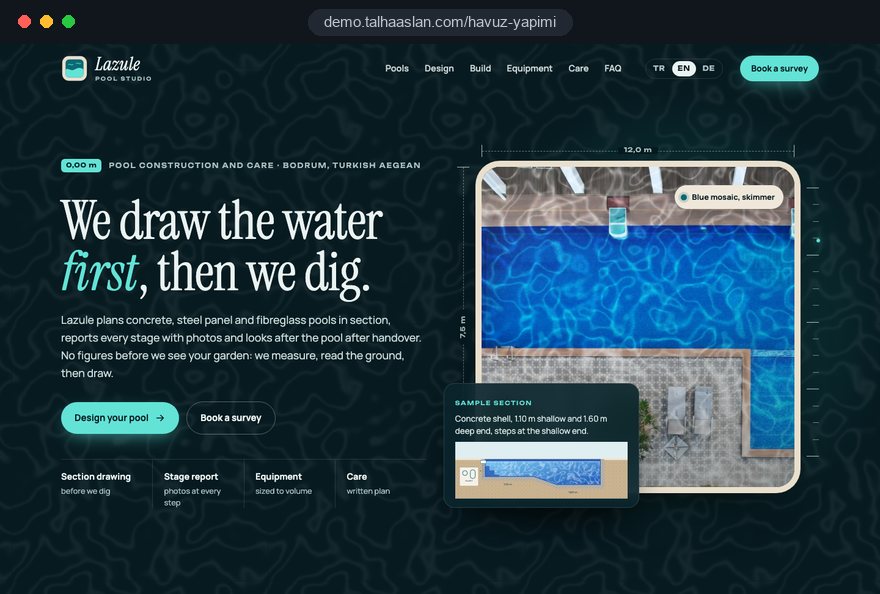
A swimming pool company website has two jobs that run on different clocks. The first is a build: a slow decision that is often researched over the winter and turns into an excavation in spring. The second is servicing: a fast request that arrives the day the water turns green. Building one site that serves both rhythms without mixing them up is the real design task.
In this guide we, Talha Aslan and team, follow the order in which a client makes decisions: choosing a pool type, requesting a survey, living through the build, comparing equipment and quotes, signing a maintenance plan, and, for commercial buyers, checking the rules. Every section ends in something you can check with your team this week.
01The client's decision calendar and your publishing plan
Your content calendar should follow the client's decision calendar; a pool type page published in early summer misses most of that year's decisions. A homeowner who wants a swimming pool usually reads about options through the fall and winter, asks for a survey in spring and hopes to swim before the summer holidays. A servicing client calls just before opening season or when something goes wrong.
Once you separate those two rhythms, it becomes clear which pages must be ready when:
- Fall: pool type pages, the gallery and the build process are live and current, because research starts here.
- Winter: the survey request moves to the front, together with an honest note on whether a pool can still be ready this season.
- Spring: the opening service and the maintenance plans are one tap away from the home page.
- Summer: the fault report and WhatsApp line sit on the first screen on a phone; new build enquiries can join a list for next season.
If you are planning a new site, pick the launch date with this calendar in mind. A site that goes live in winter collects survey requests before the season starts; a site that launches in May will mostly see servicing requests that year.
02Pool type pages and a simple chooser
A pool type page earns trust when it also says who that type does not suit; a page that only lists advantages leaves the visitor's real question open. Using the same heading order on the concrete, steel panel and fiberglass pages makes comparison easy.
Each type page can follow these criteria in the same order:
- Shape and size freedom: free form or standard sizes, and what changes on a narrow or sloping plot.
- Ground and access: which soils need extra work and how the shell or panels reach the garden.
- Finish: tile, mosaic, vinyl liner or gelcoat, and how each is cleaned and eventually renewed.
- Upkeep: surface care and water balance points that are specific to that type.
- When it is a poor fit: for example why a large one piece fiberglass shell is hard to deliver behind a terraced house with no side access.
Give skimmer and overflow systems a page of their own. In a skimmer pool, water is drawn through openings in the wall; in an overflow pool it spills over the edge into a channel and a balance tank. That difference changes the plant room, the equipment and the servicing routine.
For undecided visitors, add a four question chooser: is the pool for swimming lengths or for cooling off, will young children use it, which months will it be used, and can a digger reach the garden. The answers suggest a type and carry over into the survey request, so nobody types the same details twice.
03Building the site survey request step by step
The survey request is the written version of the questions your team asks on the phone before a visit, so it should be split into short screens. A single page with fifteen fields gets abandoned on a phone; the same questions asked in five short steps do not tire anyone.
- Project: preferred pool type (with a "not sure yet" option), rough size and the season the pool should be ready for.
- Garden: garden size, ground and slope, the width of the narrowest access point, and existing trees or structures.
- Services: distance to the electrical panel and water supply, a possible spot for the plant room, and how excavated soil can leave the site.
- Photos: one each from the house towards the garden, from the street to the gate, of the planned pool area and of the electrical panel.
- Contact: name, phone, town and a good time to talk; the full address can wait until a visit is booked.
Showing a small example image for each photo usually helps. A single line such as "photograph the side gate from the street with the gate fully open" tells your team whether a digger will fit before anyone drives out.
At the end of the form, say what happens next: who reviews the request, when you will call to book the survey and whether the survey is chargeable.
04Explaining the build from the client's garden
The build page should describe what changes at the client's home, not your internal job sequence. Clients care less about the chemistry of waterproofing than about how long the garden will be a building site, what the neighbors will hear and which days they need to be in.
Use a fixed four line pattern for every stage: what happens, what the garden looks like, what decision the client must make, and what has to be true before the next stage starts. At the finishing stage, for example, the decision is tile or liner color; if that choice slips, the schedule slips with it.
Replace timing promises with your real working plan and list what moves the schedule: wet weather, rock or groundwater found during the dig, material deliveries and the client's own decisions. Add where the excavated soil goes, the hours machinery will run and how existing plants and lawn are protected.
Describe how you keep in touch during the build as well:
- A short update with photos at the end of each stage, and the channel it will arrive through.
- One named contact for questions and the hours they can be reached.
- What handover day includes: first fill, a walk through the equipment, a written owner's manual and an offer of a maintenance plan.
05Site photos that prove the hidden work
Much of a pool's quality is buried once it is handed over, and a gallery that shows those hidden layers moves the conversation from price to workmanship. A finished pool at dusk draws attention, but the client comparing two builders is often won over by photos of the rebar, the waterproofing and the pipework.
Agree a short shot list with your crew for every project:
- Excavation: the whole dig with level and size markings visible.
- Structure: rebar placement for concrete, panel joints and bracing for steel wall pools, the shell bedding for fiberglass.
- Waterproofing: each layer and the corner details, close up.
- Pipework: pipes before backfill and the pressure test you carry out.
- Plant room: pump, filter and valves laid out neatly and labeled.
Write a one sentence caption under each image: what it shows and why it matters. The caption tells both the client and search engines what the photo is about; use the same wording for the file name and the alt text.
Never use stock images or another firm's work; a real site photo taken on a phone is more convincing. Publish a client's name or street only with written permission; for most projects the town is enough.
06An equipment guide and a quote that reads line by line
The point of an equipment guide is not to list brands but to help clients compare the quotes on their desk. The gap between two quotes often lies in whether the pump, filter and heating were sized to the pool's volume; once the guide explains that plainly, the total stops being the only yardstick.
Answer the same three questions for every item: what it does, how it relates to pool size and what it changes in servicing. Explaining turnover time, the time it takes for the whole volume of water to pass through the filter once, in a single sentence makes it obvious why pump choice depends on volume. Follow the same pattern for heat pumps, salt chlorinators, automatic dosing, lighting and covers.
Then introduce your quote format on the site. Showing which lines a quote contains lets clients spot what is missing from a competitor's quote on their own:
- Excavation, soil removal and ground preparation
- Structure, waterproofing and finish
- Pipework, plant room and an equipment list with model numbers
- Electrical connection and pool lighting
- What is not included: surrounding paving, decking, fencing and landscaping
Name brands only where you genuinely supply and service them. Instead of a general figure for running costs, say that this is worked out for the specific pool during the survey.
07Selling maintenance plans as recurring work
The maintenance page sells the second contract, the one that starts on handover day; both your own clients and owners whose swimming pool was built by someone else should find themselves there.
Separate the plans and put their scope in writing:
- Regular servicing: visit frequency, the water tests at each visit, surface and floor cleaning, filter backwashing and an equipment check.
- Spring opening: removing the cover, starting the equipment and balancing the water.
- Winterizing: lowering the water level, protecting pipework against frost and fitting the cover.
- Outside the plan: parts, finish repairs and how emergency callouts are charged separately.
Keep the fault report short but ask the right things: when the problem started, the water color, which unit is making noise or showing an error code, its model, and a photo or short video.
State the area you cover; a servicing request from outside it wastes time on both sides. Adding the maintenance page address to the handover email and the owner's manual is the simplest way to move a build client into a plan.
08A separate path for hotels, parks and clubs
Hotels, holiday parks and clubs ask different questions from homeowners, so they need their own section, their own tone and their own quote form.
The commercial section should cover:
- Technical scope: the pool sizes you build, filtration and disinfection systems, and plant room design.
- Operating support: water quality monitoring, seasonal servicing and equipment training for the client's staff, where you genuinely offer them.
- Documents: accreditations your firm actually holds and the technical file you hand over.
- Tender process: sharing a specification or drawings, survey, quote and contract steps.
In Great Britain, the Health and Safety Executive's guidance HSG179, Health and safety in swimming pools, applies to pools run as a business, and the operator carries those duties. Elsewhere, local health and building authorities set their own rules. Your site can point to the relevant guidance and explain which part of the work you support; avoid any sentence that reads as if you take over the operator's legal responsibilities.
The commercial quote form should ask for capacity, number of pools, opening season and existing equipment. Keep these enquiries out of the homeowner inbox: give them their own notification and their own follow up list.
09Planning, permits and privacy, stated with sources
Regulatory content should be short, sourced and point people to the right authority; a pool builder website that offers legal opinions creates doubt instead of trust. The homeowner's first question is whether permission is needed, and the answer depends on the property.
In England, Class E of the General Permitted Development Order 2015 lets many pools incidental to the enjoyment of a house be built as permitted development, within limits such as buildings and enclosures not covering more than half of the land around the house. Listed buildings and designated land are treated differently. Name the source, send visitors to their local planning authority and say that you check this together during the survey. In other countries and US states, point people to the local building department rather than summarizing rules you cannot vouch for.
The survey request collects a name, phone number, address and photos of a private garden, which makes it personal data. Before the form goes live, check:
- A clear link to your privacy notice right next to the form.
- Where uploaded photos are stored and how long they are kept.
- Separate written permission before a client's project appears in the gallery.
- For visitors in the EU, consent before any non essential analytics or advertising cookies are set.
10A fast site despite photos and video
A swimming pool site is visual by nature; the fix for speed is not fewer images but images delivered at the right size and in the right order.
Google's Core Web Vitals give a clear target. LCP measures how long the largest element on the page takes to appear, and 2.5 seconds or less counts as good; INP measures how quickly the page responds to a tap, and 200 milliseconds or less is good; CLS measures how much content shifts while loading, and 0.1 or less is good. These thresholds should be met for 75 percent of visits.
Typical weights on pool sites and what to do instead:
- An autoplaying water video on the home page: a light poster image and a video that loads only on tap.
- Full size gallery files straight from a phone: images converted to WebP and served at the size of the screen.
- Photo uploads in the survey form: resizing in the browser before sending, with a progress bar.
- Map and chat widgets: loaded after the page or only when someone clicks.
You can check how your current site behaves on a phone with our mobile friendly test and convert gallery photos to WebP with the image converter.
11Service areas, Business Profile and local searches
Pool construction and servicing are local work, so search visibility should be limited to the areas you genuinely cover. Clients tend to combine type, service and place, for example "fiberglass pool installer Surrey" or "pool maintenance near me".
Your Google Business Profile carries much of the weight in map results. Under the profile guidelines, the business name must match your real world name, with no added keywords such as "pool builder". If you do not receive clients at your premises, you can run the profile as a service area business, hide the address and list the areas you serve.
Use a simple rule for area pages: if you have no completed work, no servicing route and no regular surveys in a place, do not create a page for it. Every area page you do publish should include:
- Stage by stage examples from projects completed in that area.
- Local conditions that affect pools, such as clay soil, wind exposure or hard water, based on your crew's real experience.
- Which days and how often servicing visits run there.
Asking for a review after handover and again after the first spring opening catches the client while the experience is fresh. Our wider approach to search is described on the SEO services page.
12Measuring build and servicing enquiries separately
Measurement on a pool site must separate build enquiries from servicing enquiries from day one; a single "form submitted" counter puts a winter survey request and a summer fault report in the same bucket.
Track these as separate conversions from launch:
- Survey requests, with the pool type chosen.
- The commercial quote form.
- Maintenance plan requests and fault reports, kept apart.
- Taps on the phone number and on the WhatsApp link.
After one season the split shows which pool type page brings surveys, which area page wins servicing clients and which month each form peaks. Mark in your own records which surveys became contracts; the share of enquiries that turn into work matters as much as the count.
Tag the links on brochures, van graphics and site boards with the UTM builder, so you can see how many visits the banner on a client's fence produced. In spring, a single goal campaign landing page for early surveys or opening service can go live without touching the main site.
13Common mistakes on pool builder websites
Most mistakes come from treating a swimming pool business like a general builder; each has a better alternative.
- One "our services" page: instead of one paragraph for all types, give each type its own page with criteria in the same order.
- Only finished pools in the gallery: add rebar, waterproofing and pipework stages with captions next to the sunset shots.
- Headlines promising speed: replace "your pool in no time" with the conditions that move the schedule and your real working plan.
- Servicing left to a number on the contact page: publish plans with written scope and a short fault report form.
- Pools and garden design on one page: if you also landscape, give it its own section with its own project and maintenance logic, the way landscaping company websites are built.
- Pages for towns you do not serve: list only areas where you really work; empty area pages weaken both trust and visibility.
If one or two points are missing, they can usually be fixed on the existing site. If pool type pages, the survey request and the maintenance area are all missing, rebuilding the structure is often less work.
14Choosing a partner and the next step
When choosing a team for a swimming pool company website, look less at design samples and more at how hard the team tries to understand your business through questions. If your sales cycle, your pre survey questions and the source of your servicing clients do not come up in the first call, the result will probably be a generic template.
Questions worth asking in that call:
- Which information will you use to design the steps of the survey request?
- How will you separate build and servicing enquiries in measurement?
- What routine do you suggest for site photos and their captions?
- Who will update the site before each season once it is live?
We do not yet have a live client project for a pool builder, so we show our approach on the live demo linked on this page; our work in other sectors is on the references page. The scope of our web design service, where design, development and content sit in one team, is described there too.
We set scope and price in a written quote tailored to your request; reach us through the quote form. For a written quote based on your scope, use the contact form to share the pool types you build, the questions you ask before a survey and the servicing work you do; we will reply with a page structure and a written scope.