Most people researching laser eye surgery arrive with one question that matters more than any brand or technique: could this work for my eyes. They only start reading about treatments, equipment and surgeons once the site has answered that question honestly. A clinic website earns its place by preparing that visitor for a consultation and leaving the clinical decision to the surgeon.
In this guide, Talha Aslan and team walk through the decisions we make when planning a laser eye surgery clinic website, in the order a clinic owner faces them: treatment inventory, treatment and comparison pages, the suitability questionnaire, patient data, the consultation day, risks, surgeons and equipment, reviews and offers, readability, search, measurement, common mistakes and choosing a partner. Every medical sentence is approved by your surgeon; we build the structure, the wording and the technical foundation.
01Start with your treatment and equipment inventory
The sitemap of a laser eye surgery website should grow out of the treatments your clinic actually performs, so that list comes before any design work. Copying a template's treatment menu means describing procedures you do not offer, which misleads patients and invites complaints.
In the first call we fill in this inventory with your clinical team. It decides the number of pages and which surgeon signs off which text.
- Treatments: which of LASIK, PRK, SMILE, lens implants or other procedures you perform today and which are planned.
- Equipment: the laser and diagnostic systems used for each treatment, and how they will be named on the site.
- Surgeons: who performs which treatment, their qualifications, registration details and clinic days.
- Consultation flow: the steps between first contact, measurements, the surgeon's assessment and treatment day.
- Audience: local patients only, or also patients who travel from other countries.
Clinics that mainly serve patients from abroad have extra decisions about languages, travel and packages, which we cover in our health tourism website guide. This guide focuses on the clinic whose patients live within reach of its consultation rooms.
02Anatomy of a treatment page: the SMILE example
Each treatment page should answer the questions of someone searching for that treatment, in the order they ask them, and end with a route to a consultation. Take a SMILE page: the visitor first wants to know what it is, then who it may suit, then how the day itself goes.
- What it is: two or three plain sentences, with each technical term explained the first time it appears.
- Who it may suit: general criteria your surgeon approves, plus a clear note that suitability is decided at the consultation.
- Who it usually does not suit: the section most sites skip and the one that builds the most trust.
- Treatment day: the steps from arrival to going home, and whether someone should accompany the patient.
- Afterwards: a short summary of recovery that links to the risks and recovery page.
- Questions: four or five questions specific to this treatment, not repeated across every page.
At the foot of the page we show the name of the surgeon who reviewed the text and the date of the last review. That small line tells visitors and search engines that the content is maintained by a qualified person, and it gives your team a reason to revisit the page.
ASA guidance on laser eye surgery notes that marketers may say a procedure corrects eyesight but not that it cures it, so we write every treatment page with that verb in mind. Treatment pages should differ through the questions they answer, not through reworded copies of the same paragraph.
03Keeping the comparison page neutral
A page that explains LASIK versus PRK, or SMILE versus LASIK, matches real searches, but it must explain differences and decision criteria rather than crown a winner. ASA guidance warns against claiming a procedure is more advanced, innovative or revolutionary without robust evidence, and the same caution applies when one treatment is presented as simply better than another.
We build neutral comparison pages around a fixed pattern:
- Same headings for every option: how the procedure is done, the first days afterwards and who it may suit, always in the same order.
- Criteria, not rankings: wording such as "your surgeon chooses based on corneal thickness, prescription and lifestyle" instead of "better" or "newer".
- Only what you offer: treatments the clinic does not perform are left out of the comparison.
- An honest ending: the page closes with "we decide on the right approach together at your consultation" and a link to the questionnaire.
The comparison page is also an internal linking hub: anyone reading it should reach the full page for each option in one tap. Instead of a wide table we use short stacked blocks, because side by side columns become unreadable on a phone. Without audited outcome data of your own, leave percentage claims out entirely.
04The suitability questionnaire: question order and result screen
A suitability questionnaire should never hand out a verdict; its job is to enrich the consultation request and tell the visitor how to prepare. Our aim is a flow that takes under five minutes and gives your clinical team information they actually use.
- Age band, and whether the visitor wears glasses, contact lenses or both.
- Whether the prescription has changed in recent years, with known values as an optional field.
- For contact lens wearers, lens type and how often they are worn, since this affects consultation preparation.
- Previous eye surgery, known eye conditions or regular eye drops, as simple yes or no questions.
- Preferred contact method and convenient times for a call.
- A result screen that explains how to prepare and sends the consultation request.
The result screen never says "you are suitable" or "you are not suitable". It says something like "your answers are with our team; suitability is decided by measurements at your consultation and the surgeon's assessment", and then highlights practical steps such as leaving contact lenses out.
05Questionnaire data, consent and follow up contact
Eye history and prescription details in a questionnaire can be health data, which UK GDPR Article 9 treats as a special category, so the form needs its privacy information and explicit consent built in from day one. Retrofitting consent after launch usually means rebuilding the form.
- Privacy notice: a short summary directly above the form, with a link to the full notice.
- Explicit consent: a separate, unticked checkbox for processing health information, not bundled with general terms.
- Contact preference: separate permission for phone calls, e-mail and messaging, so follow up matches what the visitor agreed to.
- Where answers go: a restricted dashboard or a clinic mailbox, never a personal inbox shared across staff.
- Retention and deletion: a written rule for how long answers are kept and who handles deletion requests.
On the technical side, the form submits over a secure connection and its contents never travel to analytics or advertising tools. For measurement we record only that a form was started or sent; age, prescription and eye history never become event parameters.
If your visitors include people in the European Economic Area, Google's EU user consent policy requires consent mode for its measurement and personalized advertising features, and cookie consent is needed before non essential tracking. The final wording of every legal text is signed off by your data protection lead or adviser.
06Writing the consultation day guide from the patient's side
The pre surgery assessment often takes longer than a routine eye test and is where patients are most often caught unprepared, so it deserves its own guide page. A clear guide reduces rescheduled appointments and the same questions being asked again by phone.
We structure the guide by time: days before, the morning of, at the clinic and leaving. Each step gives the patient one clear task.
- Days before: contact lens wearers leave their lenses out for the period your surgeon specifies; the exact period is written from your clinic's instructions.
- The morning of: no eye makeup, and bring current glasses and any previous eye reports.
- At the clinic: the order of measurements, why dilating drops require waiting time and why the visit may run long.
- Leaving: vision can stay blurred for hours after the drops, so patients should not drive and should bring someone if they can.
- Next step: how results are shared and how a treatment date is planned.
This page receives links from every treatment page and from the questionnaire's result screen. If the appointment confirmation e-mail links to it too, patients read it exactly when they need it. A short printable checklist at the end helps older patients and the people who drive them.
Because timings vary from clinic to clinic, we write the guide from your surgeon's instructions and set a yearly review date in the content calendar.
07Finding the right tone for risks and recovery
The risks and recovery page exists to prepare patients for the consent discussion, not to frighten them, so its tone must be calm, specific and approved by your surgeon. Patients who have read about dry eyes, halos around lights or fluctuating vision while healing tend to ask better questions at the consultation.
We divide the page into three parts: the first days after treatment, the following weeks and the check up schedule. Each part repeats the same three prompts: what you may notice, what you should do and when to call the clinic.
- Language of possibility: "may", "some patients notice"; percentages only when your surgeon can name the published source behind them.
- No minimizing: ASA guidance advises against implying recovery is immediate and against claiming laser surgery is free from side effects, because every medical procedure carries some risk.
- Urgent signs first: which symptoms need an immediate call, and the out of hours contact route, near the top of the page.
- Back to the consultation: the page states plainly that individual risk is discussed with the surgeon.
ASA guidance also notes that presbyopia, the gradual age related loss of near focus, means many patients will need reading glasses in middle age. Saying this on the page is honest and spares the clinic difficult conversations years later.
This should be one of the most frequently updated pages on the site; when your aftercare protocol changes, the page and its review date change the same week.
08Surgeon profiles and equipment, described without hype
Surgeon and equipment pages are the main trust signals on a laser eye surgery site, and both need factual wording that can be backed up. A profile that lists real training and registration details does more than any adjective.
- Title line: name, professional title and registration details, using only titles the surgeon is entitled to.
- Training and experience: in date order and verifiable; no unsupported claims about volume or rank.
- Treatments performed: internal links to the relevant treatment pages.
- Clinic days: which days at which location, so the profile leads to a booking.
Equipment needs more care. ASA rulings have found claims such as "the most advanced" technology or "more effective than ever" misleading when the advertiser could not prove them. We therefore describe what each system does, which measurements are taken and how the laser is used in the procedure, and leave out superiority language.
Ask yourself one question for every claim on these pages: could we hand over the evidence tomorrow if asked. If not, the claim is rewritten as a plain description.
09Reviews, patient stories and offers: where the rules bite
Reviews and promotions are where laser eye surgery websites most often cross a line, because a patient's words about a result still read as a claim by the clinic. ASA guidance treats such statements with the same care as your own copy, so they need the same evidence.
Our working rules for this area:
- Review widgets: show verified third party ratings rather than a curated wall of selected quotes, and never edit a review's meaning.
- Patient stories: focus on the process and the consultation experience, with written consent, and check every outcome statement as if you wrote it.
- Time limited offers: ASA guidance asks marketers to give consumers a reasonable time to consider significant surgery and to be very careful with time limited promotions; we leave countdown timers out.
- Insecurity: ads must not exploit how people feel about wearing glasses; imagery shows real life, not before and after drama.
- Clinics in Turkey: the 2025 regulation bans price, discount and campaign information and patient thanks used as advertising.
If your clinic also advertises in other markets, each market's rules apply to the pages those ads point to. We flag anything doubtful for you and your adviser before launch, and keep a short log of which claims were checked and approved.
10Readability for visitors reading without their glasses
Many people researching laser eye surgery wear glasses or contact lenses and sometimes open the site without them, so readability is a core requirement, not a styling detail. We set typography before choosing the color palette.
- Type size: body text at least 18 pixels on phones, generous line spacing and a clear step between headings and text.
- Contrast: at least 4.5:1 for normal text, the WCAG 2.2 AA level; no light grey copy and no thin type on colored backgrounds.
- Zoom: pages stay readable at 200 percent zoom without sideways scrolling, and browser zoom is never disabled.
- Touch targets: large form fields and buttons with enough space between them.
- Plain language: short sentences and paragraphs, with every medical term explained right where it appears.
You can test your current colors in a couple of minutes with our color contrast checker: enter the text and background colors and read the ratio. Before launch we test every template on a phone with enlarged system text and high contrast settings turned on.
11Showing up for treatment and question searches
Search visibility for a laser eye surgery clinic comes from answering the specific questions people type, not only from ranking for the treatment name. People search "what is SMILE", "LASIK or PRK", "age limit for laser eye surgery" or "how long to stop wearing contact lenses before a consultation", and each of those deserves a clear answer on a relevant page.
- Write a unique title and description for every treatment and guide page, free of promises that the page itself cannot support.
- Mark up the clinic, surgeons and frequently asked questions with structured data, and check the result with our schema markup tool.
- Keep the Google Business Profile name identical to the clinic's real name, without added keywords.
- Measure Core Web Vitals against Google's good thresholds: LCP (how fast the main content loads) 2.5 seconds or less, INP (responsiveness to taps) 200 milliseconds or less, CLS (layout stability) 0.1 or less.
Location matters too: a clinic with two sites needs a page for each, with its own address, opening hours and the surgeons who consult there, linked from the Business Profile for that location.
Our SEO service combines the technical foundation with a content plan, and after launch it shows which patient questions the site still leaves unanswered.
12Measuring which treatment pages bring consultations
Measurement on a laser eye surgery site is about seeing which treatment and question pages turn into consultation requests, not about counting visits. We write the measurement plan alongside the design and test every event before launch.
- Questionnaire started and completed: two separate events, so you can see where people drop out.
- Consultation request sent: the main conversion, recorded together with the treatment page it came from.
- Calls and messages: taps on phone and messaging buttons, tracked per page.
- Guide read before a visit: your patient coordinators can note whether patients who read the consultation guide arrived prepared.
Analytics only run after cookie consent, and no form content ever enters an analytics event. Once a month we review three questions with your team: which treatment pages are read but bring no requests, at which question the form is abandoned, and which page patients say they found first. Adding a "how did you hear about us" field to your coordinators' intake form closes the gap that analytics cannot see.
13Six common mistakes on laser eye surgery websites
Most mistakes we see on laser eye surgery websites come from a general clinic template being stretched to fit, not from bad intent. Each item below includes the better alternative.
- All treatments on one page: someone looking for SMILE has to read through PRK; give every treatment its own page with its own questions.
- An online test that decides: a result screen saying "you are suitable" sets false expectations; turn the result into consultation preparation instead.
- Promising life without glasses: ASA guidance warns against implying patients will never need glasses or lenses again; describe what the treatment corrects and who it may suit.
- Superlatives about equipment: "most advanced laser" needs proof most clinics cannot supply; describe what the system does.
- Countdown offers: time pressure on a surgical decision draws complaints; give people time and a clear route to a consultation.
- Small, faint text: elegant grey type loses the visitor reading without glasses; fix large type and strong contrast at the start of design.
Use these six points as a quick audit of your current site before planning a redesign. Open it on your phone without your glasses and read one treatment page to the end; every spot where you struggle is where patients struggle too. You can also run the mobile friendly test to check the mobile layout.
14Choosing a partner and your next step
The right web team for a laser eye surgery clinic talks as confidently about advertising rules, health data and surgeon approval as it does about design. Asking agencies these questions shows the difference quickly.
- What will the questionnaire's result screen say, and how is explicit consent collected?
- At which stage, and with which tool, does the surgeon approve content, and how are review dates kept?
- How will claims about outcomes, recovery and equipment be checked against the rules of each market?
- How will readability and contrast be tested before launch?
- Which events will be measured, and how is form data kept out of analytics?
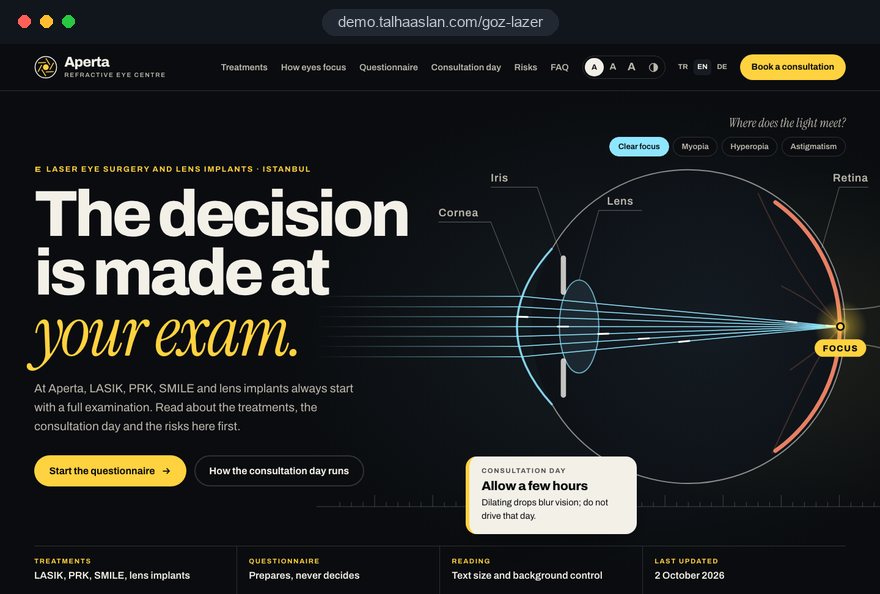
We do not have a live client project in this field yet, so we show our approach on the live demo linked on this page. You can see our work in other sectors among our client references, and our process on the web design service page.
Cost depends on the number of treatment pages, the questionnaire's scope and the number of locations; fixed packages are listed in the pricing section. To share your treatments and consultation flow, get in touch with us and we will work out the page structure and a written quote for your laser eye surgery clinic together.