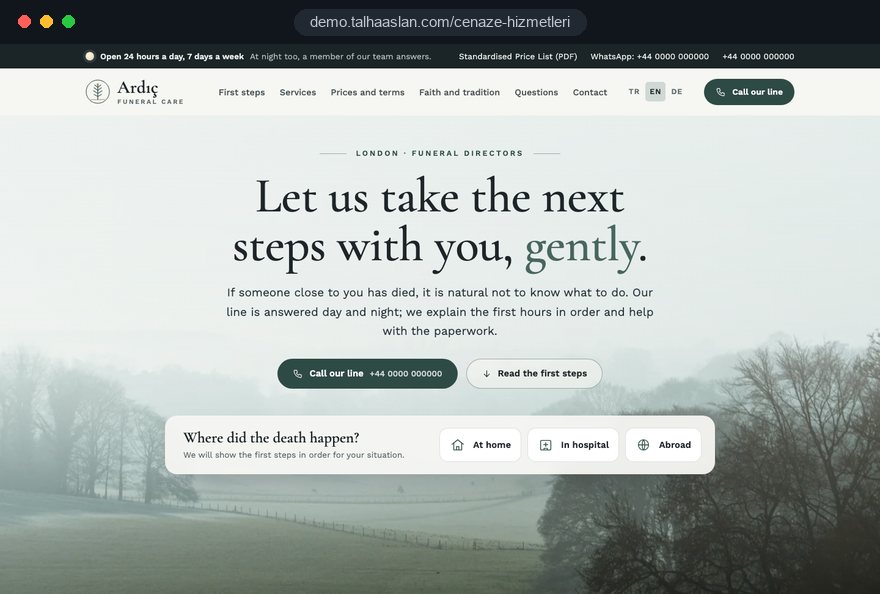
The tone is wrong
Offer badges, pop ups and sales copy hurt a family in grief. From colours to photography, a calm and restrained site is the first sign of how you will treat people when they come to you.

Your Windows contrast theme is on; colours come from your system.
Your device is set to reduce motion; animations are already off.
Your choices are saved in this browser only.
Industry-specific web design
Someone who has just lost a family member often arrives at night, on a phone, not knowing what to do next. They are not looking for clever design; they need to know whom to call, what happens now and what it will cost. So we build a funeral director website around a staffed line, plain first steps guidance and calm, respectful language.
Open the live demoA demo design we built for a fictional brand
In short
A funeral director website keeps your phone line visible on every screen, explains the first steps after a death in plain language, sets out arrangements, repatriation and memorial services on their own pages and presents options for different faiths with equal care. In the UK it must also show the CMA Standardised Price List, terms of business and ownership details; placing them clearly tells families you have nothing to hide.
Talha Aslan and teamLast updated:
Why it needs its own approach
A bereaved family is grieving and short of time. Generic templates are built for selling; the result feels cold and leaves people more confused than before.
Offer badges, pop ups and sales copy hurt a family in grief. From colours to photography, a calm and restrained site is the first sign of how you will treat people when they come to you.
You answer at night and on bank holidays, yet the number sits at the bottom of the page and the hours are not stated. If the first call goes unanswered, the family rings someone else; nobody wants to try twice at a time like this.
What happens in the first hours differs when someone dies at home, in hospital or abroad. Without a short guide in the right order, families have to ask the same questions one by one on the phone.
The CMA Order requires funeral directors to show the Standardised Price List on their website in a set format. Many sites hide it in a footer or as an unlabelled download, which feels evasive to families and falls short of the rules.
Every family wants to say goodbye in line with their own faith and customs. A site that only describes one kind of service leaves families from other faiths, or with no religious wishes, without a place.
These pages are often read in a hospital corridor, on a small screen and by a tired mind. Long paragraphs, small type and heavy images make reading hard, and harder still for older relatives.
Sources: The Funerals Market Investigation Order 2021, Articles 3 to 5, Competition and Markets Authority · Funerals Market Investigation Order 2021, publication page, GOV.UK
Our approach
We build a funeral director website for two kinds of visitor. If a death has just happened, the homepage takes the family to your line and a short first steps guide in one tap. Someone planning ahead, discussing a relative's wishes or arranging repatriation reads about services, documents and options on quieter pages. Both paths lead to the same trust section: who you are, where you are, who owns the business and what you take care of.
If you serve families who live abroad or speak another language at home, we can extend the site with a multilingual website structure; if you work with a community fund or charity that helps with funeral costs, the transparency sections of our charity website page connect to the same structure.
Because design, development and copy come from one team, the phone line, the guide and the service pages speak in the same calm voice; Talha Aslan sets the strategy and experienced team members deliver it.
Home
A family facing a recent death goes straight to the line and the first steps guide; someone planning ahead reaches services, prices and options; both paths lead to the same trust section.
The right setup
All three grow from the same foundation; what differs is what the family needs from you and when.
Repatriation
The family wants to take their loved one to another country; the site explains the process, documents and contact step by step.
Arrangements
The family wants help with the service, the wake, flowers and later memorial dates from someone they can trust.
Full service
The family wants a single person to rely on; the site brings every step from the first call to the memorial into one path.
Built for funeral directors
This list comes from the decisions we make most often with businesses that serve families, and from the rules that apply to funeral directors in the UK.
The number stays fixed on every screen and the page says plainly whether the line is answered at night and on bank holidays. For relatives who find it hard to talk, there is also a way to leave a short written message.
Short, ordered steps for a death at home, in hospital and abroad, written with you so that they match how you actually work and pointing to official guidance where families need it.
Under Article 3(7) of the CMA Order the list must be published as a PDF titled Standardised Price List, on a page no more than one click from the homepage, with a clearly labelled link. The demo uses an empty placeholder; your own list goes in its place.
Deposit size, payment deadlines, payment options and late payment charges (Article 4), together with the ultimate owner and the register of material payments to third parties (Article 5), sit on a calm page of their own.
Religious services, non religious funerals and options for different faiths appear in separate sections of equal weight, in language that does not judge. We only list what you can genuinely offer.
Pre-paid funeral plans have been regulated by the FCA since 29 July 2022. If you introduce plans, the page only describes what an authorised provider offers through you and never presents a plan as your own product unless you are authorised.
Sources: The Funerals Market Investigation Order 2021, Article 3(7), Article 4 and Article 5, Competition and Markets Authority · FCA regulation boosts consumer protection in the funeral plans market, Financial Conduct Authority
Comparison
| Topic | Generic services template | Website built for funeral directors |
|---|---|---|
| Tone | Sales copy, offers and pop ups | Calm, restrained and respectful language |
| Reaching you | Number at the very bottom | Line and hours visible on every screen |
| First hours | Not covered | First steps guide by place of death |
| Prices | Hidden or missing | Standardised Price List one click from the homepage |
| Traditions | One kind of service | Options for every faith and none |
| Readability | Small type and heavy images | Large type, high contrast, fast on mobile |
Quick check
Must haves: does your site have them?
0 of 6 in place Tick the boxes to see where your site stands.
Added as needed
We choose which of these you need together during the scoping call.
Tell us which services you offer, which areas you cover and when your line is answered; we will shape the page structure and a written quote around that.
Process
We define your business, your audience and the site’s one-sentence job: who it sells what to, through which action. Scope and timeline are written from that answer.
The home page and key templates come to you as designs first; no code is written before your approval. We do not like surprises, and we do not cause them.
The approved design becomes fast, secure, maintainable code. You follow progress in the CRM and see every page in a staging environment before launch.
The site goes live with analytics, Search Console and conversion tracking connected; panel training is given, first-year hosting and maintenance included.
Search and speed foundations
Searches such as repatriation to Turkey, direct cremation or funeral director near me arrive by type of need, and local searches favour map results. Service pages, area information and your Google Business Profile are built to support each other.
The address, phone number and line hours on the site match your Google Business Profile exactly. We never show a branch or address that does not exist.
Pages stay light so they open quickly on a weak connection; type size and contrast are chosen with older readers in mind.
Calls, messages and forms are measured separately. We do not recommend remarketing ads that follow a grieving visitor around the web.
Free tools
Before planning a new site, test how your current one opens on a phone, how easy your copy is to read and whether your colour contrast works for older readers; you can also create your WhatsApp link here. The tools are free and need no sign up.
Tech SEO
Test whether a page works well on phones: viewport, font size, tap targets, a mobile screenshot and Core Web Vitals.
Tech SEO
Scan any URL for title, meta description, headings, canonical, indexability and speed signals, and get an SEO score with a clear to-do list.
Accessibility
Calculate the contrast ratio of two colors under WCAG 2.2, see AA and AAA results and get accessible color suggestions.
Content
Readability score with Flesch (EN), Ateşman (TR) and Flesch-Amstad (DE).
Tech SEO
Generate rich-result JSON-LD for Article, Product, FAQ, Local Business.
Conversion
Create a wa.me link with a preset message + embeddable button code.
How we work
We do not have a live client project in this field yet, so we show our approach on a live demo site built by our team. The demo is not a client site. You can see our work in other sectors on the references page.
Live demo
For this field we built a one page demo site for a fictional brand, made only to show our approach. You can explore the design, the copy structure and the mobile view live in three languages.
Open the live demoBefore any draft we talk through how you speak with families, which words you use and which you avoid, and we set the tone of the site from that conversation.
Address, team, vehicles and coverage come from your real details; we never list a service you do not offer, a branch that does not exist or a response time you cannot keep.
Price, terms and ownership pages follow the CMA Order and your day to day practice, and we leave a simple structure so you can update them when your prices change.
No pop ups, countdowns or offer language. We measure calls, messages and forms separately, but we do not recommend ads that follow families around the web.
Related pages
Industries
For celebrations such as weddings and company events, which need a different structure.
Industries
For care homes and home care services that build long relationships with families.
Industries
For charities and community funds that help with funeral costs and need donation and transparency pages.
Solutions
To reach families living abroad in their own language.
 How to Build Trust on Your Website: Trust Signals That Turn Visitors into CustomersRead article
 What Is UX Writing? How to Write Website Microcopy That Gets Visitors to ActRead article
 What Is Web Accessibility? Why WCAG Standards Matter for Your WebsiteRead article
 How to Do Google Maps SEO: A Guide to Ranking Your Business Higher on the MapRead article
FAQ
If your question is not here, write to us; we will send you an answer and a written quote.
Next step
In a free 15 minute call we go through your services, the areas you cover and when your line is answered, then prepare a written scope and quote.
In-depth guide
A funeral director website is opened on one of the hardest days of a visitor's life. The person reading is often tired and unsure what to ask; others are calmer, planning ahead for a parent or bringing a relative home from abroad. A good site serves both without mixing them up, and gives each of them honest, complete information.
We have ordered the sections the way we make decisions with a funeral business: first the opening screen and the phone line, then first steps, price and ownership disclosures, repatriation, faith, funeral plans and memorial pages, and finally design, local search and measurement. UK rules get detail because they set specific website duties; elsewhere, check the local equivalent.
The first screen of the homepage belongs to the family facing a recent death; everything else can start one scroll further down. Someone planning ahead will scroll; a family in shock who cannot find the way simply closes the page. So instead of a slogan, a slideshow or a list of services, we put two clear paths at the top.
What the first screen should hold:
To test this on your current site, turn your phone's brightness right down and open the homepage with one hand. If you cannot see and tap the number within three seconds, the first screen was built to introduce the business, not to help the family.
Saying "available day and night" only means something if it is clear who picks up the phone at three in the morning. An unanswered first call on a day like this sends the family to another funeral director, and most will not try twice.
We suggest testing the prefilled message with the WhatsApp link generator and checking how it looks on the on call phone. Keep it to one sentence, such as "Someone in our family has died and we would like some help", so the family has as little as possible to type. A long contact form is a barrier nobody can face at that moment.
A first steps guide answers, in order, the questions families would otherwise ask one by one on the phone; it works well as short separate paths for a death at home, in hospital and abroad. Each path should hold five or six steps at most, and each step should describe a single action.
Rather than restating rules in your own words, point to official guidance and explain where you fit in. GOV.UK currently says a death in England and Wales must be registered within 5 days of the medical confirmation, and within 8 days in Scotland, after clearance from the medical examiner's office.
Linking to that page keeps your guide accurate when processes change. In the US and elsewhere the steps vary by state or country, so we write the sequence with you from your own practice.
For each path, answer these questions:
For funeral directors in the UK, price information is not a design choice: the Funerals Market Investigation Order 2021 sets out what must be shown and where. Article 3 requires the Standardised Price List, the Additional Options Price List and the price information supplied by crematoria to be displayed clearly and prominently on your website. Under Article 3(7), the Standardised Price List must be a PDF titled "Standardised Price List", on a page no more than one click from the homepage, with a prominent homepage link that makes clear what it leads to.
How we build that page:
In the US, the FTC Funeral Rule requires a General Price List that people can keep and accurate price information for anyone who asks by phone.
The CMA Order also asks funeral directors to publish their terms and certain interests, and a single clearly linked page is the calmest way to do it.
What Articles 4 and 5 ask you to display on your website:
The Order sets update duties too: a change of ultimate owner must appear on the website within 15 working days, and the payments register is refreshed every six months. We put a "last updated" date on the page and a reminder in your calendar. Article 6 also prohibits arrangements that encourage hospitals, care homes and similar bodies to refer families to you, so copy describing "partner" institutions needs careful wording or should be left out.
Repatriation pages serve two different readers: the family near you and relatives abroad, who often read in another language, in another time zone and from a place where phoning is hard. That is why written contact deserves as much space on these pages as the phone number.
We separate inbound and outbound repatriation, because the steps, documents and partners differ. We describe the general order of events and the information you need from the family, and name only the countries you work with regularly.
If many families you serve have roots in Turkey, Poland or another country, we build these pages through a proper multilingual website structure with a separate address for each language instead of automatic translation. Someone grieving notices a badly translated sentence immediately.
Options for different faiths, and for families with no religious wishes, should sit in separate sections of equal weight; none should look like an exception to the others. A funeral director site that treats one tradition as the default and gives the rest a line at the bottom tells families from other backgrounds that they are not expected here.
Before writing these sections, we answer these questions with you:
Photography is part of this balance. If every image belongs to one tradition, the message is the same however inclusive the copy is. Real ceremony photos need the family's written permission; without it, simple images of your premises, vehicles or quiet landscapes are the more respectful choice. As everywhere on the site, list only what you can actually provide.
If you mention pre paid funeral plans, the page must reflect who actually provides them, because these plans have been regulated by the Financial Conduct Authority since 29 July 2022. A funeral director who introduces a plan from an authorised provider is in a different position from the provider itself, and the website should make that distinction visible.
Wording guidelines we follow on a plans page:
Separate the plans page from the pages meant for a recent death. We place plans under a quieter "Planning ahead" heading, next to a simple wishes form. That form should collect only what is needed and say clearly how the information is stored, who can see it and how to change or delete it.
Online obituaries, memorial pages and condolence messages are a real service to families, but each one should go live only with the family's clear consent and within limits they set. An obituary with a wrong date or a photo used without permission damages trust in the whole site.
The steps we put in place:
Every form that collects personal details needs a clear privacy notice: why the data is collected, how long it is kept and who receives it. A short link next to the submit button is enough; there is no need to send a grieving relative through a long legal page first.
Calm design is not a matter of taste; it comes down to readability and speed. These pages are read in hospital corridors, on weak connections and through the eyes of older relatives, so we build the design on criteria you can check rather than a brief that simply says "dignified".
Be restrained with colour as well. Soft neutral tones with one quiet accent colour read as respectful and legible; an all black site feels heavy.
Families searching for a funeral home nearby usually see map results first, so your Google Business Profile and your website need to agree with each other as much as the site needs good design. Google's guidelines ask for the business name to match your real world name, with no added keywords; a profile named "Smith Funeral Directors Cheapest Cremation" breaks the rules and reads badly.
A local visibility checklist:
Asking for reviews requires particular care in this field. Sending a review link straight after the funeral, however well meant, can feel tactless. A short thank you message some weeks later, with an optional link, is more respectful. We handle the technical side of this, including structured data and page structure, as part of our SEO service.
Measurement here is not about building a sales funnel; its purpose is to find where families struggle to reach you. On a funeral director website only a few events are worth tracking, and all of them relate to being reachable.
We do not recommend remarketing that follows a grieving visitor around social media and other sites. Seeing an advert for a funeral director a week after losing a parent ties the business's name to a painful memory. In the UK, PECR requires consent for non essential cookies, and in the EU consent is needed before non essential tracking, so measurement tags should wait for that consent. If night time taps and missed calls rise together, the fix lies in call forwarding, not on the website.
Most mistakes here come from using a generic service template as it is. These six appear again and again, each with a better alternative.
Check each item against your current site; many fixes need only changes to copy and layout, not a new website.
The right partner in this field is one who first listens to how you speak with families and then puts only true information on the site. The quality of a funeral director website depends less on visual style than on getting the tone, the rules and the phone line right.
An agency that does not ask about your on call rota, the regulations you work under or the faith communities you serve is likely to repaint a generic template. Ask any agency you speak to:
We do not yet have a live client project in this field, so our approach is shown on a live demo site built by our team and linked on this page. You can see our work in other sectors on the references page and read about our web design service as a whole. Fixed price packages are in the pricing section; if you share your services, the areas you cover and when your line is answered through our contact page, we will prepare the page structure and a written quote around them.
Start a Project
Thanks {name}, we've received your brief. We usually reply within the same day.
What happens next?