Every question lands on the phone
Players call or message to ask what is free, then wait. When nobody can pick up during a game or after closing, the organiser simply books the next venue on the list.

Your Windows contrast theme is on; colours come from your system.
Your device is set to reduce motion; animations are already off.
Your choices are saved in this browser only.
Industry-specific web design
The person organising tonight's game usually finds a pitch on a phone, late in the day, with one question in mind: is there a free slot. We build pitch and sports venue websites around that question, with a calendar that shows open slots, a one-tap confirmation, fixed slots for regular teams, league and tournament pages and directions that get the whole team to the right gate.
In short
A football pitch website shows players which slots are free, turns the chosen slot into a confirmation in one step and describes the surface, floodlights, changing rooms, parking and location. Regular teams keep their weekly slot and league fixtures live on the same site. For venues with several pitches or courts, each one gets its own calendar.
Talha Aslan and teamLast updated:
Why it needs its own approach
A pitch sells hours, and an empty hour never comes back. A generic venue website does not show availability, regular bookings or match day details, so everything still runs through the phone.
Players call or message to ask what is free, then wait. When nobody can pick up during a game or after closing, the organiser simply books the next venue on the list.
Availability lives in a paper diary or on one person's phone. Two teams can be promised the same evening slot while daytime hours sit empty, and nobody notices the pattern.
Teams that play the same night every week are a venue's most valuable customers. If their block booking is not marked anywhere, the slot gets double sold or stays empty when they skip a week.
A wrong map pin, no word on parking and no hint about which gate to use leave half the team circling the car park at kick off. First time visitors who struggle rarely come back.
Surface, floodlights, changing rooms, showers and the café are what players compare, yet they are often missing or shown without a single real photo. Players stick with the venue they already know.
Fixtures and tournament entries circulate only in group chats and stories. Without a permanent page for entries, fixtures and tables, teams keep asking the same questions one by one.
Our approach
We build a pitch website in the order players organise a game: they pick a date, see what is free and ask for confirmation with one tap. That choice sits on the first screen of the home page, with the venue, house rules and location right below. Slots marked as taken in the panel close in the calendar, and block bookings close every week on their own.
If you want to take payment or a deposit online, we add an online booking system with payments; if your venue also runs coaching for children, football school pages can sit in their own section of the same site.
Design, development and content sit in one team, so the calendar, the site and search visibility are planned together. Talha Aslan sets the strategy and an experienced team handles delivery. We work remotely and in English with venues abroad.
Home
Every page ends with the same slot picker, so players reach a confirmation in two taps wherever they land.
The right setup
All three share the same slot logic; the number of pitches and who sells the time make the difference.
Single venue
Players search by area, so the site presents one venue and its hours.
Several pitches
Football pitches, tennis or padel courts and a sports hall under one roof, each hired separately.
Many venues
Several venues are listed on one site, and players search by city and district.
Built for pitches and venues
These are the points venue operators decide on most often when we plan a site together.
Players pick a date and see only free slots. You or your staff mark taken slots in a simple panel; game length, opening and closing times are set to match your venue.
Teams that play the same day and time each week have their slot closed automatically. Block booking requests come in through their own form, and a released slot can go back on sale.
Announcements, team entry, fixtures and tables live on a permanent page. The link shared in a group chat always shows the latest results and the next round.
Surface, floodlights, changing rooms, showers, café and parking are shown with real photos; the map pin, the right entrance and directions open with one tap.
In the UK, regulation 28 of the Consumer Contracts Regulations 2013 excludes services related to leisure activities with a specific date or period of performance from the cancellation rules. If you take payment online, we show your cancellation and deposit terms before checkout; please confirm how this applies to your hire with your adviser.
Outdoor and indoor pitches, tennis or padel courts each run on their own calendar; players choose the pitch first, then the slot. Coaching, holiday camps or a football school get their own section.
Sources: legislation.gov.uk: Consumer Contracts Regulations 2013, regulation 28(1)(h)
Comparison
| Topic | Generic brochure site | Site built for a pitch or venue |
|---|---|---|
| Availability | A phone number and opening hours | Open slots shown as soon as a date is picked |
| Confirmation | A note saying call or message us | The chosen slot goes to WhatsApp with a ready message |
| Regular teams | In a diary or someone's memory | Block bookings closed in the calendar automatically |
| Leagues | Social media posts | Entry, fixtures and table on a permanent page |
| Location and venue | One line of address | Map, entrance, parking and venue photos |
| Measurement | Visitor numbers | Which slot picks turn into confirmed games |
Quick check
Must haves: does your site have them?
0 of 6 in place Tick the boxes to see where your site stands.
Added as needed
We choose which of these you need together during the scoping call.
Share how many pitches you have, your opening hours and how regular teams book; we will come back with a calendar structure and a written quote.
Process
We define your business, your audience and the site’s one-sentence job: who it sells what to, through which action. Scope and timeline are written from that answer.
The home page and key templates come to you as designs first; no code is written before your approval. We do not like surprises, and we do not cause them.
The approved design becomes fast, secure, maintainable code. You follow progress in the CRM and see every page in a staging environment before launch.
The site goes live with analytics, Search Console and conversion tracking connected; panel training is given, first-year hosting and maintenance included.
Search and speed foundations
Players type five-a-side or 5 a side pitch with an area name, or simply search near me. The home page, the location page and the Google Business Profile use the same name, address and phone number so they support each other.
Venue name, address, phone, opening hours and location are marked up so search engines can read them; nothing is marked up that is not on the page.
Slots are usually picked on a phone, sometimes on the way to the venue. Pages are designed for phone screens first, photos are compressed and Core Web Vitals are measured before launch.
Slot picks, WhatsApp taps and calls are tracked as conversions from day one, so you can see which days and hours are in demand and which stay empty.
Free tools
Before planning a new site, see how the current one loads on a phone, how it looks in search and how its link appears when shared in a team chat. The tools are free and need no sign up.
Tech SEO
Test whether a page works well on phones: viewport, font size, tap targets, a mobile screenshot and Core Web Vitals.
Tech SEO
Scan any URL for title, meta description, headings, canonical, indexability and speed signals, and get an SEO score with a clear to-do list.
Conversion
Create a wa.me link with a preset message + embeddable button code.
Conversion
Turn URLs, WhatsApp, Wi-Fi, vCard and text into a QR code in seconds; download high-res PNG or SVG.
Sharing
Preview how your link looks on WhatsApp, Facebook, X, LinkedIn and Telegram, and find missing Open Graph tags and image problems.
Tech SEO
Generate rich-result JSON-LD for Article, Product, FAQ, Local Business.
Real projects
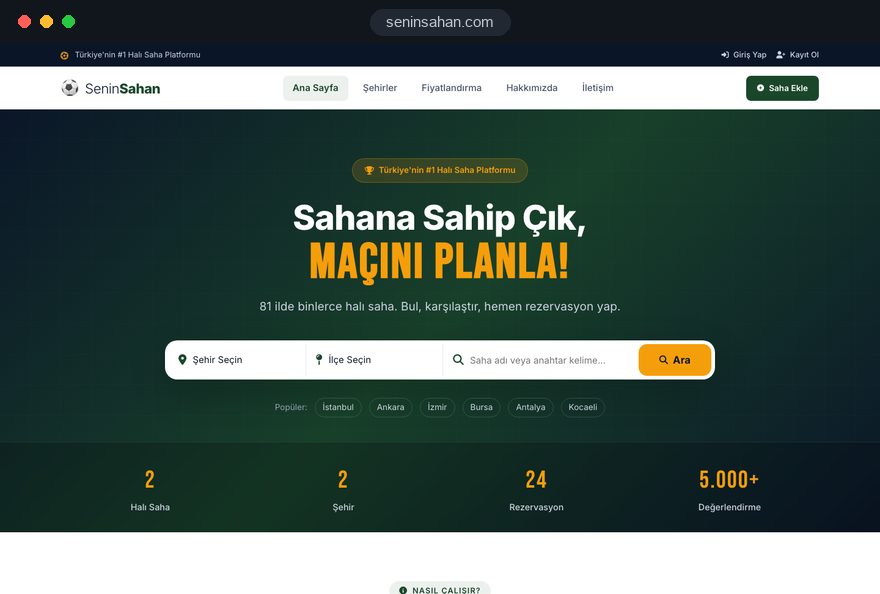
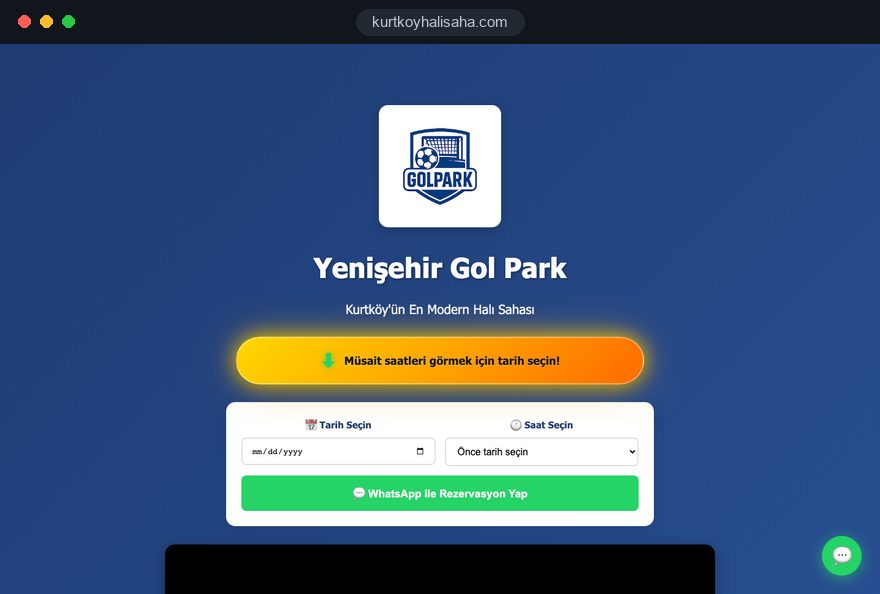
Our team designed and built both projects, and both are live in Turkey: one is a single venue site with a slot picker, the other a platform that lists several venues. You can see more of our work on the references page.
Five-a-side pitch · web design, slot picker with WhatsApp confirmation, local SEO
Pitch finder platform · custom development, venue pages, SEO
Related pages
Solutions
For venues that want online payment, deposits and reminders on top of the slot picker.
Industries
A parent-focused enrolment structure for venues that coach children on their pitches.
Industries
A different structure for gyms that sell memberships and class timetables, not pitch time.
Locations
For venues in Istanbul: a site structure built around district searches.
 How to Do Google Maps SEO: A Guide to Ranking Your Business Higher on the MapRead article
 How to Choose a Payment Gateway: What to Check Before You SignRead article
 What Is Mobile First Design? How Mobile First Affects Your SEO RankingsRead article
 How Website Video Affects Conversion Rate: When It Helps, When It HurtsRead article
FAQ
If your question is not here, write to us; we will send you an answer and a written quote.
Next step
In a free 15-minute call, in English, we will go through your pitches, your hours and your regular teams, then send a written scope and quote.
In-depth guide
A pitch operator has one thing to sell, an hour on the grass, and an hour that goes unsold tonight never comes back. A venue website exists to make that stock visible, to speed up confirmation and to get the whole team to the right gate on time; looking good matters only once it does those three jobs.
Below, Talha Aslan and team walk through the decisions we make, in order, when we plan a site with pitch and sports venue operators. Every section gives you a check, a rule or a question to put to your agency that you can act on this week.
Before any design work, put your weekly slot grid on paper; the online calendar is only a digital copy of that grid. Opening hours, game length, whether you leave a gap between games for cleaning or for the next team to warm up: if these are not settled first, the calendar breaks in its first week.
The second decision is which slots go on sale online at all. Many operators keep weeknight evenings for block bookings, hold a few back for regulars who phone, and put only the rest on the website. That is a perfectly sound policy, as long as a slot shown as free online really is free.
Answer these questions while you draw up the grid:
These answers decide whether the site needs a calendar for several pitches or a simple picker for one, and they make the scope of any quote clear.
The person organizing the game should see four things on the first screen: free slots for today and tomorrow, the area the venue is in, whether the pitch is indoor or outdoor, and how to confirm. If those four can be read without scrolling, the organizer decides; if not, they rarely phone, they move to the next venue on the list.
That moment usually happens in the evening, on a phone. A cover photo, a sliding banner and a welcome paragraph should make room for the date picker, with venue photos and house rules directly below.
Speed on a phone is part of that first screen. In Google's Core Web Vitals, the good threshold for LCP, which measures how long the main content takes to load, is 2.5 seconds or less, and for INP, which measures how quickly the page responds to a tap, 200 milliseconds or less. A calendar that misses those numbers on a weak signal at the side of the pitch loses the booking before a slot is chosen.
You can see how your current site loads on a phone with our mobile friendly test. Then open your own site on your phone and count the seconds it takes to find a slot, the area and the way to confirm; every step beyond three taps is a step to remove.
A booking calendar is only as good as the person who updates it every day. A player who sees a free slot online and then hears it is taken stops trusting the calendar and goes back to calling.
The most common problem we see at pitch venues is the lack of a single source of truth: some bookings sit in a paper diary, some in the owner's phone and some in the panel. The fix is simple to state: every booking, whether it arrives by phone, by WhatsApp or at the front desk, goes into the same panel.
The routine we suggest looks like this:
Give every member of staff their own login, so you can see who closed which slot and nothing is lost at shift change.
The slot a player picks should reach your WhatsApp as a complete, prefilled message; a message that carries enough detail to confirm without asking a single question is the fastest confirmation there is. A chat that opens with "Hi, do you have anything tonight" takes three or four messages and often goes unanswered late at night.
The prefilled message should include:
Send it to one WhatsApp Business number owned by the venue, not a personal phone, so the chat history stays when staff change. Prepare the reply too: time, pitch, arrival time and the map link.
You can check that the link opens the right number with the right text using our WhatsApp link generator. If you also want payment or a deposit after confirmation, that step becomes a booking flow and is handled separately.
Teams that play the same night every week carry a venue's income, so the site should protect their slots as carefully as it sells the rest. Block bookings should close automatically in the calendar, and the terms of a block booking should be written on the site.
The block booking page should answer the questions an operator otherwise explains out loud every season. What happens if the team skips a week, how much notice they need to give, whether a released slot is sold to someone else, whether the booking rolls over at the end of the season, and whether existing teams get first refusal for the next season. Writing these rules down ends the arguments.
Keep the application form short: team name, organizer details, preferred day and time, a second choice and how long they have played together. When peak evening slots are full, the form should offer a waiting list; a released block booking slot is offered to the first team on that list.
Every block booking also needs an end date in the panel, so renewals at the end of a season are a list to work through rather than a round of phone calls. A single week's cancellation should reopen the slot with one tap and stay in that team's booking history.
Evening slots tend to fill themselves; a website earns its keep in the weekday daytime and late night hours that stay empty. The people who buy those hours are not the organizer looking for a Thursday night game, they are a different audience, and they need their own page.
Audiences worth a daytime page include:
Each page should open with that audience's question: the company page should say in its first paragraph whether you issue invoices and how a regular weekly slot is reserved; the birthday page should state session length, group size and catering choices.
A league page earns its value from results entered on time, not from the launch announcement; a fixture list that stops updating after week one leaves a worse impression than no page at all. Decide who enters results, and when, before you start the league.
A permanent league page should carry entry conditions and the entry form, squad limits and the substitution rule, game length and referee arrangements, fixtures, the table and the top scorers. Giving every competition its own address keeps past seasons in an archive, and last season's winning team photo is a strong invitation for next season's entries.
Results should be entered from a phone, in the panel, as soon as the final whistle goes. When the referee or the duty manager enters the score, the table updates itself; the one link shared in the team group chat always shows the latest position, and nobody needs to ask for results one by one.
A permanent, regularly updated league page is also easier to find in search than a social media post. If the entry form collects players' names and numbers, the privacy notice belongs next to it; we return to that in the measurement section.
Players compare surface, floodlights and changing rooms, so shoot venue photos for comparison, not for a brochure. An empty pitch glaring in midday sun tells an evening player very little.
Here is the shot list we suggest for the photo day:
Photos should be compressed so they open quickly on a phone, and each needs a short caption, for example "Indoor pitch 2, evening lighting". A short pitch video works well for indoor venues in particular, where it shows ceiling height and netting.
When the surface is replaced or a new pitch opens, replace the photos too. A player who sees the old surface online and finds something different on arrival assumes the site is out of date, even when the surprise is a good one.
Match day information has one job: getting the whole team on the pitch at kick off, which is why an accurate map pin matters more than any design detail. Pitches are often on an industrial estate, behind a school or on a rooftop, so an address line on its own is not enough.
The location page should answer these questions: does the map pin sit exactly on the entrance, where do drivers park, which stop do people on public transport use and how long is the walk, which gate is open at night, and where do bikes and motorbikes go. A photo of the entrance and a one line direction such as "enter the car park, take the stairs on the right" removes most of the phone calls asking for directions.
Adding the location link to the confirmation message lets the organizer forward it to the team chat in one tap. Inside the venue, a QR code by the entrance and in the changing rooms can take players straight to next week's slot picker; the moment after a game is when "same time next week" gets decided. You can make that code with our QR code generator.
Most disputes at a pitch come from rules nobody wrote down; stating cancellation, late arrival and deposit terms plainly on the site protects both the venue and the players. Keep the rules page short and include its link in the confirmation message.
We suggest putting these points in writing:
In the UK, regulation 28 of the Consumer Contracts Regulations 2013 excludes services related to leisure activities with a specific date or period of performance from the cancellation rules. That does not make your own policy less important; players should see it before they pay. Other countries have their own consumer rules, so confirm how this applies to your venue with your adviser.
If you want to take deposits online, you are building a structure with payment, reminder and refund steps; we cover it in our guide to an online booking system.
Most players search by area name or simply type "five a side near me", and many of those searches end on the map; the website and the Google Business Profile should therefore be built together. The venue name, address and phone number on the site should match the profile exactly.
Google's guidelines require the business name to match the real world name, with no added keywords. A name such as "Riverside Sports Five A Side Pitch Cheap Late Games" invites suspension; use the name on your sign and leave the area and services to the description and categories.
To strengthen the profile and the site together, we recommend these steps:
A larger sports facility can explain access from nearby neighborhoods on one location page; a copied page for every area does more harm than good. We set up that balance as part of our SEO service.
What a pitch website should measure is not visits but which slot picks turn into confirmed games. Slot selections, WhatsApp taps and calls should be tracked as separate conversions from day one.
With that data you can answer these questions at the end of each month: which days and hours are chosen most but lost because they are full, which hours are never picked, which searches or shared links bring players to the site, and how many teams that request a slot actually turn up. The first answer informs your pricing and slot policy; the second tells you which daytime pages need work.
The panel should also show a weekly table of sold, block booked and empty hours per pitch; it is your most concrete evidence when deciding whether to add a second pitch.
Because you collect names, phone numbers and team details, data protection law applies. In the UK and the EU, players should get a clear privacy notice where their data is collected, so place it next to the block booking form, the league entry form and the contact form. In the EU, consent is needed before non essential tracking; in the UK, check the ICO's guidance on cookies. Ask your agency which tags run before consent and which only after.
What these mistakes share is a site built apart from the venue's daily routine; each one can be fixed with modest effort.
When choosing a team for a pitch website, look for one that asks about your operation before showing design samples; an agency that does not ask about your number of pitches, game length and block bookings in the first call will build you a generic brochure site.
These are the questions we suggest asking in that call:
You can look at the pitch website and the venue finder platform we have launched on our references page. Our web design service, with design, development and search visibility in one team, is the foundation of this setup. You can see fixed scope options on the pricing page, and to share your number of pitches and your slot pattern, get in touch with us; we will work out a calendar structure for your venue and send a written quote.
Start a Project
Thanks {name}, we've received your brief. We usually reply within the same day.
What happens next?