Packages nobody understands
Exterior wash, full valet, machine polish and coating are listed one under another; customers cannot tell what each package includes or which suits their car, so they have to call and ask.

Your Windows contrast theme is on; colours come from your system.
Your device is set to reduce motion; animations are already off.
Your choices are saved in this browser only.
Industry-specific web design
Drivers usually find a car wash on their phone while looking for somewhere nearby, while detailing and ceramic coating customers want to see the workmanship before they commit. We build car wash and detailing websites around a clear package comparison, real before and after photos and a one-tap enquiry, for businesses in the UK and elsewhere working with a remote team.
Open the live demoA demo design we built for a fictional brand
In short
A car wash website explains services such as exterior and interior valeting, machine polishing, ceramic coating and paint protection film as clear packages, shows the workmanship with real before and after photos and takes customers to an enquiry by WhatsApp or form. Durability claims are written only where you hold evidence. The same foundation adapts to a hand car wash, a detailing studio or a mobile valeting service.
Talha Aslan and teamLast updated:
Why it needs its own approach
Car wash customers come in two kinds: those who want a clean car today and those who research a coating for weeks. A generic small business template serves neither.
Exterior wash, full valet, machine polish and coating are listed one under another; customers cannot tell what each package includes or which suits their car, so they have to call and ask.
Detailing and coating customers want to see results first. Stock images or a few blurry phone shots do not show the difference your work makes, so the decision moves to Instagram or a competitor.
Years of protection, 9H hardness or guarantees are written without the product data or warranty terms behind them. In the UK, the CAP Code expects marketers to hold documentary evidence for objective claims; an unsupported claim puts trust and the business at risk.
The phone goes unanswered at busy times, WhatsApp messages get buried and coating enquiries wait without anyone knowing which car or package they are for. Customers rarely message twice; they go somewhere nearby.
Most customers search with an area name or type car wash near me. If the address, opening hours and Google Business Profile do not match the website, the business drops behind on the map.
Without a page for regular customers, company cars and dealerships, those enquiries never arrive. The site shows no difference between a one-off wash and ongoing work.
Sources: CAP Code, rule 3.7 (substantiation), Advertising Standards Authority
Our approach
We build a car wash website in the order customers decide: first they see what each package includes, then they look at the work in photos, and finally they request a slot by naming their car and the service they want. For quick wash customers, location and hours sit on the first screen; for coating customers, the detail lives on its own page.
If customers should pick their own day and time, an online scheduling system is connected to the site; for a spring offer or a coating promotion, a single-goal landing page can go live without disturbing the main site.
Design, development and content sit in one team, so none of this is patched on later. Talha Aslan sets the strategy and an experienced team handles delivery, working remotely and in English with businesses abroad.
Home
Each detailing service answers its own search, and all of them lead into the same enquiry flow.
The right setup
All three start from the same foundation; how long customers take to decide and how deep the pages go make the difference.
Quick wash
Customers are nearby and want it done now, so the site puts location, hours and packages first.
Detailing
Customers research for days, so the site explains the workmanship, products and process in depth.
At your address
The team comes to the customer, so the site makes the service area and enquiry flow clear.
Built for car washes
These are the points car wash and detailing businesses decide on most often when a site is planned.
What each package covers, roughly how long it takes and which vehicles it suits, shown side by side. Whether to publish prices is a decision we make together with you.
Real photos taken from the same angle in the same light, labelled with the car model and the service applied. Number plates and customer details are hidden.
What the product does, how it is applied, aftercare advice and common questions, each on its own page; durability and warranty details are written only from the manufacturer's documents and your own warranty terms.
Rule 3.7 of the CAP Code says marketers must hold documentary evidence for claims consumers are likely to regard as objective. We write copy within that limit; the final legal assessment belongs to your business.
A short form asking for vehicle type, service and a preferred day, plus WhatsApp and click to call buttons on every page; enquiries are measured with their source.
A dedicated page and quote form for company cars, dealerships and regular customers; if you offer monthly plans or fleet agreements, the terms are written out clearly.
Sources: CAP Code, rule 3.7 (substantiation), Advertising Standards Authority
Comparison
| Topic | Generic small business template | Site built for a car wash |
|---|---|---|
| Services | A list of services on one page | Packages compared by scope and duration |
| Workmanship | Stock images | Real before and after photos by vehicle |
| Coating content | Years of protection with no evidence | Clear content backed by product data and warranty terms |
| Enquiries | A general contact form at the bottom | An enquiry asking for car and service, WhatsApp and click to call |
| Business customers | Not mentioned | A separate fleet and subscription page with a quote form |
| Measurement | Visitor numbers | Which package and page brings enquiries |
Quick check
Must haves: does your site have them?
0 of 6 in place Tick the boxes to see where your site stands.
Added as needed
We choose which of these you need together during the scoping call.
Share your services, how many cars you handle a day and the customers you want to reach; we will come back with a page structure and a written quote.
Process
We define your business, your audience and the site’s one-sentence job: who it sells what to, through which action. Scope and timeline are written from that answer.
The home page and key templates come to you as designs first; no code is written before your approval. We do not like surprises, and we do not cause them.
The approved design becomes fast, secure, maintainable code. You follow progress in the CRM and see every page in a staging environment before launch.
The site goes live with analytics, Search Console and conversion tracking connected; panel training is given, first-year hosting and maintenance included.
Search and speed foundations
Customers search with an area name, type car wash near me or go straight for ceramic coating. Service pages, the contact page and the Google Business Profile are built to support each other.
Business name, address, phone and opening hours are marked up so search engines can read them; nothing is marked up that is not on the page.
Gallery photos are compressed without visible loss, pages are designed for phone screens first and Core Web Vitals are measured before launch.
Calls, form submissions and WhatsApp clicks are tracked as conversions from day one, so you can see which package and page brings enquiries.
Free tools
Before planning a new site, see how the current one loads on a phone, how it looks in search and how heavy your gallery images are. The tools are free and need no sign up.
Tech SEO
Test whether a page works well on phones: viewport, font size, tap targets, a mobile screenshot and Core Web Vitals.
Tech SEO
Scan any URL for title, meta description, headings, canonical, indexability and speed signals, and get an SEO score with a clear to-do list.
Image
Resize + compress photos and cut the KB; never leaves your device.
Tech SEO
Generate rich-result JSON-LD for Article, Product, FAQ, Local Business.
Conversion
Create a wa.me link with a preset message + embeddable button code.
Conversion
Turn URLs, WhatsApp, Wi-Fi, vCard and text into a QR code in seconds; download high-res PNG or SVG.
How we work
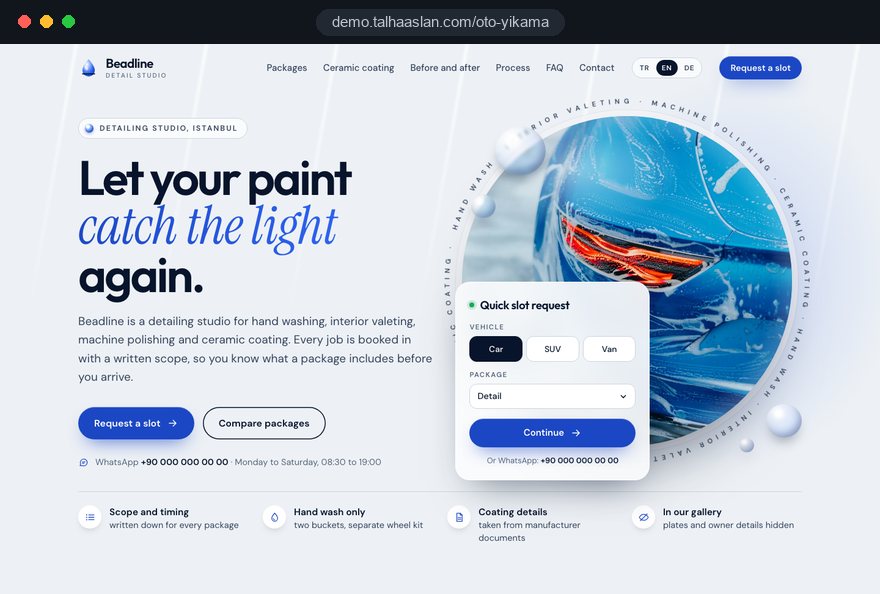
We do not have a live client project for a car wash or detailing business yet, so we show our approach on a live demo site. The demo is not a client site. You can see our work in other sectors on the references page.
Live demo
For this field we built a one page demo site for a fictional brand, made only to show our approach. You can explore the design, the copy structure and the mobile view live in three languages.
Open the live demoIn the first call we learn which services you offer, how long a car takes and which package customers ask for most, then simplify the package structure to match.
We plan with you how to shoot before and after photos from the same angle and light, and we do not fill the gallery with stock images.
Coating durability and warranty details come from the manufacturer's documents and your own terms; we do not publish claims you cannot back up.
We track which package, page and campaign brings enquiries and where customers drop off, and adjust the site accordingly.
Related pages
Industries
For garages doing servicing and repairs, built around repair enquiries.
Industries
For car dealers, built around stock and listings.
Solutions
Let customers pick their own day and time.
Solutions
A single-goal page matched to a ceramic coating or seasonal ad campaign.
 How to Do Google Maps SEO: A Guide to Ranking Your Business Higher on the MapRead article
 Professional Photography for Websites: What It Adds and How It Beats Stock PhotosRead article
 Lead Form Design for Booking, Quote and Demo Requests: UX Rules That Lift ConversionsRead article
 How Website Video Affects Conversion Rate: When It Helps, When It HurtsRead article
FAQ
If your question is not here, write to us; we will send you an answer and a written quote.
Next step
In a free 15-minute call, in English, we will go through your services, your packages and the customers you want to reach, then send a written scope and quote.
In-depth guide
A car wash website is not a digital copy of the sign by the road. Someone who wants a clean car today checks location, hours and packages on a phone and decides within minutes; someone considering ceramic coating studies workmanship and process on the same site for days. This guide covers the decisions a car wash or detailing owner makes when planning a site, in the order they come up.
You will not find promises of results or invented numbers here. Every section gives you a checklist, a criterion or a question to put to your agency.
Your revenue mix and daily capacity should shape the site, not a design trend. A car wash that spends most of the day on quick exterior and interior washes cannot work with the same homepage as a studio that coats a handful of cars a week. The first needs location and waiting time up front; the second needs workmanship and process.
Before your first agency meeting, write down answers to these questions:
The last question matters most, because the site should promote the work you want to grow, not only the work you do today. A car wash that wants more coating jobs keeps wash packages short on the homepage and gives the detailing section more room. If you run a mobile valeting service, the areas you cover and your requirements for parking and water access belong on the first screen instead of a street address.
If a customer cannot tell from the package name what they will get, they have to call to find out. Names like Gold, Silver and Platinum are easy to remember but say nothing about the work. A package name should describe the result or the scope: exterior wash, full valet, deep interior clean, single stage machine polish.
Every package card should show the same information in the same order:
Limit the number of packages as well. When six or seven sit side by side, customers stop seeing the difference; for most businesses three core packages plus a list of extras is enough. Highlighting the most requested package gives an undecided customer a place to start.
Showing prices or not is a decision about which customers you want to attract, not a design detail. Quick wash customers compare, and many postpone calling until they have seen a price. For coatings and paint protection film, quoting a firm figure before anyone has inspected the paint tends to cause disputes later.
Weigh the three common approaches against the way you work:
Whichever route you take, what the site says and what the customer hears at the counter must match. A gap between the online figure and the final bill is a typical trigger for negative reviews. During promotions, keep reduced prices in a separate offer section with a clear end date rather than on permanent pages.
A gallery persuades because its pictures can be compared, not because there are many of them. A before shot taken in a dim bay next to an after shot taken in sunshine shows the light, not the work, and careful buyers notice.
Getting written permission to use photos of a customer's car can be one line on your job card. Short clips strengthen it further: snow foam running off the panels or water beading on a fresh coating says more than a still image.
Coating customers ask the same questions before they commit, and the page should answer them before you pick up the phone. Ceramic coating, paint protection film, glass coating and wheel coating each have their own searches and their own decision process, so each deserves its own page.
A coating page should cover these points:
Saying who a service is not for builds trust rather than costing sales. End the page with a short quote form asking for make, model and age. A plain comparison of ceramic coating and paint protection film also helps the customer who is torn between the two: type of protection, application time and aftercare, side by side.
Every objective claim on your site needs a document behind it. In the UK, rule 3.7 of the CAP Code says marketers must hold documentary evidence for claims consumers are likely to regard as objective; years of durability, a hardness rating and a protection promise are exactly that kind of claim.
Before any copy is written, collect these documents in one place:
Wording makes a difference too. Instead of "years of protection", a sentence such as "the manufacturer states this lifespan with an annual inspection visit" is both more honest and more convincing. If you cannot document a number, leave it out and explain it in the consultation. We write copy within these limits; the final legal assessment belongs to your business.
A good enquiry flow tells you the car, the service and the day in a single message. A WhatsApp chat that starts with "Hi, how much?" takes four or five messages, goes unanswered at busy times, and the customer drives to the next car wash instead of waiting.
Keep the form short, but ask the right things:
Set up the WhatsApp button with a prefilled message for each page rather than an empty chat; a WhatsApp link generator lets you create a text such as "I would like to book a full valet" in a few minutes.
If you want customers to pick their own day and time, a website with online booking suits long coating jobs well. For quick washes, capacity changes by the hour, so a form with a fast reply usually works better than a calendar. Stating under the form how quickly you reply stops customers from messaging a second business while they wait.
Most car wash traffic arrives on phones, and the heaviest page is usually the gallery. A gallery full of uncompressed phone photos leaves a customer on mobile data staring at a blank screen for seconds.
Google's Core Web Vitals give you concrete targets. LCP (largest contentful paint) measures how long the largest element takes to load; 2.5 seconds or less is good. INP (interaction to next paint) measures how quickly the page responds to a tap; the threshold is 200 milliseconds. CLS (cumulative layout shift) measures how much content jumps while loading; 0.1 or less is good. All three are assessed at the 75th percentile of real visits.
Ask your agency for a report that measures these three values on the gallery and package pages separately before launch. Most visitors land on those pages straight from search, not on the homepage.
Most car wash customers search with an area name or type "car wash near me" and choose from the map. In these searches your Google Business Profile carries as much weight as the website, and the two must say the same thing.
A checklist for the profile and the site:
Marking up the address, phone number and hours on the contact page with structured data that search engines can read supports this consistency. If you want local visibility handled as ongoing work, see what our search engine optimization service covers.
Business customers who bring regular work ask different questions from private customers, and those questions need their own page. A fleet manager looks at invoicing, capacity and process, not at a package photo.
The business page should spell out:
Used car dealers are another valuable group, because preparation washes and polishing before a sale are steady, repeat work. To understand what dealers need from their own websites, read our guide to car dealer websites; the quality of their listing photos is directly linked to your work.
If you sell monthly wash memberships to private customers, write the terms out clearly: washes per month, which package, cancellation and whether the plan can be transferred. Vague membership terms tend to turn into arguments at the end of the first month.
Your booking form collects phone numbers and vehicle details, so the site processes personal data, and the legal pages are not something to add later. In the UK and the EU, data protection law expects customers to be told what you collect and why, so a privacy notice must be reachable right next to the form.
If you want to send promotional messages to numbers collected for bookings, ask for that permission separately with its own checkbox; a number given to book a wash is not consent to marketing. Plates, faces and documents left in the car must be removed from gallery images, and the same care applies if your wash bay has cameras.
We recommend having the final texts reviewed by a legal adviser; we handle the technical setup and make sure each notice appears in the right place.
Measurement exists to show which package and which page bring enquiries; visitor numbers alone tell you little. Click to call, WhatsApp clicks, form submissions and direction requests should all be set up as conversions from the first day.
Car wash demand follows the weather and the seasons. Enquiries drop in a rainy week and rise on the first dry day after it; in winter, road salt brings underbody wash questions, and early spring wakes up demand for polishing and coatings. Comparisons that ignore this pattern mislead, so compare a month with the same month last year rather than with the month before.
If you advertise during coating season, send the ad to a single focused page for that service rather than the homepage. Landing page experience is one of the three components of Google Ads Quality Score, so the page must deliver what the ad promises. If you would rather not run campaigns yourself, our Google Ads management takes over that setup.
Each of these mistakes looks small, but each one sends a customer from the site to the phone and from the phone to a competitor. We have put the better alternative next to every one.
If your current site shows more than three of these, fixing structure and content first is often more efficient than starting over. If there is no admin panel, pages are slow or the site breaks on phones, rebuilding usually takes less effort than patching.
Choose the team that builds your car wash website by how well they ask about your operation, not by how polished their portfolio looks. A team that does not ask about daily capacity, your most requested package and your coating documents will hand you a generic small business template.
Questions to ask an agency:
We do not yet have a live client project for a car wash or detailing business, so you can explore our approach on the live demo linked on this page. Our work in other sectors is in our client references, and the full process is described on our web design service page.
Our prices do not depend on your city; scope comes from the number of pages, the gallery, the booking flow and integrations. You will find the general framework in our pricing section, and for a written quote for your business, get in touch with us.
Start a Project
Thanks {name}, we've received your brief. We usually reply within the same day.
What happens next?