One mixed gallery
Fine line, realism, colour and lettering sit in the same feed. Someone looking for fine line has to scroll past dozens of pieces, and search engines cannot tell which styles you actually specialise in.

Your Windows contrast theme is on; colours come from your system.
Your device is set to reduce motion; animations are already off.
Your choices are saved in this browser only.
Industry-specific web design
People looking for a tattoo start with a style, then look for the artist who does it well, and only then for a way to describe their idea. We build tattoo studio websites around that order: a portfolio filtered by style, a page for every artist and an enquiry form that accepts reference images, with your own aftercare guide as a permanent part of the site.
In short
A tattoo studio website shows the work by style, introduces each artist on their own page and lets clients send their idea with a reference image. Aftercare, hygiene and your age policy are written down clearly; in Great Britain, tattooing anyone under 18 is an offence. Instagram stays your shop window, while the website gets you found in search and keeps enquiries in one place.
Talha Aslan and teamLast updated:
Why it needs its own approach
Most studios show their work on Instagram, and the website is either missing or a handful of photos with a phone number. Generic business templates do not fit work where the image and the artist come first.
Fine line, realism, colour and lettering sit in the same feed. Someone looking for fine line has to scroll past dozens of pieces, and search engines cannot tell which styles you actually specialise in.
Clients often choose an artist, not a studio. Without a page and a portfolio for each artist, that choice is left to Instagram messages.
Idea, placement, size and reference image arrive in separate messages; the same questions get asked again and again, and nobody knows which channel an enquiry came from.
A first-timer wants to know about sterile equipment, single-use needles and your age policy. If none of this is on the site, the decision gets put off.
In the days after a session the same questions keep arriving on WhatsApp. When your own aftercare instructions are not on the site, clients turn to conflicting advice online.
In searches for tattoo studio near me or a town name, a studio with a weak site falls behind on the map; even a search for the studio's own name often shows the social profile first.
Our approach
We build a tattoo studio website in the order clients make their decision: first they see the style, then they get to know the artist, and finally they describe their idea. The portfolio filters by style and artist, and every piece opens large without slowing the page down.
The enquiry form asks for placement, approximate size and style and accepts a reference image, so the artist can assess the idea from the first message. If clients should pick a slot themselves, an online booking system is connected; for studios in tourist areas, a multilingual structure is planned from day one.
Design, development and content sit in one team, so none of this is patched on later. Talha Aslan sets the strategy and an experienced team handles delivery; we work remotely and in English with studios outside Turkey.
Home
Each style page answers its own search, and all of them lead into the same enquiry form.
The right setup
All three start from the same foundation; the center of the brand and where clients come from make the difference.
Solo artist
Clients know the artist by name and style, so the site carries their signature.
Several artists
The brand is the studio, and each artist is introduced with their own style.
Tourist area
Clients search on their phone while on holiday, so the site helps them decide quickly in their language.
Built for tattoo studios
These are the points studios decide on most often when we plan a site together.
Fine line, minimal, realism, colour, lettering and cover ups in separate filters. Images are compressed before upload, keep their detail when zoomed and still load quickly on a phone.
Each artist's style, a short story, a real photo and their own work. A visitor who likes a piece can send an enquiry straight to that artist.
Placement, approximate size, style, description and reference image in one form. Enquiries are collected in one place with their source, and a WhatsApp button sits on every page.
In England, Wales and Scotland, the Tattooing of Minors Act 1969 makes it an offence to tattoo anyone under 18, except for medical reasons. We put your ID and age policy on the enquiry form and the FAQ; the final legal check belongs to your studio.
The first days, healing and what to avoid, written from the studio's own instructions on a single page. It can be handed out with a QR code, and a note points clients to a doctor if they suspect a problem.
Single-use needles and supplies, sterilisation, deposits, cancellations and rescheduling are written out clearly. Your studio sets the rules; we place them where clients will read them.
Comparison
| Topic | Generic business template | Site built for a tattoo studio |
|---|---|---|
| Portfolio | One gallery in random order | A fast gallery filtered by style and artist |
| Artists | A team photo or nothing at all | A page per artist with style, story and work |
| Enquiries | Name, phone and message fields | A form asking placement, size, style and reference image |
| Aftercare | Missing, questions answered by phone | An aftercare page based on the studio's own instructions |
| Visitors from abroad | One language | Pages per language with hreflang |
| Measurement | Visitor numbers | Which style and artist pages bring enquiries |
Quick check
Must haves: does your site have them?
0 of 6 in place Tick the boxes to see where your site stands.
Added as needed
We choose which of these you need together during the scoping call.
Tell us how many artists you have, the styles you work in and where your clients come from; we will come back with a page structure and a written quote.
Process
We define your business, your audience and the site’s one-sentence job: who it sells what to, through which action. Scope and timeline are written from that answer.
The home page and key templates come to you as designs first; no code is written before your approval. We do not like surprises, and we do not cause them.
The approved design becomes fast, secure, maintainable code. You follow progress in the CRM and see every page in a staging environment before launch.
The site goes live with analytics, Search Console and conversion tracking connected; panel training is given, first-year hosting and maintenance included.
Search and speed foundations
Clients search for fine line tattoo, cover up tattoo or tattoo studio with a town name. Style pages, the contact page and the Google Business Profile are built to support each other.
So that the website appears above your Instagram profile when people search for your studio's name, page titles, structured data and profile links are set up together.
Portfolio images are served as WebP, sized for the screen and lazy loaded; Core Web Vitals are measured before launch.
Form submissions, WhatsApp and call clicks are tracked as conversions from day one, so you can see which style page brings enquiries.
Free tools
Resize and convert portfolio images, test how your site opens on a phone, and prepare your Instagram bio and WhatsApp link. The tools are free and need no sign up.
Image
Convert between JPG, PNG and WebP in one click or in batches; it detects the input format, lets you set quality and a background for transparency, and uploads nothing.
Image
Resize + compress photos and cut the KB; never leaves your device.
Tech SEO
Test whether a page works well on phones: viewport, font size, tap targets, a mobile screenshot and Core Web Vitals.
Conversion
Create a wa.me link with a preset message + embeddable button code.
Bio
Write an Instagram, TikTok or X bio in seconds: hundreds of short, aesthetic and funny bio ideas, a builder for your name and niche, plus fancy fonts.
Tech SEO
Scan any URL for title, meta description, headings, canonical, indexability and speed signals, and get an SEO score with a clear to-do list.
Real project
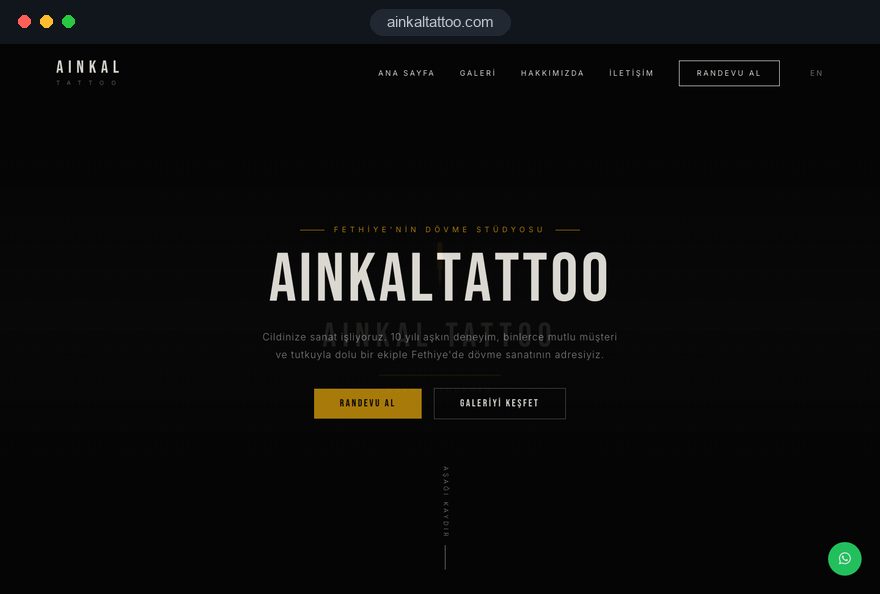
Our team designed and built this site, and it is live: the portfolio is split by style and enquiries arrive through the site with reference images. You can see more of our work on the references page.
Tattoo studio · web design, local SEO
Related pages
Industries
Another image-led site structure built around a portfolio.
Industries
A neighbouring field built around treatments and permanent makeup.
Solutions
Let clients pick their own session time from a calendar.
Solutions
A page structure per language for studios in tourist areas.
 Why Is My Instagram Ranking Above My Website on Google? How to Win Back Your Brand SearchRead article
 How to Optimize Images for Your Website: Format, Size and SEO SettingsRead article
 Lead Form Design for Booking, Quote and Demo Requests: UX Rules That Lift ConversionsRead article
 How to Do Google Maps SEO: A Guide to Ranking Your Business Higher on the MapRead article
FAQ
If your question is not here, write to us; we will send you an answer and a written quote.
Next step
In a free 15-minute call, in English, we will go through your artists, your styles and how clients find you, then send a written scope and quote.
In-depth guide
Someone planning a tattoo often browses for weeks, saves screenshots and narrows the list down to a few studios. At the end of that process your website either makes the decision easy or sends the visitor back into Instagram messages, and from there to another studio.
In this guide, we at Talha Aslan and team walk through the decisions we make when planning a tattoo studio website, in the order they come up: structure, style pages, photography and speed, artist pages, the inquiry form, personal data, studio policies, aftercare, local search, languages and measurement. Every section ends with something you can check or change on your current site.
Clients choose a studio in three steps: they look for a style, then for the artist who does that style well, and only then for a way to describe their idea. A site that follows this order never makes visitors hunt for the next step; a site that breaks it pushes every question into your DMs.
This order decides where each block on the home page goes. The first screen should lead into the styles you work in rather than a slogan, artists come second, and an inquiry button closes every gallery. Someone who lands on a style page straight from search should be able to complete the same three steps on that page alone.
Open your current site on a phone and answer four questions:
If any answer is no, fixing the order of content will do more than a new color scheme or typeface.
Who the brand is decides the skeleton of the site: a solo artist's site is built like a signature, a team studio's site like an umbrella. Making this call before design starts saves you from rebuilding the menu and the URL structure later.
Agree on a rule for artists who leave. Deleting their page throws away the searches that land on it; redirecting it to the matching style page, or keeping an archive note with the artist's consent, is cleaner. Put in writing whether their work stays on the site after they go.
A dedicated page for each main style helps visitors find what they want quickly and helps search engines understand what you specialize in. A filter alone is not enough: it changes the view inside one page, while someone searching for a fine line tattoo needs a page with its own address to land on.
A style page is more than a gallery. The top explains how the style looks in your hands, and the bottom answers the practical questions clients ask before deciding.
Name styles the way clients do. Blackwork and dotwork may be different worlds to you, but if hardly anyone searches for the distinction, one shared page with subheadings usually works better than two thin ones.
The quality of a tattoo site is usually decided by photography rather than design; sharp pictures taken in the same light from the same angle make even a simple layout look professional. That is why we discuss a shooting routine while the site is being built.
For speed, Google's Core Web Vitals are the yardstick. LCP measures how long the largest element on the page takes to load, and 2.5 seconds or less counts as good; CLS measures elements jumping around while the page loads, with 0.1 or less as the target.
In a gallery that means preparing each image in several sizes, using a light format such as WebP and lazy loading everything below the visible area. You can shrink your current photos with our image converter and run your site through the mobile friendly test to see where you start.
An artist page answers one question: would I trust this person with my skin? So it should carry proof rather than praise. Concrete details about how the artist works build more confidence than a polished bio.
Linking to the artist's own Instagram is natural, but the link belongs at the bottom. The page exists to keep visitors on your site and lead them to the form; a social button at the top sends them into another feed to scroll, and the inquiry ends up in DMs again.
Write artist texts from a short conversation with the artist. Swap adjectives that fit anyone, such as passionate and detail oriented, for lines that only fit this person, for example "works with a single needle on fine line pieces and finalizes the drawing with the client at the first session."
A good inquiry form collects everything an artist needs to assess an idea from the first message and leaves the rest to conversation. The goal is not a long survey; it is to stop asking every client the same questions again.
We recommend this order:
Inquiries should land in one place, tagged with the page and channel they came from, and in a team studio the chosen artist should be notified. If you want clients to pick a session time themselves, the form can connect to an online booking setup; for large custom work, though, a consultation first and booking second usually runs better.
Before launch, upload a large image on a weak connection and check that the thank you screen appears; a form that fails during upload loses even the keenest client.
Data collected on a tattoo site is more sensitive than an ordinary contact form: clients share body placement, photos and sometimes health details. So what you leave out of the form matters as much as what you ask.
Under the GDPR and the UK GDPR, data concerning health is special category data, which needs both a lawful basis and an additional condition, such as explicit consent, before it can be processed. The cleanest approach is not to ask about allergies or skin conditions at the inquiry stage unless you truly need to, and to use a separate consent checkbox if you do.
We draft the texts and build the form flow; the final legal review belongs to your studio, and we say so in every project. Remove form notification access the day someone leaves the team.
For first time clients, trust often decides more than style; if hygiene and policies are not written down, the booking gets postponed. Give this information its own page in plain language instead of burying it inside a long FAQ.
Photos do more work here than words. A few real shots of sealed packs being opened and a workstation being set up persuade better than a long paragraph. If your local council or health department issues a registration or license, show it on this page as well.
Repeat the deposit and cancellation terms briefly in the consent step of the inquiry form. Clients then learn the rules while deciding, not on the day, and disputes become less likely.
An aftercare page cuts down the repeated WhatsApp questions after each session and keeps clients away from conflicting advice online, but its content must always come from your studio's own instructions. We do not write medical advice; we turn what your artists already tell clients into a page that is easy to read.
Splitting the page along the timeline the client has in mind makes it easier to follow:
A short note at the top and bottom of the page tells clients to see a doctor if they notice redness, swelling or suspect an infection. The page is information, not a diagnostic tool.
To hand the guide over at the end of a session, put a QR code at the front desk or on your business card; you can create one with our QR code generator.
Many tattoo searches include a town or neighborhood, and the map appears before the regular results; local visibility depends on the website, the Google Business Profile and the style pages working together. If one of the three is weak, the others cannot carry it alone.
Instagram outranking the site for your own studio name is another common problem. A clear studio name in the page title, correct structured data and consistent links from your social profiles to the site are the basic fixes. If you want these handled together with the rest of the site, see what our SEO service covers; we do not promise rankings, but we show you exactly how the foundation is built.
For a studio in a tourist area, pages in other languages are not an extra; they are how you reach your main audience. Travelers search on their phone, decide quickly and move on if they cannot find clear information in their language, so we plan the language structure from the start rather than bolting it on.
Each language should live at its own address, with reciprocal hreflang annotations, the tags that tell search engines which page is in which language: the English page points to the Turkish one, the Turkish page to the English one, and each also points to itself. An automatic translation plugin that switches language on one URL is no substitute.
Choose languages based on where your clients actually come from, and have a native speaker read every translation. We explain the full setup on our multilingual website page.
Measurement is not about counting visits; it shows which style and artist pages bring real inquiries. That tells you where to invest in the portfolio and whose calendar will fill fastest.
Before launch, we recommend setting up these events as conversions:
A short monthly review is enough: the three pages that bring the most inquiries, the pages that bring none and the channel each inquiry came from. If the realism page gets plenty of visits but few inquiries, the problem is usually not the gallery but the prompt at the bottom of the page.
If your measurement tools use cookies, visitors need to see a cookie notice and their choice must be respected; in the EU, consent is required before non essential tracking, and Google requires consent mode for visitors from the European Economic Area. Building this into the first version is far easier than trying to repair past data later.
Most of these mistakes come from treating the website as a copy of Instagram rather than from bad intent. Each one has a better alternative:
Checking this list against your current site is also a quick way to decide whether you need a rebuild. If most problems are in content and structure, a redesign is enough; if they sit in the platform itself, starting fresh makes more sense.
When choosing who builds your tattoo studio website, look less at their design samples and more at how well they understand your clients' decision order and an image heavy build. A few questions reveal this quickly:
With us, design, development and content move forward in one team; Talha Aslan sets the strategy and experienced team members handle delivery, remotely and in English for studios outside Turkey. You can read about our overall approach on the web design service page and see live projects among our client references.
Fixed scope packages are listed under web design pricing, and for a written quote tailored to your studio you can request a free consultation. Tell us how many artists you have, the styles you work in and where your clients find you; that is enough for a useful first call.
Start a Project
Thanks {name}, we've received your brief. We usually reply within the same day.
What happens next?