Few areas of healthcare limit what a clinic may say about itself as tightly as fertility treatment. Depending on the country, success rates must follow a set format or cannot be published at all, advertising may be banned outright and patients expect a level of discretion that most medical websites never plan for. What remains is a site that answers patients' questions honestly, makes the team visible and protects privacy at every step.
This guide walks through the decisions an IVF clinic makes when planning its website, in the order we take them with clients: the rules first, then page structure, team and laboratory, images, privacy, search, speed, measurement and overseas patients.
01Start with the rules of the country you treat in
The legal framework of the country where treatment takes place decides what an IVF clinic website may contain, so we settle it before drawing a single page.
- United Kingdom: The HFEA Code of Practice sets out how a clinic website presents success rates, including recent data split by maternal age, raw numbers, the national rate and a statement that rates are of limited value in choosing a clinic. It also expects clinics to explain any treatment add ons and the evidence behind them.
- Turkey: The regulation on assisted reproduction bans advertising of these treatments in all press and communication media, even for information purposes, and statistics may not be published outside scientific journals without Ministry permission.
- Turkey, general health promotion: The regulation published in the Official Gazette on 12 November 2025 (No. 33075) bans covert and open advertising of health services and excludes prices, discounts and campaigns from any information.
- Other countries: Ask your regulator and your professional body; we build the content plan around their written rules, not around what competitors happen to publish.
For a clinic in Turkey this means no success rates without Ministry permission, no paid promotion and no advertising tone anywhere on the site. For a UK clinic it means rates may appear, but only in the format the Code describes. The final regulatory call always sits with you and your adviser.
02Mapping where patients are to the pages they need
People arrive at an IVF clinic website at very different points, and the page structure should reflect that rather than offer one generic path. Someone researching for the first time, someone coming back after an unsuccessful cycle and someone already in treatment are looking for different answers.
We usually plan around four groups:
- First time researchers: They want the overall journey, what happens at the first consultation and which tests are likely; the journey overview is their entry page.
- Patients after a cycle elsewhere: They arrive with reports and want to know how a second opinion works and what documents to send.
- Patients in treatment: They need quick practical information about medication timing, monitoring appointments and the wait after transfer.
- Patients with frozen embryos or eggs: They look for storage periods, renewal steps and a clear contact route.
Not every group needs its own menu item, but each should reach the right page in one tap. A short "where are you now" block on the home page does this without crowding the menu.
03Writing a stage page: the egg collection day example
Every stage of IVF treatment deserves its own page that tells patients, in plain language, what that day will be like. Take egg collection: patients usually read this page a day or two before, often late at night on their phone.
We give every stage page the same fixed fields, which your clinicians fill in, so readers find the same information in the same place on every page:
- What this step is: Two or three plain sentences, with each medical term explained the first time it appears.
- Before you come in: Fasting, medication timing, what to bring and whether someone should accompany you.
- How long you will be with us: The flow from arrival to going home, described as your clinic actually runs it.
- Afterwards: What to watch for, when to call and which number to use outside opening hours.
- What happens next: A link to the laboratory stage and the name of the role who will contact the patient.
Each page ends with the name of the approving clinician and the date of the last review. Numbers, odds and phrases such as "most of our patients" stay out of these pages; individual expectations belong in the consultation.
04A page for patients after an unsuccessful cycle
Patients who have already been through IVF treatment elsewhere come with different questions and deserve a page of their own. They are often tired, cautious and sensitive to anything that sounds like a promise; a general overview tells them nothing new.
On this page we describe the clinic's second opinion process in concrete steps: which reports, embryology records and test results are requested, how to send them securely and what will be reviewed at the first appointment. The wording never criticizes another clinic and never suggests that "this time will be different"; both would undermine the calm tone the page needs.
Before writing it, ask your team these questions:
- Who reviews the file from the previous clinic, and how soon does the patient hear back?
- Which secure route do documents take: an upload portal, e-mail with encryption or delivery at the clinic?
- Is counseling offered at the first appointment, and who provides it?
- Which details should patients keep for the consultation rather than type into a web form?
If your clinic offers counseling, a link from this page to the support section quietly shows a tired couple which door is open.
05Success rates and add ons, where they are allowed
Where an IVF clinic may publish success rates at all, the format matters more than the number. For clinics in Turkey this section is simple: statistics stay off the site unless the Ministry has given permission, and the space goes to a clear explanation of how individual assessment works at the first consultation.
For UK clinics, paragraph 4.10 of the HFEA Code of Practice describes what a rates page should contain. We build it in this order:
- Use the most recent data from the past three years, split by maternal age.
- Show raw numbers next to every percentage, so a small group cannot look like a large one.
- Place the national rate beside the clinic rate, with the HFEA named as the source of national figures.
- Add a clear statement that success rates are of limited value in choosing a clinic, with a link to the HFEA advice on choosing.
- Never pull a high rate from a small, selected group onto the home page.
Add ons follow the same logic. Paragraph 4.7 expects clinics to explain any add ons they offer and the evidence behind them, with reference to the HFEA treatment add ons page, whose ratings run from green to red and include grey and black. We give each add on a short factual page that links to its HFEA rating and makes no claims of its own.
06Team and laboratory profiles patients can check
The team page answers "who will I be working with", and every line on it should be something a patient could verify. In fertility care the team is far more than the consultant, so we design profiles by role:
- Doctors: Specialty, registration where the country publishes one, training institutions and publications, written as facts rather than adjectives.
- Embryologists: Training, responsibilities in the laboratory and the stages they oversee.
- Nurses: As the people patients speak to most, which topics they handle and when they are available.
- Patient coordinator: The contact for appointments and documents, and the languages they speak.
- Counselor: If support is offered in house, their profession and how sessions are arranged.
The laboratory page explains how the lab works rather than which equipment it owns. Patients want to know who handles their samples, how identity checks prevent mix ups, when the clinic updates them during fertilization and development, and what storage and renewal involve. Equipment brand names and phrases such as "latest technology" add nothing a patient can verify; in Turkey the 2025 regulation goes further and bans covert or open promotion of products and brands in health information.
Profile photos are taken on the same day, in the same light and frame, which quietly presents the team as one unit. Each profile is approved by the person it describes and updated the day someone leaves; a departed consultant who stays online for months is noticed by careful readers.
07Choosing images: real spaces instead of baby photos
Images on an IVF clinic website should show the process and the people, not the outcome. Stock photos of newborns, smiling families or positive pregnancy tests make an uncertain treatment look certain, and they can hurt patients whose treatment has not worked.
The rules point the same way in several markets. In Turkey, the 2025 regulation allows patient images only with the patient's explicit consent on the form annexed to the regulation, gives patients the right to see the image beforehand and to withdraw consent at any time, and bans retouching or later technical changes to images. With the advertising ban for assisted reproduction on top, using no patient images at all is the sensible choice there.
We plan images in this order:
- Spaces: The waiting area, consultation rooms and the patient information room, so patients can picture where they are going.
- Team: Portraits and working shots from one photo day, unretouched and consistent.
- Process illustrations: Simple drawings of treatment stages, checked for accuracy by a clinician.
- Color and type: A calm palette and a text size that stays comfortable on long pages.
08Privacy from the inquiry form to the last notification
Many people contacting an IVF clinic keep treatment private, even from family and colleagues, so every link in the contact chain has to be designed for discretion. Data concerning health is a special category under Article 9 of the GDPR and the UK GDPR, and under Article 6 of Turkey's KVKK.
We build the inquiry flow in five steps:
- Keep the form short: Name, preferred contact method and a convenient time are enough; diagnosis, age and previous cycles are discussed at consultation.
- Link the privacy notice: The notice sits next to the form, readable on a phone, not hidden in the footer.
- Neutral automatic replies: The e-mail subject line names only the clinic and "your inquiry", never the treatment.
- Discreet notifications: Text and messaging app previews are worded so a shared phone gives nothing away.
- Limit access: Only the coordinator and authorized staff see submissions, and a retention period is agreed in advance.
Booking tools, form services and messaging platforms process this data on your behalf. In the EU and the UK that requires a data processing agreement with each provider, so we list every tool the site uses before launch and check that the agreements exist.
Newsletter or reminder consent, if you want it, goes in a separate unchecked box. In Turkey the 2025 regulation also bans sending promotional messages by phone, text, e-mail or social media without the person's knowledge and consent.
09Being found in search without paid placement
For most IVF clinics, and for every clinic in Turkey, search visibility comes from pages that answer patients' real questions well, not from paid placement. The Turkish 2025 regulation allows search engine and social media listings only where they are not paid, sponsored or boosted, and requires keywords and result page information to follow its principles.
Our organic approach has four parts:
- Question pages: A question such as what to do after embryo transfer gets its own clinician approved guide, with a title and description that promise nothing.
- Review date and editor: Every guide shows its last update and a way to reach the site editor; the Turkish regulation requires both on websites, and patients elsewhere read them as trust signals.
- Structured data: Clinic name, address, opening hours and doctors are marked up; ratings, reviews and rates are not.
- Business Profile: The name on Google Business Profile matches the real world name of the clinic, with no keywords added.
You can test your markup with our schema markup tool before launch. To see whether your guides are easy to follow, run them through the readability checker.
If you want this to continue after launch, our SEO services combine a content calendar with regular technical checks, without ranking promises.
10A site that reads well at night, on a phone, in private mode
Much of the traffic to an IVF clinic website comes from phones, often late at night and in private browsing mode, and the design has to work under those conditions. Private mode keeps no cookies or history, so nothing important should depend on a login or on remembering a previous visit.
For speed we use Google's Core Web Vitals, judged at the 75th percentile of visits: LCP, the time until the largest piece of content loads, should be 2.5 seconds or less; INP, how quickly the page responds to a tap, 200 milliseconds or less; and CLS, how much the layout shifts while loading, 0.1 or less. On long guide pages we hold those thresholds with a few deliberate choices:
- Images are sized and compressed, and only the necessary image loads in the first screen.
- Large text, generous line spacing and strong contrast keep night reading comfortable.
- The click to call button and the inquiry link stay within thumb reach on long pages.
- Space for images and components is reserved in advance so nothing jumps while the page loads.
You can see how your current site behaves on a phone in a few minutes with our mobile friendly test.
11Measuring inquiries without leaking health data
Measurement on an IVF clinic website should show which pages lead to inquiries while revealing nothing about who is interested in which treatment.
We work with four rules:
- Neutral event names: A form submission is recorded under a name such as "inquiry_sent"; field contents never reach the analytics tool.
- Reports by page group: Inquiries are tracked for groups such as journey pages, team pages and patient guides, never for individuals.
- No remarketing: No tags follow visitors to other sites; that would conflict with patient privacy and, in Turkey, with the advertising ban.
- Consent first: Non essential cookies wait for consent. For visitors in the European Economic Area, Google requires consent mode for its measurement and personalized advertising features.
The report then answers two practical questions: after which guide do patients most often ask for a consultation, and on which page do they leave? If inquiries follow the first consultation guide but many visitors leave on the laboratory page, the lab explanation probably needs simplifying.
12Overseas patients and the clinic's legal framework
An IVF clinic that welcomes patients from abroad should state its legal framework plainly in every language. Patients used to their own country's rules often do not realize that eligibility and permitted treatments differ; in Turkey, for example, the assisted reproduction regulation covers medically suitable married couples.
The advertising rules do not change with the language. For a clinic in Turkey, an English or Arabic page is still subject to the ban on advertising and on unpermitted statistics; a new language is not permission to market more loudly abroad.
Our overseas pages usually include:
- A plain summary of who the clinic can treat under local law, with a suggestion to check the rules of the patient's home country.
- How the first consultation works: video call or in person, and which documents are needed beforehand.
- The clinic's reply hours and when an answer can be expected across time zones.
- A note that medical texts are translated by a native speaking editor and approved by a clinician.
So that search engines match each language correctly, every version must reference the others and itself with hreflang annotations; our hreflang generator prepares them. For the technical setup of language versions, see our multilingual website page.
13Six common mistakes on IVF clinic websites
These are the mistakes we see most often on IVF clinic websites; each one damages patient trust and regulatory compliance at the same time. The better alternative sits next to each.
- A headline success rate: A single large percentage misleads and, in Turkey, needs Ministry permission; explain how individual assessment works, and in the UK follow the HFEA format.
- A long, detailed inquiry form: Asking for diagnosis and previous cycles deters patients and collects health data you do not need; ask for name, contact method and a convenient time.
- A wall of thank you messages: Testimonials quickly read as promises, and Turkish rules ban patient thanks used as advertising; give the space to the team and the journey.
- A lab page about equipment brands: Brand names prove nothing to a patient; describe how the lab works and who is responsible.
- Undated guides: Without a review date, an approving clinician and editor contact, a guide loses trust; add all three to every page.
- Machine translated language versions: A small error in a medical term creates false expectations; use a native speaking editor and clinician sign off.
If your current site shows several of these, a content audit before any redesign usually brings the quickest improvement.
14Choosing a partner and taking the next step
The team you choose for an IVF clinic website needs to understand the rules and the privacy expectations of this field as well as design. In a first call, we suggest asking these questions:
- Against which rules is every text checked before launch, and how are doubtful phrases reported to you?
- How are forms, automatic e-mails and text messages set up so they never reveal the treatment?
- Can they show you in writing exactly what data reaches analytics tools?
- How does clinician approval work, and how quickly is the site updated when a team member leaves?
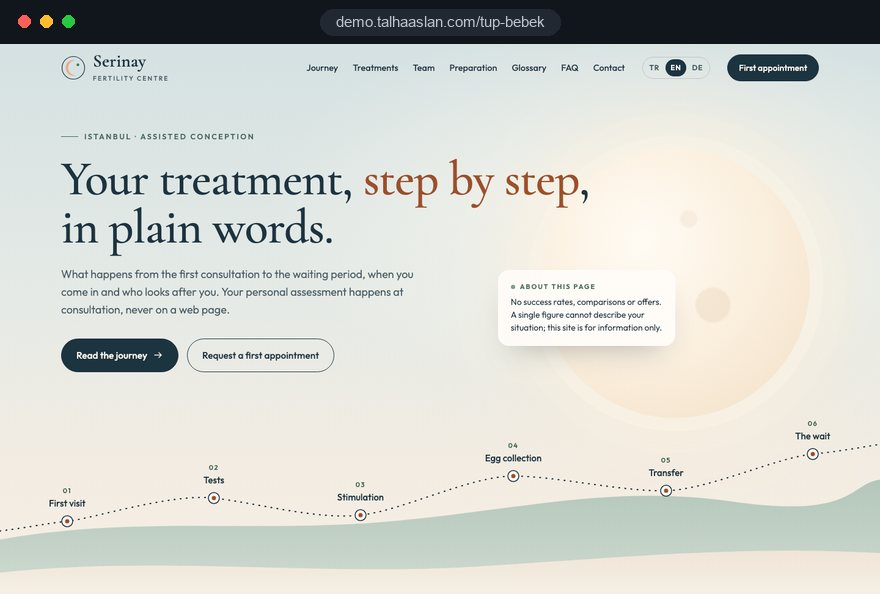
We do not have a live client project in this field yet, so we show our approach on a live demo site linked on this page. You can see our work in other sectors on our references page and the scope of our web design service, where design, development and content sit in one team.
Package scopes are listed in our web design pricing section, and the Get a quote form gives you a written proposal for your own clinic. If you would rather talk first, reach us through our contact page; we will list your treatments, your team and the questions patients ask most, and come back with a page structure that fits.