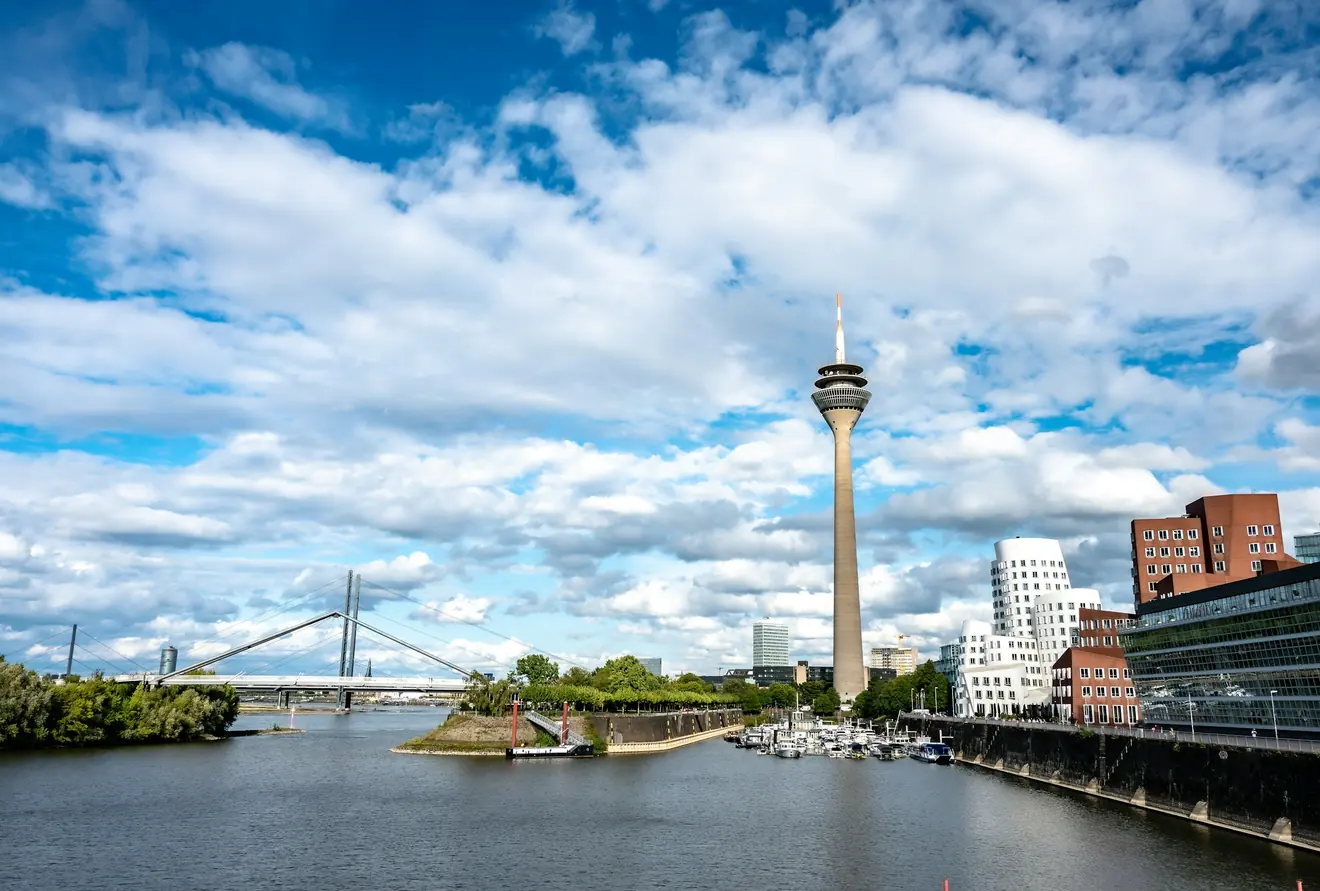
Running a business account in Düsseldorf means writing for several audiences at once, not for one city crowd. The same video is seen by a neighbor from the next street, an engineer in town for a trade fair and a family that moved here last month, and each of them is looking for the answer to a different question. This guide does not repeat the summary on the page above; it follows the order of the decisions: who you write for, in which language, on which platform and under which rules.
Talha Aslan and team deliver social media management Düsseldorf businesses can run fully online from Istanbul. We have no office, representative or employees in Germany, so every section also explains how shooting, approval, replies and measurement work at a distance.
01Who sees your account in Düsseldorf, and when
Four groups see your account, and their share shifts with the course of the year. According to Destatis, 618,685 people lived in the city on 31 December 2024; overnight guests come on top of that number. Because each group looks at your profile at a different moment and for a different reason, separate them first.
- Guests: Visit Düsseldorf reports 5.54 million overnight stays for 2024, of which 2.1 million came from abroad and more than 3.4 million from within Germany. June (571,752), November (508,714) and December (490,424) were the strongest months.
- Trade visitors: Messe Düsseldorf held 22 trade fairs in the city in 2024, and 76.5% of exhibitors came from abroad.
- The Japanese business community: City statistics count more than 6,400 residents with Japanese citizenship, most of them in Oberkassel, Niederkassel and Stadtmitte.
- The Turkish speaking network: About 12,800 Turkish citizens have their main residence in Düsseldorf, with Eller, Oberbilk and Rath as the largest districts.
Start by writing the purpose of the account in one sentence, for example: "This account reaches German speaking customers in Flingern" or "This account serves English speaking readers who look for a hotel during a fair week." If the sentence will not come, planning is premature. Language and platform follow from it.
Then think of your last ten customers: where did they come from, in which language did they write, how did they find you? That list is more reliable than any assumption, and it is the first thing we ask for in our first call.
02Which platform suits which business, and which does not
The right platform is the one where your audience decides, not the one with the most users. For social media management Düsseldorf teams usually end up with the mapping below, and no business has to use all of it.
- Instagram: the main shop window for cafes, hairdressers, studios and hotels in the Altstadt, Carlstadt, Flingern and Unterbilk. Reels serve discovery, stories carry daily information, highlights hold the fixed details.
- LinkedIn: for agencies, consultancies, industrial suppliers and fair exhibitors around the Medienhafen. Team, expertise and the fair stand become a story here.
- Google Business Profile: for anyone searching on the move; hours, photos, reviews and posts sit in one place.
- WhatsApp: not a social network, but where the conversation with Turkish speaking customers starts. The handoff from the account to it should be planned from the beginning.
- TikTok and Facebook: TikTok for businesses that can show a process in short video and want a younger audience; Facebook for district events and local groups. Neither is mandatory.
Two platforms run steadily beat five run weakly. On a platform you do not use, you can still reserve your name, but you promise no content there; an empty account carries old details in search, so one short line pointing to your active channel is enough.
On LinkedIn the personal profile and the company page do different jobs. A fair note written by a team member under their own name is often read more than the announcement on the company page, and linking the two is a good habit.
03A local content calendar for Düsseldorf
The social media management Düsseldorf calendar is built where your own season meets the fixed moments of the city. Dates change from year to year, so we check the official calendars and prepare content weeks ahead. The sequence below produces a yearly plan.
- Put the Messe Düsseldorf event calendar and the city's event pages side by side, and mark fairs such as drupa, MEDICA and wire.
- Add your own busy weeks: school holidays, season openings, menu or collection changes.
- Add the large moments only if they touch your business, such as Japan Day on the Rhine in early summer or the Rheinkirmes in July.
- For the Christmas markets in December, plan a light and clear rhythm that suits one of the busiest months of the year.
- Write a preparation date next to each entry: content ready three weeks before a fair and two weeks before the Rheinkirmes.
Fill the gaps in the calendar with district stories: a street corner in Bilk, a Sunday morning in Gerresheim, the path to the park in Benrath. Each should describe places where you actually work; the tag of a district you do not serve costs trust.
04Producing content when the team is online
In remote management the shooting stays on your side while planning and editing stay on ours. We write that split down at the start; we do not act as if we had a camera crew in Düsseldorf, and we say so.
- Shot list: framing, format and length are written for every motif, for instance a cafe counter in morning light, the dish of the day and one person from the team.
- Templates: Reels covers, carousel layouts and story frames are ready, so they can be updated quickly when a menu or hours change.
- Who shoots: you, your staff, or a photographer you select and commission. We help you put the photographer's scope in writing.
- Approval: every post comes to you before it goes live, and the last word is yours.
A phone is enough for most accounts. Light, sound and a clean frame make more difference than expensive equipment. To get stories, Reels and carousels out of one shooting day, the day's motifs must be listed beforehand.
In a cafe, a shooting day runs like this: the counter and the first cup in morning light, the dish of the day before lunch, a short introduction of a team member in the afternoon, the table setup at closing. Weeks of posts come from the same recordings.
05Community management: reply routine and handoff
In messages and comments, the right handoff matters as much as speed. A hotel question arriving in English during a fair week and an appointment question arriving in Turkish for a hairdresser in Eller do not follow the same rule, so the reply guide is written by language and topic.
- Reply guide: approved sentences for frequent questions: hours, address, booking path, parking and payment.
- Language rule: reply in the language the message arrived in, and state on the profile which languages you can answer in.
- Handoff: bookings and appointments move to the phone or a WhatsApp line; the business always confirms the slot.
- Urgent signals: a complaint, a legal threat or a press question reaches you before we reply.
We answer at the agreed hours. For messages arriving outside business hours, put a welcome line on the profile; replying first thing next morning can be a goal, but we do not promise exact response times.
06Google Business Profile and local reviews in Düsseldorf
For people who decide on the map, the Google Business Profile is as important as the social account. The business name there must match your real name, with no keywords added. In Düsseldorf, travelers, business visitors and new residents usually check the map first.
- Identical details: opening hours, phone and address match exactly between account and profile. Hours that change in a fair week are updated in both places.
- Posts: announcements, events and news about new products go onto the profile as posts alongside the social account.
- Review replies: every review gets a short, personal reply in the language it was written in. On a complaint, offer a solution and a contact path instead of getting defensive.
- Asking for reviews: you can politely ask satisfied customers for a review; do not offer a discount or gift in return.
Buying reviews, writing fake ones and joining review groups break platform rules and destroy trust. We do not recommend them and we do not do them.
07Languages: when to post in English, German or Turkish
German is the main language; English and Turkish are added when they serve a separate audience. The three lines should not be translations of each other, each one answers the question of its own audience.
- German: for neighborhood customers, authorities and directories. The Impressum link, the service description and the replies are prepared in German.
- English: for fair guests, business travelers, international teams and new arrivals. A short caption and quick facts are enough.
- Turkish: as a separate line, if your customers around Eller, Oberbilk or Rath read Turkish. Separate posts or a story series are clearer than mixing languages in one caption.
A bilingual caption often leaves both audiences half served. A single English summary line under a German post, however, helps a fair audience and does not spoil the post.
Social media management Düsseldorf work does not fix the language choice once and for all. A team that has just arrived may ask in English now and write in German a year later; the line is updated as your customer base changes. Write a short tone note for each line: formal Sie in German, plain and short sentences in English, a warm but respectful voice in Turkish.
We write only German, English and Turkish content. How much space each of the three gets is something we settle from the first month's report: which language drew more saves, and in which did messages arrive?
08Düsseldorf sector examples
The same method turns into different headings by sector. The four examples below come from the city's audience, and each can be read together with the matching sector page.
- Hotels and guesthouses: short English captions, room images and transport information prepared ahead of fair weeks and the three busiest months. Details are on the hotel social media management page.
- Restaurants and cafes: the dish that changes during the day, the morning counter, one person from the team. Booking and hours stay fixed; see restaurant social media management for examples.
- Consulting and B2B: team, a case story and a pre fair announcement on LinkedIn, with an extra English line. Details are on the consulting firms page.
- Hair and beauty: work in progress, hygiene and the team, with written consent for every person shown.
A business that peaks in fair weeks and one that relies on district customers do not share a rhythm. The fair business lives through a few strong waves a year; the district business moves in small weekly steps. Building the account plan around that difference lets one shooting day feed two different flows.
09Collaborating with local creators and the German labelling rule
In Germany a post made for payment or products must be marked as advertising when its commercial purpose is not obvious from the context. The rule sits in section 5a of the UWG, and the Medienanstalten publish a labelling guide for online media. When we work with a creator in Düsseldorf we follow four steps.
- Scope: every post made in return for money, products, a free stay or a free meal.
- Label: a visible Werbung or Anzeige marker inside the post and in every story frame.
- Brief: what is shown, which claims are off limits and when it goes live are agreed in writing.
- Follow up check: after publishing, label and content are reviewed.
The collaboration itself runs under influencer marketing; we handle the brief, the label and the check of the post on the account side. We do not recommend buying followers or comments.
When choosing, look at whether the creator's audience overlaps with your customers: a small account that knows your district is often a better fit than a large but scattered one. The ask is simple: after the visit, can the creator write your venue name, district and opening hours correctly? The brief collects these details on one page. If a legal question comes up, we point you to your German attorney.
10Privacy, consent and copyright basics in Germany
Rules for business accounts in Germany apply to everything you publish, and most of the responsibility is yours. The items below are what most accounts check first, and they can be read as a checklist before publishing.
- Impressum: for commercially used profiles an easily reachable Impressum under section 5 of the DDG is expected; link your website's Impressum page in the bio.
- Images of people: recognizable customers or staff generally need consent; data protection and the right to one's own image apply. Written consent is collected.
- Fairs and events: ask the organizer about the rules for filming on the fairgrounds, and prefer frames without recognizable strangers in a crowd.
- Music: a song used in Reels needs a license; we choose tracks under Meta's music guidelines and never copy the song playing in your venue into a video.
For legal detail, speak to a qualified attorney (Rechtsanwalt). On the technical and content side we apply the checklist and make sure the links stay on the profile.
On copyright, one simple rule helps: publish only footage you shot yourself, text you wrote yourself and music with a clear license. A photo found online, another company's logo caught at a fair stand or a customer's picture should not be reposted without permission, and if you are unsure, leave it out.
11Measurement and monthly reporting without promises
Measurement exists to show what works, not to promise an outcome. A monthly report should answer five questions, and repeating the same five every month makes comparison possible.
- Which posts were saved and shared? This shows interest better than likes.
- Profile visits and link clicks: a UTM parameter on the bio link shows which content led to the website.
- Calls and directions: requests from the Google profile are counted separately.
- From message to inquiry: you mark from your own records how many messages became real inquiries.
- Split by language: the results of the German, English and Turkish lines are read separately.
If paid boosting is needed, it is planned separately; details are under Meta ads management. To set up link tracking, you can use the free UTM builder.
There is an honesty rule here too: a busy month in Düsseldorf does not mean the account worked well, because guest flow rises anyway in months such as June, November and December. Compare the report with the same month last year and with your own rhythm, not with another city's numbers.
At the review meeting take only two decisions: which format you continue and which one you drop. A short evaluation after a fair or event is the most concrete data source for the next wave.
12Common mistakes of Düsseldorf businesses on social media
The six most frequent mistakes come mostly from time pressure, not lack of knowledge. Each has a lighter alternative, and most are set up once and then work all year.
- Writing for everyone in one language: use separate lines by audience, with German as the main one and English and Turkish apart.
- Leaving fair week to the last day: prepare posts three weeks ahead and only reply during the fair week.
- Never naming the district: use the name of the district where you work in the location and the caption.
- Updating hours in one place only: keep identical details on the account and the Google profile.
- Template replies to reviews: write a short personal reply that refers to the content of the review.
- Collaborations without a label: plan a visible ad label from the start.
Another mistake is measuring an account by like counts; saves, shares and inquiries from messages mean much more. The easiest way to find which of these applies to you is to look at your account through a stranger's eyes: what would you do as a customer?
Most of these mistakes come from leaving the account to one person's spare time. Even a fixed thirty minutes a week, protected like a meeting, keeps an account alive for a year. Social media management Düsseldorf teams do not fill that slot for you, but they turn it into a written list of what to do with it.
A final mistake is appearing only in a fair or event week and staying silent for the other months. If the account goes quiet after the event, the follower who arrived that week forgets you. Put a small thank you and follow up post into the first two weeks after the event.
13Choosing a partner and the first 90 days
For social media management Düsseldorf buyers, the right partner is one who does not claim a team in Düsseldorf, gives the scope in writing and leaves the accounts with you. When you look for social media management Düsseldorf partners, ask these questions: who keeps the accounts, who shoots, how are reply hours written, what does the report contain?
In the first three months we follow this sequence.
- Month one: account review, audience and language decisions, shot list and content calendar.
- Month two: editing of the first shooting round, writing of the reply guide, aligning the Google profile.
- Month three: the first report, formats to drop and the plan for the next period.
Current packages are listed in the pricing section. For how your website fits your accounts, see web design for Düsseldorf, and for a short call reach us through the contact page. We promise no follower count, reach or full house; what we promise is steady production, open measurement and a written scope.
Bring five things to the first call: your profile links, the district you work in, the languages your customers speak, your fair or season calendar and last month's unanswered messages. With these five, the state of the account is visible within half an hour. The written scope and quote follow from that call. At the end of three months the aim is not a miracle jump but a system that works: a clear calendar, a reply guide, aligned profiles and a readable report. Whether to continue or pause is always your decision.